After seven years of decline, Florida private school enrollment ticked up modestly for a second year in a row last year.
Enrollment grew from 316,745 in 2011-12 to 320,423 in 2012-13, an increase of 1.2 percent, according to a report released last month by the Florida Department of Education.
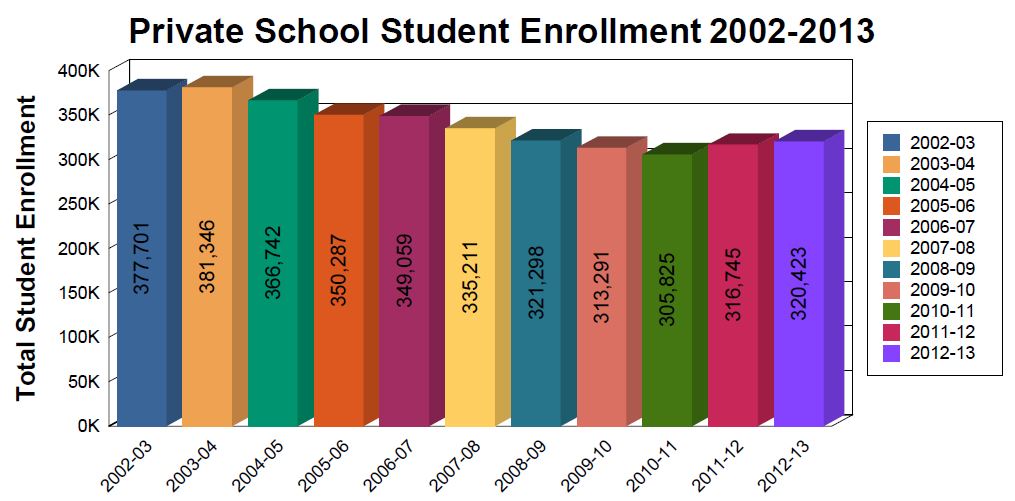
Source: Florida Department of Education
The latest numbers are still a far cry from a decade ago, when the state wasn’t crawling out of the Great Recession and private school enrollment topped 380,000. But private school supporters see more than a short-term spike.
Private schools, too, have had to step up their game because of increased competition, said Howard Burke, executive director of the Florida Association of Christian Colleges and Schools. They’ve responded to the explosion in charter and magnet schools by beefing up technology, improving communication with parents and seeking multiple accreditations, he said.
He pointed to growth in pre-K and kindergarten enrollment in private schools as evidence that parents have responded in turn. Private schools made up 14.6 percent of all pre-K enrollment in 2012-13, up from 12.9 percent five years ago. In raw numbers, private school pre-K enrollment is up more than 5,000 over that span.
“The foundation is being rebuilt,” Burke said.
It's clear from the latest enrollment numbers that publicly funded, private school choice options, particularly tax credit scholarships, are giving the private school sector a boost. They also suggest that many parents still prefer private schools despite massive growth in tuition-free charter schools. (more…)
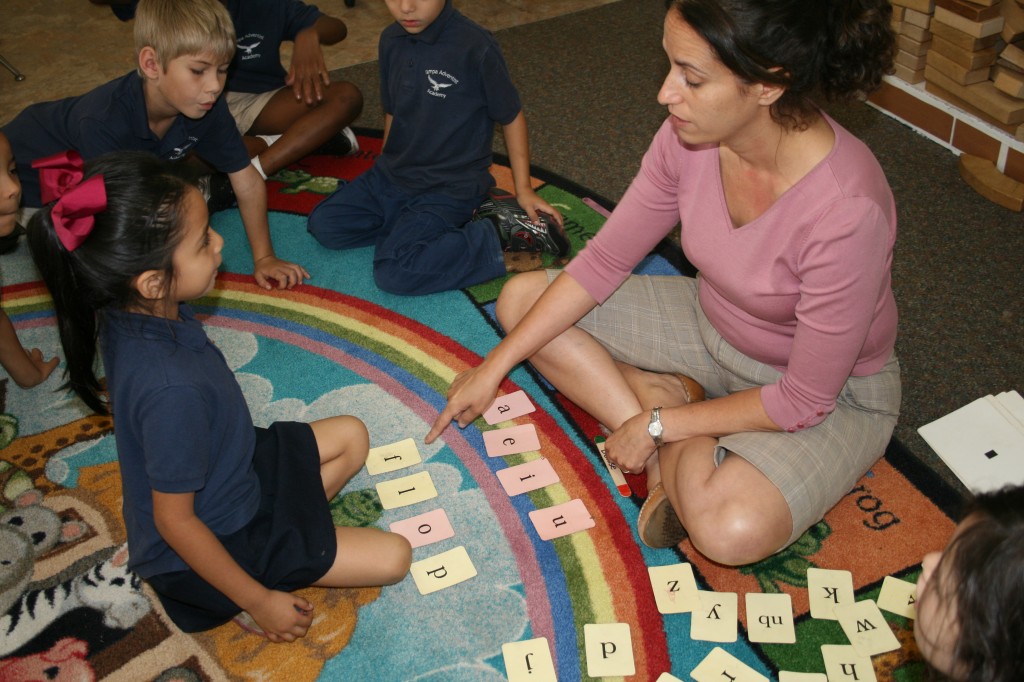
After 13 years teaching in the public school district, Merili Wyatte went to work for a private school. It was a chance to spend more time with her son and daughter, who attend the school. And to work in an environment where her religion was part of the curriculum.
This is the second story in an occasional series that looks at teachers and school choice. Read our first story here.
For years, Merili Wyatte was a special needs pre-kindergarten teacher at a perpetually A-rated traditional public school in Tampa, Fla. She loved the Title I school, her coworkers and her students. “My experience in public school was really good,’’ she said.
But the Seventh-Day Adventist and her husband sent their two children to Tampa Adventist Academy, a 155-student private school with prekindergarten through the 11th grade where Jesus is a big part of the daily lesson.
“I wanted my kids to be surrounded by that … kind of like a filter,’’ Wyatte said.
 One day, she found herself longing for that same environment.
Bring up school choice, and most people focus on what it means to parents and students. But as the school choice movement continues to grow, teachers are searching for options that work better for them, too.
Nationally, there are 602,900 private school teachers, 3.2 million district school teachers and 72,000 charter school teachers, according to the most recent figures available. There aren’t statistics, though, that track whether teachers leave public schools for private school, or explain why educators choose a charter or virtual school over a traditional one.
Anecdotal evidence points to a variety of reasons, from a desire for better pay or hours, to an opportunity to try something new or, as in Wyatte’s case, to follow personal convictions and be closer to her children.
Wyatte has a bachelor’s degree from the University of South Florida in specific learning disabilities and is half way to a master’s. After 13 years in the system, she left the Hillsborough County school district three years ago to teach kindergarten at Tampa Adventist. There she can interact with her son, 8, on the playground or at lunch, and keep an eye on her 15-year-old daughter.
“There’s a boy she likes,’’ Wyatte said. “I like that I can look out my door – and they know I’m looking.’’ (more…)
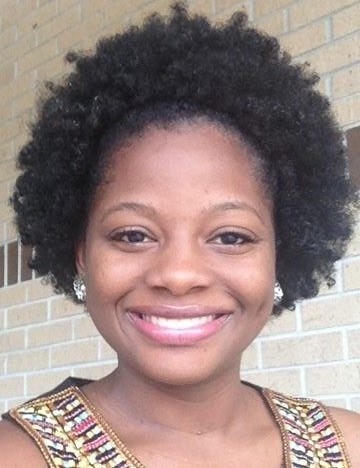
Denisha Merriweather
Former Step Up For Students scholarship student Denisha Merriweather, now attending the University of West Florida, received a standing ovation last night after speaking at the American Federation for Children school choice summit in Washington D.C. Here is the text of her prepared remarks. (Full disclosure: Step Up co-hosts this blog.)
Good evening! Thank you, Mr. Chavous, for your kind introduction.
My name is Denisha Merriweather, and I just finished my junior year at the University of West Florida in Pensacola right near the tip of Florida’s Panhandle. I am so proud to stand here before you today knowing that this time next year, I will be graduating college.
The truth is, when I was growing up, college was a dream that I didn’t even know I had. And if it weren’t for an educational option Florida gave me nine years ago, I wouldn’t be here today.
If you were to rewind my life back to my childhood, you would see someone very different. You would see someone who got in fights with her classmates. Someone destined to drop out before she made it through high school. Someone who didn’t even know what college was.
But thankfully, I did not become a statistic. Because of some help I received when I was 12 years old, my life has changed tremendously. (more…)
Parents aren’t the only ones driving the expansion of school choice. Growing numbers of teachers and principals are opting for alternative settings, too.
Their voices should be a bigger part of the education debate. So, beginning Monday, we’re rolling out an occasional series of stories simply called, “Teachers and Choice.”
The stories aren’t hard to find, especially here in Florida. A full 43 percent of students in the Sunshine State now attend something other than their zoned schools. A slew of teachers are now teaching them there. In charter schools alone, the number of teachers has doubled in the past five years – to more than 10,000. Over the same span, the number in Florida Virtual School has tripled - to nearly 1,500.
One of my favorite high school teachers spent 30 years in public schools but now heads a private school in Jacksonville. When U.S. Sen. Marco Rubio visited a Christian school in Tampa the other day, he spoke to teachers who migrated from public to private. On the phone this week, I talked to a teacher in Tallahassee who switched to a charter despite less pay. The freedom to be creative, she said, more than made up for it.
The subject of Monday’s feature by redefinED’s Sherri Ackerman is Carlene Meloy, who works for Florida Virtual. I won’t spoil it by disclosing details, but this quote serves as a nice tease: “Now that I look back,” she said of her old school, “I realize I felt stuck.”
Just like parents, teachers offer myriad reasons for their choices. Along with the benefits, there are complications, tradeoffs, and unknowns. We’ll do our best to explore them.
You can help us. Let us know if you see issues in this realm that are worth spotlighting, or teachers and principals worth profiling. We also welcome guest posts that further this conversation. You can reach me at [email protected], and Sherri at [email protected].
 Editor’s note: This is the third installment of “A Choice Conversation,” an ongoing dialogue between Doug Tuthill, president of Step Up for Students and a redefinED host, and John Wilson, a former NEA leader who writes the Unleashed blog at Education Week.
Doug Tuthill: John, it’s fascinating to see the new opportunities customization is providing teachers. In Florida, it’s increasingly common for teachers to teach at a district school in the morning, at a private school in the afternoon, and for an online school in the evening. The opportunities provided by technology are particularly intriguing. Three years ago my son’s Florida Virtual School teacher lived in Portland, Oregon, where she was a stay-at-home mom. Many online teachers are at home raising young children while teaching full time.
Recently, I’ve been wondering how customization will impact the services teacher unions provide their members. Given teachers will increasingly have multiple employers in the future, perhaps a key union service could be helping teachers manage the complexity that comes with multiple employers. For example, maybe teachers would prefer to be employed by their union and contracted out to various providers. That would reduce employment hassles for teachers and strengthen their relationship with the union. Unions could also provide financial and administrative support for teachers wanting to open their own schools, and form collaborative networks of teacher-owned schools. You’ve been much closer to internal union discussions in recent years than I have. How do union leaders think customization will affect the services they provide teachers?
John Wilson: Doug: You raise some very interesting points. Every teacher that is treated in a collective manner needs a union to leverage the unity of the group for fair wages and benefits, excellent learning and teaching conditions, and job security for being a good teacher. Customization can be bargained to accommodate those uniquenesses. I have heard some horror stories from virtual teachers as it relates to their employee status. They need a union. Those that are employees of a district have a union to represent them. Unions need to do a better job with those that are in a different configuration. Some of our state affiliates like Pennsylvania are reaching out to virtual teachers.
The challenge is not that teachers in virtual schools need a union. That is evident. The challenge is building the trust in unions to advocate policies that sustain their job. NEA supports a blended approach as the best method for virtual education. That may not be possible in every situation. There is a "chicken and egg" challenge here. If virtual educators joined the union and became activists, they would influence the policies. I have seen charter school educators do that in some state affiliates. It makes a difference, but virtual educators must join first and work from within.
Doug Tuthill: John: In this age of customization, teacher unions should use their collective power to ensure every teacher is treated as an individual. One-size-fits-all is as ineffective for teachers as it is for students. (more…)

