The school choice movement is growing because of real parents with real children, with real needs, who are seeing real benefits. In this video from Louisiana BAEO, parent LeAnn Mason talks about the upside of the voucher program in Louisiana, which is facing a constitutional challenge from the state teachers unions.
Mason said one of her children was in a public school where she endured a string of substitute teachers for two months. To get her to a better school, Mason sent her to live with relatives.
To help another child, Mason used a private school voucher. Now "my baby's reading ... she's blossoming," she said. "And this means a lot to me because this is going to help my children come out of poverty. This is going to help my children do things that I was not able to do."
Mason makes her case far better than I can. Please watch the video.
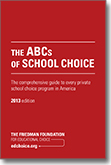 The Friedman Foundation’s latest “ABCs of School Choice” guide is out, and the numbers go like this: 21 states, 39 programs, 255,000 kids.
The guide offers a state-by-state rundown of the publicly funded, school choice options that are a vital piece of the overall school choice picture. It includes profiles of the students, parents and teachers who benefit from them. And it presents some thought-provoking stats, like how the value of each choice option compares to per-pupil funding in traditional public schools.
In Florida, a tax credit scholarship for low-income students is 34 percent of what’s spent on a traditional public school student, according to the Friedman analysis. Our own back-of-the-envelope calculations would put the percentage slightly higher, but the point is spot on: “voucher” students receive far less for their education than their public school peers. It’s a relevant detail that deserves more attention as the debate unfolds over testing for scholarship students and regulatory accountability measures for the private schools that enroll them.
The Florida section of the guide also includes a mini-profile of Davion Manuel-McKenney, a former tax-credit scholarship student who is now a freshman at Florida State College at Jacksonville. (Full disclosure: the tax-credit program is administered by Step Up For Students, which co-hosts this blog.) The story of Davion and his mother is a moving one. Click here to read more about it.
Teacher pay. Gov. Rick Scott says he wants to set aside enough money in this year’s budget to give every district teacher a $2,500 raise. Coverage from Tampa Bay Times, South Florida Sun Sentinel, Naples Daily News, Sarasota Herald Tribune, Associated Press, Tallahassee Democrat, Pensacola News Journal. Politics and poll numbers are at play, the HT also writes. Teachers "suspicious," writes the Lakeland Ledger. Teachers "skeptical," writes the Tampa Tribune. Teachers unions "cautiously optimistic," writes the Florida Times Union.
 Marco Rubio. The senator tells an audience at the U.S. Chamber of Commerce that he’ll be pushing education reform, even if it’s not the sexiest issue: “The good news is it’s not partisan, the good news is it’s something that there’s broad support for," he said. "The bad news is because it’s not partisan. Because it’s not controversial, it’s not getting nearly enough attention as it needs to be getting." The Hill.
Tony Bennett and the Legislature. Gov. Scott cancels his appearance before the Senate Education Committee, but Tony Bennett talks to senators about voucher accountability, Common Core, SB 736, etc. Coverage from redefinED, SchoolZone (two posts here and here) Gradebook (two posts here and here), StateImpact Florida and the Associated Press.
Slow down. Florida superintendents want a longer timeline to implement a suite of changes, including new tests and teacher evaluations, reports the Fort Myers News Press.
Charter schools. A new study based on Florida data suggests charter schools might not be any better than district schools at showing low-performing teachers the door. Shanker Blog.
Teacher preparation. The National Council for Teacher Quality gives Florida a B- (the best grade it gave any state) for its teacher preparation policies. SchoolZone. Sherman Dorn critique here. (more…)
New Florida Education Commissioner Tony Bennett offered more hints Wednesday that he is not satisfied with the current accountability framework for Florida private schools that accept students with vouchers and tax credit scholarships.
Making his first appearance before the Senate Education Committee, Bennett was asked by Sen. Bill Montford, D-Tallahassee, for his thoughts on “holding everybody accountable that receives tax dollars.” His response:
“I would suggest to you that this is a place where with all candor, sir, that even some of my supporters have been uncomfortable in the past. Because I do believe that schools that receive state funds should be held accountable and I believe that accountability should be just as transparent as what we expect from our traditional public schools.
“So I would share with you that in Indiana, every school that received state funds got a letter grade that was all calculated the same way. A public charter school got its letter grade calculated the same way as the traditional publics. Schools that received vouchers – and we did have the nation’s most expansive voucher program, pure voucher program – they got a letter grade, based on the same measurements as our traditional publics. And that way the public could make an informed choice around school quality.
“Now I know that constitutionally, the voucher situation here isn’t the same was Indiana. And I know there’s that discussion about state funds. So I want to lay that out there. But again, these were all schools that received money from the state budget. And I believe as a steward of the state tax dollars, we have to think about making sure that our citizens know the performance of schools that receive state tax dollars. And our job is to set the expectations for those schools and drive to those expectations.”
Senators also asked Bennett about a wide range of other issues. His biggest priorities, he said: implementing Common Core standards and reviewing SB 736, the far-reaching 2011 law that changes how district teachers are evaluated and paid. (more…)

Bennett
In this lengthy exit interview with the Indianapolis Star, new Florida Education Commissioner Tony Bennett adds to a simmering debate, sparked last month by Gov. Rick Scott, about whether students using vouchers and tax credit scholarships to attend private schools in Florida should be required to take the same standardized tests as their public school counterparts.
By law, tax credit scholarship students in Florida are required to take a nationally norm-referenced test approved by the state Department of Education. But Bennett suggests that's not enough:
"I do believe we should assess all students who get state money. I believe that in my heart. I keep having people asking me why I believe that in Florida. For voucher schools, I’ve been asked why can’t we accept just a nationally-normed test? But if IPS said let me choose a test and let me choose a performance level to determine if its schools were any good or not, would I accept that? No. So why should I buy that from them? What makes them more creditable than IPS?"
Bennett was also asked if there's anything about expanding school choice that he fears could "in any way threaten what's good about the traditional public school system." His response:
"No. I think it will enhance it. It never worries me because I believe good schools will flourish regardless, whether they are public, private or charter. I believe it will force schools to get better. I just believe that. It’s never kept me up at night. I just believe in the force that the market creates. We’ve seen it. We’ve seen (Indianapolis Public Schools Superintendent) Dr. (Eugene) White make some pretty innovative changes. I maintain he wouldn’t have done those things."
School choice in Texas is getting a big push this year from a key lawmaker who has made it a top priority.
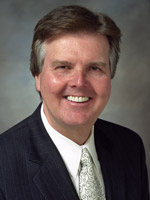
Texas Sen. Dan Patrick
“I’m the new chair of the Senate Education Committee and this is important to me,’’ state Sen. Dan Patrick, who has served on the committee for six years, said in a telephone interview with redefinED. “Here’s an issue that I’ve decided we need to push, but now I’m in a position that I can move it forward.’’
Patrick, R-Houston, and other school choice advocates in Texas are looking to create a tax credit program similar to the one in Florida that allows corporations to redirect a portion of state taxes to a scholarship fund in return for a tax credit. Low-income families who qualify can use the scholarship to help pay tuition at private schools.
Patrick has included the measure in an ambitious education plan that also calls for doing away with the 215-school cap on charter schools; incorporating a school rating system modeled after Florida’s A-F grades; and giving students the ability to enroll in any school within their district or in another district that has space.
In the interview, Patrick called school choice a civil rights issue and a “moral right.” He also offered a feisty response to an ad campaign, launched last fall by school choice opponents, that suggested “vouchers” would jeopardize Friday night football.
“With all due respect, that campaign is idiotic,’’ he said. “Texas would cut out math before they would cut out football.’’
Here’s more from the interview: (more…)
No honeymoon for Bennett. Especially from the teachers union, reports WCTV. The new commissioner should resolve the bureaucratic limbo over concordant test scores needed for graduation, editorializes the Tampa Bay Times.
Pensions. It’s a political issue for 2014 now that the Florida Supreme Court has ruled against the teachers unions, writes the Sarasota Herald Tribune.
 Writing. After last year’s reality check with FCAT writing, many schools changed their approach. Tampa Bay Times.
Teaching. Tampa Tribune columnist Steve Otto says the system is driving out good teachers like his wife.
Testing. Wendy Howard with the Florida Alliance for Choices in Education offers a defense of it in this Orlando Sentinel op-ed.
Scare tactics? How bleak is the budget situation in St. Lucie really? TCPalm.com
What really happened? A forensic audit of Manatee’s fiscal problems leaves unanswered questions. Bradenton Herald.
Perfect storm. A combination of factors led to Brevard’s budget crisis. Florida Today. (more…)
California: A parents group in Los Angeles is using the state's landmark parent trigger law to force the school district to reform a low-performing school. (Los Angeles Times). More from the Associated Press and Education Week. A national report finds the state continues to lead the nation in charter school growth, despite funding disparities and access to facilities (Huffington Post). Oakland district officials say the American Indian Model Schools, a charter network touted for its academic successes, suffers from "corrupt fiscal practices" and should be shut down (Oakland Tribune).
 Michigan: A new report finds the typical Michigan charter school student school gained more learning in a year than a district school peer, amounting to about an additional two months of reading and math learning (The Detroit News).
Texas: Key state lawmakers are looking at the franchise tax on businesses as a vehicle to fund private-school scholarships for low-income students (Austin Business Journal). Critics of a proposed voucher program say all it will strip the public school system of funding and state leaders should instead restore $5.4 billion cut from education in 2011 (KUT News). Similar arguments in stories from KX11.com and the Associated Press.
Florida: Magnet schools continue to grow on the school choice landscape (redefinED). A new bill would require emergency response agencies to notify private schools just like they do public schools (redefinED). In response to the Newtown tragedy, private schools and charter schools are considering additional security measures too (redefinED).
Georgia: Tax credit scholarships are used at private schools that bar gay students (New York Times). (more…)
 This is the fourth in a series of brief observations on the ideal technical design of state systems using “vouchers” as the means to empower parents to choose their child’s school. Vouchers are to be distinguished from tax credits; the latter fund parents indirectly through private contributions to charitable organizations, thus reducing the donor’s tax liability; the whole or part of the contribution can be credited against the contributor’s taxes. The charity then awards scholarships either to schools or to families whom it selects from among its applications.
By contrast, the voucher is simply an award of government money directly to the parents to be used for the child’s tuition at their chosen school. Vouchers will be our subject.
Why are rules important here? Why not just let the two parties - parent and school - bargain? If either says no, Suzie goes elsewhere. Such a system is imaginable, but in this society, improbable and possibly unjust. Rules of admissions are perhaps the most controversial element in the design of systems of choice - certainly of vouchers. Consider the following cases:
Susie’s mother wants her in Mozart High which emphasizes music as the medium of learning. Susie is tone deaf and hates music. Should she, by law, displace Jim, the gifted student next behind her in the lottery run by the school? And why must the school be using a lottery in the first place? And why shouldn’t the more gifted child simply have precedence?
Or, try this one. Arthur, who is black, also drew the short stick in the lottery. The school - otherwise all white - wants to admit him. Of course, to do so, someone else must get bumped.
Or, again, a disabled child wants entry to St. Cecilia, a small Catholic school with no facilities to accommodate her and no resources to redesign the school. What’s the point of forcing her admission?
Schools differ greatly in virtually every respect except in their (presumed) capacity to teach “the basics” as these are defined by law in the particular state. Furthermore, with respect to the basics, schools are free to employ a very wide range of methods. Often it is important that the pupil population come prepared to do it the school’s distinctive way. Still it is also crucial that kids who are less attractive to the school have the benefit of their parents’ choice.
Of course, long before the problem of admission even arises, a school may advertise, both positively and negatively, in order to maximize those applications it desires. It may also try directly to dissuade the unwelcome parent. In addition (as noted earlier in Essay #2) the school may, with fair warning and due process, expel a student who, after a fair trial, simply doesn’t make it. Still, the process of choice by the school itself can be confounded, for example, by an unexpected bubble of applications from children who “just don’t fit.” St. Cecilia, a Catholic school, may wish the best for Muslim applicants, but their sheer number may present a serious pedagogical problem. Like our current leaders on the Potomac, schools and parents need both a spirit of - and a mechanism for - compromise. (more…)
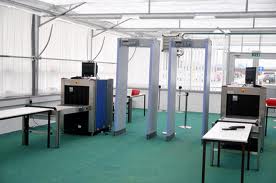
Image from schoolsecurity.org
School safety. Superintendents and lawmakers talk about more funding for more security. Coverage from Gradebook, St. Augustine Record, Sarasota Herald Tribune, Daytona Beach News Journal. Some are worried about “open campuses,” reports SchoolZone. A bill is filed that would require private schools to get safety alerts, just like public schools, from police departments and other emergency response agencies, reports redefinED.
The chairman of the Osceola County School Board, Jay Wheeler, writes in this Orlando Sentinel op-ed that the federal government should tax guns and bullets to pay for school guards: “When 26 students and school staff get killed by a crazed gunman in a public elementary school, it is a sad wake-up call for all of us that we have to do a better job protecting ourselves from our own freedoms.”
In Palm Beach County, mayors plead with the school board to install metal detectors in every school, reports the South Florida Sun Sentinel. More from the Palm Beach Post. In Lee County, deputies begin patrolling elementaries, reports the Fort Myers News Press. More from the Naples Daily News.
Test score limbo. If high school students fall short on the FCAT, he or she can still graduate if they get a high enough score on the ACT or SAT. But the state has yet to set new concordant scores for the other tests since upgrading the FCAT, leaving many students in limbo. Tampa Bay Times.
Charter school laws. SchoolZone notes the Center for Education Reform’s annual report card.
Why grading schools is good. EdFly Blog.
Vouchers and creationism. A Jacksonville school is among those highlighted in this MSNBC op-ed by student activist Zack Kopplin.
Privatization. The Bay County school district moves towards privatizing bus service. Panama City News Herald. (more…)

