 Considered separately, the students who benefit from expanded school choice options - vouchers, tax credit scholarships, charter schools, virtual schools, home schooling, etc. – still look a little fringe-y next to their peers in traditional public schools. But collectively, choice kids are mainstream, they’re growing, and their parents are a force to be reckoned with.
One of the things that best captures the size and scope of today’s school choice movement – and does more than anything to draw positive attention to it - is National School Choice Week. This year’s event in January featured more than 400 separate, local events; included every state in the country; and had tens of thousands of participants.
Next year’s event is nine months away (Jan. 27-Feb. 2, 2013). But it’s not too early for school choice supporters to begin planning.
“It’s really an opportunity to come together, unify with people you agree with on an issue and magnify the public’s attention on parental school choice,” said Andrew Campanella, the new president for National School Choice Week, in this podcast interview. This year’s events included rallies, town hall meetings, movie screenings, debates and more. “We’ve had Grandmas for Charter Schools coffee houses, balloon launches, concerts,” said Campanella. “I mean you name it, it’s been planned for National School Choice Week.”
Folks who want help with planning can go to www.schoolchoiceweek.com or contact Campanella directly at [email protected].
As we’ve noted before, there are endless examples of school choice critics talking in the abstract about choice programs, without referencing the kids and parents involved. And too often, media coverage does not include voices from choice families. National School Choice Week is a good way to remedy that.
"When opponents try to pigeonhole parental school choice and say it’s a marginal issue, you can just look to National School Choice Week and see that’s not the case,” Campanella said. “You know, we’ve gotten support from everyone from Bill Cosby to John Boehner to James Carville to the governors and state legislatures in 28 states and territories. So this is something that is supported by people regardless of their political affiliation, regardless of their walk in life.”
Editor's note: I just updated the post at 7:15 p.m. I'll continue to update it as I see more reaction in news stories, press releases, etc.
It's official: Louisiana has a new, statewide voucher program. With a Catholic school as a backdrop, Gov. Bobby Jindal today signed into law a bill that allows the state to pay private-school tuition for many low- and moderate-income students.
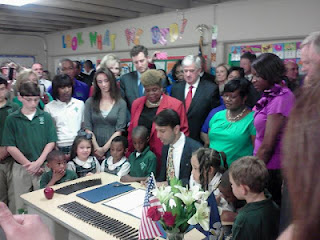 Jindal also signed off on other sweeping education changes, including making it easier to fire ineffective teachers and to create charter schools. Here is a roundup of the immediate reaction from supporters of school choice and ed reform:
From the American Federation for Children: “This is a great day for low-income children in Louisiana, whose parents will finally have the opportunity to give them the chance at an amazing education that they deserve,” said Kevin P. Chavous, senior adviser to AFC. “Thousands of students who were stuck in schools that were not working for them will now have an opportunity to attend a school that fits their needs and, ultimately, allows them to succeed.”
From the Foundation for Excellence in Education: “Louisiana is clearly committed to adopting and implementing reforms that will improve the quality of education for their students. These policies allow more families to select the best education options for their students and empower schools’ superintendents and principals to retain effective teachers in their schools," said Patricia Levesque, the foundation's executive director. “Building on the data-driven accountability system they adopted in 2010, Louisiana is on the fast track towards becoming a national leader on student-centered reform. Thanks to the bold leadership of Governor Jindal, Superintendent John White and state lawmakers, Louisiana and its students will have a brighter future.”
From the Friedman Foundation for Educational Choice: “States are realizing that school choice works,” said Robert Enlow, the foundation's president and CEO. “The more that states can move from limited school choice to universal availability, the greater its benefits will be to those in need. Indiana is witnessing this now. So, too, will Louisiana.” (more…)
 Think school choice is solely a conservative idea? Think again.
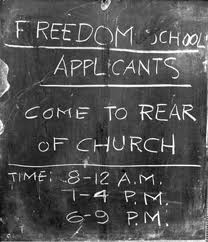
* After the Civil War, blacks in the South who were tired of waiting for the government to organize schools – or who were dissatisfied with the quality – built schools themselves.
* During the civil rights movement, activists in both the north and south established alternatives to segregated, second-rate schools.
* In the 1960s, leading progressives proposed private-school vouchers because of anger over failing inner-city schools.
Historical gems like these sparkle throughout “The Secret History of School Choice: How Progressives Got There First,” a 2005 academic journal piece by Georgetown University law professor James Forman Jr. From Reconstruction to the civil rights era to the “free schools” and “community control” movements – indeed, for most of American history - progressives have been a leading voice for choice.
So forget what you hear from choice critics and read in the newspaper. The parents who use vouchers and tax credit scholarships to help their kids can’t be shoved into one political box or another. The same goes for the political and philosophical roots that sprouted those options. Conservatives have advanced compelling reasons for school choice. So have progressives. (more…)
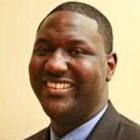 Florida has long given folks nationwide good reason to pay attention to school choice happenings at the state level. Now comes a compelling story at the local level.
Glen Gilzean, 31, is seeking a school board seat to help lead the 101,000-student Pinellas County school district. He's a former staffer with the state education department; an education entrepreneur whose business helps low income kids; an energetic guy with a solid grasp of education issues. He also happens to openly support school choice options like vouchers and tax credit scholarships.
That support prompted headlines after Florida Gov. Rick Scott appointed Gilzean to the District 7 seat in January. And it was mentioned again when Gilzean announced last week that he’s running to hold on to the seat. It should be kept in perspective.
District 7 has more black students than any other school board district in Pinellas. And as I’ve written before (and will continue to do so), black students in Pinellas score lower in reading and math than black students in any major school system in Florida. The trend lines are upsetting and baffling and don’t get the attention they deserve. They have also spurred growing numbers of parents in Pinellas to embrace expanded school choice options.
Gilzean’s support for choice may put him more in synch with the community pulse than candidates who reject such options. But he’s not a Johnny-one-note. Like many choice supporters, he sees choice as another tool to help kids, not as a silver bullet and not as an excuse to let traditional public schools flounder.
The election is Aug. 14. It will be fascinating to see if school choice becomes an issue in coming months – and, if so, how it’s portrayed and how voters respond. We know choice in Florida has strong support at the state level. The unique election in Pinellas may give us clues about how it's viewed on the ground.
 Florida: State report says charter school students perform better than peers in traditional public schools. (Florida Times Union) State task force will begin planning for digital learning. (Orlando Sentinel)
Washington, D.C.: President Obama should support the D.C. voucher program, which has shown good results and enjoys bipartisan support, the Washington Post editorializes.
Montana: Businessman gives $4.6 million to expand private school choice. (Bozeman Daily Chronicle)
New Hampshire: Lawmakers begin planning override of Gov. John Lynch's potential veto of a bill to establish tax credit scholarships. (New Hampshire Union Leader) (more…)
Today at redefinED we’re going to smash another stereotype: not all public school teachers oppose expanded school choice.
Lorena Castillo is chairwoman of CHISPA, the Coalition of Hispanic Instructors in Support of Parental Awareness. CHISPA falls under the umbrella of the Hispanic Council for Reform and Educational Options, and its 180 members – almost all of them teachers in traditional public schools - support charter schools, private school vouchers and tax credit scholarships.
Castillo sees no conflict between that support and support for public schools. The bottom line for CHISPA, she said in the redefinED podcast below, is finding the right fit for Hispanic students who are struggling. That way, they can catch up, earn diplomas, become good citizens – and not become statistics. “We have great public schools, and dedicated public school teachers,” said Castillo, who teaches middle school science in Dade County, Fla. “But for some students with special needs, they need other options in order to graduate.”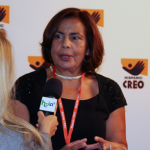
Castillo can relate. She was a teacher and principal in her native Nicaragua but moved to the U.S. 25 years ago. Before becoming certified to teach here, she worked a full-time job, a part-time job and attended night school to learn English – all at the same time.
“We were out of our environment. Different language. Different culture. So we had to struggle a lot to adapt,” she said of herself and her family. “When I see any Hispanic student in my classroom struggling, the same way I did and my kids did, I completely understand and I can make a complete connection.”
As far as we know, there are no other organized groups of public school teachers who openly support expanded school choice options. Coincidentally, “chispa” is Spanish for “spark.”
 For whatever reason, Duval County is a hotspot in Florida for criticism about school choice options for low-income students, including, most recently, a biting newspaper column about charter schools. The distinction is odd and disappointing because, for whatever reason, low-income students do particularly poorly there.
Low-income students in the Duval school district, which corresponds with the city of Jacksonville, trail more affluent classmates by double-digit percentage points when it comes to passing the state’s standardized math and reading tests. That’s not unusual. But they also trail other low-income students. When the results for low-income students in Florida’s 12 biggest school districts are compared, Duval ranks last in both subjects. (The 2010 figures showed 47 percent of Duval’s low-income kids reading at grade level or above, while 52 percent were doing math at grade level or above.)
This is not meant to disparage the hard work and dedication of public school leaders in Duval. But it does call into question the certitude with which they reject learning options that could help. Andy Ford, the president of the state teachers union, is a former union president in Duval – and definitely not a fan of vouchers or tax credit scholarships for low-income kids. Neither is influential Duval school board member W.C. Gentry or Save Duval Schools, one of the state’s most organized and media-savvy parent groups. From public hearings to the state Capitol to letters to the editor, they’ve relentlessly stayed on message: School choice is bad, a fraud, a conservative plot to enrich greedy corporations.
Expanded school choice “really takes us back to the haves and have-nots,” Gentry said in a Dec. 2010 radio interview. “The wealthy, the rich, the people in the know – they will figure it out. The poor, the disenfranchised, those who do not have that kind of support system – they will fall into the cracks and we will further enhance the disparity we now have in this city and this state between the haves and have-nots.” (more…)
 Editor's note: We're going to try something new today - "blog stars," an occasional round-up of material from other blogs that we think is worth spotlighting. Some of the most illuminating commentary/analysis about education issues nowadays is found not in traditional media like newspapers, but in the blogosphere. As with everything else we do, we'll emphasize posts that touch on school choice, parental choice and common ground in education reform. Here goes:
Dropout Nation: Embrace the Power of Families
The move today by Louisiana’s legislature to approve the expansion of the state’s voucher program can only be seen as a success for children in that state. The centerpiece of Gov. Bobby Jindal’s school reform efforts, the proposal — which would transform the program from one that just serves 3,000 students in New Orleans — will likely help as many as 300,000 more children get out of the Bayou State’s failure mills and dropout factories.
But the passage of the plan, along with one that would allow for the opening of more charter schools, is another reminder of the important shift that is happening, not only within Louisiana’s public education system, but throughout American public education as a whole. Families once relegated to the sidelines are taking more-powerful roles in shaping education decisions decision-making. It’s past time for this to happen. It is absolutely immoral and unacceptable to deny families, especially those from the poor and minority households, the ability to reshape education for their kids and keep them out of the worst education in this nation has to offer.
As Dropout Nation has reported over the past few years, more families are realizing that they can no longer assume that their children will fare well in just any school. Thanks to the work of the school reform movement — including the work of standards and accountability advocates and civil rights-based reformers in advancing the array of measures that would eventually come together in the No Child Left Behind Act — parents know more about the abysmal quality of teaching and curricula endemic in both the worst urban districts and mediocre counterparts in suburbia. And this data, along with the first wave of school choice efforts that started in the early 1990s with Milwaukee’s school voucher program and the first charter schools opened in Minnesota, have allowed families, especially those from low-income backgrounds, to realize that they don’t have to take anything that is given by traditional districts. Full post here.
Choice Words: 10 years after Zelman, challenges still loom for voucher advocates
Ten years after the U.S. Supreme Court upheld the constitutionality of the Cleveland voucher program, state judges are still sending conflicting signals about the viability of private school choice. The latest setback for choice proponents took place last week in Oklahoma, where a Tulsa County judge ruled that a voucher for students with special needs violated the state’s constitutional prohibition of public money for sectarian institutions. (more…)
 Louisiana: Senate approves statewide voucher program on a 24-15 vote. (New Orleans Times Picayune) The vote was bipartisan, again. (redefinED) Gov. Bobby Jindal succeeds in a sweeping education overhaul. (Associated Press)
South Carolina: Former Florida Gov. Jeb Bush will be the keynote speaker at an education reform summit later this month.
Pennsylvania: Flier flap in state House race tied to voucher battle. (philly.com)
Alaska: School choice expansion effort stalls. (Juneau Empire)
Arizona: Gov. Jan Brewer vetoes expansion of education savings accounts. (Arizona Republic)
Connecticut: Democratic Gov. Dan Malloy points to the rift over education reform between two of his party's biggest constituencies, African Americans and teachers unions. (CT News Junkie)
Mississippi: House education committee narrowly votes down charter school expansion bill. (Associated Press) It gets real ugly afterwards. (Memphis Commercial Appeal)
Tennessee: Charter school diversity blooms. (Nashville Tennessean)
New Jersey: State Department of Education is set to consider 32 new charter school applications. (Newark Star-Ledger)
Georgia: More families are considering on-line learning options. (Macon Telegraph)
(Image from politico.com)
 The Louisiana Senate made national headlines this week with its historic 24-15 vote in favor of a statewide voucher program. But once again, media coverage ignored a key development: The vote was bipartisan.
Seven of 15 Democrats, including four black Democrats, voted in favor of HB 976, which also expanded other school choice options. That's on top of 12 Democrats who voted for the bill in the House. All of them did so despite tremendous pressure not to stray from the traditional party line or from historic allies like the Louisiana teachers union.
Despite all the Democratic votes, the union stuck to the story: The voucher agenda was pushed by out-of-state influences, the conservative American Legislative Exchange Council and Wall Street - a nefarious cabal out to "rob local funds from our neighborhood schools."
Widely repeated lines like these are what prompted redefinED this week to spotlight a couple of Florida folks who support vouchers and tax credit scholarships. One is a St. Petersburg, Fla. pastor who also happens to be a Democrat and the head of the local NAACP. The other is a Sanford, Fla. dad whose podcast interview I posted this morning. "I'm just a dad looking to do the best for his son," Mike Enters told me.
The debate over school choice is more dynamic and nuanced that its loudest critics want you to believe. And it's more interesting than what you'll read in the papers.

