Rick Scott's proposed budget. Includes $1.2 billion more for public schools. Coverage from South Florida Sun Sentinel, Gainesville Sun, Fort Myers News Press, TCPalm.com, Associated Press, Pensacola News Journal. "A relief to educators," reports the Lakeland Ledger.
 Digital education. Jeb Bush on CNN's Schools of Thought Blog: "Digital learning is just one important element of the overall school choice movement being celebrated during National School Choice week – and rightfully so. There is no silver bullet. There is no one-size-fits-all option. There can and must be only a proliferation of ever-growing options so that students and parents can embrace whatever educational scenario is best for them."
Exposed, day two! The Tampa Bay Times plugs the Jeb-Bush-corporate-connections-conspiracy "story" by offering a link from the front of its web site to The Buzz, which channels the "news" from, of all places, The Answer Sheet blog, which The Buzz curiously describes as merely "the Washington Post's education blog."
PTA activism award. The Florida chapter is honored for successfully defeating parent trigger legislation last year. Gradebook.
School spending. The Brevard school board considers a bus fee for students in choice programs. Florida Today.
Teacher pay raises. A constitutional amendment for that is a bad idea. Palm Beach Post.
ESE changes in Hillsborough. Latest from Tampa Bay Times and Tampa Tribune.
Concordant scores. They're out now. Tampa Bay Times.
PARCC. StateImpact Florida relays a DOE overview of the coming tests.
Superintendents. Manatee adds a sixth candidate, reports the Bradenton Herald and Sarasota Herald Tribune. Whoever he or she ultimately is "must have the skill set, character and strength to bring this district back from disaster," editorializes the Bradenton Herald.
Race to the Top. Florida is back on track a year after federal education officials warned it for falling behind on grant-funded projects. Associated Press.

Shirley Ford
The mom on stage described how she and other low-income parents rode a bus through the darkness - six hours, L.A. to Sacramento, kids still in pajamas - to plead their case to power. In the halls of the legislature, people opposed to the idea of a parent trigger accused them of being ignorant, of not understanding how schools work or how laws are made. Some called them a “lynch mob.”
Then, Shirley Ford said, there was this sad reality:
“I would have thought that the PTA would have been beside me,” Ford said. But it wasn’t. “I’m not PTA bashing when I say this,” she continued. “To see that the PTAs were on the opposite side of what we were fighting for was another level of awareness of how the system is.”
Ford is a member of Parent Revolution, the left-leaning group that is advocating for parent trigger laws around the country. She spoke last week at the Jeb Bush education summit, sharing the stage with former California state Sen. Gloria Romero and moderator Campbell Brown. Her remarks, plain spoken and passionate and sometimes interrupted by tears, touched on a point that is vital and obvious and yet too often obscured.
Parents are not a monolith.
The divides are as apparent as the different dynamics that play out in schools on either side of town. In the affluent suburbs, a lot is going right. There is stability in the teaching corps. The vast majority of kids don’t have issues with basic literacy. The high schools are stocked with Advanced Placement classes. And there, behind it all, are legions of savvy, wonderfully dogged, politically connected parents who know how to mobilize when their schools are shortchanged.
The view is starker from the other side of the tracks. A parent in a low-income neighborhood is more likely to see far more teacher turnover in her school – along with far more rookies, subs and dancing lemons. She’ll see far more students labeled disabled and far fewer AP offerings. Issues like these plague many high-poverty schools, yet they don’t get much attention from school boards or news media or, frankly, from established parent groups like the PTA. (more…)
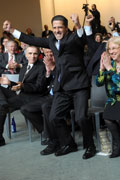
Miami-Dade Superintendent Alberto Carvalho reacts to the award announcement.
More Broad Prize coverage. As we noted yesterday, the Miami-Dade school district won this year’s Broad Prize, which goes to the urban district with the most academic progress. More from the Orlando Sentinel, Christian Science Monitor, Associated Press, Education Week. The Palm Beach school district was a finalist, which is also impressive. All this is more reason to routinely compare achievement data district by district in Florida. Also worth noting: Miami-Dade is a poster child for the new definition of public education, with a broad menu of learning options and huge numbers of parents embracing them.
Charter school issues in Volusia. The Volusia school board approves improvement plans for two F-rated charter schools, reports the Daytona Beach News Journal.
PTA doesn’t like it. The Florida PTA pans the Board of Education’s decision to set steeper improvement goals for low-income and minority students, reports the Gradebook blog.
More on Amendment 8. The Tampa Bay Times gets credit for going into detail about the legal case that’s at issue here – a case that has nothing to do with vouchers. ICYMI, our take on Amendment 8 here and here.
So the Democrat supports vouchers? In this state senate race in Central Florida, yes, notes the Orlando Sentinel.
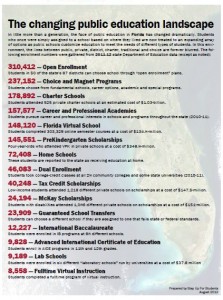 Though we know little about the parents who long have chosen their school through where they decide to live (or to pretend to live), Florida keeps count of those who no longer want their neighborhood school. And here's some data to chew on: In a state known for its breadth of learning options, that number last school year reached 1.2 million.
In other words, using a conservative approach with new 2011-12 enrollment records, 43 of every 100 students in Florida public education opted for something other than their zoned school.
This number is produced largely from state Department of Education surveys required of the 67 school districts and reflects, not surprisingly, surging growth for choice options. Though total public school enrollment grew by only 1 percent last year, reaching 2.7 million, charters grew by almost 16 percent, online by 21 percent, private scholarships for poor children by 17 percent. (See an enrollment compilation of 2011-12 options here.)
Granted, Florida is not like most other states in this regard. A combination of educational, budgetary and political factors, including the gubernatorial tenure of Jeb Bush, has put the Sunshine State on an accelerated path of parental empowerment. That said, it is a diverse, highly populous state with national political significance, and this kind of transformation is central to the new definition of public education.
The national education debate is still absorbed by adults who grew up with a pupil assignment plan built almost entirely on geography. Many of them went to the same schools as their parents and even their grandparents, and it’s natural they would define public education that way. That may help explain why parent activists or groups such as the PTA continue to oblige the teacher unions that pressure them to resist laws giving parents more options. The union message – that traditional public schools are endangered – plays to the parents’ natural fears.
That’s why these numbers are worthy of pause. (more…)
The parent trigger is headed for a showdown in Florida’s Senate on Friday, and it is worth remembering that the bill was greeted in January with bipartisan support on education committees in both chambers. Suffice it to say, warm and fuzzy has now left the Capitol.
Defeating SB 1718 has become the top priority for the Florida Education Association, and its views carry more currency in a year in which redistricting leaves lawmakers scrambling to run in new districts. The Senate is also in a state of meltdown, with an attempted leadership coup having raised the temperature in the chamber and caused senators to scurry for new alliances. Oddly, the clash may also be owed to the fact that lawmakers have written a budget that restores most of the deep funding cuts made to public schools last year, allowing educators to shift their focus. In the state’s largest newspaper today, a teacher union official and a PTA president gave us a sense for the drama. Nine days ago, the state Board of Education raised the bar for school grades, putting pressure on many of them to further improve or end up with lower or possibly failing grades. So a bill that now would allow parents to vote to overhaul or bring new management to low-performing schools feels to them like a conspiracy.
This may help to explain rhetorical excesses like this: “Florida politicians are chopping up our piece of the (American) dream." And this: the bill is “really the corporate empowerment bill” and “an effort to dismantle public education.” But the apocalyptic tone is simply confounding. (more…)
"We're living in a revolutionary moment," says Ben Austin, executive director of the Parent Revolution, as we begin our interview for redefinED's inaugural podcast. And the moment to which he refers has been marked by California's "parent trigger," a law that has upended the status quo at one Compton school in a way that few education measures can do with such sweep. A majority of parents at McKinley Elementary wanted a charter operator to come and take over their struggling school, just as the parent-trigger law allows, and what Austin and the Parent Revolution fought for, and the Compton Unified School District has done everything possible to make their job harder. The struggle will be left to the courts to resolve, but Austin does see success in the very nature of what the law has sanctioned.
The trigger has allowed parents to essentially organize and effectuate change at a bargaining table that has been the exclusive province of school boards and teachers unions. Whatever the outcome at McKinley, the law has transformed relations between school boards and the parents at their failing schools, said Austin, a former member of the California State Board of Education, who also served Los Angeles as a deputy mayor from 2000-2001 as well a variety of roles in the Clinton White House. "Already there are parents across California that are organizing to get to 51 percent with no intention of at least initially turning the signatures in," he said. "They're organizing to bargain. They're organizing to basically say, 'You haven't listened to us for years, but now we have the power to fire you, so you have to listen to us.'"
We talked with Austin about the launch of the Parent Revolution and how its role as a parent union might manifest itself at the bargaining table. What else did we ask?
Why the parent trigger, and not a more collaborative approach? "It's people with power that want a collaborative approach ... Power and Money is the language that the other side understands, and if you're not speaking that language, they're not going to listen to you."
Can the PTA fulfill the role as a parent union? "We've had good experiences with the PTA, and we've had bad experiences with the PTA. We believe there needs to be a lot more "P" in the PTA."
Click here to listen to the rest of the conversation, which runs about 24 minutes.
When the New Jersey Education Association recently urged its members to rally the heads of the parent-teacher groups in opposition to a proposed voucher bill, it was implementing a strategy that has worked for teachers unions for the last 40 years. But what’s notable is that PTAs have long aligned themselves with organized attempts to defeat legislation that arguably empowers parents.
“It’s not your members who need to contact Assembly people, it’s the parents in your district who need to put pressure on them,” read a memo signed by NJEA representative Joe Coppola to members, as first reported in the Bergen Record. "Parents need to get angry and take action!"
Organizationally, PTA groups don't need much convincing. Their alliance with the National Education Association and the American Federation of Teachers goes back decades, and AFT president Albert Shanker used that to advance his ambitions in 1978. At that time, U.S. Senators Daniel Patrick Moynihan and Bob Packwood were leading an attempt to award tax credits to families for private or parochial school tuition. If successful, Shanker warned that the proposal would spell "the beginning of the end for public education."
But, as Shanker biographer Richard D. Kahlenberg noted in Tough Liberal, the AFT president was smart enough to make the PTA the driving force of the opposition. Thus was formed the National Coalition to Save Public Education, and National PTA president Grace C. Baisinger was installed as the coalition's chairwoman. Despite the visibility of the PTA, "it was known that Al was the key power behind this," said Eugenia Kemble, executive director of the Albert Shanker Institute. (more…)

