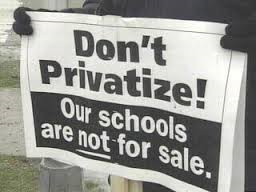
Everyone in the debate over how best to improve public education has private interests. Our collective challenge is to manage these often conflicting interests in ways that best serve the common good.
We all have private interests.
People pursuing their private interests – individually or as a group – is what drives progress and innovation. But our private interests should never trump the common good.
Private interests usurping the public good is privatization. Privatization is bad. It undermines democracy and progress.
Encouraging the pursuit of private interests while avoiding privatization is a core challenge for our economic and political democracy. In pursuing their private interests, individuals and organizations often claim their interests promote the common good, while the interests of those they disagree with don’t. Politics derives, in part, from conflicting claims of whose private interests better align with the common good.
We see this regularly in our debates over how best to improve public education.
As a long-time teacher union leader, I sold financial services, insurance and advocacy services to teachers working for school districts. Therefore, maximizing the number of teachers employed by school districts served my business interests. Our union continuously asserted that more teachers working for school districts served the common good, as did higher teacher salaries and benefits. Our favorite marketing slogan was, “Teachers’ working conditions are students’ learning conditions.”
Our union’s political and marketing strategy was to tie the private interests of district teachers to a greater common good (i.e., the welfare of children). Of course, the private interests of teachers are often – but not always – tied to children’s interest, so this was, and still is, an effective strategy.
Teacher unions use a similar political strategy when attacking school choice programs that empower students and teachers to attend schools not covered by union contracts. The unions accuse these schools of furthering privatization. As the National Education Association recently stated about charter schools not under union contracts: “We oppose the creation of charter schools for the purpose of privatization.”
Teacher unions are often criticized – unfairly in my opinion – for advocating for the private interests of district teachers. (more…)

Tuthill: The obstacles we face trying to improve public education, especially those related to generational poverty, are daunting. But I’m optimistic about the progress we’re making.
The latest Florida Department of Education report on the tax credit scholarship program, and my summer discussions with scholarship parents, students and teachers, have led me to some conclusions. These thoughts are not new, but sometimes it’s important to remind ourselves of things we know but occasionally forget.
Editor's note: Utah state Sen. Aaron Osmond raised eyebrows and sparked debate last month with a provocative post on the senate blog that called for ending compulsory education and, essentially, expanding school choice options to include no school at all. The post drew coverage from Fox News to the Huffington Post (see here, here, here, here and here) and a fair bit of commentary, too (see here, here, here and here). On a related note, a fascinating case in Virginia - involving that state's broad religious exemption for school attendance - prompted the Washington Post to weigh in with this editorial over the weekend.
Here is Osmond's post in full:
Sen. Osmond
Before 1890, public education in America was viewed as an opportunity - not a legal obligation. Prior to that time, the parent was primarily responsible for the education of their children. The state provided access to a free education for those that wanted to pursue it. The local teacher was viewed with respect and admiration as a professional to assist a parent in the education of their child.
Then came compulsory education. Our State began requiring that all parents must send their children to public school for fear that some children would not be educated because of an irresponsible parent. Since that day, the proverbial pendulum has swung in the wrong direction.
Some parents completely disengage themselves from their obligation to oversee and ensure the successful education of their children. Some parents act as if the responsibility to educate, and even care for their child, is primarily the responsibility of the public school system. As a result, our teachers and schools have been forced to become surrogate parents, expected to do everything from behavioral counseling, to providing adequate nutrition, to teaching sex education, as well as ensuring full college and career readiness.
Unfortunately, in this system, teachers rarely receive meaningful support or engagement from parents and occasionally face retaliation when they attempt to hold a child accountable for bad behavior or poor academic performance.
On the other hand, actively engaged parents sometimes feel that the public school system, and even some teachers, are insensitive to the unique needs and challenges of their children and are unwilling or unable to give their child the academic attention they need because of an overburdened education system, obligated by law to be all things to all people.
I believe the time has come for us to re-evaluate what we expect of parents and the public education system, as follows:
First, we need to restore the expectation that parents are primarily responsible for the educational success of their own children. That begins with restoring the parental right to decide if and when a child will go to public school. In a country founded on the principles of personal freedom and unalienable rights, no parent should be forced by the government to send their child to school under threat of fines and jail time. (more…)
Editor’s note: We’ve made the point many times: Public education shouldn’t be synonymous with public schools and increasingly, in this age of rapidly expanding options, it isn’t. In a new essay, James V. Shuls, the education policy analyst at the Show-Me Institute in Missouri, expertly riffs on that theme, using the moving story of a student growing up in a tough stretch of St. Louis as a hook. Here’s a taste:
Shuls
As a child, Korey attended St. Matthew Catholic Church. In 2001, St. Matthew’s parish opened De La Salle Middle School. The small private school above Big Mo’s barbeque restaurant only had 20 students. Korey did not know what to think about the idea of attending De La Salle. In time, he would come to realize that this decision changed his life. With expected pride, he says, “De La Salle put me on a path to greatness.” This school was diferent from other schools he had attended. Class sizes were small, with more one-on-one attention. His teachers were passionate, not just about academics, but also about character. One in particular, Martha Altvater, pushed him harder than he had ever been pushed. From De La Salle, he earned a scholarship to Christian Brothers College (CBC) High School, a respected private school in Saint Louis County, and then attended Westminster College in Fulton, Mo. In 2012, he graduated with a degree in business administration; sitting in the audience was none other than Martha Altvater.
At a critical moment in his life, Korey had the opportunity to attend either a public school or a private school. He chose to attend the private school. In doing so, he chose the option that best served the public, as well as him. Had he chosen the neighborhood public school, Korey says he “might have fallen in with the wrong crowd and be in jail or dead today.” That has been the fate for many of his friends who attended the public high school. But Korey’s fate was different because he found a school that recognized and developed his potential.
Though it is a private school, De La Salle Middle School serves the public much more efectively than the district-run school, where fewer than half of the students graduate. However, instead of celebrating De La Salle as a venerable public institution, we label it as a private school and deem it unworthy of public funds.
***
This essay should not be construed to say that all private schools are great —they are not. Nor should readers think that I am saying that all public schools are bad — they are not. The point is that all types of schools — district, charter, and private — can effectively serve the public. Right now, however, we have put up an artificial barrier that prevents students from using public dollars to attend the private school of their choice. Never mind that these private schools can, as was the case for Korey Stewart-Glaze, serve the student and the public very well.
Korey Stewart-Glaze’s journey has come full circle. He now recruits students to attend the school that changed his life, De La Salle Middle School. Still, funding makes this a somewhat difficult task. Though the school provides privately funded scholarships to 100 percent of its students, they still have to pay some tuition. This severely limits the number of students the school can serve and creates a barrier for many families who simply cannot bear the cost. Our narrow definition of public education prevents De La Salle from receiving state dollars and prevents more students from experiencing the life-changing moment that Korey had. It is time we redefine public education. It should no longer mean assigning students to a specific type of school, regardless of quality, but rather that we provide access to a quality education, regardless of the type of school delivering that education.
Editor’s note: Craig S. Engelhardt is a former teacher and school administrator who directs the Waco, Texas-based Society for the Advancement of Christian Education. His new book is “Education Reform: Confronting the Secular Ideal.”

Engelhardt
Public education reflects some of America’s highest ideals and is based upon a belief in the value of both the individual and American society. Its existence reflects the belief that all children - regardless of their demographic status - should have the opportunity to grow in and pursue their potential. Its curricula reflect the belief that prosperity, liberty, and peace are rooted in individuals who are knowledgeable, skilled, reasonable, individually reflective, morally responsible, and socially supportive.
I support public education as both an ideal and a “good.” However, I claim public education harbors a systemic flaw that hinders and often prevents our public schools from fulfilling their ideals. Further, I claim this flaw has survived virtually unrecognized and unchallenged for over a century. Is it possible a scientific, astute, experienced, and democratic people could have missed a “flat world” sized flaw in a system so close to their lives and communities? I maintain we have. I have extensively written about it in “Education Reform: Confronting the Secular Ideal.”
In this scholarly book, I attempt to “tease out” the roles religion has played in education from America’s conception to the present. To do this, I start with a functional definition that describes religion as a coherent and foundational set of beliefs and values that provides a framework for reason and a source of motivation for life. Defined functionally, religions are worldviews that may or may not have a deity.
Working from this definition, I discover pre-modern (roughly pre-20th century) public and private education leaders consciously held religion to be central to their efforts. In other words, they believed individuals were shaped by their religious beliefs and the educational nurture of individuals relied upon teaching the foundational beliefs of their communities, extrapolating from pre-existing beliefs, and integrating new facts with those beliefs. The question within 19th century common schools was not whether schools should be religious, but which religious tenets were most integral to and supportive of the American way of life. This educational discernment was not merely due to prejudice or self-centered majoritarian preferences (though these played a role), but to a reasoned, experiential, and historically evident understanding of the roles of religion in society. The exclusive public support of common education seems to have been an attempt to educate non-Protestants toward many of the morals, beliefs, and perspectives considered to be “American” and indebted to the Protestant faith.
So how did secular public education become an “ideal”? First, I note it never was the ideal for the majority of the U.S. population. Even now, given a choice, I believe most parents would likely prefer to send their children to a school reflecting their “religious” views. Secular public education developed in America as a result of the confluence of two mutually supporting public commitments and a national trend - all were philosophically based, but one carried the overwhelming force of law. I believe the complexity of their interplay and the slow pace of change allowed the “flaw” of linking public education with the secular paradigm to survive to our present day with little challenge. (more…)
 My recent post about the importance of including parental choice in our definition of public education accountability drew a thoughtful response from Melissa Webber, the parent of a special needs child.
She writes, “I’m not sure I agree with the writer’s explanation of accountability. While I support parental choice and have in the past taken advantage of the McKay Scholarship, I think choice is a separate issue not to be confused with accountability unless parent empowerment actually affects positive change of a program to bring it up to regulation standards. One of the private schools I visited had no certified teacher, made no attempt to comply with sunshine standards and they weren’t bound to provide services spelled out in Blake’s IEP. Basically, it served as a disorganized daycare for middle school ESE kids. It was an easy choice for me to opt for another public school program. However, my choice to do so did not make the school more accountable. There should be much more oversight to insure at least minimal standards are met so the children of less informed parents do not suffer in the name of choice.”
The public good is best served when public education operates with maximum effectiveness and efficiency. Highly effective and efficient schools are best possible through a combination of regulations and consumer choice. Regulations provide the floor below which no school should operate, but regulations alone can’t produce excellence. Excellence requires consumer choice.
Ron Matus’ recent story about one of Florida’s top charter schools included this quote from the school’s founder and principal, Yalcin Akin: “If they like us, they come to our school. If they don’t like us, they don’t come. We have to have a high level of customer service and a high level of performance – or we will not survive.”
This necessity to meet parents’ needs or go out of business is part of accountability, and helps fuel the drive for excellence. Last year, Akin’s school had a waiting list of about 1,500 students.
Now consider Melrose Elementary in St. Petersburg. Only one student chose to attend Melrose’s magnet program this year. All the other Melrose students were assigned there by the school board and, if they don’t show up, their parents can be sent to jail.
Melrose is more highly regulated than Akin’s charter school, but it is not more accountable. As long as students are forced by law to attend Melrose, it won’t go out of business, regardless of its effectiveness. (more…)
Rallies tend to be choreographed political endeavors, but the video above is worth your four minutes if for no other reason than the glimpses of the parents who participated.
This school choice rally was held at the Florida Capitol on April 3, and it represents something you don't see every day. It brought more than 1,000 students, parents and activists together to celebrate the full spectrum of school choice – from magnet schools to career academies to charter schools to online courses to tax credit scholarships for low-income students and vouchers for students with learning disabilities.
Forget the attendance numbers, which incidentally were stronger than any of the PTA-type parent rallies in recent years, and look instead at the faces. They are remarkably diverse, racially and economically, and some of them traveled all night and missed work to be there. They brought with them their passion and their belief that the school they chose is working for their children. And they are hardly alone. In Florida last year, 1.5 million of the students in PreK-12 – or 43 percent – attended something other than their assigned neighborhood school, and this kind of event is a reminder that parents are choosing their schools in ways that also change the politics of public education.
No one should read too much into a political rally, but, at a time when the more traditional parent associations continue to fight many of the learning options these parents consider essential to their children’s future, there is something poignant here. Many of these parents have felt disenfranchised in the past, and their magnet choice or charter school or scholarship has given them a sense of educational ownership. To see them fight to keep these school choice options is uplifting, and not because it reflects one political ideology or another. It means they believe in their child's education, and that has to accrue to their child's benefit.
 Editor's note: This piece ran in Monday's Gainesville Sun.
Parents with financial means long have chosen their children's schools by where they live or which private tuition they pay, but Florida is approaching a remarkable threshold in school choice. Last year, 1.5 million students — or 43 percent — attended something other than their neighborhood school. Of special note, 51,023 of the poorest among them are attending a private school at public expense.
This move toward customizing public education is owed to a simple proposition — that different children learn in different ways — and it represents an extraordinary commitment to equal opportunity. In Alachua County last year, 5,800 students chose magnet or choice programs or used open enrollment, and another 2,200 went to charter schools. This year, 335 low-income students are also attending private schools through state-backed scholarships.
That last learning option, called Florida Tax Credit Scholarships, gives pause to the Alachua League of Women Voters. Its respected president, Kathy Kidder, recently questioned the program's constitutionality and accountability. She cited a state Supreme Court case, the 2006 dismissal of a voucher given to students in schools judged to be failing, without noting two prominent U.S. Supreme Court precedents that affirm the scholarship's constitutionality.
The first, a 2002 case from Cleveland, rules that religious schools cannot be excluded from private voucher programs as long as the primary goal is education and parents aren't coerced into choosing. The second, a 2011 case from Arizona, finds tax credit scholarships to be in a separate constitutional arena altogether. In Arizona, the court ruled that tax-credited contributions are not government expenditures.
The more important measure, though, is educational progress. The $4,335 scholarship is available only to children in K-12 whose household income qualifies them for free or reduced-price lunch, and this year the average income is just 6 percent above the poverty line. Two-thirds of the students are black or Hispanic, and more than half live in households with only one parent. More striking, the students who choose the scholarship are the lowest academic achievers from the public schools they leave behind.
The encouraging news is that these same students, according to the latest annual standardized test scores, are achieving the same gains in reading and math as students of all income levels nationally. (more…)
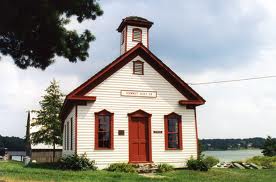
What, exactly, does "public" mean in "public education" and who decides?
by Gloria Romero
The school-choice movement has just surmounted one of its most pervasive challenges. A unanimous Indiana Supreme Court upheld the constitutionality of that state's voucher program, which makes some 500,000 low- and middle-income kids (or, about 62 percent of its families) eligible for state aid to help pay for a private or religious school. The decision cuts to the core of the most profound education debate: What, exactly, does "public" mean in "public education" and who decides?
The court ruled that Indiana is serving valid educational purposes, both by maintaining a traditional public school system and by providing options to it. In other words, that government's role is to ensure that essential services are available to the people – but the government itself does not always need to be the actual provider.
Thus, with voucher laws such as Indiana's, "public" money follows the "public," which is the family directly – not the "publicly" operated schoolhouse. Hence, families get to choose where to spend the public money: on a schooling choice made by them, or on a schooling choice made by a government official.
Historically, the fight over funding in K-12 public education has been interpreted as the strict allocation of public, taxpayer dollars to publicly operated institutions only. Essentially, this has resulted in the protection of monopoly rights of government-run schools. Students are assigned by government officials to a "local" public school, based on ZIP code. This ZIP code-restricted system has largely given rise to today's parent empowerment movement, where more and more parents – especially in inner cities – have fought back against a system that not only assigns them to a particular school, but restricts them from leaving – even if that school chronically underperforms.
Indeed, few incentives exist to transform these schools, which sometimes seem to operate more as massive public-works programs for adults. Charter schools, open-enrollment policies and parent trigger laws have all been based on the fight for greater parent rights in public education. (more…)
 Accountability in public education derives from a combination of government regulations and consumer choice. Historically, because we’ve had so little consumer choice in public education, regulations have been the dominant component of accountability. But now that school choice is becoming more ubiquitous, consumer choice is assuming a more prominent role.
Unfortunately, some of our most important public education policy wonks are devaluing the importance of consumer choice by using the term accountability as a synonym for regulations.
My friend and former colleague here at Step Up For Students, Adam Emerson, in criticizing the lack of required state assessments in Florida’s McKay Scholarship program, recently wrote on his Fordham Institute blog that:
“Virtually no accountability measures, however, exist in most of the nation’s special-education voucher programs, including the largest such program in the United States, Florida’s McKay Scholarship for Students with Disabilities.”
Parents choose to apply for and use a McKay Scholarship. If their needs are not being met at one of the more than 1,100 Florida private schools accepting the McKay Scholarships, they can vote with their feet and go to another school. To suggest this level of consumer choice equates with “virtually no accountability measures” is wrong.
Adam’s gifted colleague at Fordham, Mike Petrilli, made a similar error a few days later. He wrote that “Indiana’s voucher program has accountability in spades,” then ignored consumer choice and equated accountability only with required student testing and school grades. (more…)

