 Florida won’t pay a school to NOT educate a student. I’ll put that another way: the state doesn’t pay for students to not attend a school.
It is a simple and intuitive fact, yet some Floridians – many happen to be parental choice critics – don’t seem to get it.
For 41 years, the Florida Legislature has funded education with a formula based specifically on the cost to educate each student. The just-approved 2014-15 spending plan is no different: It determines the average student will cost $6,937 to educate, multiplies that amount by a projected enrollment of 2,722,134 and arrives at a bottom line of $18.9 billion. Each district is paid accordingly.
Not surprisingly, this means the state won’t pay a school for students educated somewhere else. But look at the responses from Floridians concerned about the newer private options available to lower-income and special needs students:
(As we always note, the scholarship program is administered by Step Up For Students, which co-hosts this blog.)
Opposing one type of school choice program because it “diverted” money, takes “tax dollars out,” or leaves public schools with “fewer resources” requires critics to ignore the state’s method of funding K-12 education. (more…)

Bigfoot...also a myth...
Education is a complex and nuanced issue, and advocates on all sides need to be mindful not to overreach. Supporters of school choice sometimes overpromise the benefits of vouchers and tax-credit scholarships, leaving them open to attack. On the other side, school choice critics sometimes appeal to a mythical concept of the common/public school that never really existed.
Edward B. Fiske, a former New York Times education editor, and Helen F. Ladd, a professor at Duke University, demonstrate exactly this in a recent op-ed in the News & Observer. Fiske and Ladd keep their arguments simple: school choice is unconstitutional because it “destroys” the state’s ability to provide a free uniform system of education that is, as they say, “accessible to all students.”
Their argument may sound reasonable to a school choice critic, but the reasoning is grounded in mythology. Understanding this mythology exposes the underlying contradictions with the opposition to school choice.
First, it is a myth that common/public schools are open to every student. Students are assigned to schools and those schools are free to reject any student not within the school zone.
As Slate columnist Mathew Yglesias recently noted, the word “public” in public school really only means the school is government-owned and operated. He correctly observes that “a public school is by no means a school that's open to the public in the sense that anyone can go there.”
Yglesias isn’t a school choice fanatic but he isn’t blind to the results of a zone-based attendance policy. The result turns neighborhood schools into a “system of exclusion.” (more…)
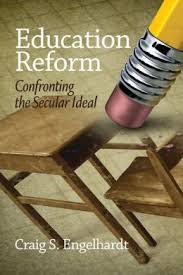 If one wishes a profound historical-dialectical account of the fate of religion in our governmental schools - all in 200 pages - make Craig S. Engelhardt’s new book, “Education Reform: Confronting the Secular Ideal,” your primer.
Engelhardt's guiding principle is constant and plain: If society wants schools that nourish moral responsibility, it needs a shared premise concerning the source and ground of that responsibility; and this source must stand outside of, and sovereign to, the individual. Duty is not a personal preference; if it is real, that is because it has been instantiated by an authority external to the person. In contemporary theory, the source of such an authentic personal responsibility is often identified in ways comfortable to the secular mind. There is Kant; there is Rawls.
But in the end, the categorical imperative and the notion of an original human bargain are vaporous. We go on inventing these foundations, but, in moments of moral crisis, such devices do not provide that essential, challenging, universal insight that tells each of us he ought to put justice ahead of his own project. Only a recognition of God’s authority and beneficence can, in the end, ground our grasp of moral responsibility.
This message is repeated at every turn to support the author’s practical and political conviction - that the child cannot mature morally in a pedagogical framework that deliberately evades its own justification. Engelhardt shows in a convincing way that the religious premise was originally at the heart of the public school movement. Americans embraced the government school for a century precisely on the condition that it gave expression to a religious foundation of the good life. When modernism and the Supreme Court gave religion the quietus in public schools, the system serially invented substitutes including “character education,” “progressivism” and “values clarification” – each of which in its way assumed but never identified a grounding source. The result: a drifting and intellectual do-it-yourself moral atmosphere - an invitation to the student to invent his own good. And all too many have accepted.
Engelhardt gives fair treatment to all players in the public school morality game. From the start he provides a generous hearing to the century-and-a-half of well-intending and intelligent minds who paradoxically frustrated their own mission of a religious democracy, first by shortchanging the unpromising Catholic immigrant, then - step by step - pulling the rug from under that transcendental dimension of education which alone could serve their wholesome purpose of training democrats. In this book, every historical player gets to give an accounting of the good he or she intended and the arguments thought to support it; of course, the rebuttals by Engelhardt are potent and even fun to read.
My first and less basic criticism of the book is its slapdash attention to the legal paraphernalia that will be necessary to school choice, if it is to serve the families who now enjoy it the least. (more…)
 Every year the National Center for Education Statistics (NCES) releases its School and Staffing Survey, a treasure mine of interesting education tidbits for education data geeks.
According to the latest (collected from 14,000 schools during the 2011-12 school year), 64 percent of private school 12th graders will go on to a 4-year college or university but only 39.5 percent of traditional public school students and 37.2 percent of charter school students will do the same.
But don’t get too excited. Some caution is needed before making a conclusion about the impact of these schools because there are big differences regarding students and teachers at these schools. For example, private schools are much whiter and more affluent than public schools. That might explain some of the 25 percentage point advantage in college enrollment rates.
But if being whiter and more affluent helps private schools, it doesn’t seem to do much for traditional public schools when compared to charter schools. (more…)
Editor’s note: We’ve made the point many times: Public education shouldn’t be synonymous with public schools and increasingly, in this age of rapidly expanding options, it isn’t. In a new essay, James V. Shuls, the education policy analyst at the Show-Me Institute in Missouri, expertly riffs on that theme, using the moving story of a student growing up in a tough stretch of St. Louis as a hook. Here’s a taste:
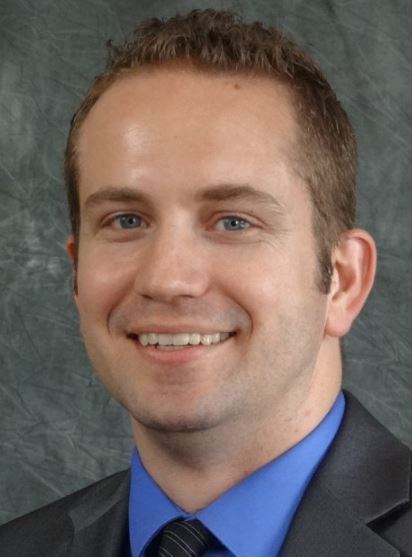
Shuls
As a child, Korey attended St. Matthew Catholic Church. In 2001, St. Matthew’s parish opened De La Salle Middle School. The small private school above Big Mo’s barbeque restaurant only had 20 students. Korey did not know what to think about the idea of attending De La Salle. In time, he would come to realize that this decision changed his life. With expected pride, he says, “De La Salle put me on a path to greatness.” This school was diferent from other schools he had attended. Class sizes were small, with more one-on-one attention. His teachers were passionate, not just about academics, but also about character. One in particular, Martha Altvater, pushed him harder than he had ever been pushed. From De La Salle, he earned a scholarship to Christian Brothers College (CBC) High School, a respected private school in Saint Louis County, and then attended Westminster College in Fulton, Mo. In 2012, he graduated with a degree in business administration; sitting in the audience was none other than Martha Altvater.
At a critical moment in his life, Korey had the opportunity to attend either a public school or a private school. He chose to attend the private school. In doing so, he chose the option that best served the public, as well as him. Had he chosen the neighborhood public school, Korey says he “might have fallen in with the wrong crowd and be in jail or dead today.” That has been the fate for many of his friends who attended the public high school. But Korey’s fate was different because he found a school that recognized and developed his potential.
Though it is a private school, De La Salle Middle School serves the public much more efectively than the district-run school, where fewer than half of the students graduate. However, instead of celebrating De La Salle as a venerable public institution, we label it as a private school and deem it unworthy of public funds.
***
This essay should not be construed to say that all private schools are great —they are not. Nor should readers think that I am saying that all public schools are bad — they are not. The point is that all types of schools — district, charter, and private — can effectively serve the public. Right now, however, we have put up an artificial barrier that prevents students from using public dollars to attend the private school of their choice. Never mind that these private schools can, as was the case for Korey Stewart-Glaze, serve the student and the public very well.
Korey Stewart-Glaze’s journey has come full circle. He now recruits students to attend the school that changed his life, De La Salle Middle School. Still, funding makes this a somewhat difficult task. Though the school provides privately funded scholarships to 100 percent of its students, they still have to pay some tuition. This severely limits the number of students the school can serve and creates a barrier for many families who simply cannot bear the cost. Our narrow definition of public education prevents De La Salle from receiving state dollars and prevents more students from experiencing the life-changing moment that Korey had. It is time we redefine public education. It should no longer mean assigning students to a specific type of school, regardless of quality, but rather that we provide access to a quality education, regardless of the type of school delivering that education.
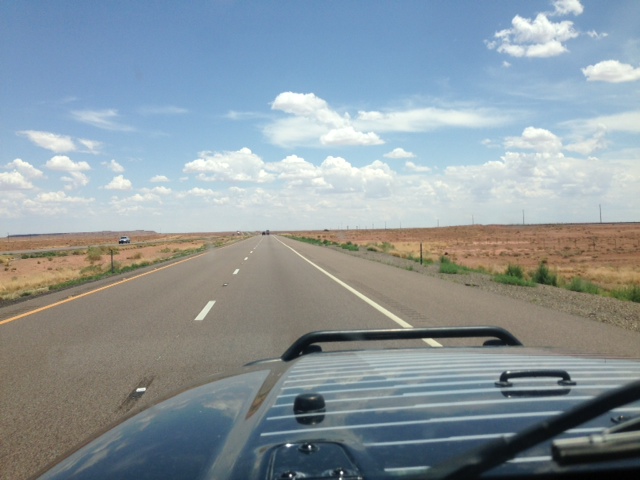
(books on tape and caffeine are highly recommended for long road trips in western states!)
After 2,500 miles through high deserts, forested mountains, windswept prairies, and boggy woodlands – and 190 gallons of gas and one flat tire – I’ve reached my education destination. For the past five years in Nevada, I made a consistent pitch to my colleagues and lawmakers and the governor: “Copy Florida.” Now I live here in Tampa.
Resident Floridians may not realize how well their state actually performs on the education front. You may not even recognize the similarities between Nevada and Florida.
Yes, Nevada and Florida have a very different geography and climate. For one thing, Nevada is the driest state in the U.S., and Florida will receive twice as much rain in July as Nevada gets in an entire year. Florida’s tropical climate is thick with forests, swamps and beautiful beaches. Meanwhile, Nevada occupies the Great Basin and Mohave Desert; a dry desolate place known for prickly Joshua trees, barren mountains and temperatures that soar above 120 degrees.
The landscapes aside, Nevada and Florida share similar public education students and challenges. Both states have a student population that is majority minority today. Student poverty rates and disability rates are also comparable, though Nevada has a larger English language learner population. Nevada and Florida also spend about the same amount per pupil. Interestingly, both states are vacation and retirement destinations with more tourists than residents.
Not surprisingly, education attainment rates were once very similar.
Data from the U.S. Department of Education’s National Assessment of Educational Progress (NAEP) reading exam shows that Nevada and Florida had virtually indistinguishable achievement rates just 15 years ago. That has changed dramatically. While Nevada in the past few years has started to catch up with Florida on math, the Sunshine State has soared past the Silver State in reading. NAEP’s 4th grade reading scores are also a good barometer for education success and graduation rates.
These reading achievement levels are also striking when we zero in on low-income students who are on free or reduced-price lunch (FRL). In the charts below, we compare Nevada and Florida’s FRL students on the NAEP 4th grade reading exam. In this way we examine only the attainment for the most disadvantaged students in both states. (more…)
What, exactly, does "public" mean in "public education" and who decides?
by Gloria Romero
The school-choice movement has just surmounted one of its most pervasive challenges. A unanimous Indiana Supreme Court upheld the constitutionality of that state's voucher program, which makes some 500,000 low- and middle-income kids (or, about 62 percent of its families) eligible for state aid to help pay for a private or religious school. The decision cuts to the core of the most profound education debate: What, exactly, does "public" mean in "public education" and who decides?
The court ruled that Indiana is serving valid educational purposes, both by maintaining a traditional public school system and by providing options to it. In other words, that government's role is to ensure that essential services are available to the people – but the government itself does not always need to be the actual provider.
Thus, with voucher laws such as Indiana's, "public" money follows the "public," which is the family directly – not the "publicly" operated schoolhouse. Hence, families get to choose where to spend the public money: on a schooling choice made by them, or on a schooling choice made by a government official.
Historically, the fight over funding in K-12 public education has been interpreted as the strict allocation of public, taxpayer dollars to publicly operated institutions only. Essentially, this has resulted in the protection of monopoly rights of government-run schools. Students are assigned by government officials to a "local" public school, based on ZIP code. This ZIP code-restricted system has largely given rise to today's parent empowerment movement, where more and more parents – especially in inner cities – have fought back against a system that not only assigns them to a particular school, but restricts them from leaving – even if that school chronically underperforms.
Indeed, few incentives exist to transform these schools, which sometimes seem to operate more as massive public-works programs for adults. Charter schools, open-enrollment policies and parent trigger laws have all been based on the fight for greater parent rights in public education. (more…)
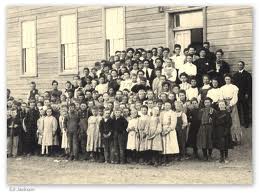
Georgia's first compulsory school attendance law was passed in 1916. Photo from georgiainfo.galileo.usg.edu.
For the last 150 years, we have assumed “public education” meant publicly funded education, but in this new age of customized teaching and learning this definition is too narrow. Today, it’s more useful and accurate to define public education as all learning options that satisfy mandatory school attendance laws, including those that don’t receive public funding, such as private schools and home-schooling.
Education - especially public education - has taken many forms in the United States over the last 300 years. According to Pulitzer Prize winning education historian Lawrence A. Cremin, in the 1700s education encompassed institutions “that had a part in shaping human character - families and churches, schools and colleges, newspapers, voluntary associations, and … laws”, while public education referred to formal instruction in public settings outside the home.
Public teaching became increasingly common in the latter half of the 18th century, and by the early 19th century most communities had at least one free school open to all white children. These free schools, which operated independently much like today’s charter schools, became known as common or public schools. They combined with religious schools receiving public funding to educate the poor to comprise public education. As Cremin notes, in 1813, most New Yorkers saw publicly-funded religious schools “as public or common schools.”
Over the next few decades, public funding for religious schools - most notably Catholic schools - became more contentious and rare. By the mid-1800s, free public schools and public education had become synonymous. Schools not receiving public funds were called private schools, even though they provided public instruction outside the home.
The birth of public education as we know it today occurred during the 1840s and ‘50s. (more…)
 Between 1992 and 2009, the number of public school students nationwide grew by 17 percent while full-time school staff increased by 39 percent, according to a report released today by the Friedman Foundation for Educational Choice. But the extra employees didn't seem to do much good, the report continued, because student achievement nationally is flat.
The report suggests public schools could have saved tens of billions of dollars each year had staffing levels grown more modestly, with the savings plowed into higher teacher salaries, early childhood education or vouchers for low-income students.
Florida's public school student population increased 36 percent over that span, the report points out, while its teaching corps grew by 70 percent.
There's no doubt Florida's class-size reduction amendment, which voters approved in 2002, played a role. Unlike their national counterparts, Florida students have made respectable gains over the past 10 to 15 years, due to many factors that are tough to untangle.
In this era of expanding school choice, the report leaves us wondering: Will public dollars be spent more effectively in a system organized around customization?
More on staff growth in public education at the EdFly Blog and this recent Jay P. Greene op-ed in the Wall Street Journal.
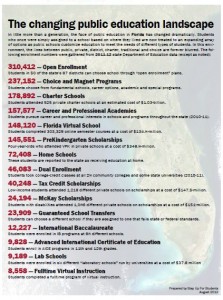 Though we know little about the parents who long have chosen their school through where they decide to live (or to pretend to live), Florida keeps count of those who no longer want their neighborhood school. And here's some data to chew on: In a state known for its breadth of learning options, that number last school year reached 1.2 million.
In other words, using a conservative approach with new 2011-12 enrollment records, 43 of every 100 students in Florida public education opted for something other than their zoned school.
This number is produced largely from state Department of Education surveys required of the 67 school districts and reflects, not surprisingly, surging growth for choice options. Though total public school enrollment grew by only 1 percent last year, reaching 2.7 million, charters grew by almost 16 percent, online by 21 percent, private scholarships for poor children by 17 percent. (See an enrollment compilation of 2011-12 options here.)
Granted, Florida is not like most other states in this regard. A combination of educational, budgetary and political factors, including the gubernatorial tenure of Jeb Bush, has put the Sunshine State on an accelerated path of parental empowerment. That said, it is a diverse, highly populous state with national political significance, and this kind of transformation is central to the new definition of public education.
The national education debate is still absorbed by adults who grew up with a pupil assignment plan built almost entirely on geography. Many of them went to the same schools as their parents and even their grandparents, and it’s natural they would define public education that way. That may help explain why parent activists or groups such as the PTA continue to oblige the teacher unions that pressure them to resist laws giving parents more options. The union message – that traditional public schools are endangered – plays to the parents’ natural fears.
That’s why these numbers are worthy of pause. (more…)

