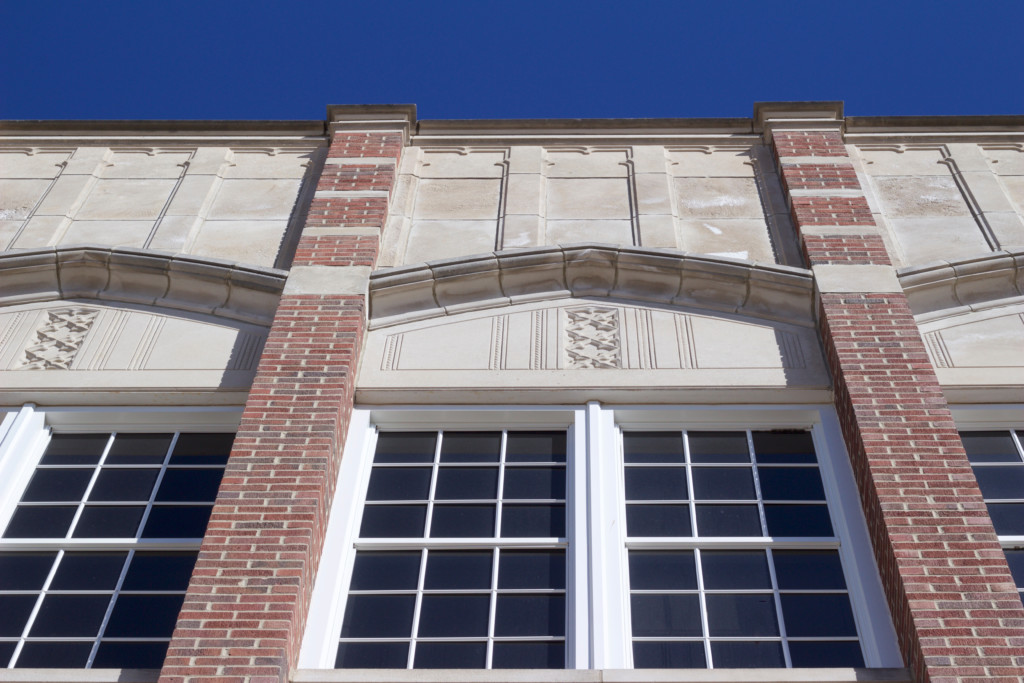
One of several century-old school buildings in Minnesota, where new language is being proposed to the state constitution that would give students "a fundamental right to a quality education."
A member of the “Purple People Eaters” may have retired from the NFL, but he now has a state teacher union on the run.
Former Minnesota Viking defensive lineman and justice of the state Supreme Court Alan Page is among those supporting a change to the state constitution that has philosophical and practical problems, but the idea has elevated an important K-12 discussion and has unions scrambling.
Page and Neel Kashkari, president and CEO of the Federal Reserve Bank of Minneapolis, have drafted a change to Minnesota’s “uniformity clause,” a provision that says the state must have a “general uniform system of public schools.”
Page and other supporters of the amendment argue that the state’s commitment to a system of schools is not enough: “No parent aspires for their child to have an adequate education,” Kashkari and Page told the StarTribune. The system should do more than spend “more and more money and [get] the same poor results,” Page said.
An admirable sentiment, but similar efforts have (appropriately) failed in some state and federal courts. According to local media, the new language gives students a “fundamental right to a quality education,” and the state’s “paramount duty” would be to make sure all children have “the skills necessary for participation in the economy, our democracy, and society.”
Sounds like a lawsuit waiting to happen.
Again, this concept has been considered in court. At the federal level, the U.S. Supreme Court ruled in San Antonio Independent School District vs. Rodriguez that the Constitution does not guarantee a federal “right” to education. Similar cases in Colorado and Wyoming resulted in debates and rulings concerning how much taxpayers should spend on K-12 schools—not a surprise, because if education is a right, then others have a duty to pay for it. And keep paying until terms such as “quality” and “skills” are fulfilled according to someone else’s definition.
Page and his allies introduced this proposal amidst a longstanding discussion of Minnesota’s K-12 achievement gaps. Recently, Kashkari’s office released a report that found the state has “some of the largest gaps in the nation” in academic outcomes such as test scores and graduation rates. The Nation’s Report Card also shows disparities in math and reading between students eligible for free- or reduced-priced school meals (a less accurate measure of poverty than before recent changes to federal meal programs, but an indicator nonetheless) and children from wealthier families. In 8th grade math, the disparity between low-income students and their peers is greater than 30 points.
Meanwhile, unions are looking for dollar signs. In its statement against the proposal, the special interest group said educators are “waiting for funding” and the legislature needs to “fully fund public education.”
The union also says the proposal would “bring our state closer to vouchers,” as though taxpayers and lawmakers should fear giving children more access to quality learning options. Left unspoken is that other state unions have used uniformity clauses to challenge education choice—something Floridians may remember from Bush v. Holmes. A revision to Minnesota’s constitution may force the union to adjust its plan for potential litigation.
The union is resisting meaningful, substantive change, which Page and Kashkari told Minnesota Public Radio that they are hoping for, at least in part. “If some kids need more choices, this amendment can support that,” Kashkari said, and if “some kids need more funding for their schools, this amendment can support that.”
In that case, we should applaud half of the intent, even if the means are flawed. Catrin Wigfall, Policy Fellow at the Center of the American Experiment (based in Minnesota) writes, “While I respect that the conversation on how to solve the gap is at least started by this proposal…[solving] Minnesota’s education achievement gap is more complicated than an amendment change.”
Minnesota is home to the nation’s first charter school law, so if this proposal has taxpayers and policymakers talking about more K-12 learning opportunities, including private options, the conversation is welcome. Making education a right is neither a necessary nor sufficient (nor fitting) condition to give students from all walks of life a chance at the American Dream.
Editor’s note: We’ve made the point many times: Public education shouldn’t be synonymous with public schools and increasingly, in this age of rapidly expanding options, it isn’t. In a new essay, James V. Shuls, the education policy analyst at the Show-Me Institute in Missouri, expertly riffs on that theme, using the moving story of a student growing up in a tough stretch of St. Louis as a hook. Here’s a taste:
Shuls
As a child, Korey attended St. Matthew Catholic Church. In 2001, St. Matthew’s parish opened De La Salle Middle School. The small private school above Big Mo’s barbeque restaurant only had 20 students. Korey did not know what to think about the idea of attending De La Salle. In time, he would come to realize that this decision changed his life. With expected pride, he says, “De La Salle put me on a path to greatness.” This school was diferent from other schools he had attended. Class sizes were small, with more one-on-one attention. His teachers were passionate, not just about academics, but also about character. One in particular, Martha Altvater, pushed him harder than he had ever been pushed. From De La Salle, he earned a scholarship to Christian Brothers College (CBC) High School, a respected private school in Saint Louis County, and then attended Westminster College in Fulton, Mo. In 2012, he graduated with a degree in business administration; sitting in the audience was none other than Martha Altvater.
At a critical moment in his life, Korey had the opportunity to attend either a public school or a private school. He chose to attend the private school. In doing so, he chose the option that best served the public, as well as him. Had he chosen the neighborhood public school, Korey says he “might have fallen in with the wrong crowd and be in jail or dead today.” That has been the fate for many of his friends who attended the public high school. But Korey’s fate was different because he found a school that recognized and developed his potential.
Though it is a private school, De La Salle Middle School serves the public much more efectively than the district-run school, where fewer than half of the students graduate. However, instead of celebrating De La Salle as a venerable public institution, we label it as a private school and deem it unworthy of public funds.
***
This essay should not be construed to say that all private schools are great —they are not. Nor should readers think that I am saying that all public schools are bad — they are not. The point is that all types of schools — district, charter, and private — can effectively serve the public. Right now, however, we have put up an artificial barrier that prevents students from using public dollars to attend the private school of their choice. Never mind that these private schools can, as was the case for Korey Stewart-Glaze, serve the student and the public very well.
Korey Stewart-Glaze’s journey has come full circle. He now recruits students to attend the school that changed his life, De La Salle Middle School. Still, funding makes this a somewhat difficult task. Though the school provides privately funded scholarships to 100 percent of its students, they still have to pay some tuition. This severely limits the number of students the school can serve and creates a barrier for many families who simply cannot bear the cost. Our narrow definition of public education prevents De La Salle from receiving state dollars and prevents more students from experiencing the life-changing moment that Korey had. It is time we redefine public education. It should no longer mean assigning students to a specific type of school, regardless of quality, but rather that we provide access to a quality education, regardless of the type of school delivering that education.

