As communities across the country rekindle decades-old battles over racial integration, education reform advocate Chris Stewart argues that other efforts to improve schools and create new options for parents shouldn't take a back seat.
Most black parents are realists. There is no evidence that perfect integration will occur soon, but our kids need an education today. With this in mind, it is unnerving to see integration fundamentalists criticizing policies aimed at educating our kids where they are. To them, reforms that assist marginalized communities are a consolation prize for our failure to achieve an idealized picture of Martin Luther King Jr.’s dream community. To us, they’re an imperfect but ultimately useful pathway helping us to navigate our kids through a racist society.
What if the supposed beneficiaries of public school integration aren’t actually pining for it? There is a long line of black intellectual thought that questions the primacy of integration as an educational goal and as a means of cultural health for black children.
W.E.B. Dubois said: “The Negro needs neither segregated schools nor mixed schools. What he needs is Education. What he must remember is that there is no magic, either in mixed schools or in segregated schools. A mixed school with poor and unsympathetic teachers, with hostile public opinion, and no teaching of truth concerning black folk, is bad.”
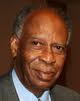
Rev. Matthews
The Rev. H.K. Matthews, 84, was beaten by white police in Selma, jailed more than 35 times and blacklisted from jobs for not backing down. So when he says expanding school choice and civil rights go hand in hand, his words carry the weight of someone who's been there. The west Florida icon sees no inconsistency in an agenda that puts support for vouchers, tax credit scholarships and charter schools on the same list as protesting police brutality, integrating lunch counters and ensuring equal opportunity in the work place.
“It has always been my contention that if a parent felt that his or her or their child was not being adequately educated in one school in the public school system, that they should have the opportunity or the choice of moving that child to a school where it would be more beneficial,” Matthews said in the redefinED podcast attached below. “If you’re being forced to keep your child in a school where he or she is not learning, that is doing nothing but crippling that child.”
As the nation pauses today to celebrate Martin Luther King Jr., we thought redefinED readers and listeners should hear from Matthews. Now living in Alabama, he is a diehard for Florida’s tax credit scholarship program and Step Up For Students, which administers the program and co-hosts this blog. In 2010, when more than 5,000 students and parents marched in Tallahassee for an expansion of the program, Matthews was in the front row.
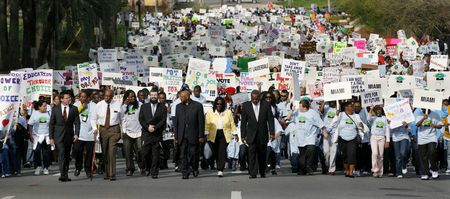
Rev. Matthews was among more than 5,000 people who rallied in Tallahassee in 2010 to support school choice. He's in the front row on the left, walking with a cane.
He remains an activist for other causes, too. Last month, he participated in a "rally for justice" stemming from the controversial arrest of a 27-year-old mom in a Wal-Mart. And in 2011, members of the Occupy movement asked him for advice. They gathered around him as he offered this nugget: “They said I was an agitator. But if you look at a washing machine, it’s the agitator in the middle that gets all the dirt out.”
Here are some highlights from the podcast:
On what Dr. King might think of school choice: “Knowing him as I knew him, and knowing his desire and his fire for people having a right to choose, my feeling is he would support school choice. Because he was always for the rights of individuals. Not barring any particular race, not barring any particular origin or religion. But he just felt that people should have a right, I think, to be free, to express themselves, and to go where they wanted to go. And to go to places that would be more beneficial to them.” (more…)
by Alan Bonsteel
In 1954, the U.S. Supreme Court decision in Brown vs. Board of Education ended the "separate but equal" racial segregation of the south. In 1962, Milton Friedman's book, Capitalism and Freedom, for the first time advocated school vouchers.
Although the two events were separated by only eight years, hardly anyone at the time saw them for what they were -- two very different visions of achieving quality education for all, one through compulsion and coercion, and the other through freedom of choice, including the liberty to choose religious schools. In 1954, the conventional wisdom of the news media was that the Brown decision would, in time, mean equal education for our minorities. And in 1962, hardly anyone other than the visionary Friedman himself could foresee when many people throughout the U.S. would come to believe in school choice as a fundamental human right. Few people in those days would have bet on Friedman's vision emerging triumphant.
But consider where we are 57 years after Brown:
At a time when the public schools are widely perceived in areas as being overly segregated, and the black middle class has experienced a unique growth through those that are single and living alone rather than through families, the notion that our public schools are capable of achieving racial equality in education now seems almost quaint. By contrast, our schools of choice, whether private or charter, have greater opportunities for better integration and offer a superb education to minorities. Further, the racial integration in those schools exists on a far deeper level than a simple counting of whites versus minorities would suggest.
In 1998, researcher Jay P. Greene authored the study, "Integration Where it Counts." In it, he and his associates secretly observed whether students of various races in public and private schools sat next to each other in their lunch rooms. He found that in private schools, students of varying races were far more likely to sit next to each other than in public schools.
Further, private religious schools outperformed private non-religious schools. Greene hypothesized that the mission of the religious schools -- of teaching that we are all children of God -- played a role. To take this thought to the next higher plane, it is the difference between teaching that racial equality is endorsed by the local school board versus loving thy neighbor as thyself being God's will.
The American Center for School Choice, of course, has taken on a special guardianship of private religious schools, and the results of Greene's study, now more than a decade old, will come as no surprise to our members. Freedom of religion -- including the right to choose a religious school -- is a fundamental human right, even without any need to demonstrate tangible benefits. But it is certainly gratifying when religious freedom and tolerance can be shown to produce worldly benefits to our children and our communities.
The notion that the public school establishment, operating through compulsion and coercion when assigning most students to school, can bring about racial equality in education has now been decisively thrown on the scrap heap of history, and, in fact, no one is now advocating any credible way out of the damage that has been caused to minorities other than through school choice.

