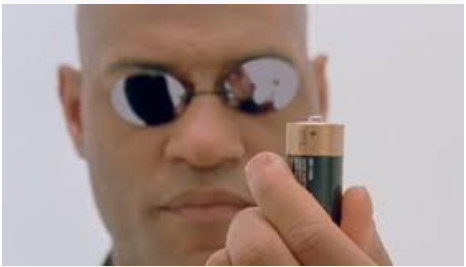
 In the film “The Matrix,” Laurence Fishburne’s character, Morpheus, explains to the protagonist that the world he perceived himself to be living in actually had been a neural computer simulation. Humanity had lost a war against its own artificial intelligence mechanical creations years before. Human beings were grown captive in tanks, kept under control by a system known as the Matrix, and used as batteries.
The film’s final scene and credits roll to a song by Rage Against the Machine called “Wake Up.”
Last week, American Federation of Teachers president Randi Weingarten gave an interview on MSNBC. Host Stephanie Ruhle posed this scenario for Weingarten’s comment:
We know that there are kids living in cities in this country where those cities and those schools are not serving them. If you live in an inner city and you’ve got kids, your best chance for economic mobility for your child is through a great education, and there are schools that are not serving our kids.
Weingarten responded:
And those schools need to get fixed like we did in New York City.
New York City schools may have been “fixed,” but this raises the question, “fixed for whom?”
Weingarten’s organization virulently opposed the education reforms of former Mayor Mike Bloomberg, who left office in 2013. Since 2013, New York City has been run by American Federation of Teachers ally Mayor Bill de Blasio. Have New York City Schools been fixed since 2013?
Fortunately, New York City is one of the districts included in the Trial Urban District Assessment of the NAEP. The chart below looks at trends for black and Hispanic students since 2013. On these tests, 10 points approximately equals a grade level’s worth of average progress.
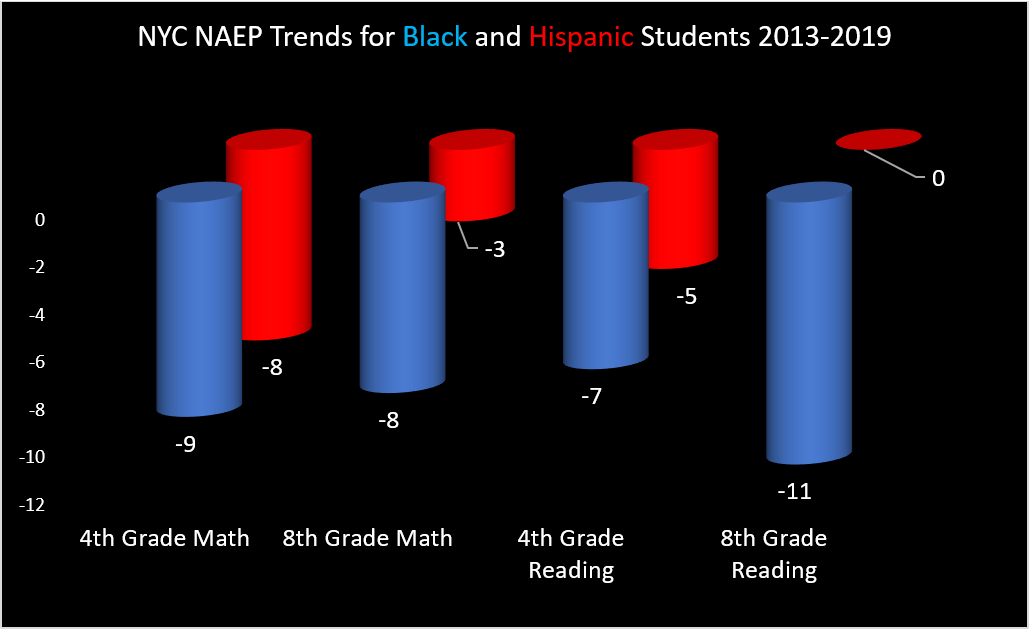
Most of both groups of fourth graders scored “Below Basic” on the 2019 fourth-grade reading exam. The schools clearly are not “fixed” for the sort of students in New York City that Stephanie Ruhle asked Weingarten about in the interview.
In fact, the schools needed improvement in 2013, and then got worse rather than better. If New York City schools have not been fixed for students, for whose benefit have they been fixed? The United States Census Bureau offers a telling clue:

Weingarten’s confusion is understandable, but New York City schools have not been fixed for all students. Rather, they look to have been rigged for her organization and others.
Wake up, New York.
 Education spending: The Senate Appropriations Committee approves a bill that would spread federal Title I funding to more schools, including charters, and give districts less control over the grants. Gradebook. The committee also approves a bill that would automatically put teachers and other public workers into a 401 (k) investment program instead of the state's pension plan if they fail to choose a retirement plan option when hired. News Service of Florida. Politico Florida. Two bills (S.B. 1314 and S.B. 902) that would increase eligibility and funding for private school choice options also are approved by the committee. redefinED. Politico Florida.
Legislative effects: Duval County school officials say the district may have to close schools as a result of decisions made in the Legislature this year. They've called a community meeting tonight to discuss how the Legislature's decisions could affect the district. Florida Times-Union.
Budget discussions: As mostly secret state budget negotiations continue, the Senate approves the placement of a constitutional amendment on the 2018 ballot that would increase the nonschool homestead exemption by $25,000. The Senate's appropriations committee also approves a three-day back to school tax holiday. Because there's a 72-hour "cooling off" period required, the budget must be finalized today in order for the Legislature to end as scheduled Friday. Politico Florida. News Service of Florida. Associated Press. Tampa Bay Times. Sarasota Herald-Tribune. News Service of Florida.
Federal budget impact: The impact of President Trump's budget would be devastating to south Florida schools, American Federation of Teachers president Randi Weingarten says at a rally. Miami-Dade County could lose $21.6 million for after-school programs, she says, and teachers could lose $17 million for professional development. Miami Herald. (more…)
Superintendent elections: Rocky Hanna soundly defeats incumbent Leon County School Superintendent Jackie Pons. Tallahassee Democrat. WFSU. Addison Davis is elected superintendent in Clay County. Florida Times-Union. Putnam County voters choose Rick Surrency as superintendent. Florida Times-Union. Kathy Burns is elected superintendent of Nassau County. Florida Times-Union. Malcolm Thomas wins a third term as Escambia County superintendent. Pensacola News Journal. Russell Hughes is elected superintendent for Walton County schools. Northwest Florida Daily News. Bill Husfelt is re-elected superintendent in Bay County. Panama City News Herald.
School board elections: School board results from around the state. Pinellas. Hillsborough. Hillsborough. Hernando. Miami-Dade. Orange. Lake. Lake. Palm Beach. Duval. Brevard. Lee. Polk. Polk. Indian River. Martin. Manatee. Manatee. Manatee. Flagler. Citrus.
School tax elections: Results of state school tax initiatives. Pinellas. Osceola. Palm Beach. Palm Beach. Manatee. Manatee. Alachua.
Retention rules: The Florida School Boards Association is lobbying legislators to clarify the law regarding the retention of third-graders. The group wants clearly defined promotion alternatives for students that consider both testing and achievement, an end to the reliance of a single testing result to determine retention, and local control over promotion decisions. Gradebook.
New superintendent: Tim Forson is picked by the school board to be the new superintendent of the St. Johns County School District. Forson, who retired last spring as deputy superintendent of operations after 36 years in the district, was the unanimous choice over Vickie Cartwright, who is the senior executive director for exceptional student education for the Orange County School District. Forson takes over Jan. 4 for the retiring Joe Joyner. St. Augustine Record. Florida Times-Union. (more…)
Testing. A computerized testing SNAFU leads to a painful ordeal, then a cheating accusation, then a firing, for an elementary music teacher. Tampa Bay Times.
Elections. American Federation of Teachers leader Randi Weingarten says Donald Trump seeks the "decimation of public education." Florida Politics. A retired teacher ventures into a state House race, challenging a heavily favored Republican incumbent in a conservative district. Sarasota Herald-Tribune. A civics teacher uses campaign season to bring class to life. Orlando Sentinel.
Collective bargaining. Rising health insurance premiums complicate labor negotiations for Indian River County teachers. TC Palm.
Charter schools. Pepin Academies, a charter school for children with special needs, offers programs to help older students get jobs. Tampa Bay Times.
Lead in drinking water. "We are not Flint," a professor who detected excessive lead levels in two Leon County schools' water systems says. Tallahassee Democrat. The district plans to create a Water Quality Assurance program. Communication needs to improve, the Democrat editorializes. The district is following EPA guidelines, a school board member writes. (more…)
Weatherford
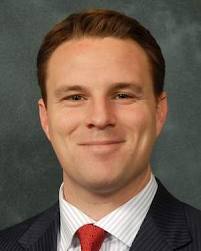
Earlier this year, during the last week of Florida's legislative session, House Speaker Will Weatherford stood in the rotunda of Florida's Capitol, posing for pictures with student activists who thanked him for helping push through a bill that had divided legislative Republicans. Earlier that day, the Senate had teed up a vote to grant in-state tuition to immigrants who had come to the country illegally as young children.
The activists, many of them Latinos, were now posing for pictures with the Republican Speaker, who, still in his thirties, may have a long political career ahead of him and who, at the same time, was helping to push separate legislation to expand school choice. It was possible in that moment to imagine the self-described acolyte of Florida's "education governor" rebuilding a more diverse, right-of-center coalition like the one that helped Florida elect two Bushes but frayed in two straight presidential elections as the state backed Barack Obama. It was possible to see him laying the groundwork for an equal opportunity platform in which education would be a key plank.
This week, it also became possible to envision Democrats seizing that mantle – if they can resolve their own internal feuding enough to beat Republicans to it. The timing turned out to be ideal for “Dem Divide,” a series of redefinED posts that explored Democrats’ current divisions on ed reform and parental choice – and ways they might be overcome.
As Dana Goldstein noted last Sunday on MSNBC, "the politics have changed."
The Obama administration is at odds with the two major teachers unions on charter schools, teacher tenure and other issues, with tensions that trace back to the 2008 campaign, when the unions supported Hillary Clinton. But, as Goldstein suggested, Clinton may be preparing to triangulate toward an embrace of charter schools, too, as her husband already has. Why? Because from New York to Indiana to Florida, the news is increasingly Dem vs. Dem.
It’s worth recapping what the voices in the redefinED series had to say about it.

Terry Moe
Editor's note: This is the first of four guest posts on the future of teachers unions.
At the heart of any discussion of the unions’ role in American education, whether that role is now or in the future, lies a fundamental dilemma. On the one hand, it is clear that teachers are the key determinants of student achievement, that they are the experts on teaching, and that, if human capital is to be organized in the best possible ways for educating children, teachers need to have systematic input when decisions are made. They also need to be involved in the implementation process as decisions get translated into action. The teacher unions - which represent teachers and provide the key means of coordinating their behavior toward agreed-upon ends - would therefore seem to have very positive roles to play in both the making and implementation of education policy.
There is, however, an on the other hand. And herein lies the dilemma. Teachers join unions to protect and promote their occupational interests as employees: in job security, in better wages and benefits, in restrictive work rules. These job interests - which are the core interests that motivate union behavior - are simply not the same as the interests of children or the requirements of effective organization. Throughout the modern era, as a result, the teacher unions have often used their political power to block or weaken major reform efforts - efforts that would expand school choice, evaluate teachers based on performance, pay teachers with some reference to performance, move bad teachers out of the classroom, and more - because these reforms are threatening to the jobs of their members. Similarly, the unions have used their power in collective bargaining to impose work rules - seniority based layoffs and transfers, restrictions on teachers assignments, onerous evaluation and dismissal procedures, and the like - that are not designed to promote effective organization, and indeed are perverse and counterproductive.
So the dilemma, to state it simply, is that teachers are enormously important to the effective organization of schooling, and their involvement in decision making and reform makes eminently good sense - yet when teachers are organized into unions, the teacher unions use their power to promote the job interests of their members rather than the best interests of children, and this often leads them to undermine effective organization and stand in the way of reform.
That there is a dilemma here is not a secret. Indeed, over the last decade or so, this problem has increasingly become a topic of concern within the reform community, particularly among the growing numbers of liberals, moderates, and Democrats who - while supportive of teacher unions and collective bargaining in general - are now critical of the teachers unions for being obstacles to reform and effective schools.
The widespread view among this crucial group of reformers, however, is that there is a solution to the problem. The solution is reform unionism: which rests on the belief that, with enlightened union leadership (think Randi Weingarten) and sufficient pressure from the outside (think Race to the Top’s “union buy-in” requirement), the unions can be expected to change their behavior - to stop blocking reform, to stop imposing restrictive work rules, and to actively embrace whatever approaches to schooling are best for kids. In a world of reform unionism, then, union power is not a problem and indeed can be welcomed and embraced - because the unions will use their power in the best interests of children and quality education.
This belief is a way of squaring the circle for those who see unions and collective bargaining as essentials of the good society. But in the hard light of reality it is fanciful and misguided, and it prompts reformers to look for solutions where they don't exist. (more…)

Blanton
Rick Scott’s education plans. The Orlando Sentinel leads with Scott’s proposal to issue state-funded debit cards to teachers so they no longer reach into their own pockets to pay for school supplies. More from WINK News, Fort Myers News Press, Palm Beach Post. The Florida Democratic Party had a negative reaction, but Scott’s plan generated mostly positive comments, including from the Florida PTA, Sen. Bill Montford of the Florida superintendents association and Wayne Blanton, executive director of the Florida School Boards Association. According to the Associated Press, Blanton “endorsed (Scott’s) recommendation to lift a cap on charter schools with a caveat — as long decisions to create new charters are left to local school officials. ‘An open-ended lifting of the cap may be more than we need,’ Blanton said, adding that districts are having a hard time keeping up with the growth of charters.”
More charter school payout. The principal of NorthStar High School, the charter school whose board paid her more than $500,000 as the failing school was shutting down, consumed the lion’s share of the 180-student school’s funding last year, the Orlando Sentinel reports. "I have never seen an act that egregious in 15 years of working with charters," said State Rep. John Legg, R-Port Richey, a charter school business administrator.
Teachers union bus tour. The AFT bus tour in support of President Obama is rolling through Florida. According to a press release, it's hitting Tampa, Daytona Beach, Ormond Beach, Orlando, Miami, Fort Lauderdale and West Palm Beach. AFT President Randi Weingarten is aboard. More from the Hechinger Report.
After spending time at the Republican convention in Tampa and the Democratic convention in Charlotte, I needed to decompress, so I headed to Montana where I am now sitting on a hill watching a herd of deer graze in the meadow below. These deer have no funny hats on their heads, buttons on their chests or noisemakers in their mouths. They seem peaceful and, as best I can tell, nonpartisan. I’m a little jealous.
I was fortunate to speak with lots of smart and interesting people at both conventions, but I’ve decided the most intriguing speaker, other than Bill Clinton, whose speech seems to have ended the suspense over whether President Obama will be re-elected, was Daniel Barnz, the director of the new education movie, Won’t Back Down. Barnz spoke after a screening of his movie at both conventions. Each time, he expressed bewilderment that his movie is being attacked as anti-teacher and anti-public education.
Even before the movie was released to the general public, AFT president Randi Weingarten sent out an open letter accusing Barnz of “using the most blatant stereotypes and caricatures I have ever seen.” She asserted the movie “is divisive and demoralizes millions of great teachers,” although she neglected to explain how these millions of teachers could be demoralized by a movie neither they nor the general public have seen.
Barnz comes from a family of public school teachers. He wanted to make a fictional movie about teachers and parents working together to improve a struggling school. His sin, at least from Weingarten’s perspective, is that the teachers and parents in his movie saw freeing themselves from the control of the teachers union as essential to their improvement efforts.
Barnz’s fantasy of a community of empowered teachers and parents working collaboratively to raise student achievement, and Weingarten’s vitriolic response, illustrate the power struggle at the heart of today’s efforts to improve public education. (more…)
 Andy Ford, president of the Florida teachers union, has done his darnedest to kick out many of the Republicans who continue to run both the executive and legislative branches in this state, and they don’t usually take a shine to his approach. Just the other day, Ford bought a two-page ad in Florida Trend, a leading business magazine, to proclaim: “IT’S MIDNIGHT IN FLORIDA. Do You Know Where Your Public Education Dollars Are Going?” He added: “The foundation of public education in the Sunshine State is devious, unreliable and crumbling before our very eyes.”
Given all that, you’d think Ford would be in a better mood at the Democratic National Convention in Charlotte. And you’d think he’d especially appreciate the speech from U.S. Education Secretary Arne Duncan, who spent much of his time criticizing Mitt Romney for gutting education spending “to cut taxes for millionaires and billionaires.” Even American Federation of Teachers President Randi Weingarten found some reason for cheer, tweeting, “Duncan: "teachers matter" and "no teachers should have to teach to the test"-very different from Romney/Ryan/Rhee agenda.”
Was Ford moved, too? Not so much. As the secretary wrapped up, he tweeted six words: “Glad Duncan is off the stage!”

