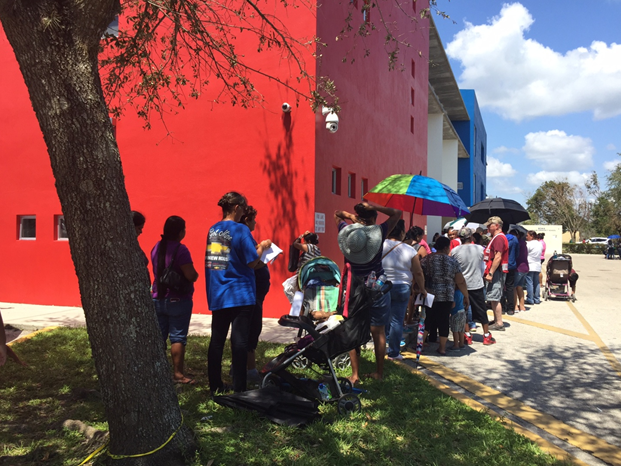
Residents in Immokalee stand in line waiting for food and water. Immokalee Community School officials helped feed families after the storm. Photo credit: RCMA
Juana Brown describes scenes that unfolded the storm-ravaged farming community of Immokalee, Fla.
A woman pleaded for help as she stood in a long line with her eight-day old baby after Hurricane Irma devastated the small town, 50 miles inland from Naples.
“I don’t have work,” the woman said. “I am ready to go back to work.”
Originally from Guatemala, she had been working in the fields when she went into labor days before Irma struck. The storm destroyed the trailer where she lived with her seven-year-old daughter, who is visually impaired. She waited for hours in the blazing sun with more than 700 other displaced residents. Many had lost their homes and sought federal emergency aid.
Brown is the director of charter schools for the Redlands Christian Migrant Association. It runs the Immokalee Community School, a charter school devoted to migrant families, where many storm victims turned for help.
A teacher began collecting diapers. School officials collected water to distribute to residents. Other staff members signed up as community volunteers. The school has helped feed more than 800 people in one day in the storm's aftermath. With the help of other community organizations and staff from U.S. Sen. Marco Rubio’s office, it's helping residents apply for FEMA assistance.
In short, the Immokalee Community School has joined other organizations to help this farming community of just more than 24,000 recover from the storm.
“This is part of RCMA’s mission,” Brown said. “We talk about opening doors of opportunity for the community. We have very intentionally located ourselves in communities. The organization was founded by Mennonites. What they saw as they came into the community is it was not about us doing for them. It was about making sure the community is part of the work we do. We are part of the community where we are located. Each of these communities are our communities.”
RCMA mostly serves children in rural poverty, and the majority are children of Hispanic immigrants. It has three charter schools and 71 learning centers in 21 Florida counties.
At least 38 percent of Immokalee residents are migrants. Many are undocumented. That complicates their efforts to get help after the storm.
The woman Brown described did not have a social security number, which is required for FEMA assistance. The woman’s daughter is a U.S. citizen. But rounding up the necessary paperwork proved difficult in a community with limited gas and electricity. Even under ideal conditions, many residents rely on bicycles for transportation.
But people at the school did not want to leave the woman without aid.
After much searching, and with help from Rubio’s office, they found the paperwork to get the woman's daughter signed up for Medicaid.
Widespread devastation (more…)
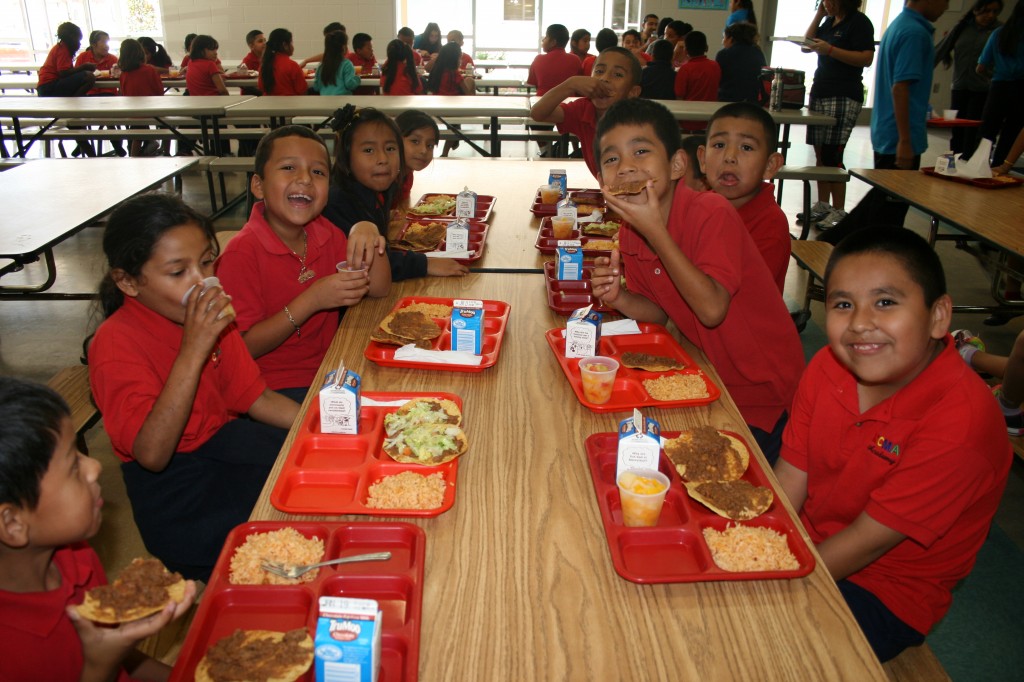
Second-graders at the Academies of RCMA in Wimauma, Fla., enjoy a favorite for lunch: tostadas. It's the little things that help school leaders forge bonds with the children and their parents.
As dusk settled on the Academies of RCMA, students sat in classrooms while more than 150 moms and dads filled long tables inside the cafeteria.
It was Parents Night at the Wimauma charter school and even though many worked all day picking crops in nearby fields, they stayed for the whole hour.
Teachers and administrators at the coveted school say they have more freedom than most traditional public schools to develop programs that address the needs of their mostly Hispanic population.
More than 150 moms and dads come to Parents Night, where they learn how to help their children - and themselves.
But the school doesn’t limit its help to students. Founded by the Redlands Christian Migrant Association, it’s committed to reaching out to parents, as well.
“They know they struggle,’’ said Marcela Estevez, the academies’ parent liaison and director of student affairs. “They work hard. But they know the school. They rely on the school.’’
More than 80 percent of RCMA’s 258 middle and elementary students live in households headed by single moms, and 35 percent to 40 percent are from migrant farmworker families, Estevez said. Practically every child qualifies for free breakfast and lunch.
RCMA, which is located behind the Beth-El Farmworker Ministry, focuses on students’ basic needs first, such as food and clothing. Then the goal is on acclimating them to English while still celebrating their culture, said Mark Haggett, director of the academies.
It takes creativity and ingenuity, Haggett said. RCMA receives about $5,300 in state funding for each student – a few thousand less than district schools get once construction costs are considered. To make up for it, the school actively seeks donations. (more…)

