Around the state: Gov. Ron DeSantis spoke in Okaloosa to highlight legislation that ends the FSA test in Florida, metal detectors are being implemented in Broward and Polk officials seek answers to their district survey. Here are details about those stories and other developments from the state's districts, private schools, and colleges and universities:
Broward: Officials in the school district here have begun using metal detectors to screen students for weapons. The district says trained security staff are using handheld wands to do random searches in classrooms. Superintendent Vickie Cartwright says the policy is meant to address a recent increase in students bringing weapons to schools. WLRN. WPLG. CBS Miami. NBC Miami.
Hillsborough: St. Joseph Catholic School in west Tampa is celebrating its 125th birthday this year. It began in 1896 under a different name and location as a school for the children of cigar workers, and grew along with the city. The school remains dedicated to the Roman Catholic faith as well. Tampa Bay Times.
Lee: Students at Cypress Lake High participated in hanging up "inappropriate" signs in the school's empty courtyard. The signs were hung up for a few minutes and then were taken down after students took photos and posted them on social media. Fox4Now.
Polk: Officials here are conducting the district's annual survey of students grades 4 and higher, employees, their families and the community to make improvements where needed. Lakeland Ledger.
St. Johns: Longtime school board member Bill Mignon said he plans to step down from his position at the end of his term later this year. Mignon has represented District 3 for 16 years, and is ready to retire. News4Jax.
Okaloosa: At Florosa Elementary School on Thursday, Gov. DeSantis celebrated the new state law that will see the FSA, or Florida Standards Assessment, replaced with a progress monitoring system called Florida's Assessment of Student Thinking, or FAST. NWF Daily News. WEARTV.
COVID relief dollars: Schools are struggling across the country to spend their COVID-19 relief dollars as quickly as planned. Their efforts are running up against a national labor shortage and supply chain issues, making it difficult to hire tutors or renovate dilapidated buildings. Chalkbeat.
State budget: Legislators earlier this week approved a $112.1 billion budget that includes $24.3 billion for K-12 education, and must be approved by Gov. DeSantis before going into effect on July 1. But on Thursday, Gov. DeSantis said the budget might be too generous in some areas. WUSF. While the state Legislature carved out $800-million for pay hikes for Florida's public school teachers, veteran teachers may or may not get a fair deal, and some teachers who are just starting their careers may not get $47,500, a starting pay initiative backed by Gov. DeSantis, according to union leaders and educators. Florida Phoenix.
Parental rights bill: Sen. Ileana Garcia, a Miami Republican who faced national criticism while debating a contentious bill in the Legislature, apologized on Thursday to anyone who was offended by what she said when arguing why she supported the parental rights in education bill. Miami Herald. Florida Politics. Meanwhile, several associations of Florida mental health professionals issued a joint statement Thursday condemning legislation that would limit instruction about gender identity and sexual orientation in schools, saying it could be harmful to the mental health of students. Florida Today.
Fashion forward: An Old Navy ad you may see on TV was inspired by a Creekside High School senior. Florida Times-Union.
Masks off: Masks are now optional for all students, teachers and staff at Catholic schools run by the Archdiocese of Miami, regardless of their vaccination status, the Archdiocese announced this week. Miami Herald.
School violence: A survey of teachers, school social workers, administrators, school psychologists and staff looked at incidents of violence and harassment toward school personnel. NPR.
University and college news: For some college students, mental health challenges create a common barrier that can prevent the completion of a degree. LEAP Tampa Bay, a network of more than 60 organizations that helps adults complete their post-secondary education, created a website designed to change that. Tampa Bay college students can go to YourCollegeCares.org to find campus mental health resources, informational sites and crisis hotlines. Tampa Bay Times. University of South Florida's 50,000-student university system is going to see historic funding from the Legislature this year. USF is slated to received $75 million from the state budget for a new science building on its St. Petersburg campus, along with millions of additional dollars for cybersecurity and nursing. The Legislature passed the budget, and it now moves along to Gov. DeSantis. Tampa Bay Times. Meanwhile, at University of Central Florida, there are student organizations on campus that get little to no funding from student government. Orlando Sentinel.
Opinions on schools: Cherie Sanders of Fort Lauderdale says when her public school officials failed to fully intervene to stop another student from bullying her daughter, she turned to the Hope Scholarship and got her child into another school. Step Up for Students, which hosts this blog, helps administer the scholarship. reimaginED. Remote learning is hard to love. The nation's forced experiment in online education over the past few years has been a disaster for kids. It's also assumed to widen achievement gaps. Robert Pondiscio, Education Next. The danger of HB 7, also known as Stop W.O.K.E. (Stop Wrongs to our Kids and Employees), which passed in the Legislature and is expected to be signed by Gov. DeSantis, is that companies will stop offering such training to avoid lawsuits. Randy Schultz, South Florida Sun Sentinel.
 Nearly a year after the COVID-19 pandemic began and reshaped the nation’s education system, parents of private and charter school students are more likely to be satisfied with their schools and less likely to report a negative effect on learning than their public school counterparts. That’s a key finding in the latest survey from Education Next.
The survey was conducted by Michael B. Henderson of the University of Louisiana, and Martin West and Paul E. Peterson, both of Harvard University. The researchers surveyed 2,155 American parents with children in grades K-12 in December, examining parental satisfaction as well as the impacts of remote and hybrid learning on students since the pandemic started.
As with the last survey in September, parents expressed general satisfaction even as their children are learning less. Private school students continue to be more likely to receive in-person instruction, where parents are more likely to report lower levels of learning loss and lower negative impacts on the student’s social, emotional and physical well-being. Overall, parents are generally satisfied with schools (71% district, 73% charter and 83% private). Private school parents are more likely to be very satisfied – 55% – compared to 35% for charter parents and 25% of district parents.
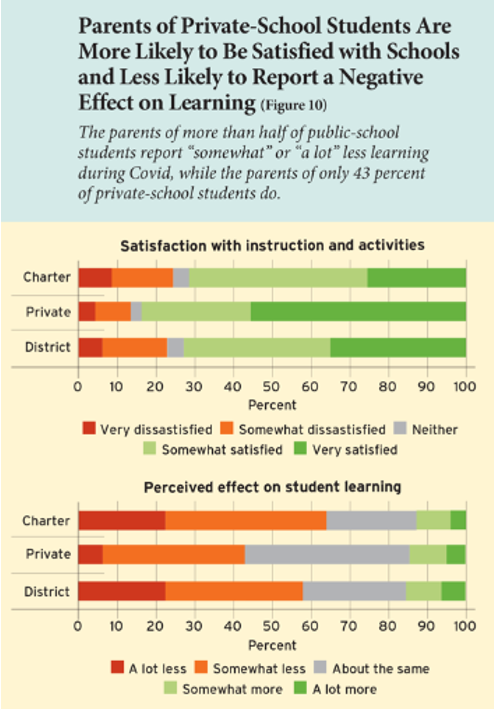
Just 18% of private school parents reported their children were learning remotely, compared to more than half for district and charter school students.
Despite this broad satisfaction across sectors, 60% believe their children are learning less than they did before. In-person learning was closely related to higher reported satisfaction and lower reported learning losses.
A small difference exists between sectors regarding impacts on “student’s academic knowledge,” with 38% of district parents reporting negative impacts to 30% of private school parents. A similar 8-point difference was observed for parents reporting negative effects on their child’s emotional well-being.
Parents do report significantly higher negative impacts on their child’s social relationships and physical fitness at district and charter schools compared to private ones.
Private schools offering remote learning do lag behind their counterparts for teachers meeting with the entire class, but there’s little difference on one-on-one teacher student meetings. Remote private schools also lag behind on weekly homework assignments (84% of parents report weekly assignments) compared to district schools (93% of parents report weekly assignments).
The survey also makes several interesting observations.
While district enrollment fell 9 percentage points between the Spring and Fall of 2020, researchers found it had little to do with the school districts’ response to the Covid pandemic.
Just 10% of new private school students and 14% of new charter school students switched due to dissatisfaction with their prior school’s response to Covid. However, among new home school parents, 61% were dissatisfied with their prior school’s response to Covid.
Meanwhile, 32% of private school parents and 19% of charter parents were dissatisfied with their prior school in some way. Parents were more likely to switch schools because of moving or because their prior school no longer offered the child’s grade level.
Covid safety appears to be roughly similar across sectors. While private school students are far more likely to attend school in person, parents across all sectors report incidents of Covid infections at roughly the same rate. Parents also equally report their school sector is doing “about the right amount,” when it comes to Covid safety measures.
Another discovery was the rate at which parents utilized in-person learning when compared to local Covid infection rates. Counties in highest quartile of infection rates offered more in-person learning options than counties with the lowest options.
Despite noting this “perverse result,” researchers also state that the observed result does “not constitute evidence that greater use of in-person learning contributed to the spread of the virus across the United States.”
Despite children learning less, parents are generally satisfied across all school sectors.
 Editor’s note: This commentary from Nick Sheltrown, chief learning officer of National Heritage Academies, a network of more than 80 charter schools serving more than 59,000 students in nine states, first appeared on Education Next.
The disruptive influence of pandemic-related school closures on student learning may serve as a catalyst for much-needed shifts in how we think about how much time we devote to learning. Decades from now, we may look back at this period as we do with the launching of Sputnik in 1957, as an event that spurred innovation in new and productive directions. The reason for this optimism lies in the lessons we are uncovering around instructional time.
In the early 1960s, psychologist John B. Carroll was studying second language acquisition when he noticed that subjects in his study were all able to master the language content, but the time they each needed to do so varied greatly. This experience led Carroll to develop a model of learning that featured the importance of time as the key variable. In Carroll’s formulation, student learning is a function of time spent learning divided by the time needed for learning.
Carroll also identified other factors like student aptitude, background knowledge, and quality of instruction as influential in the amount of time needed for learning. This may not seem revolutionary now, but Carroll’s articulation of the relationship between time and learning was highly influential.
What does this have to do with the Covid-19 pandemic and American education?
The fundamental problem Covid-19 has introduced a dramatic loss in the quantity and quality of instructional time across the American educational landscape. With students and teachers physically separated and schools scrambling to design and deliver remote learning to students, policymakers and parents alike are concerned with the potential learning gap that the Covid-19 closures cause, particularly for at-risk learners. It is unlikely that the typical school will be able to match the quality of its face-to-face learning in remote delivery.
At the same time, the wide-scale closure of school buildings presents a unique opportunity for K-12 educators to undergo a quantum leap in the development and delivery of learning to students. Schools are being forced to innovate at scale. If schools learn how to deliver remote learning well as a response to this crisis, what is stopping them from doing so during the summers and snow days? Why not create a mastery-based learning plan for every student that includes learning throughout the calendar year—a true mix of in-school and remote learning? Instead of driving a loss in learning time, perhaps the lessons we are learning now can help unlock more time than ever before.
These aspirations may seem countercultural for American educators and families, but this mindset change is critical for U.S. education. Seventy years of achievement data have shown that there have never been enough learning hours in US school calendars to close achievement gaps for at-risk learners.
The real opportunity of this pandemic is to break the monopoly school buildings and school calendars have on our collective mental model of delivering learning experiences to children. The idea of seasonal, location-centric learning is not compatible with the needs of a 21st century economy. Nor is it compatible with the realities of achievement gaps or global competition, not to mention hurricanes, polar vortexes, and—of course—pandemics. If American educators, parents, and students see learning as a continuous activity that occurs throughout the year, at home and at school, and supported by both parents and educators, there is reason to believe that this difficult period will mark a positive inflection point in education in this country.
This is not to say that extending learning time through remote learning will be easy. Certainly not. Educators, parents, and students around the country can attest to the many challenges of remote learning, amid competing demands of remote work, remote caregiving, and for many, unemployment and financial strain. Pedagogical, safety, privacy, and technical challenges have slowed ambitious educators and parents looking to provide robust remote learning experiences to students. Challenges around access persist, with too many families living without broadband Internet or enough devices for their children to use.
Even so, it is still possible to serve students without digital access. Sending printed packets home, creating video-based lessons optimized for smartphones, answering questions over the phone for students, and taking advantage of low-tech, on demand tutoring services like Kapeesh are all better than the alternative of complete educational inactivity. The lessons we are learning about remote learning are not limited to digital spaces.
The mistake often made in education policy circles is to focus on every input in learning—curriculum, technology, pedagogy—while holding instructional time constant at 180 days. But recall Carroll’s finding: learning is a function of time. If we want to improve student learning, we must increase the quality of learning time or the quantity of learning time.
Remote learning represents a clear opportunity to solve for the quantity portion of this problem. Schools and families will get better at remote learning because this pandemic is forcing us to do so. That is the necessity. The opportunity, however, is to capitalize on what we learn from this disruption and provide students extended learning time outside of the traditional school year.
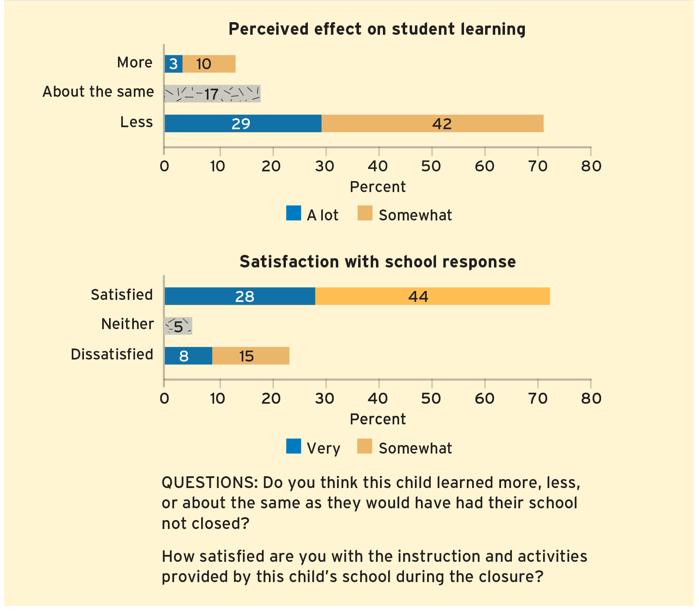
A new Education Next survey reveals 71% of parents perceived their children learned less during the pandemic than they would have had they remained in brick-and-mortar schools.
COVID-19 upended and changed the lives of millions of Americans this spring, forcing the nation’s schools to close and requiring a shift from in-person to virtual learning. In retrospect, what do parents think about the quality of instruction their children received?
Education Next surveyed them to find out. The results, released earlier this week, paint an interesting picture.
Among the 1,249 parents of 2,147 children surveyed, 71% said they thought their children learned less at home than they would have had they been in school. But surprisingly, 72% said they were satisfied with the attempt.
Black and Hispanic parents reported higher satisfaction with remote learning (30% and 32%, respectively), than white parents (26%). Charter school and private school parents (45% and 39%, respectively), reported higher satisfaction than parents whose children attended a public district school (29%).
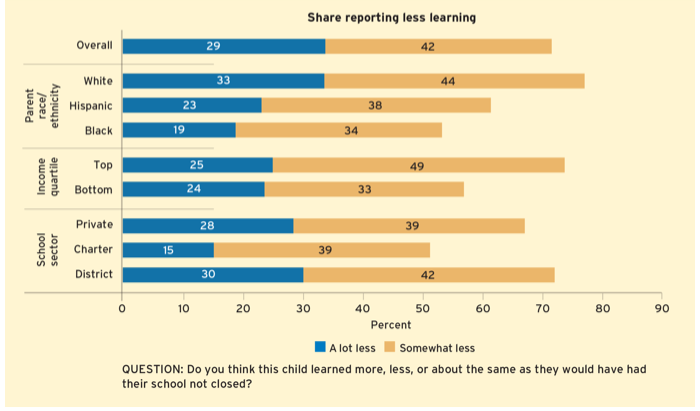
According to their parents, larger shares of the children of white respondents and children in higher income households learned less than they would have if schools had remained open than children of Black and Hispanic students and those in lower-income households.
Not all schools prioritized learning new content according to the survey. Overall, 74% of parents said their child’s school introduced new content, while 24% said the school focused on reviewing content students had already learned.
A large gap in perception persisted between high- and low-income families. Among low-income families, 33% reported that schools reviewed content students had already learned, compared to 19% of high-income parents.
Parents overall reported that one-on-one meetings between students and teachers occurred rarely, with only 38% saying such meetings occurred at least once a week. About 40% said one-on-one meetings never occurred.
Parents reported that class-wide meetings occurred more frequently, with 69% reporting class-wide virtual meetings with teachers occurred at least once a week.
Black parents reported their children spent more time per day (4.3 hours) on schoolwork than white parents (3.1 hours). Black parents also said their students suffered less learning loss than the parents of white students.
The survey also included a sample of 490 K-12 teachers who work in schools that closed during the pandemic. Teachers’ responses generally mirrored how parents described their children’s experiences with several exceptions.
Thirty-six percent of teachers said they met individually with students multiple times a week, compared with 19% of parents. Teachers also reported providing grades or feedback more often than parents. Meanwhile, teachers reported providing fewer required assignments than parents said their children received.
Parents and teachers generally agreed on how much students learned during distance learning, with teachers more likely than parents to say children learned less than they would have if schools had remained open.
The survey was conducted from May 14 to May 20 by the polling firm Ipsos Public Affairs via its KnowledgePanel. Respondents could elect to complete the survey in English or Spanish.

