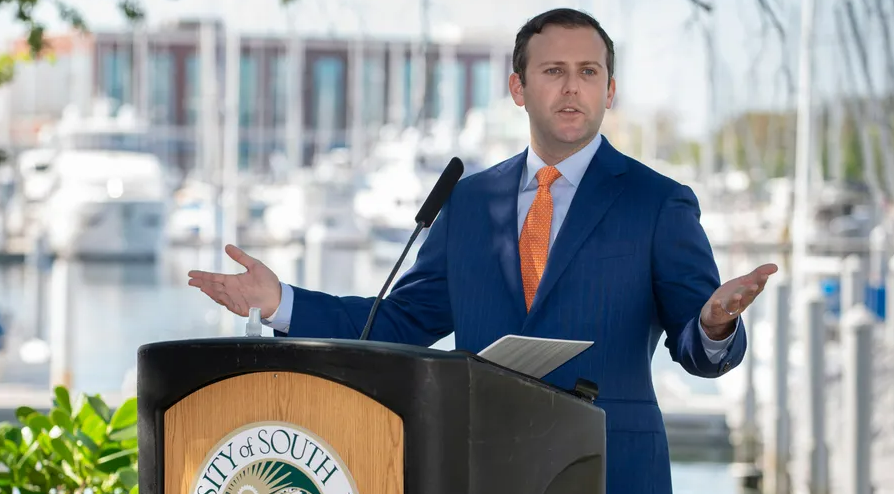
Outlined in HB 3, the New Worlds Reading Initiative and other literacy programs were part of Florida House Speaker Chris Sprowls’ legislative agenda, which included HB 7045, the largest expansion of a school choice program in the nation.
Editor’s note: Families can check eligibility requirements for the New Worlds Reading Initiative and enroll their children at newworldsreading.com. To read more about what Florida legislator Chris Spowls has to say about the program, click here.
A $200 million effort approved in 2021 by the Florida Legislature already has shipped nearly 336,000 free books to elementary school students in the state, making good on a promise to deliver a new book every month to children who need to boost reading skills.
The state’s New Worlds Reading Initiative, signed into law last June, is the first statewide book delivery service for Florida’s struggling early readers. Students who are reading below grade level at both traditional district schools and district charter schools are eligible.
Families can choose books at their child’s grade level from several genres including humor, adventure, art history and science. Books are available in English, Spanish, Haitian Creole, Braille and large print. Each month’s delivery includes support materials for parents.
The program was proposed by Florida House Speaker Chris Sprowls, R-Palm Harbor, as a way to encourage students to read at home and to help build home libraries for families who cannot afford to buy books. Outlined in HB 3, it aligned with Sprowls’ legislative agenda, which included HB 7045, the largest expansion of a school choice program in the nation.
“We cannot overstate the profound impact teaching a child to read will have on their future success,” Sprowls said while promoting the program at an event last summer. “Not only do we open them up to new worlds and ideas, we give them the tools to expand their imagination, foster their curiosity and ultimately chart their own destiny.”
More than 100,000 students have enrolled in the program so far, but state officials say more than 500,000 may be eligible. That estimate is based on 2021 reading scores on the state’s standardized test, where 45% of third graders scored below grade level in reading.
To help meet the demand, the Lastinger Center for Learning at the University of Florida, a national education innovation hub whose stated mission is to create educational systems where every child and educator experiences high quality learning regardless of life circumstances, is administering the New Worlds Reading Initiative.
We know what we need to do to support kids as readers,” said Shaunte Duggins, assistant director of the program at the Lastinger Center. “This is part of that puzzle.”
Duggins and her team spent months preparing for the program launch, conducting interviews and focus groups across the state with stakeholder groups including families, literacy leaders and district and community advocates. Included in input from participants at the well-attended sessions were suggestions for book titles, including “I Am Enough,” “Charlotte’s Web,” and “Hidden Figures,” based on the Florida Department of Education booklist embedded within the B.E.S.T. Standards.
Scholastic Corporation, the world’s largest publisher and distributor of children’s books and print and digital materials, was tapped to distribute the books. The company sent the first book shipments in December from a warehouse in Missouri. Books now are being packaged and shipped from a new Scholastic warehouse in Sanford that was created to manage the New Worlds initiative.
 Within an hour of Fifth Third Bank's announcement via a press release that it will continue to fund scholarships for Florida's most disadvantaged students, state lawmakers took to social media to thank the bank for reconsidering its decision to fund the Florida Tax Credit Scholarship program.
Those lawmakers included Rep. James Bush III, D-Miami, who posted: "The return of Fifth Third as a donor to the Florida Tax Credit Scholarship program is a victory for the more than 100,000 low-income students who need options in their education."
Rep. Kimberly Daniels, D-Jacksonville, referenced the pressure exerted upon Fifth Third by activists who came out in force this week to support the scholarship program and urged others to tweet @Fifththird to thank the bank for continuing its support.
Several other lawmakers, including Rep. Chris Sprowls, R-Palm Harbor, applauded Fifth Third for "coming back to the table" and listening to all voices. "This decision means that thousands of underprivileged, minority children will not have to give up their dream of a better future," Sprowls tweeted.
Rep. Patricia Williams, D-Pompano Beach, tweeted: "I celebrate the announcement by Fifth Third Bank, which will bolster education opportunities for those who need it most -- low-income, minority students."
Rep. Chris Latvala, R-Clearwater, and Rep. Byron Daniels, R-Naples, also weighed in, with the latter thanking Fifth Third for "doing the right thing" in resuming its corporate donations.
Meanwhile, Rep. Al Lawson, D-Tallahassee, commended the bank for supporting equal education opportunities for all children. "Our great state will be the better for it," Lawson tweeted.
Adding their voices to the praise chorus were two national figures.
Former Florida Gov. Jeb Bush, who signed the Florida Tax Credit Scholarship program into law in 2001, thanked Fifth Third and tweeted, "Great to see @FifthThird continuing to support Florida's families seeking a better education for their children."
And U.S. Sen. Marco Rubio commended the bank, tweeting "Great job by the bipartisan coalition that made this possible."
Rubio made headlines earlier this week when he called Fifth Third's decision to cease donations, along with Wells Fargo's, a "publicity stunt aimed at earning 'wokeness' points with the radical left."
 Testing reforms: Under the proposed "Fewer, Better Tests" bills filed Wednesday in the Legislature, all K-12 assessment testing would take place in the final three weeks of the school year, starting in the 2017-2018. S.B. 926 and H.B. 773 would also require results be returned to teachers within a week of testing, and that an understandable report be sent to parents. It also directs the education commissioner to study the feasibility of replacing the Florida Standards Assessments with the SAT or ACT. If the changes are approved, the state would also have to renegotiate its contract with testing vendor American Institutes for Research. Bill sponsors Sen. Anitere Flores, R-Miami; Rep. Manny Diaz Jr., R-Hialeah; and Rep. Chris Sprowls, R-Palm Harbor, say the goal of the bills is to reduce stress and anxiety among students, parents and teachers. Miami Herald. Orlando Sentinel. News Service of Florida.
Per-student funding: Florida's spending per student ranks well below the U.S. average among states, according to a report by the National Center for Education Statistics. In the 2013-2014 school year, Florida spent $8,714 per student. The U.S. average was $10,936. Miami-Dade County spent the most per student among districts, $9,106. Gradebook.
Teaching incentives: Senators on the Florida PreK-12 education budget committee react coolly to Gov. Rick Scott's $58 million proposal for incentives to recruit and retain teachers. Specifically, senators criticized Scott's proposal for $10 million in hiring bonuses for new teachers who score in the top 10 percent in their subject-area exam. "It concerns me that we continue to look for the best performers in college -- and not the best teachers," said Sen. Doug Broxson, R-Gulf Breeze. Miami Herald.
Gun-free zones: Bills filed in the Legislature this week are aimed at ending gun-free zones in Florida - including at K-12 schools. Sen. Dennis Baxley, R-Ocala, and Rep. Don Hahnfeldt, R-Villages, filed S.B. 908 and H.B. 803 to eliminate all restrictions on where people with concealed-carry permits can take their guns. Miami Herald. (more…)
Testing reform: Three legislators say they will file a bill today that would cut back on state-required assessment testing. The "Fewer, Better Tests" bill's goals are to cut down on and improve state tests, move the exams to later in the school year, get the test results to teachers sooner, and provide better student score reports. Filing the bill are Sen. Anitere Flores, R-Miami; Rep. Manny Diaz Jr., R-Hialeah; and Rep. Chris Sprowls, R-Palm Harbor. Sunshine State News. Gradebook. The Manatee County School Board tables a discussion on a proposal to limit district-required testing. Bradenton Herald.
Charter school takeovers: Members of the House education committee who are discussing district methods of turning around underperforming schools say districts should consider allowing charter school companies to take over operations at those schools. This week, the Florida Board of Education will consider a plan to make the Jefferson County School District a charter district. Politico Florida.
Student ID cards: The Duval County School District will issue new student IDs that are linked to data such as grades, academic progress, attendance and discipline. Students would have to swipe the cards when they get on and off school buses and when they go to classes. The setup cost is $1.1 million, with a $123,500 annual fee. Florida Times-Union.
School recess: The 2016 bill that would have required daily recess at all Florida elementary schools also would have prohibited teachers from withholding recess for misbehaving students. This year that provision has been stripped out of the recess bills, at the insistence of two powerful legislators who say they don't want to take away teachers' flexibility. Miami Herald. (more…)

