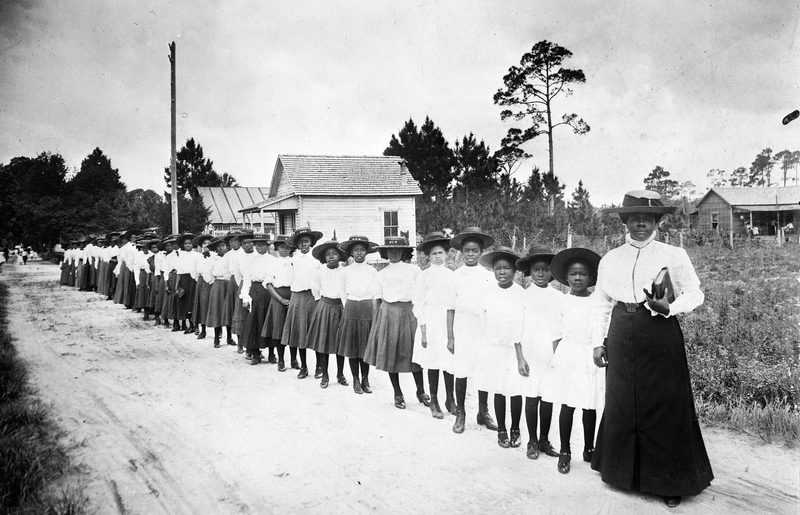
Editor’s note: This month, redefinED is revisiting the best examples of our Voucher Left series, which focuses on the center-left roots of school choice. Today’s post from June 2016 tells the story of civil rights activist and school choice pioneer Mary McLeod Bethune, who started a private, faith-based school for African-American girls in 1904 that became known as Bethune-Cookman University.
How fitting: The choiciest of school choice states may soon be represented in the U.S. Capitol by the statue of a school choice pioneer.
A state panel nominated three legendary Floridians for the National Statuary Hall last week, but the only unanimous choice was Mary McLeod Bethune. The civil rights activist and adviser to President Franklin D. Roosevelt is best known for founding the private, faith-based school that became Bethune-Cookman University.
Assuming the Florida Legislature gives the Bethune statue a thumbs up too, more people, including millions of tourists who visit the hall each year, may get to hear her remarkable story. And who knows? Maybe they’ll get a better sense of the threads that tie the fight to educational freedom in Bethune’s era to our own.
With $1.50 to her name, Bethune opened the Daytona Educational and Industrial Training School for Negro Girls in 1904. There were public schools for black students in early 1900s Florida, but they were far inferior to white schools.
Bethune’s vision for something better was shaped by her own educational experience.
She attended three private, faith-based schools as a student. She taught at three private, faith-based schools before building her own. In every case, support for those schools, financial and otherwise, came from private contributions, religious institutions – and the communities they served. Backers were motivated by the noble goal of expanding educational opportunity. Black parents ached for it. That’s why, in the early days of her school, Bethune rode around Daytona on a second-hand bicycle, knocking on doors to solicit donations. That’s why her students mashed sweet potatoes for fund-raiser pies, while Bethune rolled up the crust.
Failure was not an option, because failure would have meant no options.
Goodness knows, I’m no expert on Mary McLeod Bethune. But given what I do know, I think she’d be amazed at the freedom that today’s choice options offer to educators. More and more teachers, especially in choice-friendly states like Florida, are now able to work in or create schools that synch with their vision and values – and get state-supported funding to do it.
Bethune was forever hunting dollars to keep her school afloat, and it wore her down. In 1902, she asked Booker T. Washington for money. In 1915, she asked philanthropist and civil rights advocate Julius Rosenwald for money. In 1920, she made a pitch on the letters page of the New York Times. (All of this can be found in “Mary McLeod Bethune: Building a Better World,” a nice collection of Bethune’s writing.)
In 1941, Bethune even asked FDR. “I need not tell you what it has meant in Florida to try to build up a practical and cultural institution for my people,” she wrote to the president. “It has taken a wisdom and tact and patience and endurance that I cannot describe in words.”
“We are now in desperate need of funds,” she continued. “My nights are sleepless with this load upon my heart and mind.”
I can’t help but wonder what a superhero like Bethune could have done, had Florida had vouchers and tax credit scholarships a century ago. I don’t mean to dismiss the inequity in funding for choice programs – it’s real, and it deserves more attention – but inequity is relative. The funding streams available for low-income students today would have allowed Bethune to park the bike, forget the pie crust and focus on her core mission.
It would also have allowed her to rally more to the cause.
Bethune, who initially hoped to be a missionary, understood how much education and faith are intertwined for so many parents, and that it doesn’t make sense to pit public against private, or one school against another.
In 1932, she weighed in on a feud between state teacher colleges with an essay that foreshadows the all-hands-on-deck views of many of today’s choice supporters. She referenced the massive number of truant African American students and the “pitiful handful” that graduate from high school. “Unfriendly rivalry was never more needless, never more inexpedient among the schools of Florida than just now,” Bethune wrote.
The same could be said for K-12 education today.
Somehow, though, Bethune managed to end her essay on an up note, with an appeal to common ground:
Florida faces a new day in education. Grim as the picture appears today, it is not nearly so bad as it was just a few years hence, and the aspect is rapidly changing for the better; a veritable miracle is transpiring before the eye. The day for which many warriors now aging in the service have longed, the day for which they have prayed and sweat drops of blood – that new day of the hoped-for better things is approaching. With the scent of victory in the nostril, may every agency redouble its zeal; with jealousies forgotten, with the spirit of competition thrust aside, may every organization and individual unite under the banner of One Common Cause, the grim battle against ignorance and vice, and carry the issue to a glorious victory.

The Netherlands decided nearly a century ago to end long-running religious strife over schools and let 1,000 flowers bloom. The Dutch system of universal school choice gives full government funding to public and private schools, including all manner of faith-based schools. (Image from Wikimedia Commons)
Editor’s note: This month, redefinED is revisiting the best examples of our Voucher Left series, which focuses on the center-left roots of school choice. Today’s post explores one of the world’s most robust systems of government-funded private school choice in a country known as a progressive’s paradise: the Netherlands.
By common definitions, the Netherlands is a very liberal place. Prostitution is legal. Euthanasia is legal. Gay marriage is legal; in fact, the Netherlands was the first country to make it so. Marijuana is not legal, technically, but from what I hear a lot of folks are red-eyed in Dutch coffee shops, saying puff-puff-pass without looking over their shoulders.
Given the rep, it might surprise school choice critics, who tend to consider themselves left of center, and who tend to view school choice as not, that the Netherlands has one of the most robust systems of government-funded private school choice on the planet. Next year the system will reach the century mark, with nearly 70 percent of Dutch students attending private schools (and usually faith-based schools) on the public dime.
By just about any measure, the Netherlands is a progressive’s paradise. According to the Social Progress Index, it was the ninth most progressive nation in 2015, down from No. 4 in 2014. (The U.S. was No. 16 both years.) On the SPI, it ranked No. 1 in tolerance for homosexuals, and No. 2 in press freedom. On another index, the Netherlands is No. 1 in gender equality. (The U.S. is No. 42.) It’s also among the world leaders in labor union membership (No. 19 in 2012, with 17.7 percent, eight spots ahead of the U.S.). And by some accounts, Amsterdam, the capital, is the most eco-friendly city in Europe.
Somehow, this country that makes Vermont look as red as Alabama is ok with full, equal government funding for public and private schools. It’s been that way been since a constitutional change in 1917. According to education researcher Charles Glenn, the Dutch education system includes government-funded schools that represent 17 different religious types, including Catholic, Protestant, Jewish, Muslim, Hindu and Rosicrucian, and hundreds that align to alternative bents like Montessori and Waldorf.
Glenn, an occasional contributor to redefinED, has written the book on the subject. He calls the Netherlands system “distinctively pluralistic.”
The Netherlands' tradition of pluralism dates back hundreds of years. After the Dutch won their independence in 1609, Amsterdam became the commercial capital of Europe. It served as a hub for trade and finance, a cultural center that produced the likes of Rembrandt, and a refuge for migrants from across the continent, many of whom came fleeing religious persecution.
By the late nineteenth century, however, the country's diverse religious factions, including Catholics, different Protestant sects, and various secular groups had created their own cultural silos, or "pillars." Each had its own churches, its own schools, and its own social clubs. Some wanted public schools to be faith-based. Some wanted them to be “neutral.” Some wanted them to reflect one faith more than another.
The 1917 constitutional change was part of a broader reconciliation in Dutch politics called “The Pacification.” It followed decades of strife over schooling. No remedy worked until different factions agreed to let the parents decide, and let the money follow the child.
The system continues to have its tensions and tradeoffs. Some liberals still wonder if “common schools” would be better at unifying a country that grows ever more diverse. The influx of Muslim immigrants gives people pause, even as older divisions between religious factions fade. The Dutch way also includes far more regulation than some choice stalwarts in the U.S. would be comfortable with.
I don’t know enough to have a good opinion. But Glenn does, and he concludes most parents and the general public in the Netherlands are satisfied with their schools. Ed policy expert Mike McShane also points out the Dutch system produces some of the world’s best academic outcomes (Top 10 internationally in math, science and reading), at less cost per-pupil than the U.S. That should count for something.
For my skeptical liberal friends, I’d like to note that even the socialists are on board. Even before the 1917 constitutional change, the Socialist Party in the Netherlands was backing full public funding for private and faith-based schools. Why? Because, according to a resolution it adopted in 1902:
“Social democracy must not interfere with the unity of the working class against believing and nonbelieving capitalists in the social sphere for the sake of theological differences … “
There you have it: Fight the man. Not school choice.
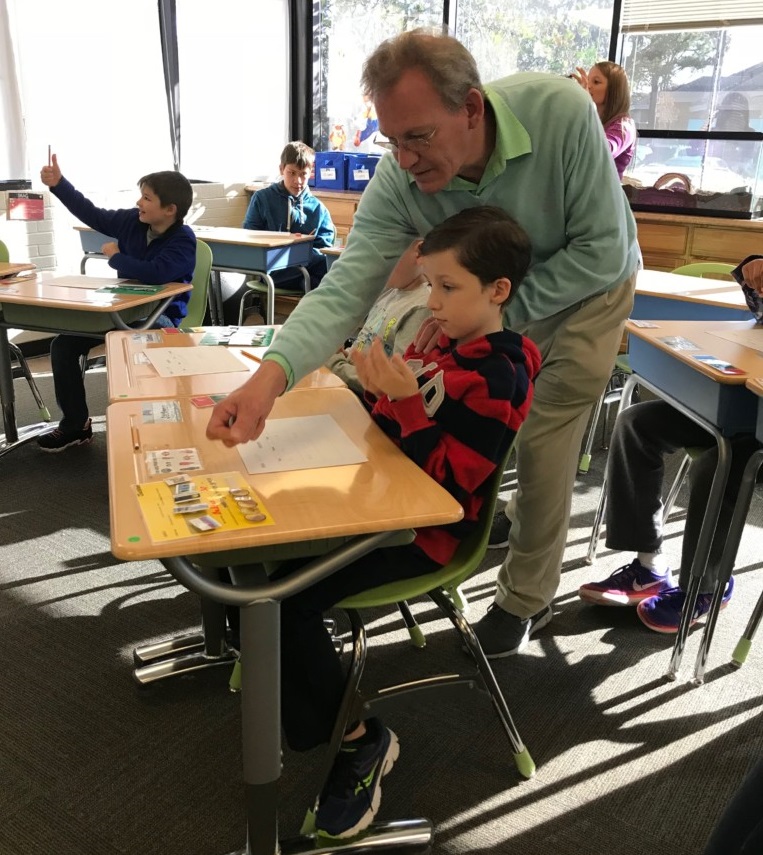
Teachers and therapists at the Jacksonville School for Autism often work one-on-one with students.
Editor’s note: redefinED is supporting National Autism Awareness Month each Saturday in April by reposting articles from our archives that celebrate those who champion the educational rights of children with autism. Today’s post, which originally appeared in March 2018, features a couple whose desire to help their son led them to open an education center for children with Autism Spectrum Disorder.
By Livi Stanford
Michelle Dunham was troubled as she watched her son, Nick, struggle in school.
He had autism and was grouped in a classroom with children with different learning disabilities at a public school.
Dunham described her son as a gentle giant who hovers around 6’3. But he's also non-verbal. She felt he needed one-on-one support to succeed academically. She didn't fault his teachers, who were doing all they could to help. But to thrive, Dunham said, he needed an intensive learning environment.
“They had no resources to support him,” she said.
She talked things over with fellow parents. They encouraged her to start a school of her own.
Dunham and her husband opened the Jacksonville School for Autism in 2005, as a nonprofit K-12 educational center for children ages 2-22 with Autism Spectrum Disorder — a neurological condition characterized by a wide range of symptoms that often include challenges with social skills, repetitive behavior, speech and communication.
In 2007, the CDC reported 1 in 150 children were diagnosed with autism. Now, 1 in 68 children get diagnosed.
Dunham views the school as one part of a growing societal recognition that, with the right support, people with autism can flourish.
She started the school with the Schuldt family, which has an autistic daughter named Sarah.
“We were two families that could not find the right environment for our children,” Dunham said. “Our kids needed to have more intensive therapeutic support. We wanted it to be an environment that was full of enrichment and resources: a safe environment for kids to learn.”
Individualized learning
Since its founding, the school has blossomed, with 51 students and 50 therapists and classroom teachers. With a 22,000-square-foot building and funding entirely from donations and student scholarships, the school is close to maxing out its space. Ten JSA students receive a Gardiner Scholarship from Step Up For Students, which publishes this blog. Meanwhile, 35 students receive McKay scholarships and six students pay out of pocket.
Dunham said Nick has excelled at the school. Within three months, he started reading.
“He has been able to be participative in his world, because he understands,” Dunham said. “He has been able to show us his intelligence in so many ways.”
The school focuses on helping children with autism and their families by channeling all available resources into supporting students, and by embracing what Dunham calls “outside-the-desk” thinking.
“Children are unique in their learning ability,” Dunham said. “We want to make sure that we leave no stone unturned as far as trying to reach them. If it requires a natural teaching environment, we do that. Whatever it takes to help them.”
The school’s model blends highly structured classroom teaching environments and ABA clinical therapy. Applied Behavioral Analysis is a therapeutic approach that helps people with autism improve their communication, social and academic skills.
Chrystal Ramos, a clinical therapist at the school for the past two years, said lesson plans are tailored to students’ individual needs.
“When I was teaching at different schools that had lesson plans that we had to follow, it was not catered to each child,” she said. “A lot of students that were having trouble were falling through the cracks. We couldn’t focus on their needs. It was following the lesson plan.”
Trina Middleton, educational director at JSA, said many children have “splinter skills.”
They might master higher-level skills in a subject area without being able to demonstrate lower-level skills that educators typically view as building blocks.
For example, a student might be able to add or subtract numbers, but still struggle to match the number seven with a group of seven objects on the table – a concept known as 1:1 correspondence.
Many of the students work one-on-one with a teacher or therapist for half-day or all-day sessions. They also take part in an array of other activities such as music therapy, occupational therapy, speech therapy, yoga and karate.
Programs like music therapy are designed to cater to students’ interests, while also meeting their therapeutic needs.
“Many individuals with autism have an affinity for water and music,” Dunham said. “One of the things that we have been able to see with our music therapy program is that music for our students doesn’t just grab their attention. It has a healing property to it.”
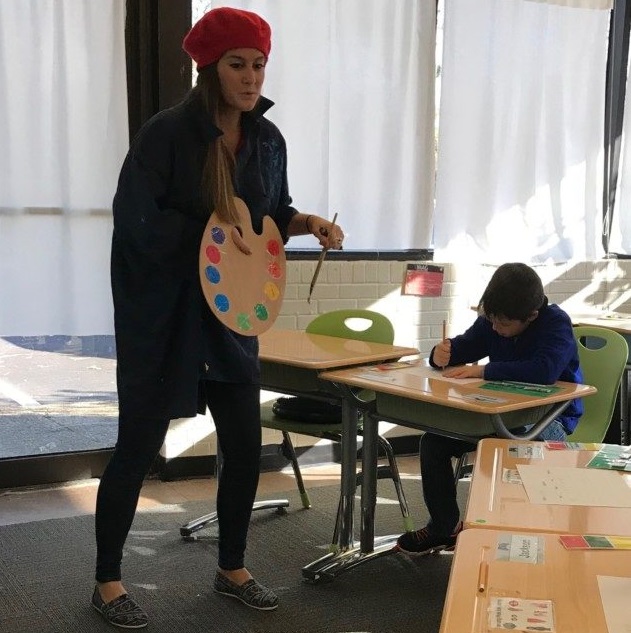
Krista Vetrano uses costumes to engage with her students.
Building social skills
During a recent visit to JSA, a teacher was dressed up as a painter to engage with students.
Krista Vetrano said she uses costumes to help introduce topics in a fun and creative way — a technique she calls "social modeling."
Vetrano said she tries to make the characters relate to the topic of the lesson. Characters like Pablo Punctuation or Nanny Noun help teach grammar concepts. They give students the opportunity to ask questions practice getting to know someone different and new.
While the school embeds academics everywhere, the staff is focused on one long-term goal: helping students assimilate to the outside world.
For example, if a student has a fear of public restrooms, they visit the restrooms as a first step in helping the child to overcome his or her fear.
The school uses role-playing to help students understand how to greet people or handle situations like waiting in line.
“It is about making their world bigger and bigger,” Dunham said.
Ready for work
The school also implemented a vocational training program for older students to help them acquire skills to become gainfully employed in the future.
Dunham said she began the program because she wanted Nick to thrive as a citizen. Now she wants to expand the program to allow as many individuals as possible to gain skills.
“Our goal is not only train (students), but also to help them seek employment and retain employment,” Dunham said.
Dunham said at the end of the day the school will grow as needed to support the student base.
“We don’t want to grow at the expense of quality,” she said. “We want to make sure we don’t change the culture of learning we worked so hard to build for our students and their families.”
Nick takes part in vocational training at Publix.
His mother describes him as an anxious young man who has difficulty standing in one place. He craves order.
His job at the grocery store is to stack fruit on the shelves, which Dunham described as a perfect fit for him.
“When he goes into Publix and puts his apron on there is a calmness about him,” Middleton said. “He is actually participating and being expected to be responsible for a job that he enjoys and plays to his skill set. His pacing and anxiety decrease.”
Dunham said her son craves social interaction.
“He really loves to be around people,” she said. “That is one of the reasons he enjoys Publix.”
Life with autism
Kristopher Turcotte recently moved with his wife and son from South Carolina to Jacksonville. He was looking for options for his 8-year-old son, who has autism.
“This was one of the best options that we could find,” he said of JSA.
Since his son has enrolled in the school this summer he has acquired more speech.
“He has problems with social settings,” Turcotte said. “That is one of the things that the school has worked with him on."
Dunham explained some students with autism also suffer from food allergies and sleep deprivation, or have a sensitivity to light and sound.
While all teens struggle with puberty, Dunham said for students with autism it is a “mountain to climb.”
She explained many teenagers with autism do not understand what is happening to their bodies. Some develop seizures.
“Puberty can bring out anxiety and aggression in our children,” she said. “We work with the children trying to obviously look for these indicators and what is happening in their life and try to support them first.”
Dunham worries as they grow up and leave school, they may not have all the support they essentially need.
“What is the next step for these students?” she said.
The statistics about increasing autism diagnoses only highlight the urgency for Dunham to develop a working community to support young adults with autism as they transition to adulthood.
“I am looking at a lifespan model that would provide the educational, vocational and residential support for our young adults,” she said.
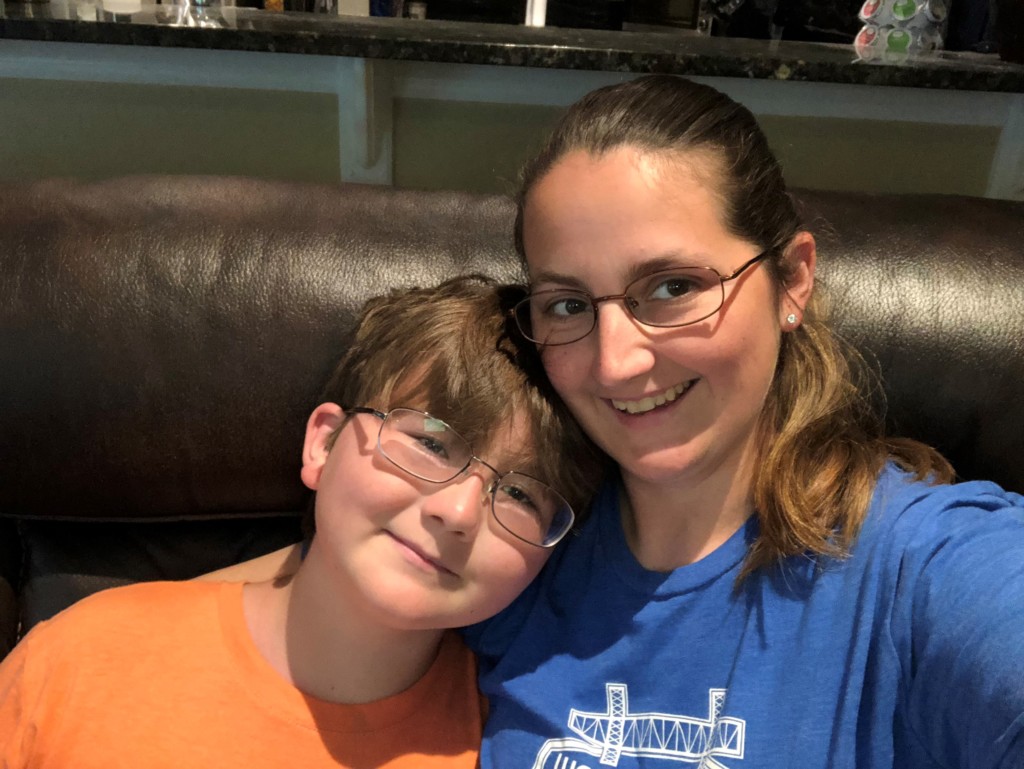
Jared Wendlberger, pictured with his mother, Sandy Edwards. An administrator at her son’s school told Edwards about the Gardiner Scholarship, which afforded the family the ability to tailor education programs, high-end curriculum and therapies to suit her son’s needs.
Editor’s note: redefinED is supporting National Autism Awareness Month each Saturday in April by reposting articles from our archives that celebrate those who champion the educational rights of children with autism. Today’s post, which originally appeared in September 2018, features a mother and son that found success through a Gardiner Scholarship.
By Livi Stanford
Every day was a battle for Jared Wendlberger in school.
The 7-year old, at the time, would come home in tears, after his backpack and lunch were stolen by his classmates.
Jared, who has high-functioning autism, was placed in an emotional behavior disorder class in the second grade. Some of the students in the class were two years older and several of them were violent, his mother, Sandy Edwards, remembers.
Jared was bullied regularly and it affected him on many levels. He was self-conscious about everything and became withdrawn. He was unable to finish his school work and was performing poorly.
But the abuse did not happen just at school. He faced it with other adults in his life, in encounters that had to be handled in the court system. He was beaten and ended up with a major concussion.
Edwards moved Jared from three different public schools to a private school. But each school presented new challenges.
Jared found it hard to participate in a classroom setting. He was reluctant to finish his work and became argumentative with the teacher. He would say no to everything. Depending on the situation, he would either display zero emotion or every emotion. He would read something and burst into tears. These were traits, his mother says, that are common for children with high-functioning autism.
“We were in the midst of the trauma of behavior issues,” Edwards said. “There were days when I did not know what I would do as a parent because there were times when the behavior was so bad that we were almost at our wit’s end.”
An administrator at her son’s private school then told her about the Gardiner Scholarship, a state program that allows families with children with severe special needs to pay for therapy, school tuition and other education-related services of their choice. The scholarship afforded Edwards the ability to tailor education programs, high-end curriculum and therapies to suit her son’s needs.
The Gardiner Scholarship is also unique in another way among the educational choice options that Florida provides: It provides scholarship support for parents who choose home education for their children. Last year, 1,615 students with autism were homeschooled with help from Gardiner.
Now in his fourth year as a homeschooled student, Jared is thriving, Edwards said. He is ahead in every class and is taking Algebra 1 as a seventh grader.
“When you talk about the power homeschooling has given me to provide him the best path, it doesn’t get any better than this,” Edwards said.
With the scholarship, Edwards can provide a full engineering curriculum for her son, who aspires to go to MIT. She ordered a Lego robotics kit and enrolled him in occupational therapy to help him work on hand-eye coordination and growth motor skills.
The Lego set has a programmable robotic brain, so he can create working prototypes. Next year, he will be old enough to join a robotics team. Within a homeschooling environment, he can work one-on-one with his mother figuring out problems. This makes it easier for him to grasp concepts.
Writing is his biggest challenge.
“It is not coming up with the words on paper,” Edwards said. “It is the act of putting the words on paper. He is so self-conscious about his penmanship.”
While in the school system, Jared worried so much about the penmanship he was paralyzed from writing anything coherent, Edwards said.
Now he is constantly working on his writing, overcoming his anxieties. He is performing above grade level.
Jared is in many ways your typical middle school child. Oftentimes, you will find him with a book, his mother says. Harry Potter and Lord of the Rings are his favorites. He also loves to build things.
To a great degree, Edwards credits the scholarship options. “Having my son, I have learned that these choices are so important for kids because no kid fits in the same box as another child,” she said.
Other students with autism have also benefited from homeschooling with the help of the Gardiner scholarship.
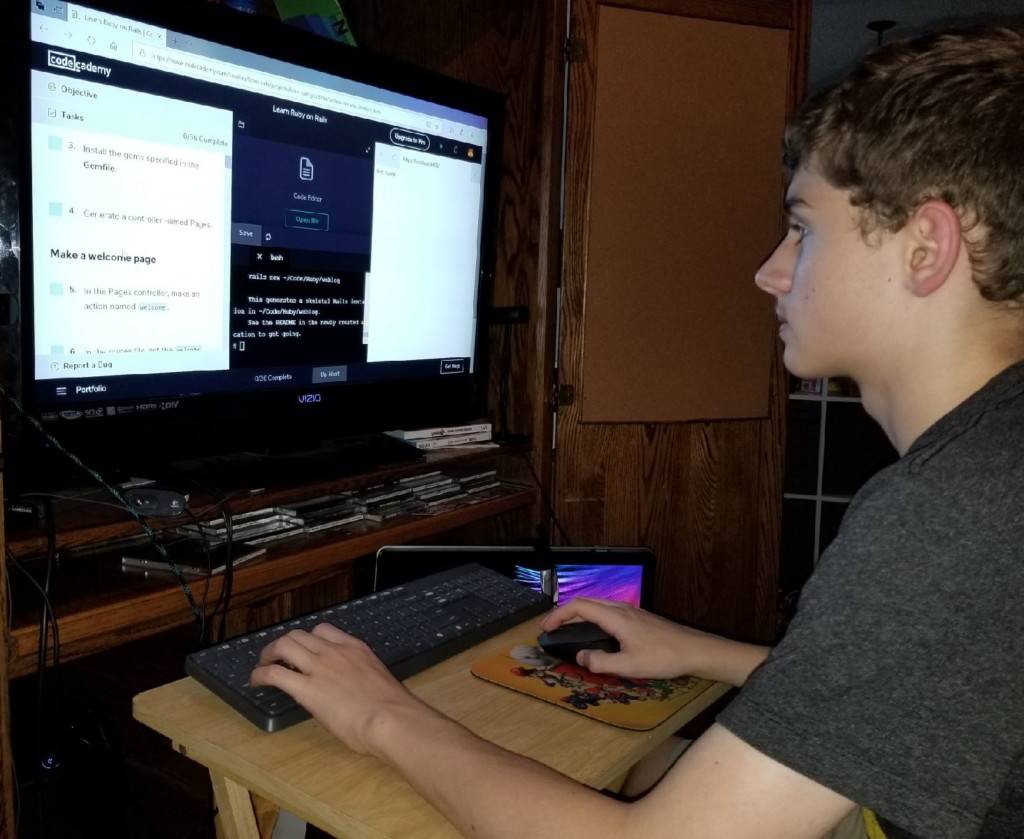
Garrett Volshell's academic struggles began turning after his family applied for the Gardiner Scholarship. Now he is enrolled in the Classical Conversations homeschool curriculum and hopes to become a video game designer.
Erin Voshell’s son, Garrett, who also has autism, was bullied and struggled in traditional public schools.
Voshell said he couldn’t complete 50 percent of the work in fifth grade.
The family looked for options and thought about enrolling him in a high-functioning autism private school. But administrators said he was too high-functioning, Voshell said.
Looking for a different option, Voshell learned about Gardiner, and like Edwards, found that coupling the program with homeschooling was the most beneficial option for her son.
Now he is enrolled in Classical Conversations, a worldwide homeschool curriculum focused on the classical method of teaching. He is taking Latin and Algebra. The 14-year-old is performing better than he did in the traditional public-school system, his mother says.
In public school, Garrett was timid and did not want to engage in much conversation. The scholarship provides Garrett with Applied Behavior Analysis, a therapeutic approach that helps students with autism improve their communication, social and academic skills.
As a result, he became more confident, Voshell said.
“You can see how lighthearted, fun and happy he is,” said Voshell. “He loves school now. That is not something you hear out of a 14-year-old.”
Garrett hopes to become a video game designer. The scholarship allowed Voshell to buy her son a computer that teaches him how to code for video game design.
“The (Gardiner) program has helped to give me my child back,” she said.

