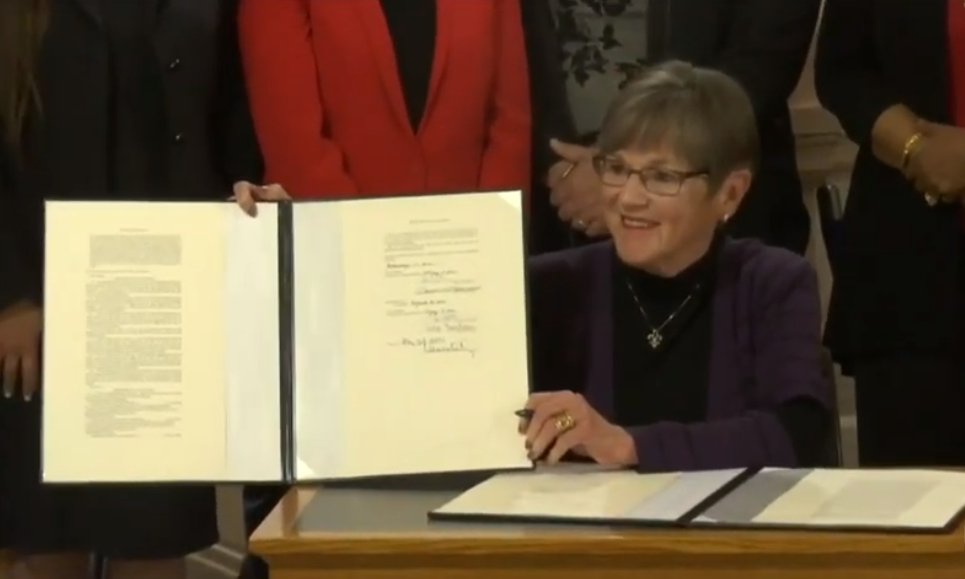
Kansas Gov. Laura Kelly signed into law Monday HB 2134, one provision of which will expand education choice opportunities for Kansas families.
Among education-related legislation signed into law by Kansas Gov. Laura Kelly is the expansion of a tax credit program for low-income student scholarships that will broaden eligibility to include those who qualify for free or reduced-price meals.
The program currently is open to low-income students eligible for free meals and attending one of the 100 lowest-performing public schools. The total tax credits would remain capped at $10 million a year.
Rep. Kristey Williams, chair of the House K-12 Education Budget Committee, said the scholarship expansion was a step toward raising educational competency for more Kansans.
“Education isn’t just about money,” Williams said in a joint statement with House Speaker Ron Ryckman. “It isn’t about most kids. It’s about every kid.”
House Bill 2134, the product of negotiations between House and Senate lawmakers and the governor’s office, also funds the state’s 286 local public school districts at an annual rate of $5.2 billion for the budget year beginning July 1. Additionally, it places restrictions on public schools’ use of remote instruction and directs local school boards to use federal COVID-19 aid to give district employees a $500 bonus.
While less than enthusiastic about the scholarship expansion portion of the legislation, Kelly nevertheless praised efforts across political lines for working to provide students and teachers with needed resources.
“Ensuring kids have access to a quality education not only helps them succeed. It helps our businesses succeed and promotes economic development by providing employers with a highly educated, skilled workforce,” Kelly said.

Marie Echevarria, an Orlando district high school teacher, was one of several Florida parents who thanked lawmakers for their expansion of education choice during the recent legislative session.
In a May 24 Forbes piece titled, “Oh, what a year for school choice,” Mike McShane, director of national research at EdChoice and a redefinED guest blogger, references legislative outcomes in Florida not once, but three times.
What’s more, Forbes chose to illustrate the piece with an Associated Press photo of Florida Gov. Ron DeSantis celebrating the passage of HB 7045 at one of two schools he visited the day of the bill signing.
“It has been hard to keep up with the number of school choice programs state legislatures have created so far in 2021,” McShane writes. “As sessions across the country wrap up, it is worth pausing to underscore just how massive the wins for the educational choice movement have been this year.”
McShane points to Florida for converting one of its scholarship programs – the McKay Scholarship Program – into an education savings account program, allowing more students to have access to ESAs. He includes Florida in the list of states along with Arkansas, Georgia, Indiana and Maryland that expanded their voucher programs, allowing either broader eligibility, increasing the amount of money available for vouchers, or both.
He also names Florida, along with Arkansas, Indiana, Iowa, Kansas, Montana, Oklahoma and South Dakota, as a state that either created new tax-credit scholarship programs or expanded eligibility or funding for their existing programs.
In total, McShane writes, 13 states have created five new programs and expanded 13 existing programs, providing new opportunities that previously were financially out of reach for hundreds of thousands of families across the country.
The upshot? A majority of Americans, a super majority of parents, and increasing numbers of state legislators and governor seem to agree that education choice is a good thing – and that it’s here to stay.
You can read McShane’s full commentary here.
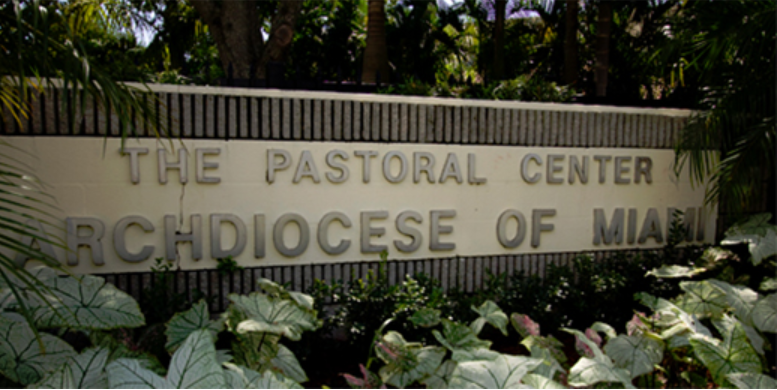
The Archdiocese of Miami, home to more than half a million Catholics in three South Florida counties, encompasses 109 parishes and missions and 62 schools.
“It will be wonderful to work in a state that understands the value of school choice and enables families of all backgrounds to pick the best school for their child." -- Jim Rigg
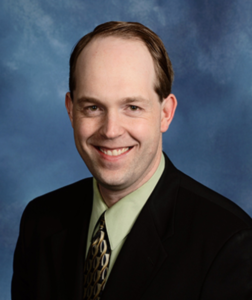
Jim Rigg
The Archdiocese of Miami is getting a new cabinet secretary of education and superintendent of schools.
Jim Rigg comes to Miami from the Archdiocese of Chicago, where he served for the past six years as superintendent of schools. Previously, Rigg served as director of education and superintendent of schools in the Archdiocese of Cincinnati, overseeing the Office of Catechesis as well as Office of Schools.
In his new position, Rigg will head a veteran leadership team as he guides 57 Catholic schools, including a virtual school, across the archdiocese, which encompasses Broward, Miami-Dade and Monroe counties. He brings a rich background beyond his superintendencies, having served Catholic schools in Tennessee and Colorado as a teacher, dean, principal, assistant superintendent, and college-seminary lecturer.
Rigg received a Bachelor of Arts degree in history from College of the Holy Cross in Worcester, Massachusetts. He holds a Master of Education from the University of Notre Dame and received his Ph.D. in educational administration from Capella University in Minneapolis. He is married and has four children.
redefinED interviewed Rigg to learn more about his thoughts on the importance of education choice, his role models, and his vision for Catholic schools in south Florida. Answers have been edited for clarity.
Q. What attracted you to the position in Florida?
A. While I have sincerely enjoyed my experiences in the Archdiocese of Chicago, I was attracted to the Archdiocese of Miami for several reasons. First, the archdiocese strikes me as a great place for Catholic education. The schools are strong and successful and staffed by men and women of great dedication and talent. Miami has a national reputation for excellence and vibrancy, and it is exciting to become a part of this success. I also know that Archbishop (Thomas) Wenski and other archdiocesan leaders are very supportive of Catholic education, and this is major advantage.
Not only are the Catholic schools of the Archdiocese of Miami delivering a strong education, but they are doing a great job of embracing and teaching our Catholic faith. Our schools exist to make Christ known, loved, and served. The Catholic schools of the Archdiocese of Miami understand this mission and work hard to engage each student and family in the love of Christ.
I am sincerely looking forward to experiencing the great diversity of the Archdiocese of Miami. I’m told that Mass is offered in 17 languages, and schools and parishes rejoice in their local ethnicities.
The presence of an array of parental choice programs was another key factor that influenced my decision. It will be wonderful to work in a state that understands the value of school choice and enables families of all backgrounds to pick the best school for their child.
Finally, you can’t ignore that Florida is a great place to live. The quality of life in South Florida is unsurpassed. I believe Florida to be an ideal place to raise a family, and my wife and I are very happy to be relocating south. We have family in the area as well, and that is a major plus. I also love coffee, and I’m looking forward to many a cup of Café Cubano!
Q. Can you share your background in advocacy? What have you accomplished in that regard and how do you intend to apply it to your new position in Florida?
A. I believe passionately that Catholic schools should be available and accessible to any family that wishes to attend. Finances represent an obstacle for many families to enroll in Catholic schools. All families, no matter their background, deserve the ability to choose the school that is best for them. State parental choice programs are critical to enabling this choice.
I have done my best to support advocacy for parental choice programs throughout my career. During my time as superintendent of Catholic schools in the Archdiocese of Cincinnati, I supported the passage of a new needs-based voucher program as well as two state-funded scholarships for students with defined special needs. In Chicago, I helped advocate for the passage of the Invest in Kids Act, which established the first parental choice program, a state tax credit scholarship, in Illinois. These programs have helped thousands of families join and remain in Catholic schools.
While a superintendent’s job is very broad, I have felt it important to support advocacy for parental choice. Of course, such efforts happen alongside advocacy experts, such as those in the local Catholic conferences. Most importantly, I’ve worked to help the voices of each legislator’s constituents be heard. In my experience, nothing is more powerful than when a legislator hears from a parent or student within their district.
Of course, I’d be remiss if I did not mention the upcoming June 1 deadline for applications for Florida Tax Credit and Family Empowerment scholarships. All qualifying families should consider participating in this important program. We want to help you choose and remain in a Catholic school.
Q. News accounts say that more than 200 Catholic schools closed last year and that enrollments continue to decline. What can be done to turn those numbers around, especially as fewer people identify as Catholic, and the schools depend more on non-Catholic enrollment?
A. I strive to always operate out of a mindset of hope. While our schools have faced numerous challenges in recent years, I believe that the future is bright for Catholic education. Many of our schools are growing and thriving, and we have seen several exciting turnarounds in individual schools.
In my experience, many schools do not deeply understand their unique challenges and why some families may not be choosing them. The specific issues tend to vary school by school. A key part of my role as superintendent is helping each school realize its specific gifts and opportunities and helping equip the school with the perspective, knowledge, and resources to succeed.
For some schools, they may need to invest in new academic or faith formation programs. Other schools may need more of a focus on fundraising or expense control. Others may need support in marketing. I have found that there is no “silver bullet” for school improvement, but rather a suite of proven strategies that can be deployed depending upon each school’s specific situation.
Fundamental to this work is the quality of leadership at each school. I believe the principal is the most important factor in determining each school’s success or failure. I consider it a key duty of my role to identify, recruit, support, and develop school principals in their essential role.
It is impossible to ignore the disturbing faith engagement trends, particularly amongst the generation of parents who have children in our schools. These trends are fueled, in part, by several crises and scandals that have faced the Church in recent decades. I believe that Catholic schools can and should be in the forefront of the renewal of our Church. Our schools represent a massive opportunity to engage children and families deeply in our faith. If our schools can succeed in their educational and ministerial mission, I have no doubt that we will see a reversal of the trends impacting our Church. Our schools will also benefit wider society, as we graduate students who are ready to embody leadership and virtue as adults.
Q. What are your immediate goals for the schools in the Archdiocese of Miami?
A. My priority will be to get to know the people and landscape of the Archdiocese of Miami. In my initial months, I plan to do a lot of listening and learning, and spend time studying the various forms of data for each school. I look forward to experiencing the great diversity represented by the schools of the Archdiocese. I have been incredibly impressed by the commitment and vibrancy of Catholic education in greater Miami, and it is important that I understand the unique strengths and challenges facing each school.
As superintendent, I see it as my role to help each school be successful, working in partnership with local pastors, principals, and other leaders. I would like to determine if there is a collective vision for Catholic education in the archdiocese. If so, I see my role as enabling each school to fully contribute to this vision. If not, I hope to work with Archbishop Wenski, school and parish leaders, and all school stakeholders to construct and realize such a vision.
Q. How have Catholic schools weathered the pandemic? Do you see any opportunities with the transition to post-pandemic life?
A. I see great opportunity for Catholic schools in the current COVID pandemic. While the past year has been incredibly challenging, I have been extremely impressed at how our Catholic schools have stepped up to serve students. We were able to move to virtual learning incredibly quickly when the pandemic began last spring. We’ve done an incredible job of supporting safe in-person learning this school year, even while instructing students learning from home. Our flexibility and resilience amidst the pandemic reflect our unwavering commitment to students and families. In the Archdiocese, I know many schools are experiencing an influx of new students because of this success.
Q. The archdiocese was the first in the nation to have a virtual school. How will you maximize its use?
A. I see the presence of a virtual school in the Archdiocese as a gift. Many families are not able to join traditional in-person classes for a variety of reasons, and a virtual school is a wonderful opportunity to engage these families. I see the virtual school as an important way of expanding the reach of Catholic education without offering direct competition with our brick-and-mortar schools.
If anything, the COVID pandemic has shown us that we need to be flexible in the education of our children and freely harness technology to support instruction. I’m sure that we can learn much from the approaches of the virtual school, assisting in-person classes with utilizing technology to support learners.
Q. How do you see fatherhood as benefiting you in your job?
A. One of the unique perspectives I bring to my new job is my role as a father of four current Catholic school students. This provides me with an understanding of the journey of our school parents. I have been so impressed by how my children have grown through their education, becoming young people of faith and conviction. My role as a parent has certainly deepened my appreciation for the value of our Catholic schools.
Q. Aside from famous people and your family, who were the biggest influences on your life?
A. I have certainly drawn influence from the many educators who have impacted my life. I can recall several teachers in my own upbringing who inspired me and influenced me to become a Catholic school educator. I’ve also seen many incredibly talented teachers and principals in my role as a superintendent, and these educators inspire me every day.
Of course, I’m also influenced by our students, who are the focus of our educational ministry. I’ve had a chance to hear directly from many students and families who offer touching expressions of how Catholic education has positively changed their lives.
Additionally, I am inspired by many religious figures, who connect deeply to my vocation of Catholic education. The Blessed Mother is a wonderful source of inspiration. St. Joseph provides an example of selfless giving to family. Educators such as St. Francis Xavier and St. John Bosco inspire me. One of my favorite saints is St. Bruno, who served as a Catholic school superintendent in France. Throughout his ministry, St. Bruno always remained focused directly on Christ, serving the Church with humility and compassion.
Q. Aside from the Bible, what are you reading right now and why?
A. I consider myself an avid reader and am usually working my way through several books. I’m currently re-reading “Founding Brothers” by Joseph Ellis, one of my favorite historical writers. I’m a huge fan of history, a subject I used to teach. The book provides an engaging humanized glimpse of several of the main historical figures of our nation’s founding.
I’m also reading “Antiquum ministerium”, the new Apostolic Letter by Pope Francis. This letter formally institutes the ministry of the catechist, which resonates with me as a Catholic educator. I see all Catholic school teachers as catechists, as they form the faith development of their students.
On a lighter note, I’m also reading “The Song of Troy” by Colleen McCullough, a historical account of the Battle of Troy. Colleen McCullough is one of my favorite historical novelists. I love feeling transported to another time and place by a talented writer.
Q. What do you enjoy most when you are not working?
A. One of my favorite activities is spending time with my family. Whether at home or out and about, I sincerely enjoy sharing the world with my wife and children. I also enjoy reading and find reading to be a great way to wind down after a long day. Music is also a major way for me to relax. I play three instruments and am active in my parish’s music ministry. Finally, I love taking walks with my family and try to exercise regularly by running and weightlifting.
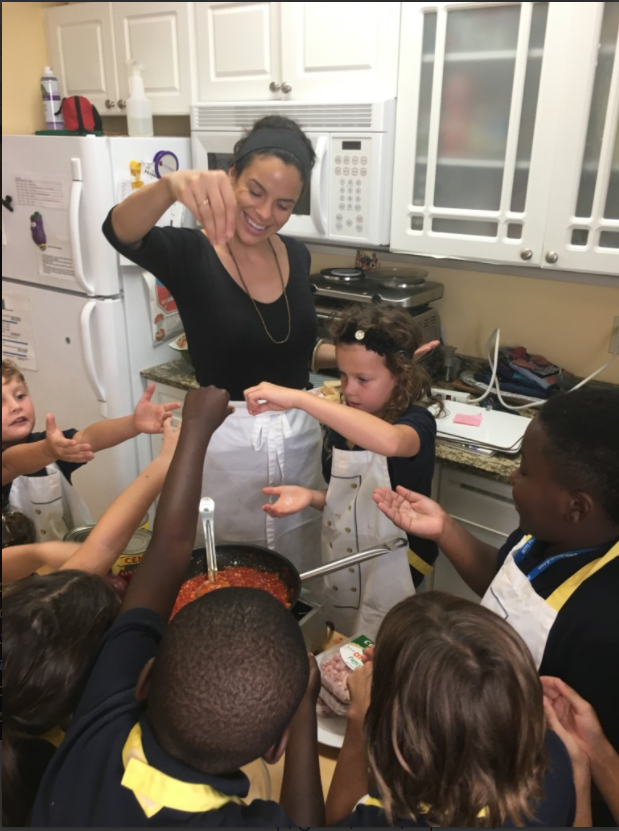
BB International School in Pompano Beach, Florida, is an example of how education choice opens the door to more fun and less bureaucracy. Here, first- and second-graders in Alexa Altamura’s class mix academics with enrichment.
What teachers need are PODS (All together now!)
Teachers want those PODS! (Everybody)
Teachers love those PODS, PODS,
PODS are what they need (PODS are what they need)
Okay, so now that I’ve got a song stuck in your head for the rest of the day (week?) let’s discuss an EdChoice survey that shows teachers love learning pods. And that includes teachers from every K-12 sector:
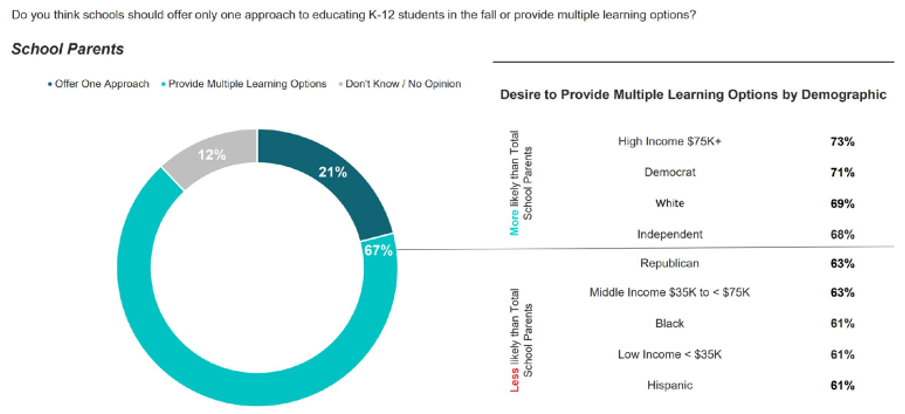
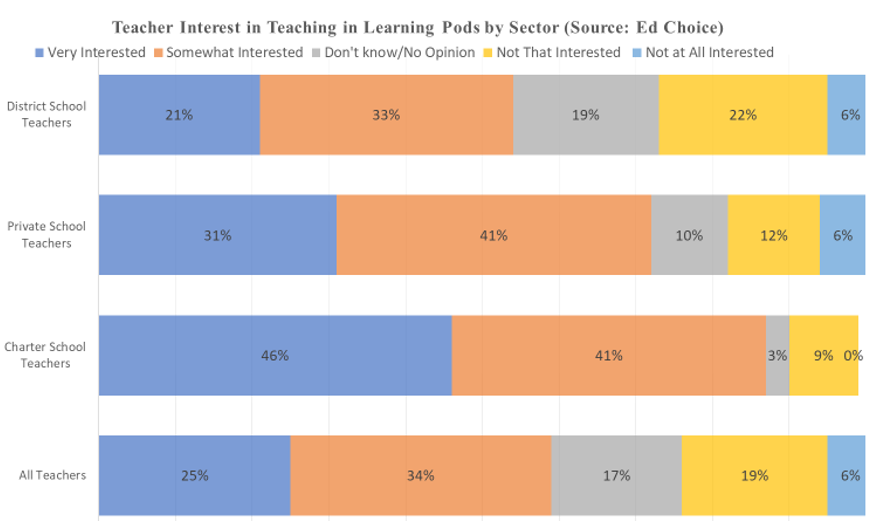 The research shows some 87% of charter school teachers are either “very interested” or “somewhat interested” in teaching in a learning pod; 59% of all teachers are interested. Schools just might want to find a way to give teachers what they want, especially given the fact that the same survey shows families also want multiple options for their children this fall:
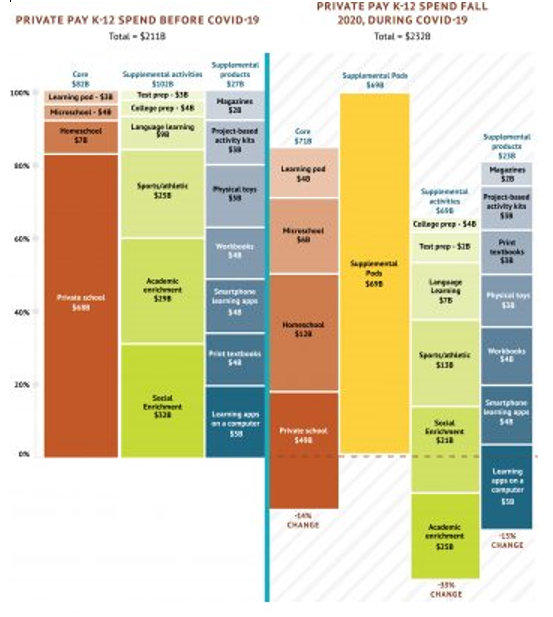
 Oh, and then there is the new Tyton Partners survey showing that families dropped more of their own money on learning pods last fall than on private school tuition:
 It would be interesting to survey former teachers on what they think of pods. Every state has a large pool of experienced teachers, many of whom tapped out of the profession in frustration of various sorts. Could they be tempted back into the teaching profession by new school models with more fun and less bureaucracy?
I’d love to find out, because we need all the effective teachers we can get.
 The Oklahoma House of Representatives on Thursday gave final approval to a bill which will expand the Oklahoma Equal Opportunity Education Scholarship Act in a 63-36 vote. The scholarship program offers tax credits to businesses and individuals that donate to scholarship-granting organizations and to public school districts that include charter schools.
Senate Bill 1080 would increase the amount of tax credits available for scholarship program donations from $3.5 million to $25 million per year. The amount available for donations to public schools would rises from $1.5 million to $25 million annually.
Jonathan Small, president of the Oklahoma Council of Public Affairs, praised Oklahoma policymakers for the expansion.
“Decades from now, when today’s children are adults, thousands of them will look back and know they were able to achieve great things thanks to the education made possible by lawmakers with this vote today,” Small said. “A quality education opens the door to a better life for all children, but especially those whose current circumstances are mired in challenges few of us can comprehend.”
Supported by the Oklahoma State School Board Association, SB 1080 further allows public schools with fewer than 4,500 students to apply for funds for “innovative educational programs.” Examples include robotics and STEM programs that prepare students for careers in science, technology, engineering and mathematics-related fields.
Two-thirds of the 2,500 students who currently benefit from Opportunity Scholarships are from low-income families.
Oklahoma Gov. Kevin Stitt said he is "thrilled" the bill awaits his signature.
“I will always fight for parents to be able to choose a school that best fits their child’s needs, regardless of ZIP code or income level,” Stitt said in a statement. “I look forward to signing SB 1080 into law.”
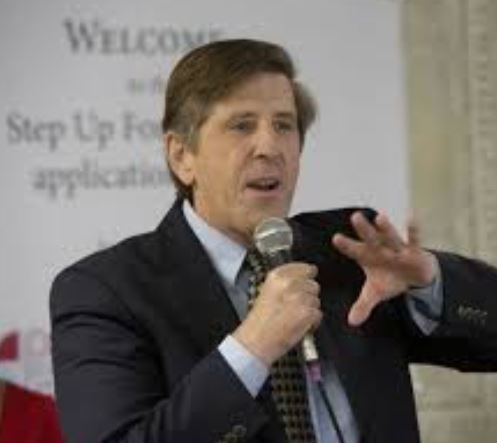
 For more than a decade, the Thomas B. Fordham Institute has hosted a weekly podcast, the Education Gadfly Show. On this week’s episode, Step Up For Students president Doug Tuthill joins Mike Petrilli, the Fordham Institute’s president and a research fellow at Stanford University’s Hoover Institution, and David Griffith, a senior research and policy associate at the Fordham Institute, to discuss the potential impact of, and lessons learned, from Florida’s new school choice expansion in a segment titled, “Hooray for Florida’s new school choice legislation.”
Here’s a taste of what you’ll hear from Tuthill as he reflects on the landmark expansion of education choice in Florida.
“I think the Legislature said, ‘Okay, it’s time to grow up. We can integrate these programs, make them more simple and more elegant, easier for families to access,' and that’s the big message in this bill. It significantly improved access. Over 1 million students were added to the eligibility through this program. The legislation dramatically expands the number of children who have access.”
“These programs have been islands. We’ve now integrated them into the funding system of the state of the normal public education funding mechanism. What you’re really seeing is a simplification over time, making them more user friendly, and sort of a normalization. It’s now a normal part of public education … It’s now normal in Florida.”
“We wanted to make sure no families are left out. Our philosophy has never been that only some kids deserve access to the school that best meets their needs … We’ve never been a pro-private school choice organization. We’ve always been a pro-education choice organization … When we find families who are being priced out or locked out, we try to reduce those barriers to maximize access for every family and every child.”
You can listen to the podcast here.
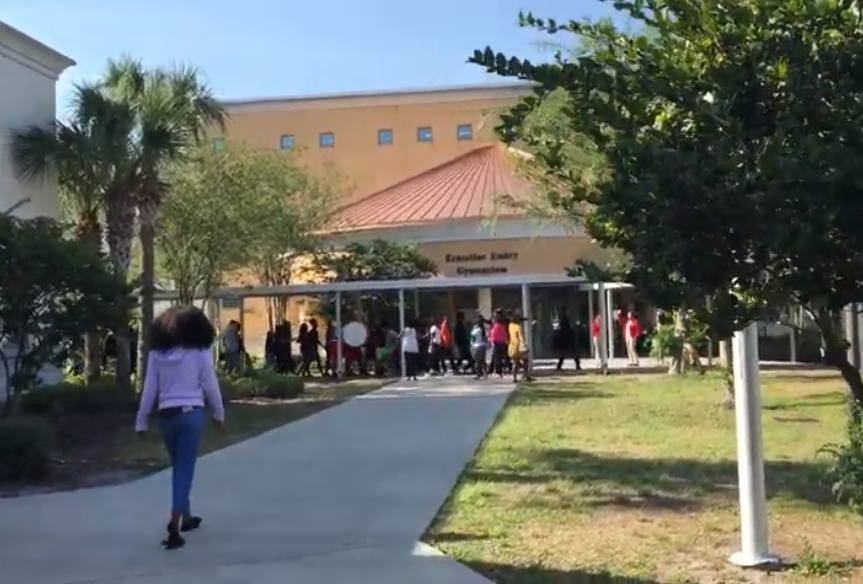
More than 250 students at Jones High School in Jacksonville, which last year celebrated its 125th anniversary, attend a physics class. That's more than the number at most Orange County high schools.
Editor’s note: This commentary from Denisha Merriweather, director of public relations and content marketing at the American Federation for Children and founder of Black Minds Matter, appeared Thursday on orlandosentinel.com.
As the Black daughter of a 16-year-old mother raised in poverty in Jacksonville, I was delighted to see Jones High School (in Orlando) create a great physics program. The school is an inspiration.
But I was perplexed to see Jones’ success used to disparage the Florida Tax Credit Scholarship – a program that turned my life around.
In a recent Orlando Sentinel op-ed (”Jones success illustrates inadequacy of vouchers,” May 16), former Polk County School Board member Billy Townsend perpetuates three myths about education choice in Florida.
Myth 1: Private-school scholarships have high dropout rates due to poor school quality.
Urban Institute studies of the Florida Tax Credit Scholarship program found that scholarship students were more likely to attend and graduate from college than their peers who remained in public schools. Townsend ignores this success and instead points to a statistic in the studies; from 2004 to 2010, 61% of recipients left their scholarship within two years, and 75% within three years.
He claims this proves families’ dissatisfaction with schools, which constitutes “an extraordinary record of failure.”
That conclusion is not supported by surveys showing 90% of scholarship parents satisfied with their schools. Nor is it supported by the report’s authors, who addressed this misreading on the Urban Institute’s blog: “Our study finds positive effects on college enrollment and degree attainment, which makes it unlikely that broad dissatisfaction or dropping out is driving students to stop using the scholarship” (emphasis added).
To continue reading, click here.
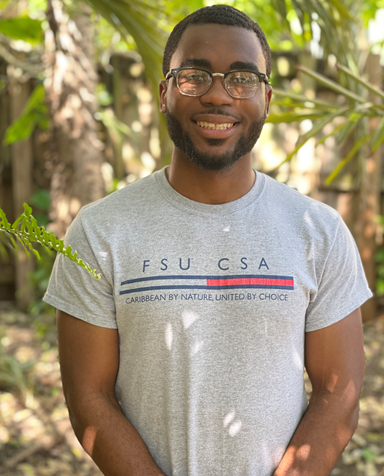
Editor’s note: This profile is the third in a series featuring former Florida Tax Credit Scholarship recipients who are included in the 2020 cohort of the American Federation For Children’s Future Leaders Fellowship.
 Ask Nanya Morris-El the secret of his success and he’ll respond without hesitation: powerful role models and a state scholarship that allowed him to attend a private school.
Both were crucial, he says. But if it hadn’t been for the scholarship, the role models would not have appeared in his life.
As one of six children, Nanya had become accustomed to going without the extras his peers enjoyed. His parents sometimes struggled to put food on the family’s table. There was no educational option for Nanya beyond his zoned public school, despite the fact it was overcrowded and didn’t always feel like a safe place.
Nanya had difficulty learning to read, and to comprehend what he was reading. He was held back in second grade, which only served to further undermine his confidence. By the end of fourth grade, he felt he was swimming against a strong current he was powerless to overcome.
“I was unable to receive the help and attention from teachers that I needed,” recalls Nanya, who is now 23. “Because I came from a lower income family and this elementary school was the only one in my school zone, I had to continue going there.”
Then his family learned about the education opportunities available to Nanya and his siblings through the state’s system of education choice scholarships. One, the Florida Tax Credit Scholarship, had a track record of assisting low-income families like Nanya’s by providing them with financial resources to send their children to private schools that could be a better fit for them.
Nanya started attending Academy Prep Center of Tampa and his life changed.
Among the resources available to him at Academy Prep was an additional English class that helped him with grammar and reading comprehension. He had the opportunity to go on field trips to museums that expanded his world. Most important, he established relationships with teachers who were willing to go out of their way to guide and nurture him.
One of those teachers was Regina Fuller, who introduced him to a book he still remembers fondly, “We Beat the Streets.” The book recounts the story of three boys growing up in a neighborhood choked with guns and gangs. The boys overcame these obstacles, went to college and became doctors.
“I started to learn that just because you’re in a challenging situation now, it doesn’t mean you can’t get ahead in life,” Nanya said.
Another mentor was his science teacher, Ralph Moore. Under Moore’s careful tutelage, Nanya reveled in hands-on activities that “went beyond the textbook” and kindled in him a love of science and nature.
Also on Nanya’s list of role models was Chris W. Altenbernd, a former appellate judge who had served more than 27 years on Florida’s Second District Court of Appeal. Nanya came to know Altenbernd in his role with the Greater Tampa Bay Area Council of Boy Scouts of America.
“He taught us how to tie knots and volunteer in the community,” Nanya recalls.
Nanya graduated from Academy Prep and earned a seat at highly competitive Jesuit High School in Tampa. He continued to excel academically and was accepted at Florida State University, where he majored in chemical engineering. He graduated in December, one semester ahead of schedule.
Now, he’s participating in General Electric’s Operations Management Leadership Program, which consists of three eight-month rotations that allow students to build leadership and functional skills through challenging assignments. He just finished a rotation at a healthcare manufacturing plant in Florence, South Carolina, and has moved on to Milwaukee, Wisconsin, where he’ll be immersed in the manufacture of X-ray imaging and CT scanners.
He’s also deeply involved in advocating for the type of education choice he says is responsible for getting him where he is today. As a member of the American Federation For Children’s Future Leaders Fellowship, Nanya travels the county meeting with families who struggle, as his did, with finding the best education options for their children. He writes op-eds for media outlets and talks to policymakers, all in an effort to dispel myths and spread the word about education choice.
For Nanya, this type of advocacy work has become second nature.
“Once I grasped its importance, I thought to myself, ‘If this is taken away, students just like me are not going to have the opportunity to go to a school like Academy Prep or Jesuit,’” he said. “You go to your public school, and if that doesn’t provide for your needs, that’s it. You just have to deal with it. I didn’t think that was the right way to go about it.”
For more information about scholarship programs administered by Step Up For Students, click here.
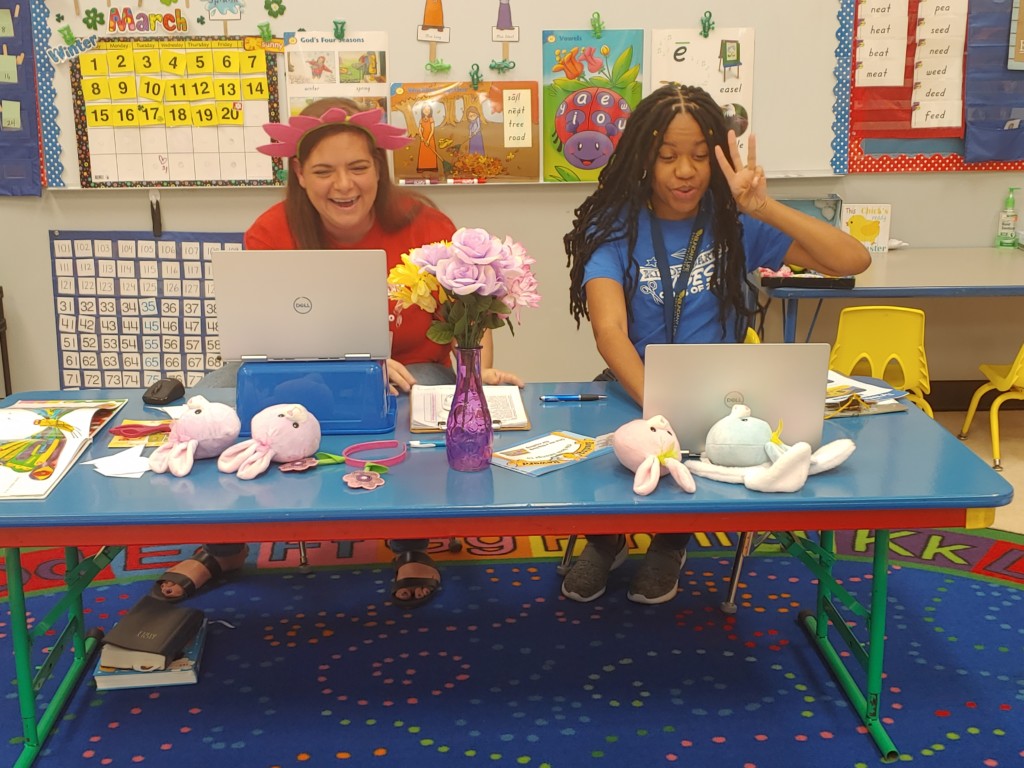
Abundant Life teachers Sarah Hennebery, left, and Carmen Mondesir conduct their end-of-week lesson, which included devotions, circle time, a spelling test and a math lesson.
The past year has been like a wild ride through the wilderness for Abundant Life Christian Academy, a small, faith-based private school about 15 miles northwest of Fort Lauderdale. Think Big Thunder Mountain Railroad, a fast, bumpy, roller coaster-type ride aboard a speeding train through a haunted goldmine in the dark at Walt Disney World Resort in Orlando.
Days before state leaders ordered COVID-19 school closures, principal Stacy Angier knew what was coming. As a member of the Broward Health Board of Commissioners, she had been working with the county’s nonprofit healthcare system to prepare her community for the shutdown.
Taking steps to prepare her students, families and staff for virtual instruction was nevertheless a challenge. The intrepid Angier managed to do it all in three days.
One year later, as the 2020-21 school year comes to an end, she’s breathing a sigh of relief. Despite enrollment declines that threatened the existence of some private schools and resulted in permanent closings of 209 of the nation’s 6,000 Catholic schools, Abundant Life remains intact.
“We have survived,” Angier said. “Most of our kids are back at school, and we’re going to make it.”
Fourth-grade teacher Jasmine White assists third-grade teacher Sharon Nugent in learning online platforms for remote learning.
Angier reopened Abundant Life to in-person instruction in August while continuing online learning for those who wanted it. Masks, desk shields, daily deep cleaning, social distancing and $320,000 in federal aid made it possible, along with state scholarship programs managed by Step Up For Students, which hosts this blog.
Angier also closely monitored the latest COVID information from Broward Health.
About 60% of the students chose in-person instruction. That number recently rose to 80% as families began feeling more comfortable about sending their children back to the classroom. Abundant Life’s total enrollment stands at 457, about the same as it was during the 2019-20 school year.
Looking ahead, Angier said she expects to see more interest from families whose children attend district schools, thanks to the recent expansion of state scholarship programs and raised awareness among parents.
Angier said positive COVID tests were limited to 26, thanks to safety protocols that included isolating and sending home anyone who appeared to be the slightest bit under the weather. It came to be known informally among the students and staff as the “three-sneeze” rule.
“I had a student tell me a teacher had sneezed three times and ask if they should be sent home,” Angier recalled. “When you can minimize exposure from kids not feeling well and from adults, keeping people who are sick home really does help everybody else.”
She said the school had zero flu cases, which she attributed so the stringent rule enforcement.
Despite the challenges, Angier and her staff managed to maintain a sense of community. They hosted an in-person National Honor Society induction ceremony for students and parents. They also allowed school sports to continue as much as possible.
At the end of the soccer season, the team gifted Angier with a backpack signed by all the team members as a thank you for letting them play.
“We tried to keep things as normal as possible,” she said.
Learning among those who were online proved to be the biggest challenge. Angier said teachers monitored virtual students closely to make sure they were turning in assignments and hitting benchmarks. Those who didn’t were directed to return to campus.
“The ones who have been home all year, unless they had a really focused parent … did not do as well as we wanted,” she said.
To address learning losses, Abundant Life is offering a three-week summer program in July that will be open to all students. Aigner expects those students who were learning at home, especially those with less adult supervision, will benefit the most.
“Those kids are seeing the most learning loss, so we we’re trying to target that to get things made up,” she said. “Some of these kids have lost a year.”
Slowly, things have returned to what used to be, although the school will continue some practices, such as encouraging children to eat lunch at outdoor picnic areas.
This week, Angier and 36 eighth graders, along with chaperones, celebrated the end of a stressful year with a field trip. The trip wasn’t part of her original plan; it evolved after the eighth-grade teachers came to her and told her the students were restless and disappointed that they had not been on a field trip all year.
“Where do you want to go?” she asked the kids. “You guys plan a trip and we’ll see what we can do.”
They chose Walt Disney World, the “happiest place on earth.”
Angier said the hotel staff worked to make it special, allowing the kids to swim one evening until 10. A Michigan couple at poolside asked if this was a school trip. Angier said yes.
“It looks like they’re all family,” the woman replied.
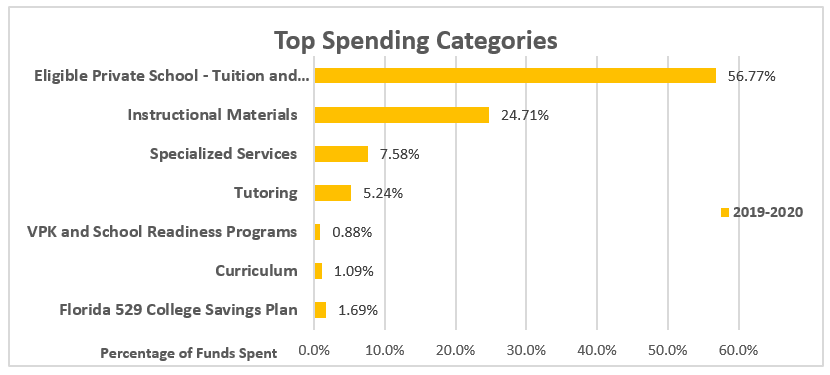 Families with children on Florida’s Gardiner Scholarship for students with special needs spent $117 million on private school tuition, books, curriculum, technology tutoring and more during the 2019-20 school year, according to a new report compiled by Step Up For Students.
While more than half (close to 57%) of scholarship monies was spent on school tuition, more than $50 million was spent on educational items not covered by other state scholarships, such as the McKay Scholarship, the Florida Tax Credit Scholarship and the Family Empowerment Scholarship.
Unlike those scholarships, Gardiner operates as an education savings account that allows parents to use scholarship funds to pay for a host of different educational options, such as curriculum, textbooks, school supplies, tutoring and afterschool or summer school programs. Unspent money rolls over from one year to the next, and parents can use the funds save for their child’s college expenses through college savings plans.
There were 14,319 students awarded Gardiner Scholarships during the 2019-20 school year, with 13,463 enrolled through Step Up For Students, which hosts this blog, compared to 11,393 students in the 2018-19 school year. The program funded $139 million in scholarships worth an average of $10,392.
Students ranged from 3 years old to 12th grade and comprised several different races, grade levels, prior school types and disabilities. Of those students, 62% had a diagnosis of autism; 10% intellectual disability; 8% rare disease; and 5% “high risk.” A little more than 3% of scholarship recipients had multiple diagnoses.
Other key findings in the report include:
· More Gardiner Scholarship students were enrolled in kindergarten through fifth grade (44%) than in middle or high school.
· There has been a slight increase in the percentage of Gardiner Scholarship students who are homeschooled students; 33 % were homeschooled in 2019-20 compared to 29.5% in 2014-15.
· More Gardiner Scholarship students live in Miami-Dade County (13%) than in any other county, followed by Orange County (8%).
· Around 84% of all scholarship funds awarded in 2019-20 were used by June 30, 2020.
· Only about 2.5% of families did not spend any of their scholarship funds in 2019-20 compared to 23.8% of families in 2014-15.
Gov. Ron DeSantis earlier this month signed a bill that will merge Florida’s two scholarship programs for students with special needs beginning with the 2022-23 school year.

