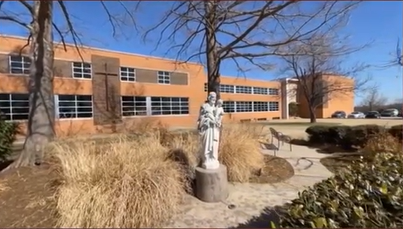
Oklahoma voted to approve the nation’s first religious charter school on Monday, a vote that will almost certainly be challenged in court as debate rages over whether taxpayer dollars can constitutionally go toward funding for religious schools.
An Oklahoma board made history Monday by approving the nation’s first religious charter school, a move that could set the stage for a legal battle over whether such schools, which receive taxpayer money but are independently managed, are public or private.
In a 3-2 vote, the Statewide Virtual Charter School Board approved an application from the Archdiocese of Oklahoma City and the Diocese of Tulsa to open St. Isidore of Seville Catholic Virtual School of Seville, which would serve students across the state without access to a traditional Catholic school and expand course offerings for those who already attend Catholic schools.
Because the application said the charter school would be “Catholic in every way,” it sparked fierce controversy, with threats of lawsuits from opponents and supporters regardless of the decision. The board’s general counsel, Deputy Attorney General Niki Batt, reminded members before the vote that the state constitution and the charter school law included language requiring charter schools to be non-sectarian.
She said the courts would ultimately decide the issue and that the board’s role is to act in an “executive” capacity as opposed to one of advocacy.
“The heart of the matter comes down to whether these schools are public schools or private schools,” Batt said. “This is an issue making it up to the U.S. Supreme Court we speak. It’s not your job to make the law, and not your job to interpret the law. It is your job to enforce the law as it currently exists.”
Two of the three board members who voted for approval said they considered a no vote a violation of recent U.S. Supreme Court rulings banning religious discrimination in education. You can watch the board meeting here. (The proceedings begin at minute 1:33.)
Opponents argued before the board Monday that granting the application violated the separation of church and state. Supporters, including former Oklahoma GOP Chairman A.J. Ferate, an attorney who has worked on national religious freedom cases, said anything other than approval would run afoul of recent U.S. Supreme Court decisions that ban discrimination against faith-based in schools in state education choice programs.
“Over the past six years, there have been three very clear statements from the U.S. Supreme Court,” he said, citing Trinity Lutheran Church v. Comer, Espinoza v. Montana, and Carson v. Makin, which all upheld the positions of religious groups. “There is no reason that this board needs to enforce or consider any protections under that state provision.”
He added that he would be “happy to protect and defend” the board in a lawsuit from groups opposing their decision.
Since the state’s Catholic leadership filed the application, the issue has caused division, even among the state’s Republicans. Former Attorney General John O’Connor issued an opinion in December as his final official act that came as the statewide virtual charter school authorizing board was set to decide on the application.
O’Connor said in his opinion that the state’s ban on publicly funded charter schools operated by sectarian and religious groups could violate the U.S. Constitution’s First Amendment and should not be enforced.
His successor, Gentner Drummond, withdrew O’Connor’s opinion and argued that it was based on precedent for private schools. Drummond said that state law defines, and the attorney general has previously recognized, charter schools as public schools, and that allowing the state to sponsor a religious school would create “a slippery slope” to use religious liberty to justify state-sponsored religion.
The clash promoted Gov. Kevin Stitt to weigh in by releasing a letter disagreeing with Drummond’s withdrawal of his predecessor’s opinion. State Superintendent of Education Ryan Walters also supported the application.
On Monday, supporters praised the board’s decision.
"This is a win for religious liberty and education freedom in our great state, and I am encouraged by these efforts to give parents more options when it comes to their child’s education," Stitt said in a statement.
“We are elated that the board agreed with our argument and application for the nation’s first religious charter school,” Brett Farley, the executive director of the Catholic Conference of Oklahoma, said after the decision. “Parents continue to demand more options for their kids, and we are committed to help provide them.”
Others, however, provided immediate pushback, including the nation’s leading charter school advocacy group.
“This decision runs afoul of state law and the U.S. Constitution. All charter schools are public schools, and as such must be non-sectarian,” Nina Rees, president and chief executive officer of the National Alliance for Public Charter Schools said in a statement shortly after the vote.
Rees continued that the application would undoubtedly face legal challenges from public school supporters.
“We stand ready to support charter school advocates on the ground in Oklahoma as they fight to preserve the public nature of these unique schools and protect the religious and civil rights of the students and teachers who choose them.”
The U.S. Supreme Court could decide the issue before any case involving St. Isidore of Seville reaches it. In a North Carolina dress code case, Peltier v. Charter Day School, the 4th U.S. Circuit Court of Appeals ruled that charter schools are state actors under the state’s legal framework and therefore bound by the Equal Protection Clause when it comes to setting and enforcing educational policies.
The high court asked Solicitor General Elizabeth B. Prelogar, the Biden administration’s top Supreme Court lawyer, for guidance.
 Last week saw some excitement in Arizona political circles as the Arizona Department of Education estimated 2024 Empowerment Scholarship Enrollment at 100,000 students. Sadly, “some excitement” translated into absurd fear mongering predictions of financial ruin for Arizona.
Allegedly, We.Are.All.GONNA.DIEEEEEEEE!!!!!!
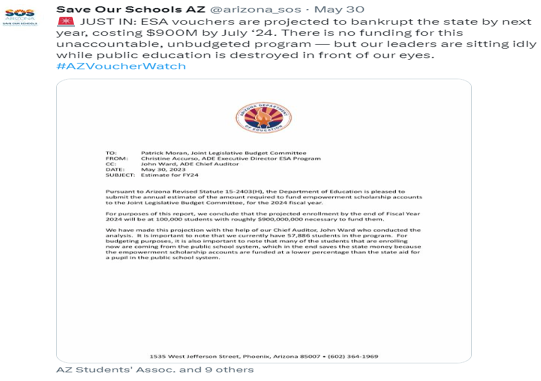
If Arizona choice opponents had done a bit of math, they might have spared themselves from having to breathe into a paper bag. I can, however, be of some assistance: $900,000,000 divided by 100,000 students is an average of $9,000 per student.
How much do taxpayers put per pupil into district and charter schools? Arizona’s Joint Legislative Budget Committee has an answer from fiscal year 2021:
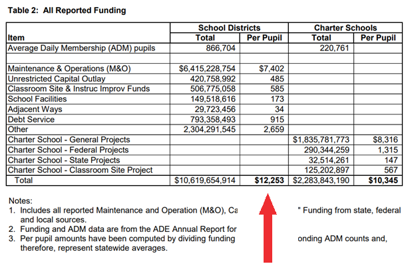
JLBC also has a statewide estimate for fiscal year 2023 of an average of $13,306 per student. In the reverberations of the Arizona anti-choice echo chamber, you’ll hear people desperately trying to claim that it doesn’t matter that $13,306 > $9,000 because of different pots of money (local, state and federal) because reasons.
Reasons that cannot be coherently articulated, but reasons.
 This belief is quite odd given that all the pots are filled up by the same taxpayers, who all pay local, state and federal taxes. Ergo, while the taxpayer may magnanimously pay more for students to attend district or charter schools at their option, it’s not like they have any reason to oppose children opting for the Empowerment Scholarship Account if that floats their particular boat.
My Texas public school math training informs me that the average ESA students uses approximately 32% fewer taxpayer resources per pupil than the average Arizona student. For you incurable skeptics, consider the budget of Mesa Unified:
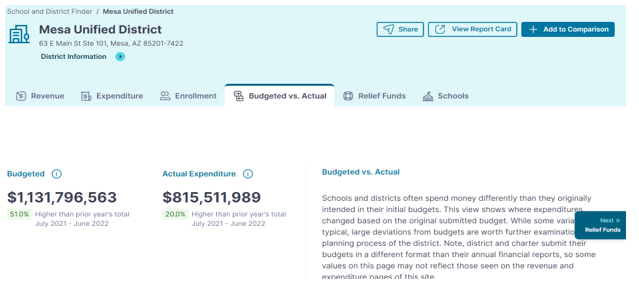
Mesa Unified had 54,000 students, was budgeted for $1.1 billion and change, actually spent $815 million and change. The memo that caused Arizona choice opponents to panic estimated 100,000 students at a cost of $900 million. So … ESA has far more students but fewer taxpayer dollars. If ESA is going to bankrupt Arizona, Mesa Unified is going to send Grand Canyon State taxpayers to a debtor’s prison.
Is the growth of the ESA program going to “destroy public education?” Hardly.
Arizona lawmakers have been listening to such non-stop predictions of doom since passing charter school and open-enrollment legislation in 1994. Since then, they have created a scholarship tax credit program (1997), expanded it multiple times, and created the Empowerment Scholarship Account program (2011) and expanded it multiple times. Lo and behold, Arizona’s spending per pupil in districts is currently at an all-time high, and this happened in academic growth:
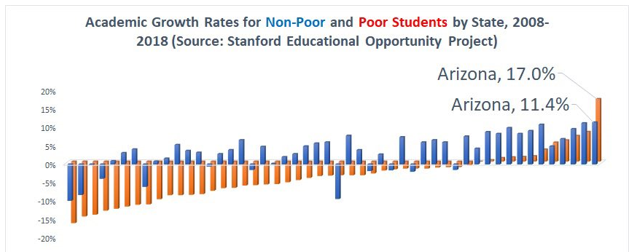
Please, sir, can I have some more “destruction?”

 Miami-Dade: More than 20,000 new immigrant students have enrolled in Miami-Dade County public schools this year. Officials say it's a historic increase that's helping the school district grow for the first time in two decades. NPR. Meanwhile, a long-time teacher in Miami is retiring after 40 years on the job. Aldin Everette has been at Miami Edison Senior High since 1983. WPLG.
Duval: The school district here had more A-graded schools and better funding in place when Diana Greene's five-year tenure as superintendent ended on Friday. In addition, it had fewer students in traditional schools and fewer whom state-mandated testing considered proficient in subjects like English, math and science. Greene's replacement will have to weigh those facts in addition to goals from a Duval County School Board strategic plan and new material that includes an ongoing legal review of claims about teacher misconduct. The Florida Times-Union. Some are debating the right way to pronounce the name of Ribault High in Jacksonville. Some say "Ree-balt," while others think it's "Ree-beau." News 4 Jax.
Volusia: As most high-schoolers prepare for a four-year college education, a number of them are trying their hand at old and new skilled trades that are in demand. In Volusia County, Pine Ridge High School has opened its doors to multiple skilled trade options that could lead to six-figure salaries in specific trades. WKMG.
Food support: Local school districts in the bay area are ensuring kids don't go hungry by offering free breakfast and lunch through the Summer Food Service Program for Children. Officials say between 3,000 and 4,000 meals will be prepared daily throughout the summer. "When school is out, kids are still hungry, so this program allows us to provide nutritious breakfast and lunch to any child 18 and under throughout the whole county," said Shani Hall, general manager for student nutrition services in Hillsborough. ABC Action News.
Overdose policies: Naloxone is a medication that rapidly reverse the effects of an opioid overdose. Across the country, schools are working to stock up as the opioid crisis takes a fatal toll on students. According to 2022 study from the Journal of the American Medical Association, adolescent overdose deaths jumped from 492 in 2019 to 1,146 in 2021. Fox 4.
Union dues: Central Florida unions are getting creative when it comes to collecting members dues after a law passed making it illegal to deduct these fees from a person's paycheck. Ron Pollard, local president of the Orange Education Support Professionals Association, says without dues, unions die. Pollard is assisting teachers and support staff sign up for an alternative payment platform called e-dues through the Florida Education Association. Under the new law, 60% of all professionals represented by a union must be enrolled in that union in order for it to operate in Florida. WMFE.
Public schools poll: A new NPR/Ipsos poll dives into the battles that have been playing out in America's public schools this year. WBUR.
University and college news: Students at Florida Gulf Coast University created a Hurricane Ian aftermath website as their capstone project. Ten students were tasked with writing roughly six stories each, putting together audio projects, videos, and capturing photos for the website students created, swflafterian.org. Hurricane Ian made landfall in 2022 in Cayo Costa, a small barrier island west of Fort Myers, as a Category 4 hurricane. Eight months later, the region is still rebuilding. "I'm just really proud of them. They did a lot of good work," said Professor Judd Cribbs said. "I hope that gives them a taste of what the professional world of journalism is gonna be like if they get into it." Ft. Myers News-Press.
Opinions on schools: The window of opportunity for school choice is still open, but it's uncertain for how long. Rick Hess advises advocates on various ways they can take advantage, which include focusing on how school choice solves problems for parents and paying attention to details of how choice policies work for families and educators, explaining how choice policies better serve the public interest and ensuring that choice policies serve all families. Lindsey M. Burke and Jason Bedrick, reimaginED. Young minds need to learn how to think, not what. Teach history, yes. But forcing things — agenda-bending, ideological service and the like — only add another murky veil to already complex material. Let them find the answers. Even middle schoolers do that. Bruce Anderson, The Ledger. Not only will more schools jack up their prices now that they know they can bill taxpayers for hefty chunks, more private schools will set up shop to cash in. Especially because in Florida, it's easy to open a school regardless of whether you're qualified to run one. Fiscal watchdogs and voucher critics predicted this cash grab would occur — that schools would raise tuition, pricing out some of the very families that voucher advocates claimed they were trying to help. Scott Maxwell, Orlando Sentinel. Language matters when it comes to talking about student learning, achievement and accountability. The United States need a K-12 accountability system that focuses on justice, not deficits. Jennifer Randall, The 74th.
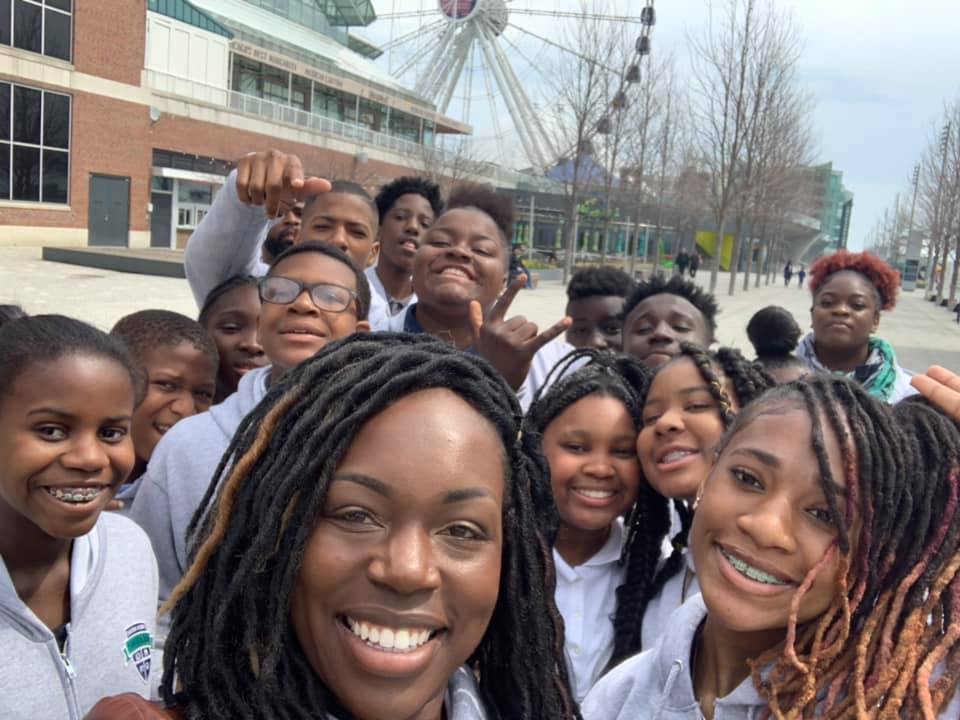
Monica Hall, pictured here, opened T.H.R.I.V.E Christian Academy in Stone Mountain, Georgia, in 2013. T.H.R.I.V.E. stands for Truth, Humility, Respect, Integrity, Victory, and Excellence, the six pillars upon which the school was founded.
Editor’s note: This report was compiled by Denisha Merriweather, founder of Black Minds Matter and senior fellow at the American Federation for Children; Dava Cherry, former director for enterprise data and research at Step Up For Students; and Ron Matus, director for research and special projects at Step Up For Students.
Across America, education entrepreneurs are on the rise, fueled by frustration with traditional schools, a pandemic that magnified the inequities of public education, and the accelerating expansion of education choice.
Black education entrepreneurs are in the thick of it.
We wanted to learn more about this distinctive group of innovators. So, we surveyed Black school founders who are listed on the Black-owned Schools Directory maintained by Black Minds Matter. The responses we received from 61 founders are a first-ever glimpse into who these entrepreneurs are.
Here’s a taste of what they told us:
 Who are the Black school founders?
Who are they serving?
What is motivating them?
What have they created?
You can read the full report here.
 Editor’s note: This commentary from Lindsey M. Burke, director, Center for Education Policy at The Heritage Foundation, and Jason Bedrick, research fellow at the center, appeared Wednesday on The Heritage Foundation’s website.
In his essay “Opening Doors for School Choice,” Rick Hess has offered characteristically sage and sober advice to advocates of school choice. In the midst of the movement’s most successful year ever—five states have enacted universal education savings accounts or ESA-style policies so far, in addition to several more new or expanded choice policies—Hess urges advocates to leverage their momentum prudently.
The window of opportunity for school choice is still open, but who knows for how long? To take full advantage before the window closes, Hess advises advocates to focus on how school choice solves problems for parents; to pay attention to the details of how choice policies work for families and educators, from transportation to barriers to entry; to explain how choice policies better serve the public interest; and to ensure that choice policies serve all families, not just the worst off.
However, it is worth elaborating on a point Hess made in passing that holds the key to this recent progress. In explaining why parents embraced school-choice policies in the wake of the pandemic-era school closures, Hess observes:
Parents were left hungry for alternatives, especially amidst bitter disagreements over masking and woke ideology. This was all immensely practical. It wasn’t about moral imperatives or market abstractions. It was about empowering families to put their kids in schools that address their needs, reflect their values, and do their job.
The choice movement’s recent successes stem from a confluence of factors, but one key ingredient has been a shift in how some central players in the movement talk about school choice. In his seminal book, “Agendas, Alternatives, and Public Policies,” John Kingdon argued there are fleeting moments in which a public policy problem, favorable political conditions, and a ripe policy idea are in alignment.
School closures and the politicization of the classroom posed a significant public policy problem for many families to which school choice could provide a solution, both in offering parents an immediate escape hatch to educational alternatives and in giving parents more bargaining power with their local district schools. When school officials know that dissatisfied parents can take their money and leave, they have a strong incentive to listen.
However, leveraging the favorable political conditions required choice advocates to connect with parents over cultural issues—an approach that the movement had previously avoided.
To continue reading, click here.

David Facey, who attends a private school in Florida using a Family Empowerment Scholarship for Students with Unique Abilities, cheers for the Tampa Bay Lightning at a game in Tampa during the 2022-23 hockey season.
PINELLAS PARK – David Facey remembers sitting in his Language Arts class last year hoping for salvation. Hoping someone would pull the fire alarm. Drastic, yes, but anything to bring class to an end.
The other students were nearly finished with their writing assignment. David had written only three words.
His teacher noticed. She wasn’t happy.
“David, what’s wrong with you?” she asked. “You need to concentrate.”
David wanted to scream.
It’s not a lack of focus. It’s dysgraphia, a neurological disorder that affects his ability to write. David can’t write within the lines. He can’t properly space letters. It took him nearly the entire class to write those three words. His hand cramped. He had a headache. He could no longer remember what he was writing about.
The topic was the ocean. David can talk for hours about the ocean. He just can’t write about it. That led to a confrontation with the teacher, a trip to the principal’s office, and a phone call to David’s mom.
David’s biological mother used drugs throughout the pregnancy, said Betty Facey, who along with her husband, Arlen, adopted David when he was 3. David was born addicted to those drugs. As a result, he has dysgraphia and dyscalculia, another neurological disorders where he struggles with numbers and math. He has atypical cerebral palsy, which affects his core strength and fine motor skills. He struggles with anger management.
“His are more hidden disabilities,” Betty said.
David, 14, didn’t have a problem in school until the Faceys moved from Michigan to Pinellas Park in 2021. Betty learned the teachers at his assigned school were not following his individual education plan. He couldn’t understand assignments. He couldn’t complete them. He couldn’t keep up with his classmates.
And when confronted by his teachers, he couldn’t control his anger.
“I would act all crazy and stuff,” David said.
With the help of an education choice scholarship, Betty enrolled David at Learning Independence For Tomorrow (LiFT) Academy in Seminole. LiFT is a private K-12 school that serves neurodiverse students.
“I would say if Florida didn’t have this (education choice) option, he would be stuck in (his assigned school) school,” Betty said. “He’d have to put up with the stuff they were dishing out. … He would hate school. He would probably not have a chance to graduate.
“To me, to be able to get him in a place like LiFT, which really is the perfect place for him, is sort of like a miracle.”
To continue reading, click here.
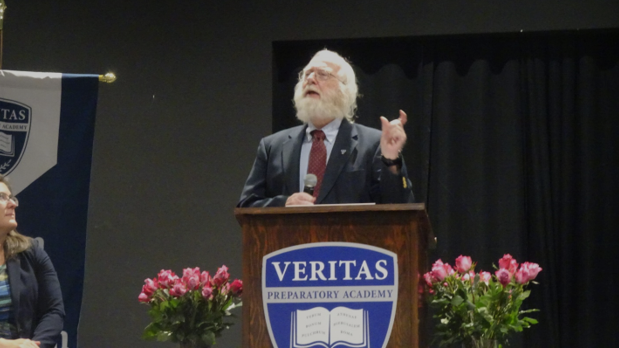
Mike Sullivan, who taught Classical Languages and Humane Letters at Veritas Preparatory Academy for 20 years, retires at the end of this school year. Before coming to Veritas, he was a private practice attorney and served the University of Minnesota in its Student Legal Services department after serving in the U.S. Army Intelligence corps as a translator and interpreter.
Veritas Preparatory Academy, a founding member of the prestigious Great Hearts Academy in the Phoenix metropolitan area, held a joyous retirement ceremony for one of its founding faculty members, Mike Sullivan, on May 20. Great Hearts recruited Sullivan, a 60-year-old attorney living in Wisconsin, to teach Latin and Greek.
Sullivan had enjoyed a career in the military followed by a legal career before finishing strong in the classroom for two decades. His most recent career holds a valuable lesson for policymakers.
Students, colleagues, and students who went on to became colleagues all related fond memories and valued lessons imparted by beloved sage-curmudgeon during the event. Veritas Prep’s first headmaster, Andrew Ellison, told of hosting the visiting Sullivan on a recruiting visit.
Ellison felt a growing sense of desperation over the course of the day, thinking he just had to have Sullivan join the faculty. Sullivan at one point told Ellison that he had been waiting all day for Ellison “to say something wrong” so he could get on a plane and go back to Wisconsin.
“But it hasn’t happened yet, and I don’t think it’s going to happen,” Sullivan said. Ellison described this as “the moment Veritas Prep was born.”
Policy decisions impact lives, sometimes in incredibly positive ways. It is worth noting that many states would not have allowed Mike Sullivan to launch his second career in teaching without jumping through a number of useless hoops. And, yes, I can demonstrate the uselessness of the hoops.
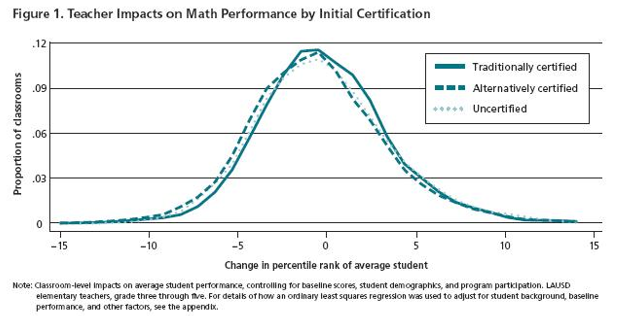 If you look very, very closely at this chart that comes from a study of student learning gains conducted by the Brookings Institution, you will see a dotted curve along with the line and dash curves. The three curves show the learning gains/declines from the students of traditionally certified teachers (the line curve), alternatively certified teachers (the dash curve), and finally from uncertified teachers (the dot curve).
Notice the lack of any meaningful difference in the overall curves; they all have highly effective teachers and highly ineffective teachers. But also note the difference between a right side of the bell-curve teacher and left-side is gigantic. As explained by the authors of the Brookings study:
Moving up (or down) 10 percentile points in one year is a massive impact. For some perspective, the black-white achievement gap nationally is roughly 34 percentile points. Therefore, if the effects were to accumulate, having a top-quartile teacher rather than a bottom-quartile teacher four years in a row would be enough to close the black-white test score gap.
Arizona lawmakers wisely gave charter school leaders the flexibility to recruit from any of the three curves in search of highly effective instructors. Ipsi prudenter elegerunt!
Veritas Prep found Mike Sullivan practicing law in a distant state and had the flexibility to coax him into a next great career. The adoration of Sullivan’s students and colleagues seems like a much greater compensation than any provided by a law firm.
More Sullivan-like instructors are likely awaiting discovery at some unexpected place. Find them and get them in the classroom!

Cornerstone Christian School outside Omaha, Nebraska, one of 228 private schools in the state serving more than 42,000 students, is a non-denominational Christian school that uses a biblical-based curriculum. Its mission is to equip children with “godly character and biblical truth.”
Editor's note: This commentary from Valeria Gurr, a Senior Fellow for the American Federation for Children and a reimaginED guest blogger, appeared Saturday on Nebraska's townhall.com.
Just a decade ago, there were only a couple dozen states in the U.S. with school choice programs. This week, Nebraska has made history as the 50th state in the nation to pass a school choice bill — a monumental win for families in the Cornhusker State.
This passage is not only a major victory for the school choice movement in Nebraska; it is also a testament to the advancement of educational freedom and opportunities nationwide for all children, regardless of color, race, or economic status.
Nebraska’s LB753, the Opportunity Scholarship Act, which just passed with a supermajority from the Unicameral Legislature, establishes a tax-credit scholarship that will help more than ten thousand students attend a non-public school of their choice.
Scholarships will average around $9,000 per student, depending on the needs of the family and tuition costs.
The Opportunity Scholarships Act will give first priority to students living in poverty, students with exceptional needs, those who experienced bullying, are in the foster system or are in military families, and children denied enrollment into another public school.
With the goal of empowering families, passing school choice in Nebraska was the right thing to do. As a Hispanic education advocate, I am fighting for my community to overcome inequality in education. A high-quality education is one of the only paths to success for children living in poverty.
A quality K-12 education is a path to economic progress and opportunity, preparing students for college and successful careers, and school choice will always be part of the solution since the traditional system of education will never fit all the individual needs of students and families.
To continue reading, click here.
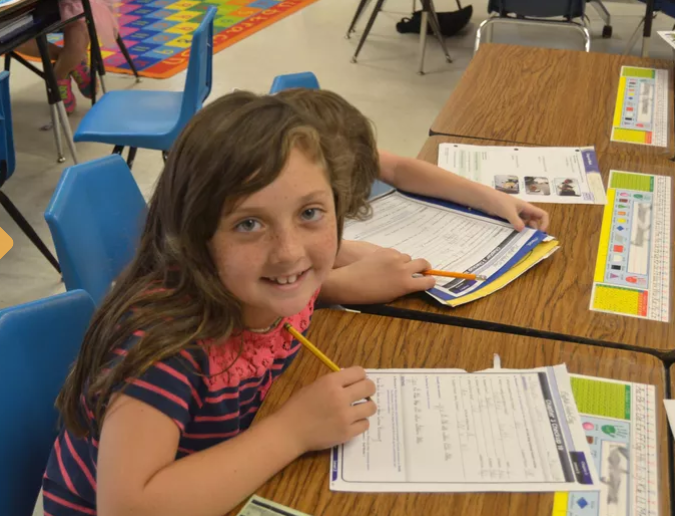
East Texas Christian Academy in Tyler, Texas, is one of 2,037 private schools in the state serving more than 331,600 students. Founded in 1979, East Texas Christian provides a quality education in a loving, supportive environment with a dedicated faculty and staff who integrate the word of God in every subject.
Editor’s note: This commentary from Jonathan Butcher, Will Skillman senior fellow in education at The Heritage Foundation and a reimaginED guest blogger, and Mike Gonzalez, the foundation’s Angeles T. Arredondo E Pluribus Unum senior fellow, appeared Friday on houstonchronicle.com.
Will additional private education choices force a mass exodus from assigned schools in these areas? Or everywhere across the state?
The answer to the first question is no. As best as we can determine, private learning options implemented in states including Arizona and Florida have never resulted in a public school shutting down.
A proposal to create education savings accounts offers parents and students more than just a new school. The accounts are not vouchers, and the distinctions are important. Arizona courts emphasized the differences in a 2013 opinion and ultimately ruled that the accounts did not violate the state constitution.
With vouchers, or private school scholarships, parents can choose a new school for their child — a life-changing option for children who have been bullied, are falling behind in class, or for whom the assigned school has not met their needs.
With an account, after parents choose not to send their child to a public school, the state deposits a portion of a child’s funding from the state education formula into a bank-style account. (Under Abbott’s proposal, that would be $8,000 per year.) The parents can use the money to buy certain preapproved education products and services for their children.
Private school tuition is one option for parents, but not the only one. Parents who want to offer their children a course not available at a local public school can use an account to pay for the course online or at a local college. Or they can find personal tutors or education therapists suited to meet a child’s unique needs.
The education options that Abbott seeks will not change local high schools’ role as key parts of civic life. By our calculations, just 5% of Arizona students use education savings accounts, and 2% of children in Florida participate.
To continue reading, click here.
 The map below shows states with either major school choice expansions or pending major expansions (green). I may be missing some green:
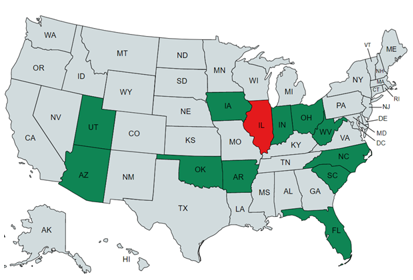 Sadly, the state of Illinois is in red, and seems poised to kill the Invest in Ed tax credit that provides 9,000 low-income Illinois children the opportunity to attend private schools. As the Wall Street Journal explains:
Unions want to kill the program because its popularity showcases the failure of the public schools. Invest in Kids had more than 31,000 applications last year, roughly five students for every scholarship it could provide. Every family lined up for a place at a private school is an indictment of a union monopoly that continues to prioritize its power over student learning.
Allowing the tax credit to sunset and forcing 9,000 students out of the school preferred by their families is, in a word, reprehensible.
A remedy however is available for these families: leave Illinois. Your state lawmakers care much more about rent-seeking special interests than they care about your family or your children. Other states not only value you more; they have much better return on investment for your tax dollars. These families are, alas, living in the wrong state.
Options are plentiful, but they lie outside of this cruelly indifferent state. Let’s consider some options:
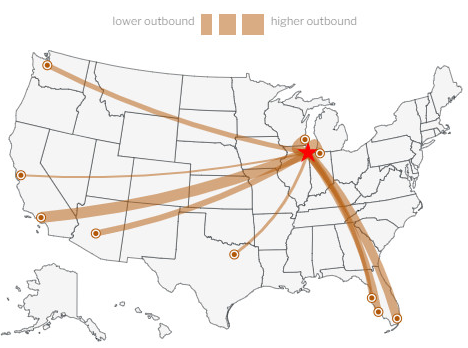
Wisconsin: The Badger State has not expanded its choice programs in 2023, but all 9,000 Invest in Ed students, and likely all 31,000 waitlisted students, will likely qualify for one of Wisconsin’s private choice program.
Note that Milwaukee is a train ride from Chicago, and Wisconsin is a state whose laws will provide K-12 options, lower taxes, and far more solvent public sector pensions. In other words, it is a far better governed state that is delightfully free from the need to imprison governors on a regular basis. Milwaukee is the new Chicago, check it out.
To Illinois’ immediate west lies Iowa, which delightfully just passed a universal private choice program. For decades, Iowa taxpayers have supported first-tier research universities only to watch many graduates move to Chicago. Chicago was once a great American city, but the smart money has already begun to leave. It’s time for Iowa to reverse the flow.
Even closer to Chicago lies Indiana. All the students who qualified for Invest in Ed will also qualify for the Indiana Choice Scholarship Program. Students with disabilities can qualify for the Indiana Education Scholarship Account Program.
Wisconsin, Iowa, and Indiana all constitute much, much better options for young families than Illinois, but this is not to say that they necessarily constitute the best option, which (obviously) lies in Arizona. Arizona not only has universal private choice, the nation’s strongest charter school sector and a low-and-flat income tax, and your Cubs have spring training here.
People having been moving from Chicagoland to Arizona for decades and Arizona has room for more! Did I mention that Arizona is delightful in the winter? Golfing in the winter looks like this:
 Last but not least, Florida has become the migration colossus of the United States. Other states will need to bring their “A-game” if they want to compete.
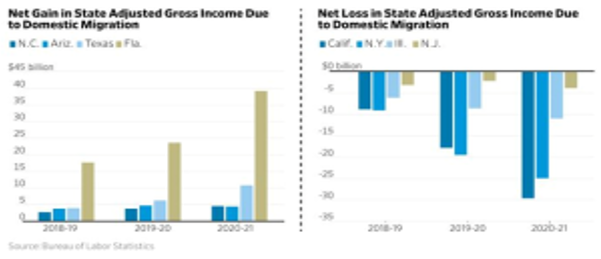 Feel free to make a case for your state in our blog’s comments.
The United States is gripped by a baby bust that began in 2008. Starting round about next year, this cohort will age into the working-age population. Young people are not just an increasingly scarce resource, they are the future for their states.
Illinois has over 2,000,000 students. Other states should try to rescue all of them.

