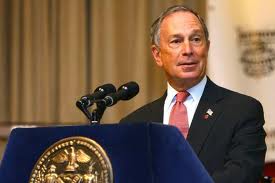
 New York: For the third year in a row, New York City charter schools outperform traditional public schools, drawing praise from Mayor Michael Bloomberg, pictured here (New York Times). More from the New York Daily News.
New Jersey: The state teachers union fights new charters even as it attempts to unionize charter school teachers (NJ Spotlight). State education officials approve nine new charters, but reject 10 and postpone 13 (NJSpotlight), including a full-time virtual charter. (NJ.com)
Florida: State education officials reject appeals from three virtual charter schools seeking to open in the Miami-Dade school district. (Miami Herald) Education Commissioner Gerard Robinson defends charter schools at a town hall meeting (South Florida Sun-Sentinel). In a key Democratic primary in South Florida, state senate candidates differ over support for vouchers and tax credit scholarships. (Palm Beach Post)
Louisiana: Students and schools in the state's new voucher program are not likely to face the same regulatory accountability measures as public schools (Baton Rouge Advocate). A nonpartisan watchdog group recommends state education officials seek legislative guidance as they craft accountability rules (Associated Press). The state teachers union pans the academic results of the state's first all-grades, on-line charter school, but the school fires back with accusations of cherry picking (Baton Rouge Advocate).
Michigan: Democrats fear vouchers will be part of Gov. Rick Snyder's plans to overhaul school funding (MLive.com).
Washington: Gubernatorial candidates Rob McKenna and Jay Inslee agree on many aspects of education policy, but disagree on charter schools. (Seattle Times)
Elsewhere: Study finds students in K12 Inc. virtual charter schools are lagging behind their peers in traditional public schools. (Washington Post)
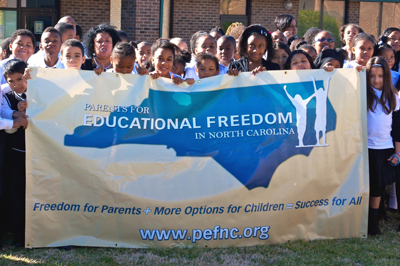 An attempt to bring a tax credit scholarship to low-income children in North Carolina succumbed to a short session and broader tax and education politics as the General Assembly adjourned on Tuesday. But the effort is worth noting in part because of the group pushing it.
Parents for Educational Freedom in North Carolina is a diverse, progressive organization with a membership of 60,000 and is led by a home-grown talent, Darrell Allison, who has a legal and civic mind and has worked in the White House and the U.S. Department of Justice. Allison and his team bring both a zeal to help struggling low-income children and a concern for getting the policy right and making the program accountable. (Disclosure to readers: I worked with PEFNC in preparations for the bill.)
The bill that ultimately was filed, HB 1104, fell short of the type of academic testing requirements the group was seeking. But overall the language kept faith with the 1,200 people who rallied at the Capitol in May, the 4,000 calls and emails that urged lawmakers to act, and the Democrats who signed on as co-sponsors. Importantly, at a time when some tax credit scholarship programs are coming under scrutiny for laws that lack genuine accountability and transparency, Allison and his team were trying to make sure their program had plenty of both.
The “Equal Opportunity Scholarship” was to be funded by contributions from companies that in turn received a dollar-for-dollar tax credit, and the scholarships were to be restricted to students with genuine economic disadvantage – those with household incomes not exceeding 225 percent of poverty. Scholarship organizations could not be tied to any school and could not allow donors to designate that their money go toward any particular student or school. The scholarship itself was to be $4,000, or just under half the amount the state and local governments spend on each public school student. Early fiscal evaluations showed that some versions of the bill saved money even when factoring only the state portion. (more…)
Stephanie Saul offered an indictment in the New York Times today of tax credit scholarship programs that have, in my opinion, serious design flaws. These flaws were almost guaranteed to provide examples like Saul found for her article. How lawmakers and, just as importantly, parental choice advocates respond is an important test of their credibility.
Not much of what Saul reported is new, though that makes it no less troubling. Georgia’s law sets no boundaries on the income of scholarship recipients and no limit on the amount of the scholarship itself. It requires no financial audits, no attempt at any meaningful data collection. Many of the contributions are steered through schools and parents with a self-interest to underwrite the tuition of their own students. In Georgia and two other states she covered, Pennsylvania and Arizona, the public has little idea whether students are learning because no tests are required and no academic data collected.
The story was loaded with powerful anecdotes of abuse, but employed surprisingly pedestrian journalistic standards in its attempt to portray those practices as national in scope. The punchline in what newspaper writers call the nut graph – that “the programs are a charade” – was qualified as a question raised by “some” private school administrators. The characterization of programs becoming “enmeshed in politics” was leavened again with the word “some.” How many of the eight states with tax credit scholarship laws “collect little information”? You guessed right. The answer was “some.”
To her credit, Saul did acknowledge that at least one state has different statutory and regulatory standards: “In Florida, where the scholarships are strictly controlled to make sure they go to poor families, only corporations are eligible for the tax credits, eliminating the chance of parents donating for their own benefit. Also, all scholarships are handled by one nonprofit organization, and its fees are limited to 3 percent of donations. Florida also permits the scholarships to move with the students if they elect to change schools.”
The Florida scholarship program, as readers of this blog should be aware, is where the creators of this blog work. So we certainly have a self-interest in seconding such an assessment but also an intimate appreciation of the tension that appropriately exists with education options that have one foot in the private market and the other in the public treasury. We want to give the parents of poor and struggling school children something they could not otherwise afford – a private school learning option – and we recognize that with tax-credited funding comes public responsibility.
Finding the right balance between regulation and market is no simple feat. But our prescriptions for a well-designed law are as follows: (more…)
New Jersey: At the American Federation for Children national summit, N.J. Gov. Chris Christie invokes civil rights  era imagery to make his case for vouchers. (Associated Press) Louisiana Gov. Bobby Jindal tells choice advocates they have "truth and the American people on (their) side." (abcnews.com) Newark Mayor Cory Booker decries an education system that "chokes out the potential of millions of children." (redefinED) Beyond the headlines, choice supporters also talk accountability. (redefinED)
Alabama: Embattled charter school bill is watered down again before passage. (Associated Press)
New Hampshire: Charter schools in the state are expanding rapidly. (Concord Monitor)
Montana: Vouchers and tax credit scholarships become an issue in the race for governor. (Billings Gazette)
California: Two dozen high-performing traditional public schools in Los Angeles seek to become charter schools. (Los Angeles Times) (more…)
The headlines covered Gov. Chris Christie's passionate call for education options in New Jersey, but the fine print here was equally edifying. In papers and workshops presented Thursday afternoon at the American Federation For Children's Annual Summit, the policy message was unambiguous and remarkably consistent:
All learning options must be scrutinized and must measure up.
Craig Barrett, the former chairman of Intel Corp. (pictured here), may have most succinctly summed up the discussions of accountability for charter schools and private learning options.
"We have to be willing," Barrett said, "to shut down schools that aren't working. We have to be ruthless, and I'm hopeful we'll have enough pragmatism to do that."
Summit participants were also handed a three-page document from AFC that described various academic, financial and administrative accountability provisions as essential ingredients to "ensuring the highest level of program quality and sustainability."
"Not only are transparency and accountability smart public policies," the document stated, "but they provide the school choice movement with readily available data and information to improve programs and illustrate the success of those programs."
AFC has gone so far as to rate the strengths and weaknesses of voucher and tax credit scholarship accountability provisions in 26 different programs across the country. And it didn't pull many punches. For example, it ranks Arizona's "Empowerment Scholarships" as measuring up on only two of eight broad accountability measures.
These proclamations won't end the division over how to measure success, of course, but they demonstrate a policy maturity that is beginning to draw a sharp contrast with some of the opponents of charter and private options - including the New Jersey teachers union with which Gov. Christie is at war. Just as it would be untenable for proponents to reject any public oversight and rely only on market mechanisms, it is also unpersuasive for opponents to argue that every option must be regulated in precisely the same way.
(Image from podtech.net)
 Do critics have a double standard when it comes to scrutinizing school choice options like charter schools and vouchers? Florida Education Commissioner Gerard Robinson suggested as much in an interview published today by the Tampa Bay Times’ Gradebook education blog.
In response to a question from the Times editorial board, Robinson noted that charter schools that struggle academically and/or financially can be shut down (in Florida, that has happened many times) but that same ultimate penalty is rarely leveled at traditional public schools (off hand, we can’t think of any examples in Florida). “For the bad charter schools that aren’t working, they should close,” Robinson said. “But for the traditional schools that have also failed a number of our kids, we don’t see the same level of righteous indignation.”
Robinson has deep roots in the school choice movement, having once served as president of the Black Alliance for Educational Options. And interestingly enough, the editorial board's questions focused mostly on choice options. Here are some other excerpts:
On testing accountability in voucher schools: “The private school curriculum isn't aligned to what we test on the FCAT (the Florida Comprehensive Assessment Test). So you're comparing apples to oranges. At the same time, there are the Stanford tests, there are Iowas, there are other tests you can take. So I'm not against assessment. What I am saying is, simply saying because they don't take the FCAT therefore they're not accountable is not correct.... “
On charter schools vs. magnet schools: “Charters and magnets both are theme schools. Charters and magnets both are public. And charters and magnets both take money. You often find magnets cost more than charters. But yet people say charters take money from public schools. People say charters are creaming the best and brightest kids. I can tell you from looking at the scores, that's not the case. And yet the magnet schools … are taking the best and brightest students … Magnet schools historically have been the largest public school choice program in the country, but also been more exclusive than other programs. And yet, all the angst we put on charters.”
On closing the achievement gap: “I've often said what you don't have is a political gap problem as much as you have a political crap problem. … If white kids are reading better than black, Latino, Hispanic or Native American kids, that's not a reading problem. We know what it takes to get kids proficient in reading. The question is, are we willing to make the tough decisions, political decisions, to get the right resources - human and financial - into the schools or after-school programs … to make it happen?”

