Editor’s note: As we reported last night, Florida Education Commissioner Tony Bennett made newsworthy comments yesterday when he spoke at an all-boys magnet school in Tampa. He suggested school choice wasn't a matter of public vs. private, and credited Florida school districts – Hillsborough’s in particular - for expanding magnets, career academies and other quality choice options. Here are his full remarks, edited slightly for length and clarity.
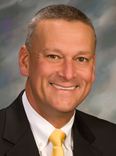
Bennett
The overview I want to give you about Florida’s choice framework is one that is, in my opinion, a true blueprint for our country. And I want to take you on this little journey. So just bear with me for a moment.
For many years, we said choice was about competition in education. And competition will raise all tides, right? The rising tide of competition will raise all the boats. And I can tell you, Florida has kind of changed that discussion. Again, being from Indiana, being from a state that tried and worked very hard to champion very similar policies, while competition in the educational system is good, the issue of choice here in Florida personifies the importance you put on what I believe to be the most important social justice issue in education. And by that, I want to do a little scenario.
If my wife and I didn’t have grown children, and in December when I was appointed, we would have gotten in our car, we would have driven to Tallahassee, and we would have driven around the community of Tallahassee, and we would have found the school that works best for the Bennett children. And the reason we could do that is frankly we could afford to. We could afford to live anywhere we wanted, send our kids to the school that we thought best fit their needs ...
And my point in this is, Florida is leading the discussion that all parents, regardless of the color of their skin or regardless of how much money they have, should have the same choice as Tony Bennett or MaryEllen (Elia, the Hillsborough superintendent). And that is a very different discussion in choice. And it is a discussion that I see is transcending what I believe can be really the first round of choice. And the first round of choice was frankly privates and charters against the public schools. Virtual schools against the traditional bricks-and-mortar buildings.
And I think MaryEllen in Hillsborough is an example of how we have taken that discussion in a completely different direction. Because this school (Franklin Middle Magnet and its Boys Preparatory Academy) provides a choice for children. This district provides a culture and a climate where choice is accepted and encouraged, and the opportunity that all children should have the same choices that Tony or MaryEllen have. They live that way.
So we’re now talking about choice – not just private schools and charter schools and virtual schools – we’re talking about public school choice. We’re talking about creative leaders like MaryEllen, like the team here, creating educational opportunities for children within the district. And really going to what we all heard was the purpose of choice to begin with, to provide incubation for innovation for our public schools. So I am very encouraged. (more…)
Florida’s new education commissioner is known for his zealous support of charter schools and vouchers and other learning options that some critics see as anti-public school.
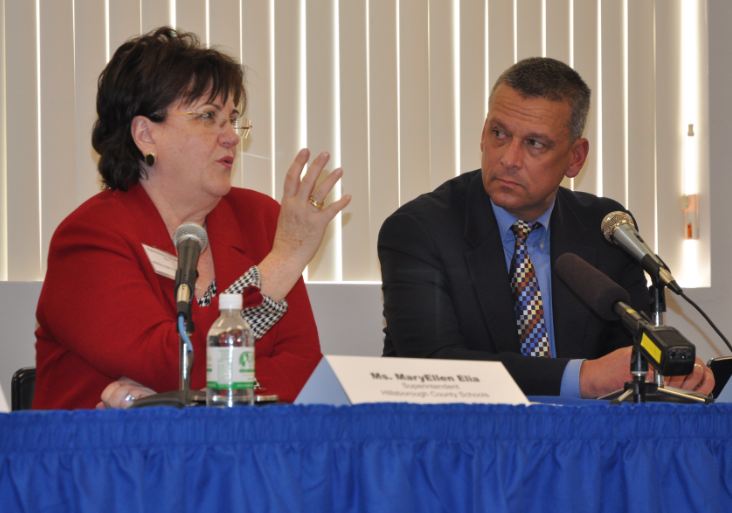
Florida Education Commissioner Tony Bennett and Hillsborough Superintendent MaryEllen Elia were among the panelists at a National School Choice Week event in Tampa. (Photo by Lisa A. Davis/Step Up For Students)
But on Tuesday afternoon, Tony Bennett sat next to Hillsborough County Public Schools Superintendent MaryEllen Elia inside a Tampa magnet school for boys, and praised the growth of choice in district schools across the state.
Florida is transcending the first round of conversations on choice that pit private and charter schools against public schools and virtual schools against “brick and mortar’’ ones, Bennett said during an event marking National School Choice Week. The new conversation, he suggested, isn’t either-or; it’s whatever works to ensure all kids have access to quality choices.
“So we’re now talking about choice – not just private schools and charter schools and virtual schools – we’re talking about public school choice,” he told an audience of about 100 people gathered at the Boys Preparatory Academy. “We’re talking about creative leaders like MaryEllen, like the team here, creating educational opportunities for children within the district - and really going to what we all heard was the purpose of choice to begin with, to provide incubation for innovation for our public schools.”
Tuesday’s event was sponsored by the Florida Alliance for Choices in Education, a coalition that includes a wide swath of school choice groups. Bennett and Elia sat on a panel with representatives from home-schooling, virtual education, magnet schools, career academies, Florida tax credit scholarships and McKay scholarships.
Most were parents who had lived and breathed school choice, starting with their own children. As they shared stories of searching for schools that practiced their faith or fit their child’s academic needs, they offered numbers that shed light on the choice movement’s impact. (more…)
California: The award-winning American Indian Model charter schools face closure after failing to fix problems with financial oversight that resulted in $3.8 million of questionable expenses (The Oakland Tribune).
Wisconsin: Three former state House speakers push for a voucher expansion (Associated Press). School choice options continue to grow with proponents pointing to achievement gains (WisconsinReporter).
Indiana: Ball State University pulls its sponsorship of seven struggling charter schools, likely ensuring their closure (Associated Press). School choice supporters press for an expansion of the state's voucher program (NWI.com).
Texas: A school choice proponent testifies that a tax credit scholarship program would save the state $2 billion a year (Houston Chronicle). More from San Antonio Express News. Waco-area school boards support a resolution opposing any publicly funded private school choice options for the state (Waco Tribune Herald).
Michigan: The legislative path for Gov. Rick Snyder's school choice expansion plans remain murky (MLive.com).
Tennessee: A school board member in Knox County tries unsuccessfully to convince his colleagues that private school vouchers are a good thing (Knoxnews.com). State lawmakers scrutinize Tennessee Virtual Academy, operated by K12 Inc., over poor test results (Tennessee Public Radio). Memphis charter schools are poised to grow - again (Memphis Business Journal). The NAACP pushes for more regulatory accountability for charter schools in the wake of complaints about one in Memphis (Memphis Commercial Appeal). Gov. Bill Haslam is expected to unveil his proposal for a limited statewide voucher in his State of the State speech tonight (News Channel 5).
New York: Twenty-four more Catholic schools in the state will close because they're not financially self-sufficient (New York Times). (more…)
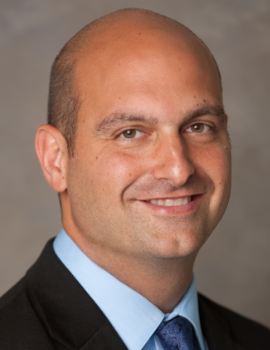
Vitti
The sprawling, 125,000-student school district in Duval County, Fla., has a reputation for being particularly cold territory for vouchers and charter schools. But last month, its new superintendent recommended the school board approve a dozen new charter schools and, in doing so, sounded this refrain: We have to compete.
In an interview with redefinED, Nikolai Vitti said the competition injected into public education through expanded choice will improve schools in Duval, which has struggled with low-income students more than other big districts in Florida. He said he “vehemently opposed” limiting options for low-income parents. He spoke admiringly of the mission and innovative practices of the KIPP charter schools.
“The reality is, the market – meaning the structure of choice – forces me to compete, even if I don’t want to. And if I don’t compete, parents will continue to leave the school district,” Vitti said. “And so my role as superintendent is to improve our product.”
But Vitti, who previously served as chief academic officer in the Broad-Prize-winning Miami-Dade district, also offered a number of caveats. State rules tilt the playing field towards charter schools, he said. And in his view, the debate over them has been driven by perceptions of quality, not data.
“There are charter schools that have a track record of success, and particular charter schools that have failed, and failed in multiple areas,” he said. “Let’s not have an ideological conversation. Let’s have one based on data where we look at individual charter schools, individual traditional public schools, and ask the question: Who’s successful? Who’s not? And what’s the best situation for parents based on how they’re looking at it, and how the district as informed educators are looking at it?”
Vitti also offered a surprising take on who should authorize charter schools. In Florida, only school boards can do so – a situation that charter school opponents prefer, and one that may be tough to change because of restrictive language in the state constitution. But Vitti said unless changes are made to the charter application process – something that forces better dialogue between charters and districts – he’d rather have the state do the authorizing.
“I do believe there’s a way to create a balance between simply approving charter schools at the district level based on a boilerplate application process … and instead allow and require the charter school to be more strategic with the district,” he said. But “if we’re not going to create some kind of balance between that, then simply place the onus of the application process on the state. Because essentially that’s what’s happening already.”
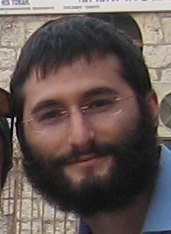
Rabbi Dubrowski
As a Rabbi in training, I had the opportunity to travel and live in countries around the world, such as Argentina, France, Israel and Ukraine. What I saw was greater emphasis on preparing the youth to succeed in life. Kids were being given the skills necessary to grow and become successful adults who can find work and support themselves and their future families. In the U.S., we are definitely falling short of this goal.
As the most prosperous country in recent history, we owe a great deal of our success to free markets and the excellence that competition breeds. The ability to choose where you live, work and play has forced the marketplace to create products catered to our society.
Education should be no different. The more options we have for schooling our children, the more focused schools will be on providing the best experience possible. This means supporting a successful public and private school system, so parents can find the right environment and system that caters to their individual child's needs.
The reality is many children have been removed from this marketplace by the cost of tuition at private schools. Even with scholarships available, it is still too costly for many of our middle-income families, thereby excluding them from making the right choices for their children.
Floridians are truly fortunate that our state has seen this challenge and acted to overcome it. (more…)
Count newly-elected Florida Rep. Manny Diaz, Jr. among a number of state lawmakers who are public school district employees. But Diaz, an assistant principal in the Miami-Dade public school district, isn’t just a cheerleader for traditional public schools.
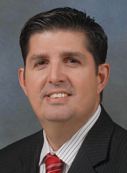
Rep. Diaz
He’s also a huge – and very vocal - advocate for school choice.
“We have an evolving student body – different than what it was five years ago,’’ Diaz, a Republican who represents his hometown of Hialeah, said during a recent telephone interview with redefinED. “I do believe we have to look at all the options.’’
Diaz has been appointed to the House Education Committee, as well as the K-12 and Choice & Innovation subcommittees. Among his goals there: to help guide fellow lawmakers and education leaders toward reform that is “student-centered and parent-centered.’’
To that end, Diaz said he fully supports district programs, such as magnet schools; high-quality charter schools; and other nontraditional options, such as tax credit scholarships.
“I think the competition makes our educational choices better,’’ he said. And better can only be defined by results. “I’m big on the accountability side,’’ Diaz said. “It’s a matter of having the political courage to move forward, to take measures already in the law.’’
If a district school isn’t helping students succeed academically, bring in interventions, he said. If a charter school isn’t operating ethically, shut it down.
Diaz also responded to recent news reports in which Gov. Rick Scott called for private schools that accept tax credit scholarships to give those students the same tests as their public school peers. (more…)
 Florida: Incoming Florida Education Commissioner Tony Bennett talks about the idea of voucher students being required to take the same standardized tests as their public school peers (Tampa Bay Times' Gradebook blog).
Texas: Lt. Gov. David Dewhurst sees expanded school choice as part of a legislative agenda that aims to make Texas the most conservative state in the country (Associated Press). The pending fight over vouchers highlights a difference over the best way to fund schools (Dallas Morning News).
Tennessee: A possible school voucher program will be a top issue for Gov. Bill Haslam and state lawmakers next year (The Tennessean).
New Hampshire: The state's new tax credit scholarship program will again be the subject of debate - and potential legislative action - next year (New Hampshire Public Radio.)
Indiana: The state's school districts turned to marketing efforts in 2012 to compete with private school vouchers (Evansville Courier & Press). Charter school administrators say they have the flexibility to quickly respond to make improvements (Evansville Courier & Press).
Massachusetts: A new Pioneer Institute report opens a debate over the value of school choice options, specifically tax credit scholarships and education savings accounts, for Jewish day schools (Masslive.com)
Louisiana: Education reform,including creation of a statewide voucher program, ranks as one of the year's biggest stories (Houma Comet). Gov. Bobby Jindal's education reforms have reliable backing from the state education board, including its elected members (Baton Rouge Advocate).
Ohio: A long-troubled charter school moves again (Cincinnati Inquirer).
Washington D.C.: Fewer than half of the city's charter schools employ nurses (Associated Press).
Pennsylvania: Charter schools aren't just small, independent operations any more (Pittsburg Post Gazette). The western part of the state is seeing a rapid increase in charter school enrollment (Trib Live).
Delaware: Three charter schools delay opening next year, citing start-up costs and problems securing locations (Delaware Online).
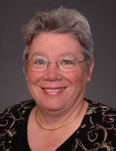
Frank
When people hear the term “school choice,” they usually don't think about it in a traditional public school setting, said Joy Frank, general counsel for the Florida Association of District School Superintendents. But public school districts offer students a growing array of choice programs, too, from online classes to career academies to International Baccalaureate programs.
“We have embraced choice,” Frank told members of the Florida House Choice & Innovation Subcommittee during its first meeting this week.
Frank’s comments are another sign of evolving perceptions regarding parental school choice. She and others who are grounded in the traditional public school camp may not embrace publicly funded private options such as vouchers and tax credit scholarships. But it wasn’t long ago that even public options such as IB and magnet schools were considered controversial. Implicit in her remarks is an acknowledgement that giving parents more choice for their children is a worthy goal.
Frank went on to tout public school choice programs across the state, including Polk County’s Central Florida Aerospace Academy, which has a high school at the Lakeland Regional Airport. She also lauded the phenomenal growth of school choice in Miami-Dade County, which opened its first magnet school in 1973 and now offers some 340 choice programs serving 43,000 students. (Coincidentally or not, the Miami-Dade school district also has among the highest rates of students enrolled in charter schools and private schools via tax credit scholarships.)
Traditional school leaders in Florida are increasingly making similar statements. (more…)
Tony Bennett. He’s in the mix for Florida education commissioner. Coverage from Orlando Sentinel, Indianapolis Star, StateImpact Florida. A list of all candidates on Gradebook here.

Vitti
Welcoming competition. New Duval Superintendent Nikolai Vitti is recommending the school board approve 12 of 14 charter school applications up for a vote today, reports the Florida Times Union. He also tells the board the district has to compete and “dominate the market” so “when a charter school tries to set up shop they will find themselves unable to compete with us because we are that dynamic and innovative.”
More on grad rates. Orlando Sentinel. AP. The Ledger.
More on remediation. StateImpact Florida.
Cherry picking. EdFly Blog calls out Reuters for last week’s story about Florida’s academic gains.
Union news. Karen Aronowitz won’t seek another term as president of United Teachers of Dade, reports the Miami Herald.
 At Jeb Bush’s National Summit on Education Reform in Washington, D.C. last week, two prominent education reformers from the center-left and the center-right joined to make a remarkable statement about parental choice. Asked from the audience to name their “No. 1 idea” to improve public education, former New York City school chancellor Joel Klein and former U.S. Secretary of State Condoleezza Rice answered with a remarkably united voice.
Their three minutes of extemporaneous remarks are well worth your time, and are available through C-SPAN.org here.
In brief, Klein spoke of the way various types of learning options, including charter schools, have helped spur improvements in New Orleans and Harlem: “About a third of the kids in Harlem in the third grade are in charter schools. What’s amazing is the Harlem District went up, and this is apples to apples, went up dramatically from when we started this intensive choice process there to now. … Not only did the charter schools outperform almost everybody, but the public schools … actually moved up significantly themselves.”
Rice spoke to how competitive pressures have produced a “catalytic” effect in higher education, and noted that only wealthier families tend to have choice in a K-12 system where pupil assignment is determined only by geography: “So the only people stuck in neighborhood schools are poor people, and that’s the height of inequality. And that’s why I’ve called it a civil rights issue.”

