EdChoice retained the polling firm Morning Consult to survey a nationally representative sample of more than 1,500 American parents in early November 2023 about what they want from schools and how they go about finding it. The above figure shows that more than twice as many parents report looking for school information from school ratings websites as from state report cards, and exactly twice as many report seeking information from friends and neighbors as from state report cards.
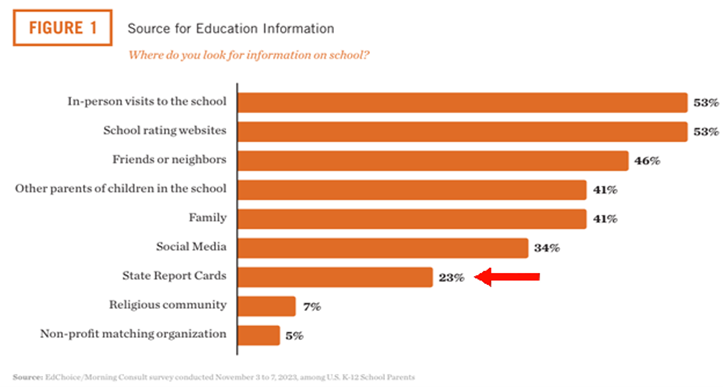
This finding reinforces previous research showing that parents value school reviews (which state report cards do not typically collect) and trust non-profit information sources more than government ratings. While mileage may vary by state, the public’s preference for private rating websites and informal networks strikes me as entirely appropriate given the presence of many state rating systems on a three-dimensional spectrum of convoluted, deceptive and/or more difficult to decipher than Mayan hieroglyphics. Some systems manage to earn a hat-trick on these dimensions (I’m looking directly at you Arizona).
Non-profit organizations run private rating systems, and delightfully have proven much more resilient to district industrial lobbying complex influence than state bureaucracies. If anything, your author can’t help to wonder if those 23% were just being, well, polite.
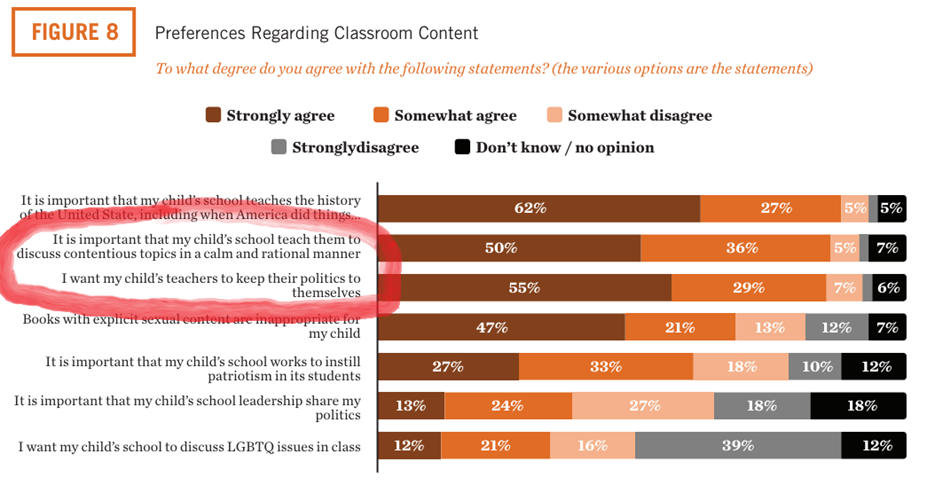
The survey also asked about what parents want from schools in terms of dealing with contentious issues. 86% of parents agreed with wanting students to learn to discuss contentious issues in a calm and rational manner, and 84% agreed with wanting teachers to keep their politics to themselves. Public school teachers posting political manifestos on social media looks bad for business. You don’t forfeit your First Amendment rights because of little things like blue-colored hair and/or a portrait of Pennywise tattooed on your forehead, so you do you. Likewise, however parents don’t forfeit their free association rights

In terms of what parents are looking for from school, it certainly varies (thus the need for pluralism) but it is not terribly hard to decipher.
 Editor’s note: This article appeared last week on the74million.org.
As parents become increasingly frustrated over pandemic learning loss, their desire for education savings accounts, or ESAs, has boomed — gaining overwhelming support from not only Black parents but also Black teachers, according to a new poll by YouGov.
The poll released by Yes. Every Kid. gathered respondents’ views on ESAs, a program giving families access to state education funds to pay for approved services, such as private school tuition, instructional materials and tutoring.
From the 634 parents interviewed, 59.7% support ESAs, with 14.6% opposed and 25.7% undecided.
Similar splits were seen among parents along party lines, with 67.5% of Democrats, 61.3% of Republicans and 55.3% of Independents in favor of ESAs.
But ESAs are certainly controversial, with supporters, often Republicans, backing the program’s boon for family empowerment; and opponents, often Democrats, arguing how the program undermines public education.
“The momentum we are seeing, not just with the public but with parents, educators and those who are in some way touching education in America right now is very much inspiring,” said Erica Jedynak, chief operating officer of Yes. Every Kid.
According to the YouGov poll, support for ESAs is decisive among Black parents, with 70.3% in favor of the program. By comparison, 59.1% of white parents and 50.8% of Hispanic parents support ESAs.
The pattern is similar among teachers: From the 313 teachers interviewed, 58.8% support ESAs in contrast to 14.7% that oppose and 26.5% that are undecided.
Among Black teachers, however, 78.9% favor ESAs. By comparison, 56.2% of white teachers and 60.7% of Hispanic teachers favor the program.
To continue reading, click here.

Support for school choice has increased since April 2020 by 8 percentage points, from 64% to 72%, according to a new poll from RealClear Opinion Research.
The largest increase in support for school choice came from Democrats (up 9 percentage points) followed by Republicans (7 percentage points) and registered Independents (7 percentage points). Overall Democratic support also was higher than registered Independents (68% compared to 67%) but lower than Republicans (82%).
Hispanic Americans were the most likely to support school choice (77%) compared to white Americans (72%) and Black Americans (70%). Asian Americans showed the least support (66%) and were more likely to oppose school choice (26%).
Tommy Schultz, CEO of the American Federation for Children, called the poll numbers “stunning.”
“The past two years have exposed to the world what many in the parental choice movement have known for decades: no single educational environment is right for every child,” Schultz said. “As the battle over educational freedom continues, party affiliation is secondary to ensuring all families are empowered to choose the best educational setting for their children.”
Schultz warned policymakers:
“As these poll numbers show, there will be consequences if you go against the staggering majority of parents who support this issue.”
RealClear Opinion Research polled more than 2,000 registered voters Feb. 5-9 for the survey.
Other demographic research shows that in Florida, 48% of K-12 students utilize some form of school choice, up 45% from the previous year.
Public options, such as charter schools and district open enrollment, are among the most popular choices, but private school scholarships have been among the fastest growing. This year, 188,774 students received scholarships from Step Up For Students.
The scholarship administration nonprofit, which hosts this blog, manages four scholarship programs that allow students to attend private schools, including the Florida Tax Credit Scholarship, the Family Empowerment Scholarship for Educational Opportunities, the Family Empowerment Scholarship for Students with Unique Abilities, and the Hope Scholarship for victims of bullying, harassment and sexual assault.
Step Up also administers transportation scholarships allowing students to attend other public schools, as well as a Reading Scholarship to help public school students who struggle with reading and reading comprehension.

New research from a national polling organization shows 65% of more than 1,100 registered voters surveyed support school choice while 16% are unsure. The results are true across party lines, with 75% of Republicans, 61% of Democrats, and 60% of Independents saying they strongly or somewhat support school choice.
Meanwhile, 55% of voters polled say that some or all of the funds the federal government set aside for K-12 education should be directed by parents, with 21% saying that none of the funds should be directed by parents and 24% unsure.
Regarding school choice, the poll asked: School choice gives parents the right to use the tax dollars designated for their child's education to send their child to the public or private school which best serves their needs. Generally speaking, would you say you support or oppose the concept of school choice?
Support was strongest among Black voters, with 69% answering affirmatively, followed closely by Asian voters (68%); Hispanic voters (67%) and white voters (64%).
On the second question, the poll asked: The federal government allocated $190 billion towards K-12 education from stimulus packages since March 2020, which would essentially be $3,400 for every K-12 student in the country. How much of that funding should be directed by parents?
Here, support was strongest among Black voters, with 66% in favor, followed by Hispanic voters (58%); Asian voters (55%); and white voters (52%).
American Federation For Children president and CEO Tommy Schultz observed that while the pandemic underscored the need for additional school options, public support for school choice is nothing new.
“This year already, at least a dozen states have enacted new school choice programs or expanded existing programs because they're recognizing just how popular this issue is amongst K-12 families,” Schultz said. “We are grateful that lawmakers are listening to the needs of families, but millions of children are still waiting for better options. We will continue fighting for those kids and to empower parents with the funds meant to deliver a high-quality education."

