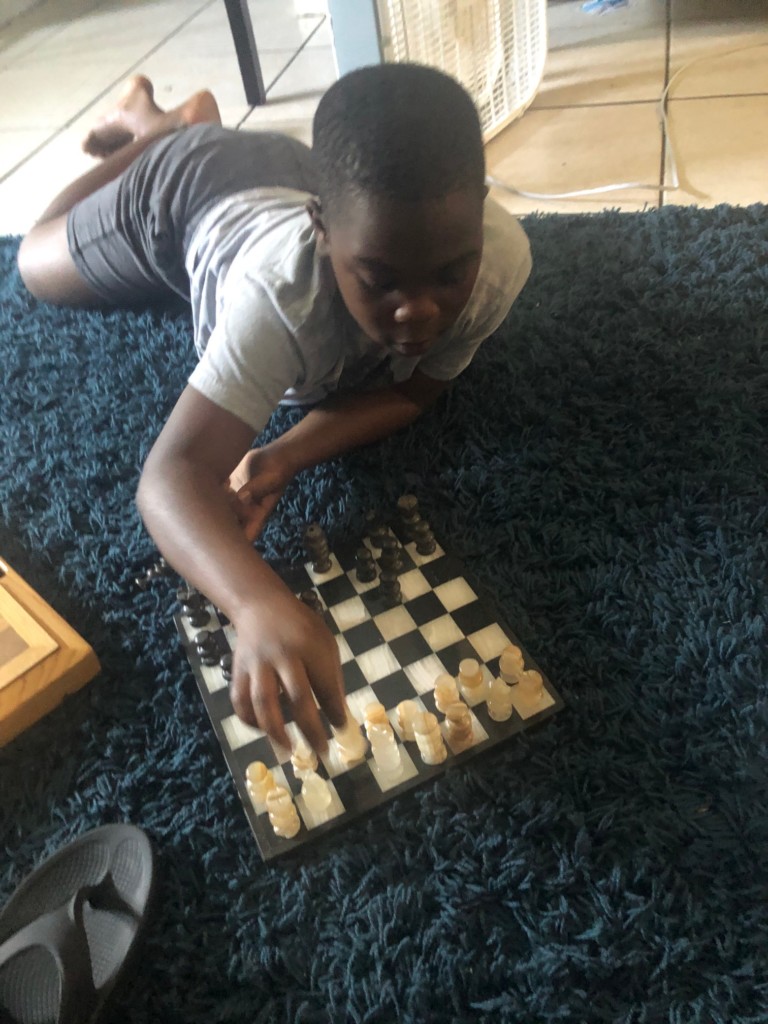
Joshua Edwards, who has benefited from the education choice options his parents have exercised over the years, wants to start a chess club at his school.
This commentary is an exclusive to redefinED from William Mattox, director of the Marshall Center for Educational Options at the James Madison Institute.
TALLAHASSEE – Harold and Talethia Edwards have a house full of precocious children. And to hear them describe their offspring is a veritable delight.
There’s the musical son who plays five instruments. The studious daughter who skipped a grade and now tries to hide her age from her International Baccalaureate classmates. The flower child who makes up songs as she paints. The athletic kid who wants to start a chess club at his classical school. The spicy little sis who gets restless if she feels chained to a desk. The witty drama queen who wants to wear “sparkly clothes” instead of school uniforms.
And then there’s the preteen son who scored 159 on an IQ test and someday hopes to find the solution to one of the six problems no mathematician has yet been able to solve. A scholar at Florida State University’s famous “mag lab” is interested in helping mentor this boy’s academic development.
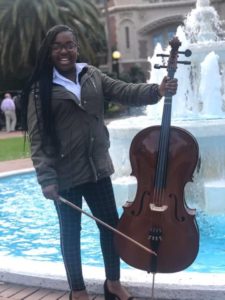
Haniah Edwards excels in both academics and the arts.
Which is one of the reasons Talethia supports converting school choice vouchers (which the Edwards have used at a conventional private school) into flexible education savings account scholarships that parents can use to fund a wide array of “unbundled” educational opportunities, including one-on-one mentoring arrangements.
Talethia believes expanding the flexibility of school choice scholarships would make them more useful to many families, including the growing number of African American families now embracing innovative micro education options.
Thankfully, a proposal before the Florida Senate would do just that – convert school choice vouchers into flexible ESA scholarships. But the House companion stops short of going this far, partly out of concern that a major overnight change could spur too much disruption in current schooling patterns.
Is there room for a grand compromise? You bet.
Florida leaders ought to consider differentiating scholarship amounts for those using traditional tuition vouchers and those using flexible ESAs. The precedent for such differentiation is found in Florida’s current treatment of online education, where the state’s per-pupil allotment for full-time online students ($5,230) is less than that for students attending traditional brick-and-mortar schools ($7,786).
The rationale for differentiation is that Florida taxpayers ought to be able to reap the savings of more cost-efficient (online or unbundled) ways of learning. And while this rationale raises some very legitimate concerns about the equitable treatment of all students, the current question before the Florida Legislature is not whether differentiated funding is ideal. The current question is whether differentiated funding would enable more families to benefit from non-traditional learning opportunities without spurring a mass exodus from conventional brick-and-mortar schools.
Differentiated funding would have that very positive effect.
It would give greater flexibility to scholarship-eligible families (like the Edwards) who need learning options not on the current menu. At the same time, it would give scholarship recipients happy with their current school no economic incentive to switch from vouchers to ESAs.
That’s a win-win.
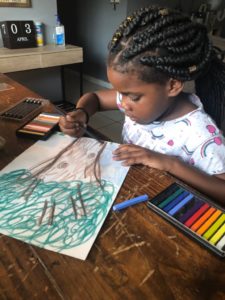
The youngest Edwards child loves to draw.
Moreover, if Florida legislators were to differentiate scholarship funding, they would be able to more easily expand eligibility for (lower-cost) ESAs to many middle-income families currently denied any per-pupil scholarship assistance. (And aiding middle-income families currently left out in the cold is arguably a greater equity concern than equalizing scholarship amounts for current recipients.)
Indeed, many middle-income families have turned to DIY education options like pod learning and hybrid schooling during the pandemic. And many would happily continue these highly effective educational practices if flexible (and less costly) ESA scholarships were available for their use.
When Florida’s House and Senate leaders go to resolve differences in their two approaches, let’s all hope they adopt a compromise that gives greater learning flexibility to more Florida families without significantly disrupting current voucher usage.
Doing this would greatly benefit many Florida families. And it just might help a precocious Edwards child someday find the solution to one of those six math problems no one has been able to solve.
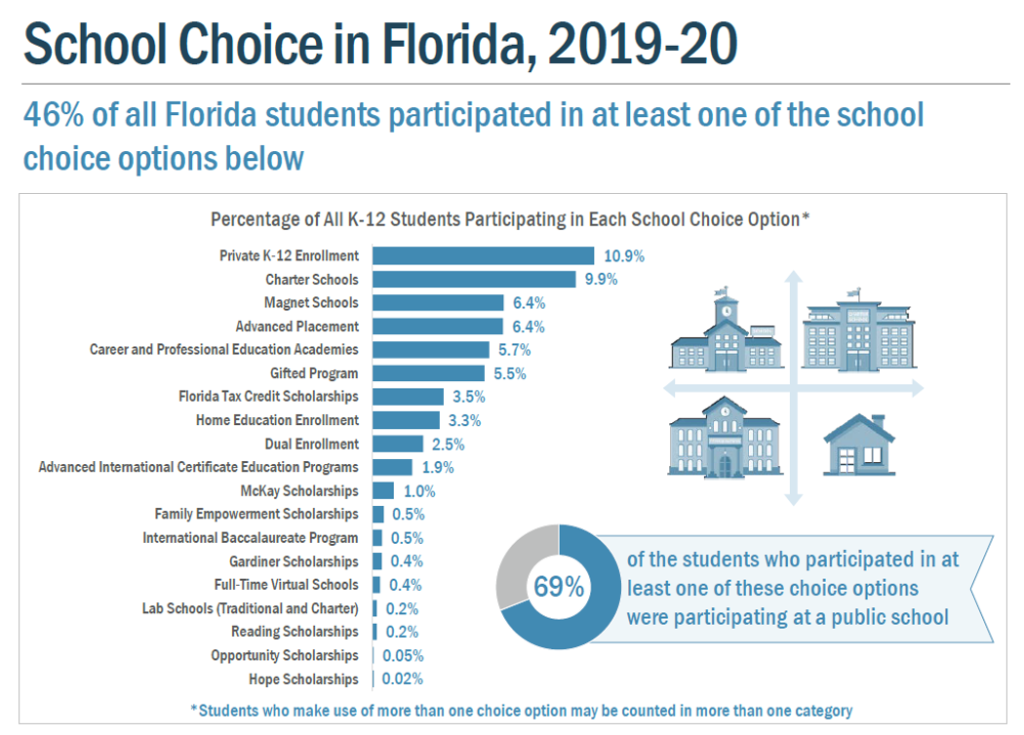 A research arm of the Florida Legislature on Wednesday presented to the state’s Appropriations Subcommittee on Education a detailed 132-page report showing how Florida families are participating in education choice programs.
The report from the Office of Program Policy Analysis and Government Accountability (OPPAGA) expands upon the one-page summary produced for the past 12 years by Step Up For Students, the state-approved nonprofit funding organization that helps administer five scholarships for Florida schoolchildren.
OPPAGA reviewed 21 school choice programs, providing detailed descriptions of each program including the number and percentage of students participating. The report provides a county-by-county breakdown of students enrolled in choice programs throughout the state and provides demographic data for most of the choice programs.
According to OPPAGA, 86% of students attend public schools, 11% attend private schools, and 3% are educated at home. Of those public school students, 12% are enrolled in public charter schools.
Overall, 46% of all Florida K-12 students participated in a school choice option. Of the students exercising choice, 69% exercised a public school choice option.
Florida’s public schools, including choice schools, enroll nearly 2.8 million students. Public schools have “grown incrementally” according to the authors, increasing by about 62,000, or 2.2%, over the last five years. Of public school students, 63% are nonwhite; 55% are eligible for free or reduced-price meals; 14% are students with disabilities; and 10% are English language learners.
Charter schools grew 22%, with enrollment growing by more than 58,000 students over the last five years. Of charter school students, 70% are nonwhite; 43% are eligible for free or reduced-price meals; 10% are students with disabilities; and 10% are English language learners.
Home education grew the fastest of the three education sectors, increasing by 27% over the last five years by adding nearly 23,000 students.
Meanwhile, private school enrollment increased by about 52,000 students, or nearly 18% over the last five years. Private schools overall are 50% nonwhite.
Fifty-six percent of students who participate in the Family Empowerment Scholarship program for low-income and working-class families are nonwhite. Forty-seven percent of special needs students who participate in the Gardiner Scholarship program and 55% who participate in the McKay Scholarship program are nonwhite.
The Florida Tax Credit Scholarship, which serves low-income students, is Florida’s largest private K-12 scholarship program. That scholarship enrolled 113,120 students, up 41% over the last five years. About 73% of these scholarship students are nonwhite.
The public-school program enrolling the highest percentage of minorities is Jeb Bush’s Opportunity Scholarship program, with 74% of students being nonwhite. The Opportunity Scholarship allows students in the lowest performing public schools to enroll in higher performing public schools. Prior to being struck down by the Florida Supreme Court in 2006, that program provided scholarships for students to attend private schools as well. At the time, 86% of the students were nonwhite.
The program with the fewest minorities is Florida Virtual School, with 42% of its students being nonwhite. FLVS is also one of the few choice programs that have been shrinking, with enrollment declining by 9% over the last five years.
Among the other interesting findings, OPPA noted that:
· Charter schools are the most popular alternative public school enrolling 323,385 students
· Specialized public school programs were the second most popular option with 208,644 students enrolled in magnet schools; 185,699 students enrolled in career and professional academies; and 178,162 students enrolled in admission selective programs for gifted children.
· Accelerated programs such as Advanced Placement, Dual Enrollment, Advanced International Certificate Education and International Baccalaureate have grown to a combined 366,101 students, up 22% from 300,224 students just five years ago.
· Miami-Dade County Public Schools has three times as many students attending magnet schools as the next highest county, Orange.

