When it comes to reasons why parents move from public to private schools, standardized test scores are nowhere near the top of the list, but concerns about classroom discipline and atmosphere are, according to a new report from the Friedman Foundation For Educational Choice.
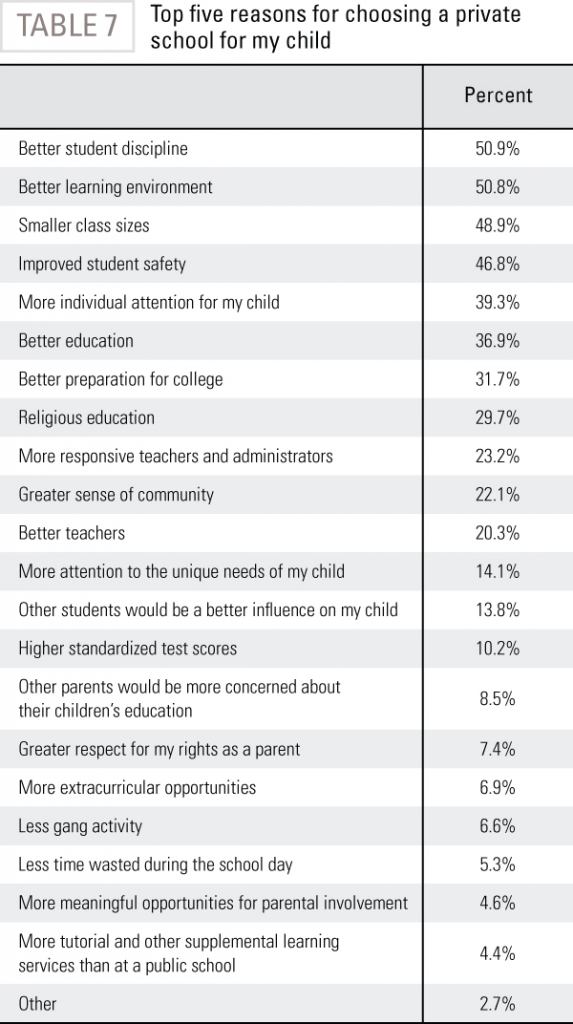
Based on a survey of 754 parents of tax credit scholarship students in Georgia, “More Than Scores” finds the five top reasons are better discipline, better learning environment, smaller class sizes, improved safety and more individual attention. When asked the single most important reason for choosing a private school, 28.2 percent of parents said a “better education.” In second place, 28.1 percent said a “religious education.”
No parents chose “higher test scores” as their top reason. Only 4.2 percent listed the reason in their Top 3 and just 10.2 percent listed it in their Top 5.
When given a list of 21 possible reasons why they chose a private school, parents most often chose “better learning environment” (85.1 percent). “Religious education” came in at No. 5 (64.1 percent). “Higher standardized test scores” came in at No. 15 (34.6 percent).
The relatively low regard for test scores led the authors to conclude that “public officials should resist the temptation to impose national or state standards and testing on private schools or demand that private schools publish ‘report cards’ emphasizing test score performance.”
Full disclosure: I’m also a research fellow for the Friedman Foundation.
Other coverage: Rick Hess at the American Enterprise Institute weighs in here. The report’s authors weigh in at Jay P. Greene’s Blog here.
The American Federation of Teachers released a new survey this week, “Public School Parents and the Promise of Public Education,” that claims many things. But most important to school choice supporters, it says the vast majority of parents prefer traditional public schools and are opposed to educational options.
The quality of any survey is heavily dependent upon the methodology applied and, of course, the questions asked. AFT and the firm that did its survey, Hart Research Associates, condensed their findings in a short memo that’s worth reading.
The memo suggests the survey question about vouchers may be misleading participants by directing them along a predetermined path. For example, participants were asked to choose the better of two education approaches. Take a look at the language below (from page 6):
Approach A) We should focus on ensuring that every child has access to a good public school in their community. We need to make the investments needed to ensure all schools provide safe conditions, an enriching curriculum, support for students’ social and emotional development, and effective teachers.
Approach B) We should open more public charter schools and provide more vouchers that allow parents to send their children to private schools at public expense. Children will receive the best education if we give families the financial freedom to attend schools that meet their needs.
Not surprisingly, 77 percent of survey participants chose Approach A.
There are a few glaring problems. (more…)

