A new Florida law that expanded education choice eligibility also allows public school districts more flexibility in transportation.
Each weekday morning feels like a new nightmare.
The Echo Dot alarm goes off at 4:55 a.m. so my husband can make sure our son wakes up in time to make it on time to high school.
Morning bell: 7:06 a.m.
We flip on the overhead bedroom light and start the wakeup warnings.
It’s a process. The lump under the covers doesn’t budge as the warnings take on a more threatening tone. The bus departs at 5:59 a.m.
Our bleary-eyed teenager gets up at the last possible minute, skips breakfast and grabs an energy bar as he gets in the car for the mad dash to the bus hub.
The stakes are high.
If he misses that bus, it leaves mom or dad on the hook to drive him to school, which is outside our attendance zone. It’s an hour round trip for us if we are lucky enough to arrive before peak car line time.
On days when the bus runs late, mom or dad are still on the hook. Education is a huge deal in our family and missing even a few minutes of first period is unacceptable. We count ourselves fortunate with our flexible remote work schedules to be able to make that sacrifice, as inconvenient as it is.
We know that financial situations and job schedules leave some parents with no other options, putting their kids at risk of falling behind because they miss valuable instruction time.
It’s unfair, but solutions have been elusive.
Getting to school on time wasn’t always such an ordeal.
Until 2021, all Pasco County high schools started at 7:30 a.m. Sleep research shows that’s still too early for teens. Their circadian rhythms keep their eyelids from feeling heavy until about 11 p.m. Students in rigorous specialty programs such as Cambridge, dual enrollment or International Baccalaureate, which my son is in, get hit hardest due to homework loads that keep them studying until the wee hours.
Last year, plagued by a severe shortage of bus drivers, our school board approved new start times at all the schools so fewer drivers could cover more routes.
Though the situation smoldered for years nationally before COVID-19 became part of our collective consciousness, the pandemic caused a surge in demand for commercial drivers and turned It into a five-alarm fire.
Our son’s school got placed into the first of a new four-tier bus route system. Some other schools, mostly elementary, got their start times pushed to 10:10 a.m. The changes wreaked havoc with work schedules, bedtimes and wakeup times for all families, disrupting even those who didn’t depend on the bus.

Dylan Wood, left, and his father, Mark Wood, get up at 5 a.m. to make it to the bus stop before 6 a.m. Photo by Lisa Buie
Officials told upset parents that they disliked the changes, too, but saw no other way but to make do with fewer drivers as they struggled to attract people willing to transport sometimes unruly students and work a split shift for $15 an hour.
No one mentioned that the shortages were symptoms of a broken, antiquated business model that was created before World War II. I heard no calls for a need to scrap the old system and build a 21st century system capable of serving students in the era of school choice and customized education. That’s likely because yellow school buses, driven by licensed commercial drivers, are the only option available to districts under Florida law.
Neither did I hear anyone discuss looking at other states, particularly Arizona, which has a reputation for innovation.
“Public school transportation is expensive, bureaucratic, and cumbersome,” wrote Emily Anne Gullickson, founder and CEO of A for Arizona, a nonprofit organization that seeks to solve education issues with best practices from the business community. “Needless to say, changes to our K-12 public transportation system are long overdue. But rather than put a Band-Aid on a failing system, Arizona chose to move forward in the 2021 legislative session with meaningful change prioritizing equity and opportunity.”
The result was the Arizona Transportation Modernization Grant Program, authorized by the state and administered by A for Arizona’s Expansion & Innovation Fund. The program gives schools, local governments and organizations the opportunity to reimagine public school transportation.
The first year, $20 million of state and federal funds were granted as seed funding to the best proposals that meaningfully improved access to safe and reliable transportation for districts offering open enrollment or public charter schools as well as submissions that supported efficiency and broader K-12 innovation.
Funded projects included Black Mothers Forum’s carpooling app, a partnership between local school districts and its Boys & Girls Clubs to use the nonprofit’s mini-buses, while another partnered with third-party provider HopSkipDrive to scale ridesharing for students who needed customized solutions.
This year, an additional $14 million in grant funding has been approved.
Florida approved landmark legislation this year to establish universal eligibility for education choice scholarships. Not surprisingly, that part of the bill grabbed the media spotlight. What didn’t get covered was the part of the bill that mandates relief to public school districts of “the most onerous regulations.” In selling the bill, lawmakers said it would help ensure a fair playing field in the competition for students’ education dollars.
Among the list of provisions: the ability for districts to use alternative means to get students safely to school. That doesn’t mean the big yellow buses will go away, state Sen. Corey Simon said during committee meetings. However, it would relax the mandate that the yellow bus system is the only allowable method, allowing districts to find solutions that make the most sense for each situation.
The bill drew praise from former state Sen. Bill Montford, a former public school superintendent who is now CEO of the Florida Association of District School Superintendents.
“We want our schools to be the first choice for parents, not the default choice, and to do that we need to reduce some of the outdated, unnecessary, and quite frankly, burdensome regulations that public schools have to abide by,” he said.
That flexibility will be critical as school districts prepare to comply with another new law, HB 733, which requires later start times for all middle and high schools by 2026, because it’s clear that more advertising and job fairs offer no permanent fixes.
None of this will happen in time to help my son and other members of the Class of 2024, but I take comfort in the fact that 8 a.m. is the earliest start time for most college classes.
After years of setting alarm clocks for 5 a.m., it’ll feel like sleeping in.
 Editor’s note: This commentary from reimaginED executive editor Matt Ladner is the first in a series of posts that will examine how arcane rules and regulations are hindering forward progress for K-12 education – and what needs to be done to break through them.
Recently, trucking executive Ryan Peterson had a Twitter thread that just might have saved the American economy from shortages and hyper-inflation.
A great deal of America’s current supply chain problem can be traced to a nonsensical rule that forbade stacking more than two empty containers on top of each other in the ports of Los Angeles and Long Beach. Some folks apparently thought that more than two was unsightly, and incredibly, this led to a cascade of failures that caused cargo ships to idle off the port of California.
Petersen wrote a detailed thread explaining how this happened and what needed to be done about it, including but not limited to stacking shipping containers higher than two. He basically called for a “flood the zone” with solutions to break the bottleneck.
Petersen’s thread went viral, and the stacking change was made, giving the country a fighting chance to avoid having swimmers trying to board stranded cargo ships to do their Christmas shopping.
There are similar bottlenecks in K-12 education – things that if they ever did make sense, stopped making sense long ago. This post will kick off a series about such rules, asking questions such as:
What would Ryan Peterson do about the student transportation crisis?
I recently wrote a white paper on student transportation for the Arizona Charter School Association. The more I looked into this subject, the more interesting it became.
Arizona has been expanding choice since 1994, and the state’s leaders have begun to confront long neglected equity issues. As a demonstration, the paper takes the address of the Arizona Capitol building in downtown Phoenix as an anchor point and examines options available to a middle school student.
The district bus system primarily serves the zoned district school. If a family can transport the child 3 miles round trip daily, they can choose between five public schools. If they can travel 6 miles daily, they can choose between 19 public schools, including multiple schools with very high academic and community ratings on the Greatschools and Niche websites.
A family lacking a car or with a work schedule that precludes student transport might find those other 18 schools tantalizingly out of reach. Meanwhile, the school with the easiest access by bus is one of the lower performing schools as rated by community members and as well as according to academic rankings of both websites.
A majority of Phoenix area students are attending something other than their zoned district school. Open enrollment transfers outnumber charter school students, and charter school students outnumber private school students, who outnumber homeschool students.
All Arizona families pay a separate property tax to support the district yellow bus system, but ridership on that system was in decline even before the COVID-19 pandemic. In 2019, data from the Arizona Auditor General indicated that just over 23% of Arizona public school students were transported to school by district bus.
What about, ahem, the other 77%?
School bus drivers are required to have a Commercial Drivers License (CDL). In the years leading to the pandemic, the competition for CDL holders grew steadily from firms like Amazon and Instacart. These firms offered full-time work and benefits, and they wanted more and more CDL holders.
This made it increasingly difficult for districts trying to hire part time workers with odd hours and no benefits.
COVID-19 not only shut schools; it sent the demand for delivery drivers through the roof. In-person learning eventually came back, but many of the drivers did not.
Making matters worse, many older drivers had not been interested in working full time but were also not interested in getting into an enclosed space with dozens of unvaccinated kids. This fall the American yellow bus system experienced a systemic collapse not radically different from the Port of Los Angeles.
Arizona districts, like other districts around the country, struggled during the fall of 2021. One media report featured Litchfield Elementary School District’s bus fleet parked idle for want of personnel. According to Nathan Whyte, the district’s director of transportation:
“Out of the 75 staff needed to run a smooth transportation operation, the district is missing 18 drivers and eight aides. We have been using all sorts of means to try and recruit. We’ve used social media, we’ve used word of mouth, we’ve used the newspapers, we are doing everything possible to draw in new members of staff, but it’s not working.”
Amphitheater Public Schools boosted its starting pay and also changed its school start times to make do with fewer drivers, describing the situation as a “crisis.”
What is to be done? In Ryan Peterson-type fashion, we need to flood the zone with solutions to attack the bottlenecks.
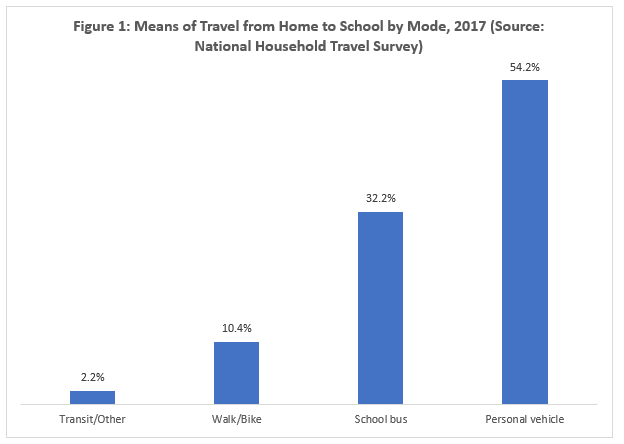
Bellwether Education found that in 2017, 54% of students reached school in a private vehicle and only 32% in a bus. It will be interesting to see just how far that bus percentage has dropped when and if we get figures for 2021, but let’s just dare to predict that it won’t be pretty.
The CDL is the two-container stack rule here: We need to figure out every way possible to get kids to school that doesn’t involve a CDL license holder. Amazon is not going away.
In a country where 54% (+ now) of students get to school in a private vehicle, every empty seat in a private vehicle needs to be viewed as an opportunity. Carpooling should not just be encouraged; it should be subsidized if we want to get kids to schools and take vehicles off the road.
Municipal bus systems have often operated in a separate silo from school transport. This needs to end as soon as possible. Minneapolis piloted a program to give municipal bus passes to high school students; truancy dropped, and grade point averages improved. When surveyed, the students reported that the increased flexibility of a system with more than one opportunity to reach their destination was helpful.
Innovative private firms have created software to facilitate carpooling and ride-share firms specialized in student transportation. Intergovernmental agreements and non-profits could play productive roles. Arizona Gov. Doug Ducey championed a Transportation Modernization Grant program to create competition among schools, cities and non-profits to find innovative solutions during the 2021 session.
A process of generating bottom-up solutions will be needed to see our way through this, and these challenges are hardly limited to Arizona. We still need the yellow bus system, but the yellow bus system alone has steadily become an 8-track player in a music streaming world.
As our system moves away from ZIP code herding students into schools, we will require a more varied, flexible and equitable system of transport. Stay tuned to this channel for updates on transport modernization, and other K-12 bottlenecks to break.
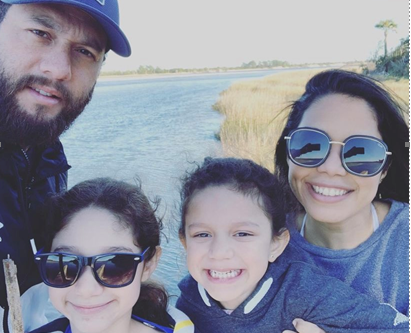
The Vira-Hernandez family, from left, Alberto Vira, Mariavictoria Vira, Sienna Vira, and Jenifer Hernandez.
Jenifer Hernandez is every bit the school choice mom, though her two daughters attend Jacksonville public schools.
Her 7-year-old, Sienna Vira, goes to Seaside Charter Elementary, a school inspired by the Waldorf education tradition. Eleven-year-old Mariavictoria Vira attends LaVilla Middle School of the Arts, a Duval County Public Schools magnet, so she can focus on visual arts.
The schools are 18 miles and more than a half-hour apart, which requires time and gasoline. And with gas now going for more than $3 per gallon, that’s a lot of money.
Hernandez and her husband, Alberto Vira, were relieved to learn from other parents about the Florida Transportation Scholarship. The scholarship is part of the Florida Tax Credit Scholarship program, which lets parents who qualify choose between a scholarship that can be used on tuition and fees at a private school or $750 per student toward transportation to a public school other than the one they are assigned to attend.
Both scholarship programs are managed by Step Up For Students, which hosts this blog.
Hernandez decided to apply for the scholarship and was delighted when her daughters were awarded.
“My husband and I drive the girls to school when we can, but due to our work schedule, we also pay a friend to drive them to school,” she said. “The scholarship is definitely a great help.”
The scholarship assists the family not only by defraying travel costs; it also means Hernandez and her husband won’t have to pay for costly after-school care.
“Instead of using after care, we get to help a friend by paying her for the rides,” Hernandez said.
Transportation has been a nagging headache for years but recently became a colossal migraine for school districts as bus driver shortages have resulted in students arriving late to class and missing critical instruction time.
Some districts are boosting pay and offering bonuses as well as making major changes to school start times, a move that has drawn objections from parents and bus drivers alike. In Massachusetts, Gov. Charlie Baker brought out the National Guard to get the behind the wheel.
But for those who seek education choice options as a means of finding the best learning environment for their kids, transportation always has been an obstacle, especially for families of modest means.
A research paper written in March 2020 by Michael McShane and Michael Shaw of the national nonprofit organization EdChoice called school transportation “inextricably linked” to school choice and said choice supporters ignore the issue at their peril. They called for policy changes to provide transportation funding.
“Leaving the means to get to a school of choice out of the equation risks creating choice in name only,” they wrote.
McShane, a reimaginED guest blogger, followed up with a post that described Florida as “a great example of the second generation of policy questions” for which an expanded vision of school choice asks and demands answers.
He wrote:
“Put yourself in the shoes of a parent who was just awarded a tax credit scholarship, or who just won a charter lottery to the school they have been hoping to send their child to for years. Think of the elation, the feeling that this is their lucky day. Their ship has finally come in. But then imagine that family realizing that transportation is not part of the deal. Their child can attend the school if they can get her there. But they can’t. How heartbreaking. It would be like running a marathon but twisting your ankle on the last mile.”
Arizona recently approved $20 million in state and federal money for a modernization grant program to provide seed funding for ideas that meaningfully improve access to reliable and safe transportation for district students who utilize open enrollment or who attend public charter schools. The funding also would support proposals focused on efficiency solutions and broader K-12 transportation innovations.
For the Viro-Hernandez family and other eligible Sunshine State families, the Florida Transportation Scholarship program represents first steps to address the issue locally. Since the 2017-18 school year, the program has grown each year, with more than 500 students participating so far this year compared with 212 just a year ago. Officials are still processing requests and expect this year's total to rise even more.
“The scholarship is helping us save money in so many ways, but it is also a blessing to have,” Hernandez said. “It is giving us the opportunity to have the girls in amazing schools without worrying about transportation since we need to physically drop them off and pick them up from school. Everything is covered by the scholarship.”
 In recent weeks, reimaginED has published several posts that address the growing concern nationwide about public school transportation – how a perfect storm of challenges is confounding families as well as school districts on how to get children to and from school. (See here, here and here.)
 As many pundits have observed, the most robust education choice programs will fail to serve families if those families lack efficient transportation options.
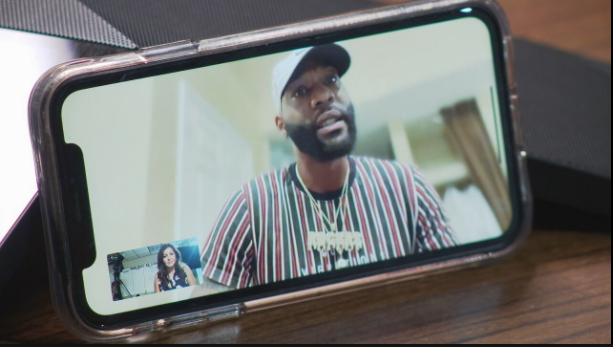
This afternoon, we bring you a story from Columbus, Ohio, about how one parent, frustrated when his children missed a day of school because their bus failed to show up, took matters into his own hands.
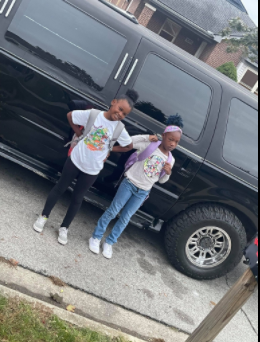
He decided to use his family’s limousine service to pick up 25 children in his neighborhood and give them a ride to school.
"Everybody always wants to say, ‘Let's help the community, let's stop this violence,’ that type of stuff, but I feel like a big step of stopping the violence is getting kids to school instead of letting them skip school and go out and get into trouble," said Sean Rogers Jr.
You can read the story and watch a video interview with Rogers here.
 Editor’s note: Emily Anne Gullickson, founder and CEO of A for Arizona, provided this commentary exclusively to reimaginED. You can hear reimaginED executive editor Matt Ladner conducting a podcast with Gullickson here.
Across the country, there have been countless stories this school year about school bus driver shortages and the impact that shortage is having on kids getting to school. While a new onslaught of abrupt cancellations and modified routes no doubt is an obstacle for parents, the reality is that transportation barriers for families have persisted for years.
The issue is exacerbated in Arizona due to robust district open enrollment and public charter school systems, making it even more difficult for families to find accessible and reliable K-12 transportation to deliver their children to the school that best meets their needs.
Public school transportation is expensive, bureaucratic, and cumbersome. We have a system that is completely antiquated, largely in the same form when it was established nearly 80 years ago. Nationwide funding formulas operate as if kids and families are all still attending their assigned school within neatly designed and restrictive attendance zones.
But in Arizona, where nearly one out of every two students attend a public school other than the neighborhood district school to which they were assigned, the system is broken.
Ridership has plummeted over the years and has continued to plummet with pandemic enrollment declines. Many public school leaders rightfully have been hesitant or restricted from trying something new or innovative due to fear of losing funding often coupled with lack of permission as a result of overregulation.
Needless to say, changes to our K-12 public transportation system are long overdue. But rather than put a Band-Aid on a failing system, Arizona chose to move forward in the 2021 legislative session with meaningful change prioritizing equity and opportunity.
In K-12 education, we are notorious for swinging the pendulum from one one-size-fits-all idea to another. Some experts believe it is time to get school districts entirely out of the business of transportation and let an organization or governmental body run point on all K-12 transit needs.
In a metro city with roughly 750,000 students, leveraging district, magnet and public charter choice as well as other educational options, this sounds like a bureaucratic nightmare.
On the flip side, other experts loudly say just give 100% of the funding to parents in the form of a debit card and call it a day. Part of Arizona’s new policy bundle empowers families to access direct in lieu of transportation grants from their public school to help cover driving costs, create carpools, leverage K-12 ridesharing opportunities, or access public transit options.
This is an important and critical option, but it is not a solution for every family.
Rather than force a single solution on the masses, Arizona is inviting and funding community solutions. The Arizona Transportation Modernization Grant Program, authorized by the state and administered by A for Arizona’s Expansion & Innovation Fund, gives schools, local governments, and organizations the opportunity to rethink public school transportation.
This year, $20 million of state appropriations and federal stimulus monies awarded by Gov. Doug Ducey will be granted as seed funding to the best submissions that meaningfully improve access to reliable and safe transportation for district students using open enrollment or who attend public charter schools as well as proposals that support efficiency solutions and broader K-12 transportation innovations.
With nearly $54 million in requests to date, the competition is real – and inspiring. In the first round of grant submissions, 74% of applications came from entrepreneurial leaders in rural and remote communities, identifying additional options to transport students not solely reliant on yellow school buses.
Local leaders have brilliant approaches to solving Arizona’s long-standing inadequacies in the K-12 transportation system. Our state is rich with transportation experts who never have been given the opportunity to innovate without facing funding penalties; nor have they been provided the runway to cross-collaborate with organizations, cities, tribal communities, and the many public schools at the table.
Meanwhile, Arizona has benefited from a steady influx of brilliant engineers, technology wizards and strategists from Silicon Valley as well as home-grown entrepreneurs ready to change the way we transport K-12 students, drive down costs, enhance safety and prioritize efficiency.
Non-profits are leaning in too, as many K-12 students engage and thrive with night classes, microschools and evening learning hubs. As more schools embrace new seat time flexibilities that will modernize when, where, and how learning can occur, operating a one-size transit solution around a single bell schedule per site is no longer reality.
These modernization grants are serving as a catalyst to tearing down long-standing access barriers so that every Arizona family has meaningful public school options to serve their child’s unique needs. The initial portfolio of finalists will be announced by A for Arizona in early November and will be models to watch.
We look forward to learning what is working, what parents do and do not want, and what must be protected at all costs in our next-gen bundle of transit options for K-12 students.

