 In 2006, thousands of people jammed the courtyard next to the Florida Capitol not long after the Florida Supreme Court struck down the state’s first school voucher program. I was a reporter covering the state education beat, and in the second sentence of my story I noted the obvious: The majority of rally goers were black.
Somehow, almost every other print reporter missed that, leaving readers with an incomplete picture of an extraordinary event. The omission baffled me then, but I’ve since learned to expect it. It doesn’t take a sophisticated media analysis to see that the parents and children who are clamoring for and benefiting from expanded learning options are too often left out of the story.
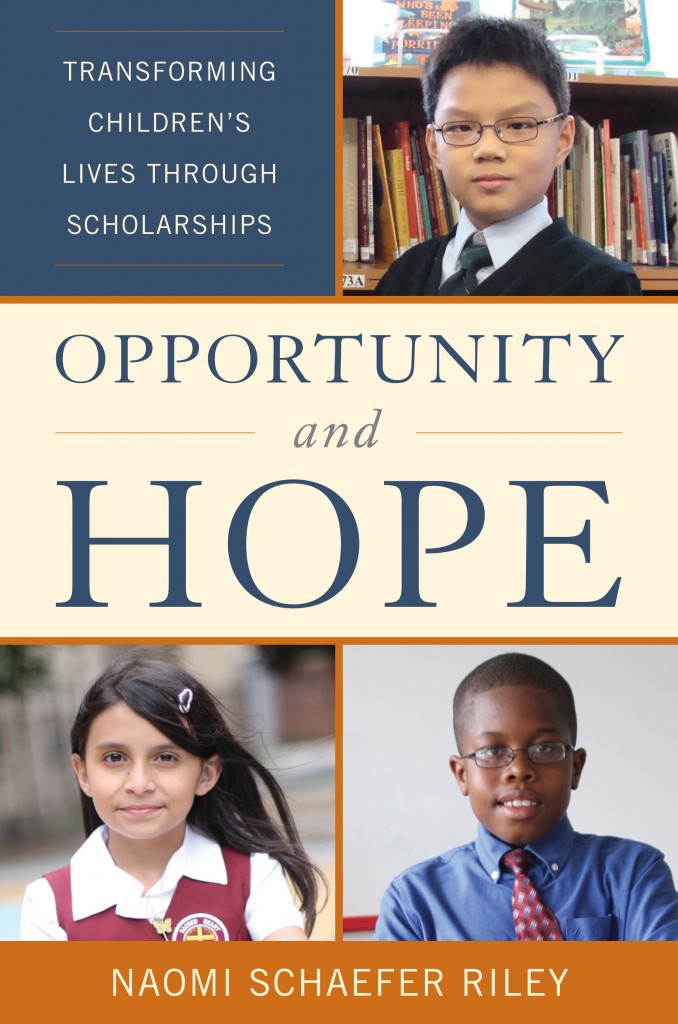
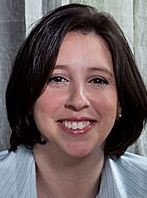
Against that backdrop, a new book by former Wall Street Journal editor and writer Naomi Schaefer Riley fills in the gaps. To give visibility to those at the heart of the school choice debate, and to dispel the abstractions that cloud it, Riley follows a simple formula.
She tells us about the kids.
There’s a lot of pluck and love in the 10 profiles in “Opportunity and Hope.” And a lot of shattered stereotypes about low-income parents and faith-based schools. And a hammered-home fact that is again obvious but overlooked: a different school can put a child on a remarkably different trajectory in life.
Riley
Aleysha Taveras’s mother, a teacher’s aide at a public school in the Bronx, saw too much violence and too little learning. So she enrolled her daughter in a Catholic school with, as Aleysha puts it, “teachers who would always be on top of me.” Now Aleysha is on the verge of graduating from Manhattan College and embarking on a career as a teacher.
Carlos Battle was raised by a single mom in a tough Washington D.C. neighborhood. He had ADHD. But after a stint in a private school, Carlos got a full ride to Northeastern University in Boston, where he’s now majoring in psychology and social service. He envisions starting a nonprofit that will rescue kids from being stuck in neighborhoods like his. “I just want to break that cycle of stuckness,” he says.
Most of the black and Latino students profiled by Riley received scholarships through the Children’s Scholarship Fund, the pioneering, privately funded choice program started in 1998 by Ted Forstmann and John Walton. Danielle Stone is one of the exceptions, with her scholarship coming from Step Up For Students, which administers Florida’s tax credit scholarship program and co-hosts this blog.
Riley lets the students and parents do most of the talking. She asks the basics. Who are these kids? What were their lives like before the scholarship? What are they like now? What made the difference? (more…)
 Editor's note: Parental choice supporters released this collaborative statement today, calling on ed reformers to fully embrace vouchers, tax credit scholarships and other publicly funded private options as part of a three-sector approach to providing more high-quality learning options for low-income children. A number of prominent names in ed reform and parental choice circles have already signed on (see the list of original signers here). To add your name in support, go here.
For 50 years, America has struggled to provide low-income students, especially those in inner cities, with high-quality schools. The consequence has been devastating: Generational poverty, disenfranchised neighborhoods, and millions of boys and girls robbed of the American Dream.
But we have not been asleep at the switch. Over this half-century, some of our sharpest minds, strongest backs, and deepest pockets have attempted to solve the problem. Decades of effort have been poured into improving district-run schools. Two decades ago work on a parallel track was launched through the passage of a tax supported voucher program in Wisconsin and the option to create charter schools in Minnesota. The voucher program provided limited access for low-income parents to send their children to private schools, and the charter school legislation provided for the possibility of the development of new public schools with increased autonomy and accountability.
In spite of all of our best efforts, gains in district schools have been modest. Although chartering has produced many outstanding schools, numerous barriers have impeded the creation of a sufficient number of high-quality charter seats. Even with the expanded choice to the private sector, they also have produced modest results. So despite the expenditure of enormous personal and financial resources, it is still sadly true today that far too few needy boys and girls have access to great schools.
Those interested in improving the fortunes of these students should share a mindset: We must double down on our efforts to grow the number of high-quality schools available to low-income children. When so many obstacles stand between our young people and a lifetime of success, we simply cannot and must not support only one of the approaches that are available to us.
We strongly support a “three-sector” approach to reform and improvement.
We must push for transformational changes within traditional districts while working to strengthen the other two options.
There is controversy and opposition to each of the strategies, but, those involving the private sector create the most angst; particularly those that involved publicly supported programs like vouchers and tax credits. Unfortunately, some of this resistance has come from within our own ranks—those supporting other efforts to improve the educational opportunities available to disadvantaged students.
We believe it is time for members of the reform community to reconsider their opposition to these programs and fully embrace the three-sector approach. Many things have changed since Milwaukee’s voucher program initiated this movement 20 years ago—when many people took hardened positions on this issue. (more…)
A lawsuit seeking more funding for public education has widened to challenge programs that help Florida parents send their children to private schools.
The original case aimed to put Florida's education system on trial, arguing among other things that lawmakers had not adequately funded public schools, in violation of the state constitution.
An amended legal complaint filed late Friday afternoon adds new claims to the case, challenging the tax credit scholarship program for low-income students and the McKay Scholarship program for special-needs students.
First filed nearly five years ago, the case centers on a requirement in the state constitution that the Legislature must provide a "uniform, efficient, safe, secure, and high quality system of free public schools."
The revised lawsuit contends:
Many of the State’s reforms and programs, including the accountability system, changes to the graduation requirements, retention and promotion requirements, teacher evaluations, charter schools, and the FTCSP and the McKay Programs, have wasted millions of dollars without producing the desired effect of a high quality public school system, and are thus not efficient.
It also argues the state "is not providing a high quality pre-kindergarten learning opportunity," in violation of a related constitutional provision that led to the creation of Florida's Voluntary Pre-Kindergarten program.
The Florida Supreme Court ruled in 2006 that the state Opportunity Scholarship voucher program, which used state education funding to help pay private school tuition for children in poorly rated public schools, was unconstitutional.
The ruling in Bush v. Holmes hinged in part on the fact that the program used funds already set aside for education. Justices gave themselves room to rule differently on other private school choice programs, including those that cater to students with disabilities.
Neither McKay nor tax credit scholarships have faced a similar constitutional challenge until now. The revised lawsuit argues that by creating and expanding the two scholarship programs, "the Florida Legislature intended to divert public money from the education finance program and use this money instead to fund private school vouchers." (more…)
It's not new news that progressive icon Howard Dean likes charter schools. Or that another big-name Democrat likes charter schools. Or that another big-name Democrat is all aboard with school choice (Cory Booker, Joe Trippi, Mike McCurry ... ). But until that expanding list starts to dent the narrative that parental school choice is a Koch Brothers scheme, well, we'll keep highlighting them. 🙂
The latest is what Dean said at a recent appearance at a college in Vermont. He told the audience his son taught for Teach for America in New Orleans, then continued:
“And his kids that he was teaching in the 9th grade … were essentially illiterate. Now this is 40 years after the civil rights movement, 40 years after African Americans and whites were supposed to have equal opportunity under the law. These kids had no equal opportunity. They were being starved by a corrupt school board, and a culture that had never valued them as much as they valued white kids. I was furious. I was so angry, in a moment I converted my whole philosophy of education, to we had to try anything we could to get inner city schools better."
"And inner city schools are being reformed by people in your generation who are joining Teach for America. There are principals … tons of them, all over the country, who are not yet 30 years old. It’s the charter school movement. There’s some things I don’t like about the charter school movement. They’re not all created equal. For profit charters are clearly worse than non profit charters. But the charter school movement is transforming inner city education. It is getting kids through high school with diplomas that never would have had a chance even five years ago."
Plenty of thoughtful folks would disagree with Dean about for-profits in education. And we can only hope his eye-opening led him to revisit his opposition to vouchers, too. But in the big picture, it's clear Dean is representative of a trend: growing bipartisan support for a growing array of options. (more…)

Campbell
Ken Campbell, president of the Black Alliance for Educational Options, has advice for school choice supporters who may be frustrated by critics who distort the evidence and hew to tired arguments.
Call 'em out.
"We have to recognize and not be afraid to call out the level of hypocrisy that exists in a lot of these narratives," Campbell told redefinED for the podcast interview attached below. "Because honestly, most of the time, the people who are fighting against parent choice are people who have parent choice. They are people who are exercising choices for their kids every day. They are fighting to keep kids in schools that they never in a million years would send their own kids to."
Campbell continued: What they're saying is, "If your kids leave, then we might not have the system survive. Now it's okay if mine leave, but if yours leave ... And there's something about that, Ron, that chills me to my soul when I think about what that argument really says."
Campbell's comments come with "the narrative" cranked at full volume in the Florida Capitol. On Tuesday, lawmakers on a second straight House committee voted in favor of a bill to expand Florida's tax credit scholarship program, the largest private school choice program in the country (and one administered by Step Up For Students, which co-hosts this blog). But disappointingly, the vote again came along party lines. Democrats voted no, choosing to stand with the Florida PTA and state teachers union instead of the scores of low-income parents, many of them black, who came from all over the state to show support. At one point, Florida PTA President Eileen Segal told lawmakers in support that they were pitting parent against parent. "And it’s sad."
No one called her out.
Campbell's comments also come on the eve of BAEO's annual symposium, the largest gathering of black school choice supporters in the country. This year's event, which begins Thursday, will bring more than 700 people to New Orleans.
The location isn't coincidence. (more…)
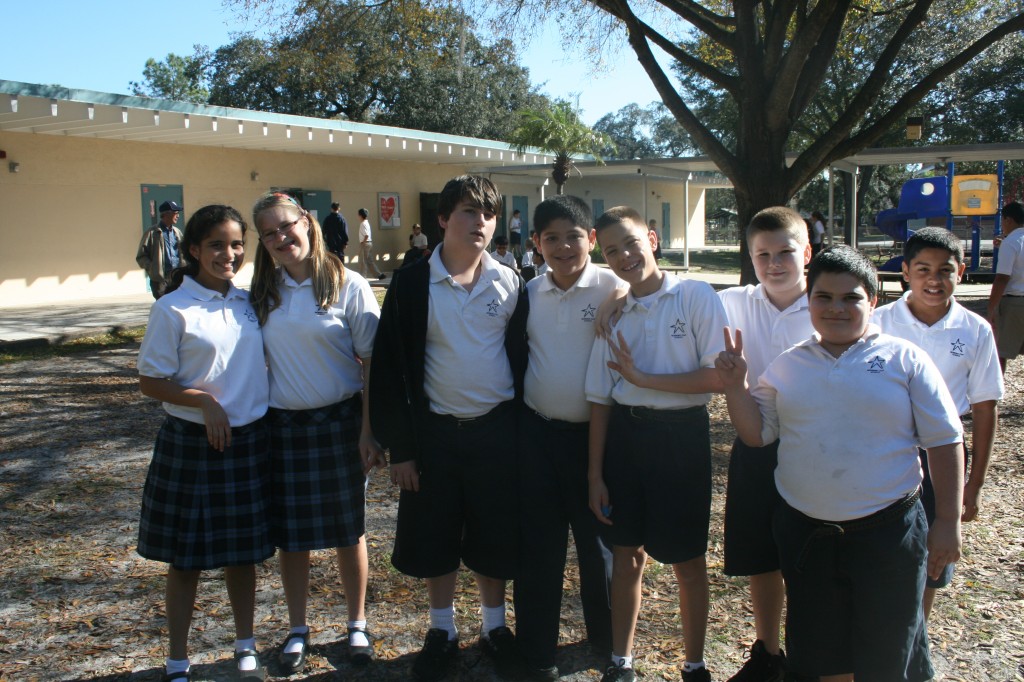
“They’re just children,’’ Principal Eileen Daly says of her students at Morning Star Catholic School in Tampa, Fla. “They come to us to learn what they’re good at and what they can do. … But really we’re teaching them how to do well in school.’’
When Madelyn Tomas was in the third grade, teachers at her public school wanted to retain the speech- impaired student another year. Madelyn’s mom, a school nurse, chose, instead, to move her daughter to Morning Star Catholic School in Tampa, Fla.
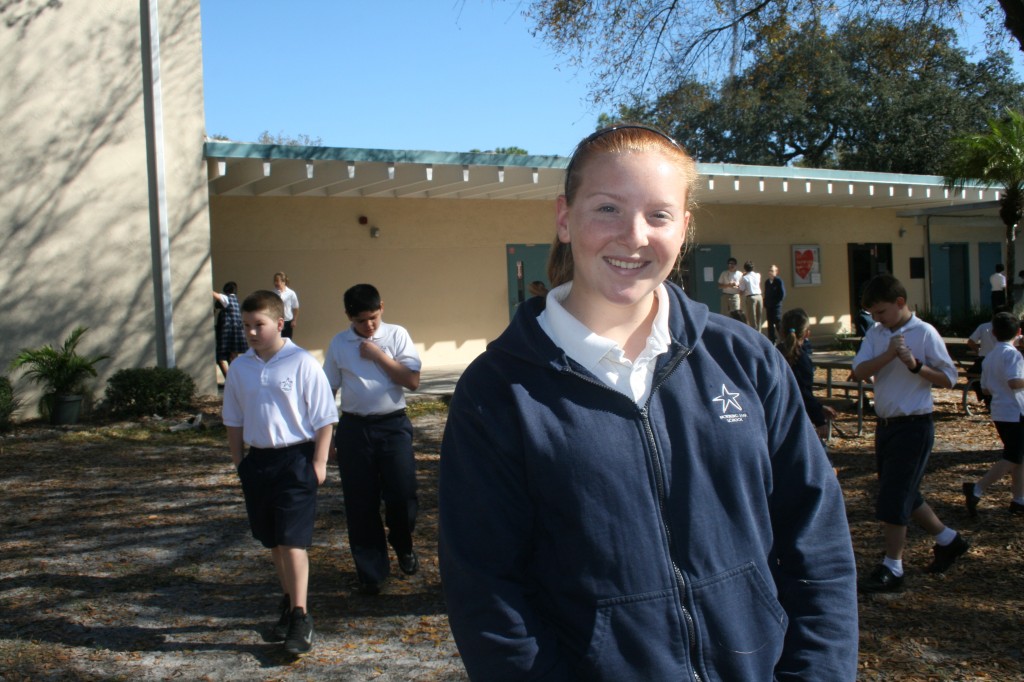
Madelyn Tomas says Morning Star helped her fit in at school, and excel.
“It saved my life, to be honest,’’ said Madelyn, now an eighth-grader who earned straight A’s last semester. “The small class sizes helped me focus. I’ve gone from thinking I couldn’t learn anything to knowing I can learn.’’
That’s the goal at Morning Star, one of six private schools and three programs in the Florida Catholic Diocese system that serves 566 children with special needs. The first Morning Star opened in Jacksonville in 1956 to serve boys and girls with physical needs. Through the years, the schools have broadened that focus based on a growing need to provide more educational opportunities for students with learning disabilities.
“They’re just children,’’ said Principal Eileen Daly, who has been with the Tampa school for 23 years, first as a reading teacher. “They come to us to learn what they’re good at and what they can do. … But really we’re teaching them how to do well in school.’’
Morning Star opened in Tampa in 1958 in a small concrete-block building behind Most Holy Redeemer Catholic Church. Most of the school’s 78 students in grades first through eighth have been diagnosed with a speech, language or learning disability. The rest have a combination of physical impairments and developmental disorders, such as autism or Tourette syndrome.
Sixty students receive McKay Scholarships, state dollars that go to families of children with special needs. Another four receive Florida Tax Credit Scholarships for low-income students, which provides $4,880 of the school’s $10,750 annual tuition. (Step Up For Students is the nonprofit that administers the scholarship program and co-hosts this blog).
The school, a nonprofit that receives funding from the diocese as well as the community, also provides its own scholarships. About half of the student body is Catholic, but Morning Star focuses more on academics, said administrative coordinator Paul Reed.
Students are taught in classes with 10 students per teacher. Sometimes, when the school has extra dollars, there’s an aide. There also are SMART boards, laptops and iPad minis in almost every class. Junior high students are allowed to bring their own devices, such as a tablet.
Lessons adhere to the same standards and benchmarks taught at other diocesan schools, but Morning Star students don’t receive grades. Learning gains are measured through the Iowa Test of Basic Skills.
Students also are exposed to classes and clubs found in most any school, like student council, yearbook and show choir – “so they can kind of be top dog, where elsewhere they wouldn’t be,’’ Daly said.
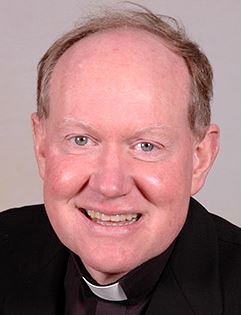
Father Scully
Many talk school choice and equal opportunity, but few do it as persuasively as Father Tim Scully.
Scully founded the Alliance for Catholic Education at the University of Notre Dame, a group working to transform and revive Catholic schools. A priest and political scientist, he pitches school choice as fundamentally American - or, at least, fundamental to an America that strives to live up to its ideals.
“That’s a central tenet of our creed that we promise to every citizen … (that) every child will have an equal opportunity to realize his or her potential. And that is simply false. Simply false in this country,” Scully told redefinED in the podcast interview attached below. “How can we look in the mirror and kind of say, ‘Yeah, American democracy is a function of fair democracy’ when we don’t allow kids and parents to have a decent opportunity to escape the poverty under which they often have been born?”
Scully’s group is making the mirror more forgiving. ACE helps prepare teachers and leaders to work in inner-city Catholic schools. Its ACE Academies are turning a handful of Catholic schools (including two in Florida) into models of reform. And for five months now, its reps have been criss-crossing the country in an RV to raise awareness about the value that Catholic schools have for all of us, whether we’re Catholic or not. (Scully was on a Florida leg of the tour when he stopped to chat with redefinED.) Last fall, Scully’s leadership earned him the William E. Simon Prize for Lifetime Achievement in Social Entrepreneurship from the Manhattan Institute.
Expanding school choice is key to Catholic school revitalization. Unlike their counterparts in other states, Catholic schools in Florida are seeing enrollment growth thanks to vouchers and tax credit scholarships. But, Scully said, support for school choice obviously goes far beyond its impact on any particular education sector. (more…)
Vouchers: Standardized testing would threaten private-school appeal, writes the Orlando Sentinel. The president of the League of Women Voters of Florida says expanding private scholarships is a further abdication of the state's responsibility to provide a high quality education to Florida's children. Orlando Advocate.
 Fundamental schools: Is St. Petersburg's fundamental school within a school working? Tampa Bay Times.
District schools: Escambia County's Warrington Middle School continues to fail its students - and improving the school will take a community-wide effort that must begin this week, writes the Pensacola News-Journal. Hillsborough County's Brandon High celebrates 100 years. The Tampa Tribune. A Duval County high school hosts a conversation about volunteerism, bridging disparities and the community roll of a historic African-American school. StateImpact Florida.
Teachers: Hundreds of thousands of Florida teacher evaluation scores that measure effectiveness on student learning are released after the Florida Times-Union wins lengthy legal battle. The Department of Education sends teachers a message about the release of records. Florida Times-Union. This Duval County teacher's class is all about goals. Florida Times-Union.
Ed leg: If the Legislature adjourns after its upcoming session without passing a single education-related bill, there will still be big changes coming to Florida classrooms this fall. Tallahassee Democrat. Pop-Tarts law is gun lobbying we don't need at school, writes Sue Carlton for the Tampa Bay Times.
State testing: Florida's students are getting ready to write the final chapter in a 17-year saga known as the FCAT. Sun Sentinel. FCAT season begins this week with a low-stakes writing assessment that over the years has seemed to have little purpose. TC Palm. Sen. John Legg aims to address over-testing in Florida public schools. Tampa Bay Times. This coming week marks the beginning of the end for the four most hated letters in Florida education: FCAT. Palm Beach Post.
Common Core: Why less is more for a rural Florida school preparing students for the new education standards. StateImpact Florida.
School boards: Hillsborough County School Board member April Griffin decides to seek a third term after all, citing issues within the school district’s transportation and special education departments that she believes have not been resolved. The Tampa Tribune. The Black Educators Caucus of Palm Beach County still backs the district superintendent, but wants progress report. Palm Beach Post. For Polk County's assistant superintendent, it's all about the kids. The Ledger.
Vouchers: Three weeks after Florida House Speaker Will Weatherford promised a “massive increase” in school choice scholarships for underprivileged schoolchildren, his chamber releases a 40-page bill. redefinED. The proposal is expected to be one of the most-contentious education battles of the 2014 legislative session. The News Service of Florida. More from CBS Miami.
Charter schools: Hillsborough County charter school operators organize their first school choice fair for parents and students to learn about nontraditional public school offerings. The Tampa Tribune.
Technology: Leon County and other school districts across the state begin to realize the potential of putting a computer in every student’s hands, and the obstacles they will have to clear to make that happen. Tallahassee Democrat. Pasco classrooms are opening up to new technology coaches. Tampa Bay Times.
Rick Scott: As a Florida governor, Rick Scott will never be confused with Jeb Bush. Tampa Bay Times.
School boards: Palm Beach school board members should be careful bypassing the superintendent to deal with district personnel issues, writes the Palm Beach Post.
2014 session: Senate Education Committee Chairman John Legg tells the Gradebook there is no must-pass bill this year. House Democrats say session will be 'class warfare.' The Florida News Current.
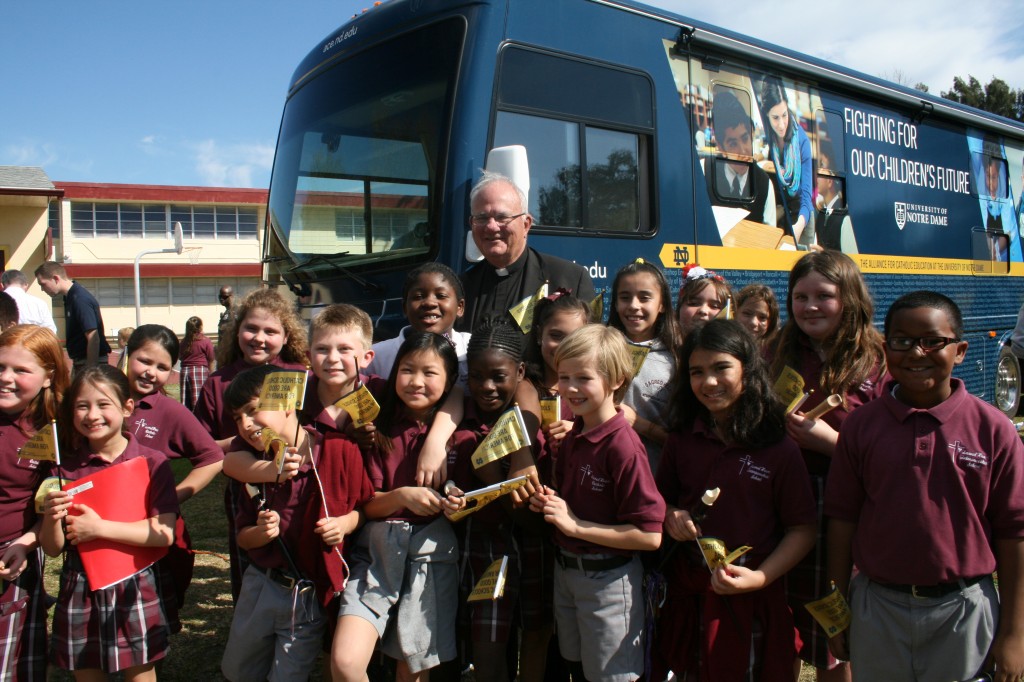
Bishop Robert Lynch of the Diocese of St. Petersburg helps celebrate the growth of Sacred Heart Catholic School in Florida, and other Catholic schools across the state during the University of Notre Dame's Alliance for Catholic Education bus tour that made a stop in the Tampa Bay area.
Nearly two decades ago, Sacred Heart Catholic School in Pinellas Park, Fla. was on the “death watch list,’’ said Bishop Robert Lynch of the Diocese of St. Petersburg. Families struggled to afford private school tuition, enrollment dwindled and tough decisions loomed for school leaders.
But instead of closing the school, Lynch forged a partnership with the University of Notre Dame and the Alliance for Catholic Education, a graduate program that trains future Catholic teachers and leaders.
Nearly 17 years later, Sacred Heart has more than 200 students and, like other Tampa Bay area Catholic schools, is expecting more growth in the years to come. It’s a success story that owes a lot to ACE.
“It saved these … schools,’’ Lynch told redefinED Wednesday, during a celebration that brought a giant blue RV emblazoned with the University of Notre Dame and ACE logos onto the grounds of Sacred Heart.
The stop was part of a national 50-city tour called Fighting for Our Children’s Future. It’s designed to raise awareness about the value of Catholic education and the profound impact it can have on children’s lives. It also stresses the need to keep Catholic schools relevant, active – and open. More than 1,300 U.S. Catholic schools have closed in the past 20 years.
“I just knew ACE coming to our diocese would be a blessing,’’ Lynch told an audience of students, parents, school donors and ACE leaders. “ACE is grace. It is the catalyst. It’s been the yeast that has raised the leaven – and the Catholic education.”

