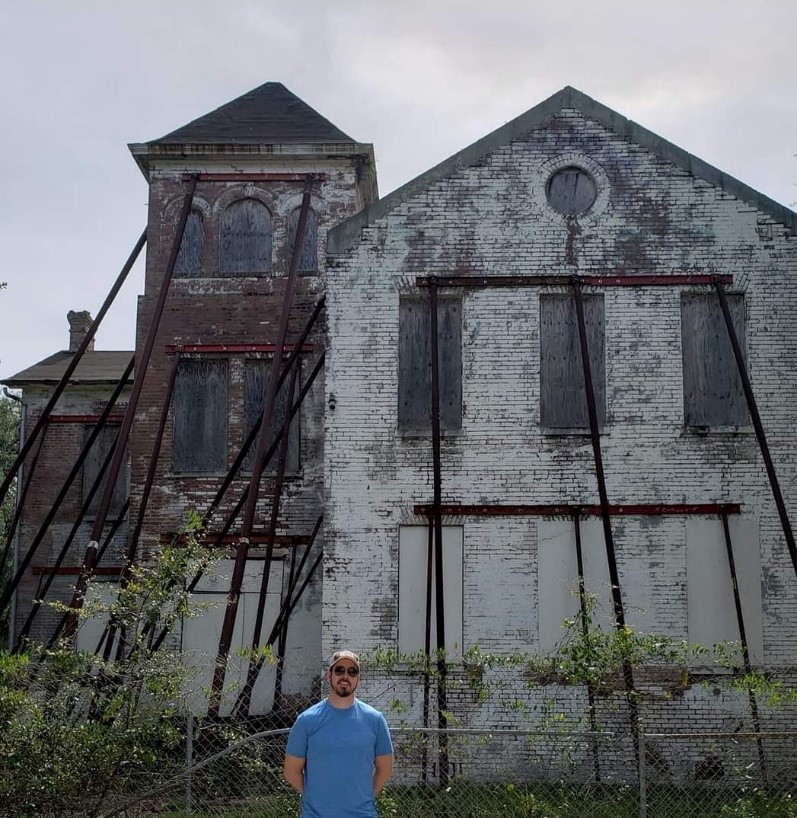
Author Patrick Gibbons poses in front of the building that once housed a history-making effort to educate black students in Jim Crow-era Florida.
After sitting derelict for more than half a century, St. Benedict the Moor School in St. Augustine, Fla. will be getting a new lease on life. The Sisters of St. Joseph of St. Augustine gathered last week to announce that the former schoolhouse will be turned into a community center aiming to help single mothers, according to First Coast News.
The school was built in the late 1800s with the financial backing of St. Katherine Drexel and became historically significant in 1916 when the sisters teaching at the school refused to stop educating black students and were arrested because state law prohibited white teachers from educating black students.
The sisters, backed by the Diocese of St. Augustine, stood firm in their convictions that the law was discriminatory and won a victory in court.
However, the ruling only impacted private schools as public schools continued to prohibit white teachers from educating black students.
The Sisters of St. Joseph, who arrived in Florida following the end of the Civil War, and other religious orders took up the mission of educating freed slaves and their descendants at a time when public schools would not.
by Jeff Barlis and Travis Pillow

LaToya Jones' daughters have found a new home at their Catholic school.
Catholic Schools Week is a national celebration of Catholic education, but don’t tell LaToya Jones of Jacksonville that it only lasts for one week.
Jones celebrates her school – St. Pius V Catholic School – on a daily basis.
The church rents its former convent to Jones, who lives with her three daughters two doors down from the school that has transformed their lives.
A year ago, the family was rocked by the loss of husband and father Lionel Jones, who died from complications of diabetes. Already struggling in a variety of neighborhood and private schools, the girls had a hard time coping.
At St. Pius, LaToya found a new home and a new home away from home, and her girls are thriving.
“It’s like our extended family,” LaToya said. “They help us out a lot. There’s always something going on, and the facilities are always open. It’s like a family away from home. They know my girls like their mom and grandma and auntie would. All the way down to the coach and janitor.”
Catholic schools have long provided more than just education to families like the Joneses. They strengthen communities for Catholics and non-Catholics alike. Yet nationally, over the past decade, there has been a net loss of nearly 1,000 Catholic schools. Enrollment has shrunk by 17.6 percent. This represents lost community assets and squandered social capital. (more…)
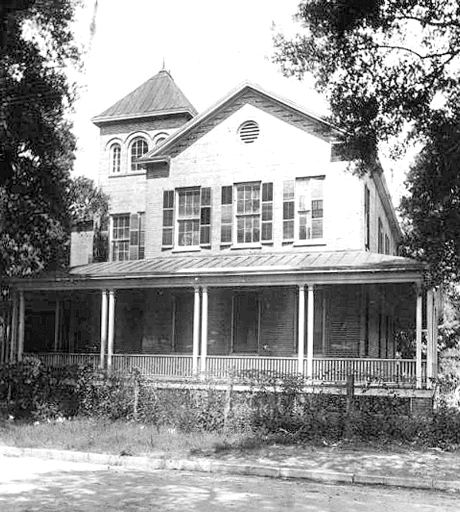
St. Benedict The Moor School, St. Augustine, Fla. Source: Wikimedia Commons.
A century ago, three Catholic sisters in St. Augustine, Fla. were arrested for something the state Legislature had recently made a crime: Teaching black children at what, in the parlance of the time, was known as a "negro school."
The ensuing trial propelled a 266-year-old French Catholic order and America's youngest Catholic Bishop into the middle one of the wildest and most racially charged gubernatorial campaigns in Florida history. A hundred years ago today, the white sisters won their legal battle, vindicating the rights of private institutions like the Saint Benedict the Moor School that fought to create educational opportunities for black children in the era of Jim Crow segregation.
Black parents' demand for quality education didn't begin with Brown v. Board, but hundreds of years before, in chains and in secret. But near the turn of the twentieth century, as Jim Crow laws reversed the progress made under post-Civil War reconstruction, public institutions intended to uplift freed blacks became increasingly inadequate and unequal. Black parents often turned to their own churches or to missionary aid societies, like the Sisters of St. Joseph, to educate their children.
The story of the three white Catholic sisters has been examined over the years by multiple scholars, whose work informs this post. And while details in the historical record are at times murky and ambiguous, the episode sheds light on the countless struggles across the South to educate black children who were pushed to the margins by oppressive public institutions.
* * *
 Founded in 1650 in Le Puy-en-Velay, a rural mountain town in southern France, the Sisters of St. Joseph took up a mission to serve, educate and care for the poor and disadvantaged. For the next 200 years, the sisters pursued their mission throughout France until they were invited to Florida by Bishop Augustin Verot after the end of the U.S. Civil War.
Verot, a native of Le Puy, recruited eight sisters for a new mission: To educate newly freed slaves and their children.
The sisters established Florida's first Catholic school for black students in 1867 along St. George Street in St. Augustine. They would go on to establish schools in Key West and in Ybor City. With the financial backing of a wealthy heiress, Saint Katharine Drexel, the Sisters of St. Joseph opened St. Benedict the Moor School in 1898.
The Sisters of St. Joseph, along with other religious groups like the Protestant American Missionary Association, educated black students in private and public schools in Florida for several decades. But then the legislature lashed out against their efforts. "An Act Prohibiting White Persons from Teaching Negroes in Negro Schools" unanimously passed through both chambers without debate, and was signed into law on June 7, 1913. (more…)

