The National Assessment of Educational Progress (NAEP) created a new measure of socioeconomic status for the 2024 exams. This is a welcome addition, and a better measure of student economic status has proven revealing, specifically regarding charter school performance. Shifting eligibility criteria made the reliability of the old standby, free and reduced-price lunch, questionable over time. The new socioeconomic status variables incorporate surveyed measures of the number of books in the home and parental education into a new measure. Charter schools have succeeded in large part in their core goal of improving the academic achievement of disadvantaged students.
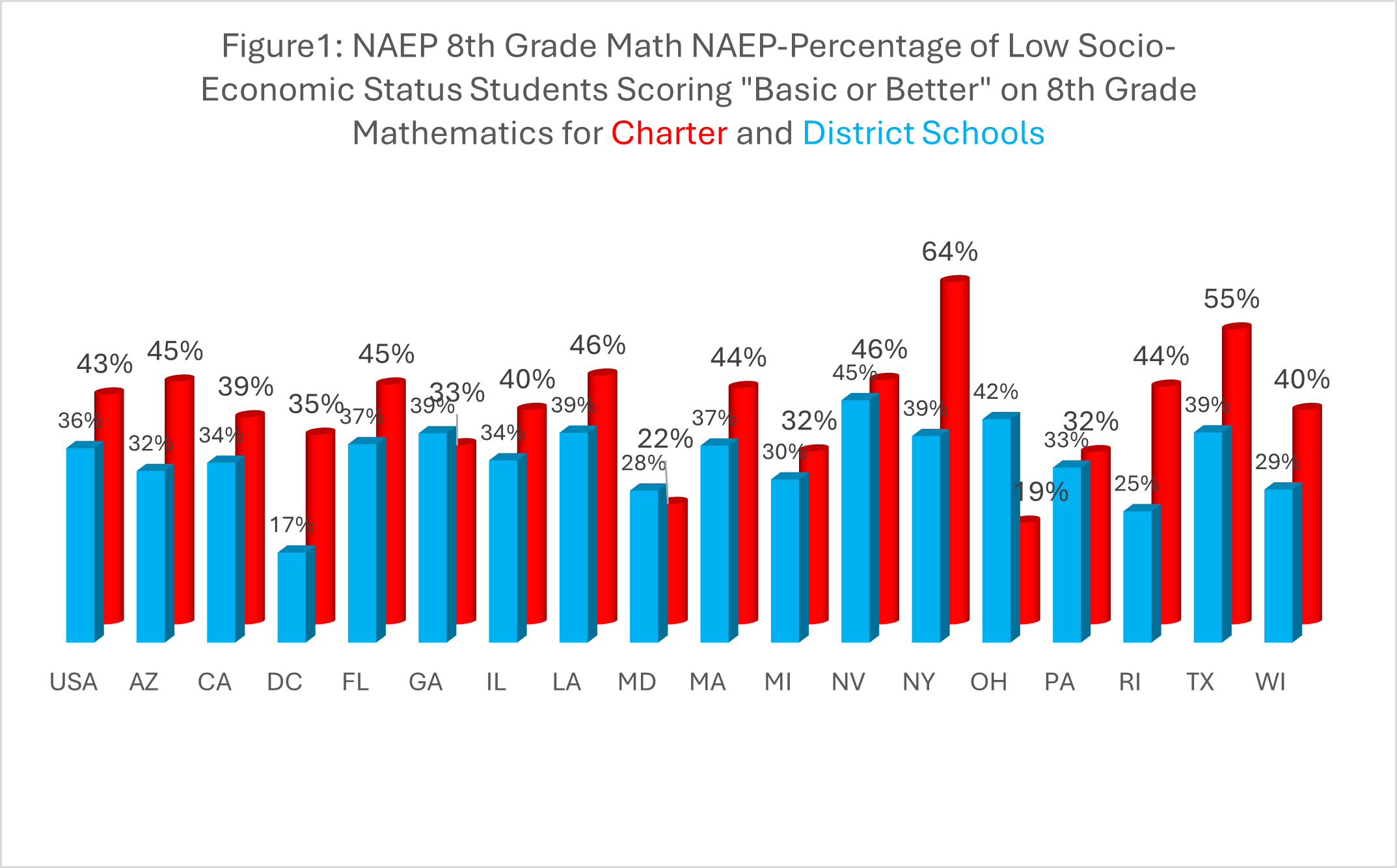
A few caveats before jumping in: we have no trend data yet. Obviously, not all states have charter schools, and even fewer have charter sectors large enough to report NAEP achievement for charter subgroups.
The COVID-19 shutdowns impacted all these scores. Finally, NAEP is given to representative samples of students across states, so subsamples (low-socioeconomic status students) of subsamples (charter schools) can have large standard errors, which you can think of as the plus/minus that goes along with polling. This means both the red and the blue lines can be either too big or too small, or both at the same time.
Finally, differences may or may not reflect faster rates of learning by sector as it is not possible to control for all student differences with snapshots of achievement. Random assignment studies can (and have) shown positive academic impacts of charter school attendance, whereas NAEP data should be seen as merely suggestive. We are peering through a glass darkly, and as such I’ll try to bring in some other data along the way.
Having said all of that, with a few exceptions, the red-colored charter columns tend to be larger than the accompanying blue district columns. Just for some perspective, the difference between the nationwide “Basic or Better” number of 43% for charter schools as compared to 36% for district schools is statistically significant, meaning that it is unlikely to have been caused by chance.
Some of the red columns are much larger than their corresponding blue columns. For example, in the District of Columbia, low socioeconomic status charter school students hit the “Basic or Better” threshold at more than twice the rate as their district peers. This is no mean feat, especially since Patrick Wolf and his coauthors found that the District of Columbia Public Schools spent $4,245 more per pupil than DC charter schools in 2019-20. The Stanford Educational Opportunity Project also shows a faster rate of academic growth for DC charters between 2008 and 2019, which is at least directionally similar.
Should we take 64% of low socioeconomic status students in New York charter schools at face value? Perhaps so. CREDO’s analysis of charter performance found New York City had some of the highest performing charters in the nation. Using a matching research strategy, the researchers found that New York City charter students received the equivalent of 80 days of extra math instruction compared to their district-matched sample.
Obviously, what you should do with a sector of school that is crushing the academic ball with highly disadvantaged students is to cap the total number you can have, which is what New York’s highly ethical lawmaking class has done. They can’t get enough of New Yorkers becoming Floridians.
The same crosstab procedure for the eighth grade reading exam produces information for fewer states, as seen in Figure 2 below.
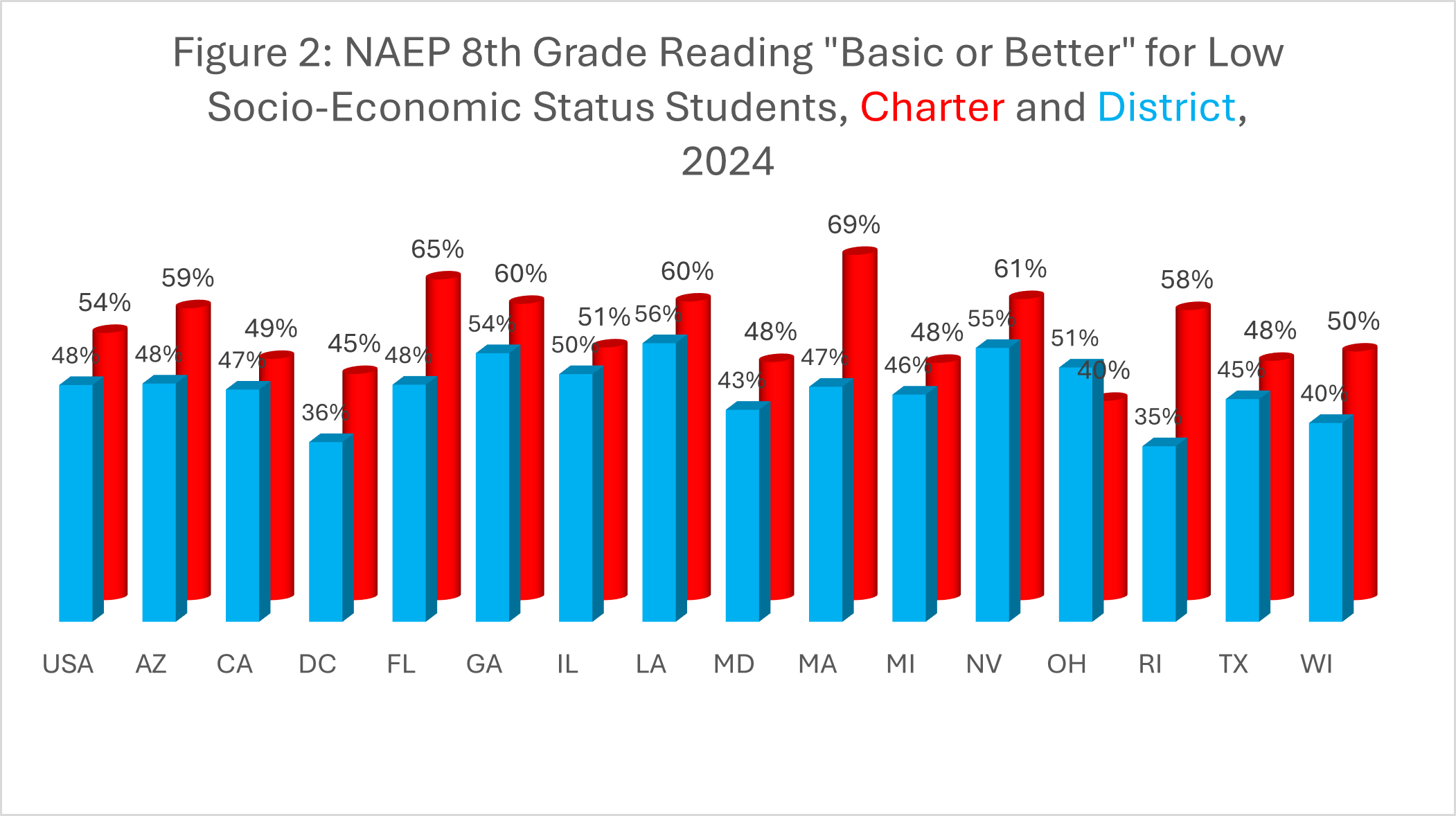
The national difference between charters and districts again registers as statistically significant. I would test the state differences, but the NAEP website moves at a glacial pace, and we have deadlines to meet here at your favorite edublog. More to come, but for now let’s just note that charter schools have largely succeeded on average in producing better academic outcomes with significantly fewer resources.
The NAEP released 2024 results last week, and the results continued to disappoint, especially for disadvantaged student groups. While scores began to recover among high end performers, the decline continued among lower performers, as can be seen in the eighth grade math chart below:

Rick Hess summarized the bad news:
Fourth- and 8th-grade reading scores declined again. Between 2019 and 2024, 4th-grade reading is down (significantly or otherwise) in every state but Louisiana and Alabama. Among 8th graders, fewer than one-in-three students were “proficient” readers. Thirty-three percent were “below basic.”
 On fourth grade reading, note the gradual improvement across racial subgroups from 2003 to 2015, but then the backsliding since then across groups. Critically, the slide started before the COVID-19 pandemic (the 2017 and 2019 exams both occurred before the outbreak). The decline between 2022 and 2024 is especially disappointing.
This continued slide occurred despite the federal government putting $190 billion into the school system. The 2024 NAEP was the second post-pandemic data collection (after 2022). With a sad predictability, the return on investment for this staggering funding appears to be minimal.

The defacto “plan” in the public school system appears to be to age the students out of the system unremediated. The 2026 fourth grade NAEP, for example, will be testing students largely too young to have been enrolled during the 2019-2020 school years. The eighth grade NAEP will take longer to age the pandemic fiasco-affected students out, but this will eventually happen as well. The affected students, however, will be aging not out of the elementary and middle schools but into society.
The news was not all grim: nationwide Catholic school students show signs of academic recovery. Unfortunately, the Catholic results are the only private school scores available, but they show a notably different trend than those in the public school system. See for example the trend among Hispanic students in Catholic schools and public school students on eighth grade mathematics:

The gap between Hispanic students attending Catholic schools has effectively moved from approximately a grade level, to approximately two grade levels in 2024. Louisiana was also a bright spot in the 2024 results. More number crunching to follow, but what I am finding thus far is the closer you look, the worse the results seem.
Editor's note: This post originally appeared in K-12 Dive.
The Nation’s Report Card is in, and it’s one that the U.S. Department of Education begrudgingly signed off on — but not without a warning to do better.
The scores show declines in both reading and math at grades 4 and 8 for the majority of states in 2022, according to results released Monday for the National Assessment of Educational Progress. Average national reading scores in 2022 reverted back to levels last seen in the 1990s, and math scores saw the largest declines ever recorded in that subject.
“Results in today’s Nation’s Report Card are appalling and unacceptable,” U.S. Education Secretary Miguel Cardona told reporters. “This is a moment of truth for education.”
The average math score for 4th graders fell 5 points since 2019 (from 241 to 236), while the score for 8th graders dipped 8 points (from 282 to 274), according to the Education Department’s National Center for Education Statistics, which administers NAEP.
In reading, average score declines were not as steep, but still decreased by 3 points in both grades compared to 2019.
NCES Commissioner Peggy Carr described the results, which are based on tests administered in early 2022, as “massive comprehensive declines everywhere.”
To continue reading, go here.

Weatherford
School choice will have its own legislative committee. From the News Service of Florida (subscription required): “Incoming House Speaker Will Weatherford, R-Wesley Chapel, is revamping the House's committee structure, including making changes that will affect education and regulatory issues. The changes, outlined in a memo sent to House members Wednesday, include creating an education Choice & Innovation Subcommittee, which will deal with a wide range of issues such as charter schools, virtual instruction and voucher-type programs.”
A plea on teacher evals. The Florida Education Association asks Gov. Rick Scott to use his authority to postpone the linking of standardized test scores to teacher evaluations, the Orlando Sentinel reports.
More school funding votes. Voters in Seminole said yes to a tax hike, voters in Volusia said no, the Orlando Sentinel reports. Brevard voters also said no, Florida Today reports.
Charter school closing. The Lee County School Board prepares to close a charter school with financial problems, the Fort Myers News Press reports.
About that $155 million verdict for the former charter principal. Nevermind, the Miami Herald reports.
Mounting criticism over student deaths. Hillsborough County parents start facebook pages and have scheduled a protest in response to the deaths of two special needs students, the Tampa Bay Times reports.
From Idaho and Indiana, a message for Jeb Bush? StateImpact Florida.

