Common Core: There is general acceptance among teachers, teachers unions and politicians in Florida that Common Core is a good thing, but questions remain about testing and funding, the Associated Press reports.
Next big step. President Obama can build on Common Core by creating another Race to the Top competition, inviting teachers to create top-notch, MOOC-like courses that can be viewed by students anywhere, write David Colburn and Brian Dassler in this op-ed for the Tampa Bay Times.
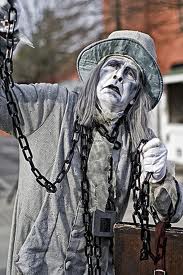 Ed reform Christmas Carol. Have we forgotten the Ghost of Education Past? From EdFly Blog: “For some, this brings nostalgia for the days when teachers and schools set their own standards. Forgotten is that while this system worked well for the children of affluent parents who lived near the best schools, it failed a growing number of kids not born into such fortunate circumstances.”
Private school security. The Palm Beach Post looks at the response from private schools in the wake of Newtown. The Post also looked at how charter schools in Palm Beach County responded.
Rookies. A year in the life of a first-year teacher. Second in a series. Fort Myers News Press.
Transfers. A Collier County teacher fights an involuntary transfer. Naples Daily News.
More school grades. The grading formula is in flux. School Zone.
Is the FCAT required or not? StateImpact Florida.
Florida Catholic schools are embracing Common Core academic standards and seriously considering whether to take the coming state tests aligned to them. In the meantime, their leaders say, 30 to 40 Catholic schools want to administer the FCAT in 2014, in what would be a trial run for potential transition to Common Core testing.
“Our mission is the same, public or Catholic school, to create productive citizens in our world that actually have the skills in life they need,” Alberto Vazquez-Matos, schools superintendent for the Diocese of St. Petersburg, told redefinED. “We’ll all be raising the standards and talking the same academic language.”
The push by Catholic schools towards common standards - and perhaps common tests - is an interesting counterpoint to the debate that followed last week’s comments by Gov. Rick Scott. Scott re-opened the door to a long-running conversation about voucher and tax-credit scholarship programs by saying he wants to see students in those programs take the same tests as their public school peers.
Right now, the state does not require tax credit scholarship students to take the FCAT, but they are mandated to take another comparable, state-approved test such as the Stanford Achievement Test or Iowa Tests of Basic Skills. Disabled students who use McKay vouchers to attend private schools are not required by the state to take any such tests.
This year, Catholic schools in Florida enroll 7,673 tax credit scholarship students. (The scholarship program is administered by Step Up for Students, which co-hosts this blog.)
Scott’s comments sparked suggestions from some school choice critics that private schools were dodging comparisons to public schools. But Florida’s Catholic schools have been quietly moving towards Common Core for more than year. In fact, all 237 Catholic schools in Florida will be rolling out a “blended’’ version of the language arts standards, right along with public schools, in 2014. (more…)
Vouchers and accountability. Gov. Rick Scott’s call for “voucher” students to take the same standardized tests as public school students is long overdue, editorializes the Tampa Bay Times: “Voucher proponents can't have it both ways,” it concludes. “They can't claim they are a good bargain for taxpayers but then be unwilling to prove it.”
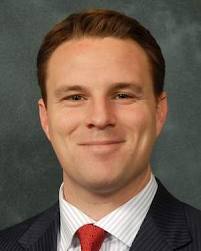
Weatherford
“Yes we are!” House Speaker Will Weatherford gives Tony Bennett a thumbs up on Twitter after a critical Tampa Bay Times column says the selection shows the state is doubling down on Jeb Bush ed reforms. Gradebook. A look at Bennett’s re-election upset in Indiana. Tampa Bay Times.
Home-schooled or truant? A Flagler County dad faces a criminal charge after not following requirements for home-schooling, reports the Daytona Beach News Herald.
Sex abuse lawsuits. Involving a former middle school teacher. Miami Herald.
Basking in the glow. Interim education commissioner Pam Stewart touts the PIRLS results on CNN. U.S. Education Secretary Arne Duncan offers praise, notes Orlando Sentinel. More from Fort Myers News Press.
More Tony Bennett. Tampa Bay Times columnist John Romano sees the same old agenda. The Tampa Bay Times editorial board says the BOE pick shows it “values conservative ideology over proven performance.” More from Tampa Bay Times, Florida Times-Union, Palm Beach Post, News Service of Florida, Sunshine State News,
More on testing and voucher kids. According to this Tampa Bay Times story, Gov. Rick Scott will propose that tax-credit scholarship students take the Common Core tests when they replace the FCAT.
DOE errors. Board of Education members criticize mistakes in teacher evaluation data. Gradebook. School Zone. Sun-Sentinel columnist Michael Mayo isn’t a fan.
 Within minutes of his selection as Florida’s next education commissioner this morning, Tony Bennett was in the midst of his first press gaggle in Florida (well, if four reporters can constitute a “gaggle”). Among several things that were noteworthy, Bennett said he probably didn’t do a good job of communicating with teachers in Indiana about coming changes – and vowed to do better in Florida. He raised the question of whether the new teacher evaluation law in Florida needs to be tweaked. And he described himself as an “unabashed supporter of school choice” for this primary reason: Social justice.
"I have school choice because I can afford it. And in Indiana, I believe every parent in the state of Indiana should have the same choice I had because I could afford it," he said. "And that’s social justice. Every child should be able to live the American Dream the way the Bennett children lived the American Dream."
Here is a transcript of Bennett’s remarks, edited slightly for length and clarity.
Q: What’s your reaction to the selection?
Bennett: I’m humbled and honored first. I’ve often said that I thought I had the dream job, working with a second-term governor with a very high approval rating. Who made education reform a priority. And who basically said, ‘Go out, develop, executive and implement the nation’s most aggressive education reform agenda.’ And he basically said, at every step along the way, ‘I support what Tony Bennett’s done.’
The reason I give you that context is because there’s only one state I believe is better than that. And that’s Florida. Florida has a rich history of serving students in a way that I don’t believe any other state has replicated until Indiana came along in the past four years. And I have made the comment many times that if I wasn’t the state chief in Indiana, the place I always thought you could make the biggest difference for children, not only in the state, but in the national context, is in Florida. Because I think this state is so vitally important to the national education discussion. (more…)

Robinson
Standardized test costs. They total about $1.7 billion a year nationwide, according to a new report from Brookings that includes state-by-state figures. Not much, concludes researcher Matt Chingos, who adds “perhaps we’re spending less than we should.” Coverage from Education Week and Huffington Post. Former Florida education commissioner Gerard Robinson tells the latter about test anxiety: “I won't pretend that tests don't matter and there's no anxiety -- but I also tell people there's anxiety with sex. There's anxiety with sex, but there isn't any talk about getting rid of that.”
And still more Jeb summit coverage. Politic365 on the “Florida Formula.” EdFly Blog on the crucial center. Rick Hess on "The Common Core Kool-Aid."
More protests from Hillsborough parents. They want better training for employees who work with special-needs children, StateImpact Florida reports. More from Tampa Bay Times.
They’re one of the first things people notice when they walk inside the new Brooks DeBartolo Collegiate High School in Tampa.
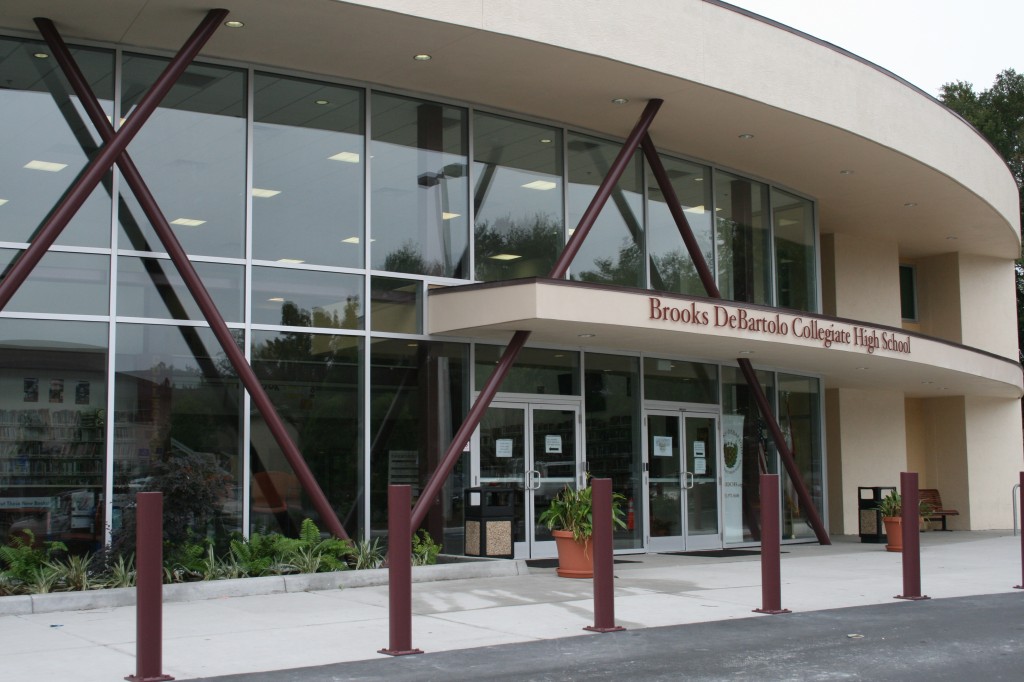
Brooks DeBartolo Collegiate High School
Windows, everywhere.
Inside the 67,000-square-foot renovated building, light pours in through an expansive curved entryway, between the cafeteria and lush outdoor dining area, inside classrooms and even along the second-floor hallway, where students can peer down into the giant gymnasium.
Compared to the charter school’s first digs, a cramped old Circuit City it leased for five years, “this is such a change of environment,’’ said Principal Kristine Bennett.
For its new home, the school’s foundation spent $15 million outfitting a former church with 20 classrooms, two computer labs and a media center. There’s a cafeteria with a LED-powered vending machine offering gluten-free snacks, and a full-sized gym featuring one wall with a painting of a fiery red and orange Phoenix – the school’s mascot.
The striking makeover is fitting for a student body that has undergone its own metamorphosis.
Three years ago, the state gave Brooks DeBartolo a “D’’ grade for academic performance. The school, which garnered a “C’’ the year before, faced losing its charter.
One of the school’s founders and financial backers, Derrick Brooks, the legendary former linebacker for the Tampa Bay Buccaneers, vowed his namesake school would work harder. And it did. The next year, it scored six points higher than the state required for an A grade.
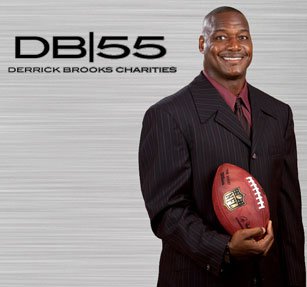
Derrick Brooks
Today, students are attending an “A’’ school for – hopefully, say administrators – the third year in a row. (more…)
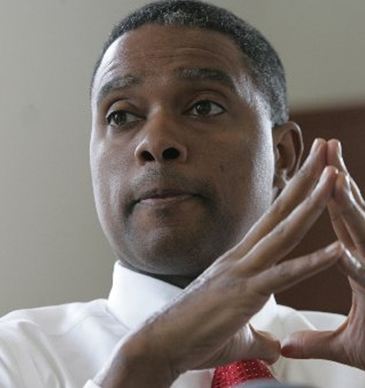 Gerard Robinson. The former Florida education commissioner, who stepped down three months ago, will be among the panelists next week responding to a new Brookings report on standardized testing and the Common Core. More here.
DOE responds to Tampa Bay Times contracting story. I can't remember the last time DOE did a point-by-point, line-by-line rebuttal to a story. Press release here.
Career academies. Get a nice write-up in the Gainesville Business Report.
Testing. New Duval Superintendent Nikolai Vitti removes some internal standardized tests from the district schedule, prompting praise from teachers union president Terrie Brady, reports the Florida Times Union.
FCAT. Will any private schools that accept tax credit scholarships give it? Asks Gradebook.
Contract talks. Continue next week in Palm Beach County after nearly falling apart last week, reports the Palm Beach Post’s Extra Credit blog.
Schools put kids in reach of convicts. Tampa Bay Times columnist Sue Carlton.
Ryan Wallace left his big, cliquish high school last spring for The Foundation Academy, a non-denominational Christian school with vegetable gardens and an aquaponic farm. “I wanted a chance to try something new,’’ said Ryan, now a 17-year-old junior planning a dodge-ball fundraiser for his class president campaign.
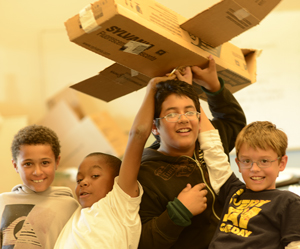
Boys in Aaron Unthank's single-gendered fifth- and sixth-grade class learn from each other, too. The setup gives Unthank more freedom to cater classes to meet boys' learning styles.
Twelve-year-old Marc’Anthony Acevedo came to the academy as a second-grader after being bullied at his old school. This year, he’s part of a single-gendered class of fifth- and sixth-grade boys. “Sometimes we have arguments, but we get over it,” he said. “We’re all friends.’’
For Cori Hudson, the Foundation was his last shot at a diploma. He messed up at the school district’s option of last resort. “I come to school every day now,’’ said the 16-year-old. “I feel like school is the most important thing to me.’’
These transformations are exactly what principal Nadia Hionides hoped for when she started the academy near Jacksonville Beach, Fla. nearly 25 years ago.
With a style that’s part Montessori, part Waldorf, the Foundation offers hands-on, project-based learning with a college-preparatory curriculum based on the philosophy that everyone learns differently.
The school has 280 students in kindergarten through 12th grade; 100 are in high school. They share a 23-acre campus that Hionides and her husband, a ship deck builder and painter, bought in 2008 for $600,000. The couple spent another $5 million for eight, prefabricated steel structures, which include a front-office foyer where the floor is made from vinyl records.
Tuition starts at $6,000 a year. But 81 students receive tuition assistance from Step Up For Students, the nonprofit that administers Florida’s tax-credit scholarship program for low-income kids and co-hosts this blog.
The academy separates students into groups of two grade levels - kindergarten and first-graders, second- and third-graders, etc.
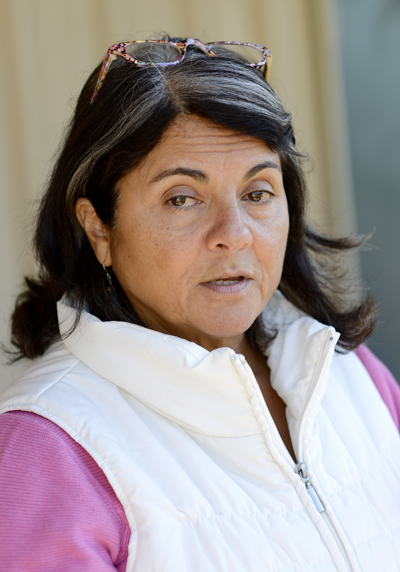
Hionides
“Because that’s real life,’’ Hionides said. Also, “they push each other to shine.’’
It seems to work in the fifth- and sixth-grade boys’ class – for the students and their teacher.
“It’s fantastic,’’ said Aaron Unthank, a longtime private school music teacher and baseball coach. “There’s a different kind of camaraderie as a class and there’s a lot more freedom I have as a teacher to talk about guy things.’’
The younger boys learn from the older boys, and the older boys gain confidence, Unthank said. He paraphrased Einstein: “You don’t know a thing well enough unless you can talk about it.” (more…)

