School choice. The Black Alliance for Educational Options draws 650 attendees from 20 states to Orlando for its annual symposium. Check out #SY2013 on Twitter for what's happening. Legendary school choice activist Howard Fuller says attendees shouldn't be knee-jerk about the participation of for-profit companies. Also check out this redefinED podcast with BAEO President Ken Campbell.
 Charter schools. Jeanne Allen, president of the Center for Education Reform, tells SchoolZone Florida needs additional charter school authorizers and that the current system favors charter management companies over mom-and-pop charter schools. The House Appropriations Committee approves a charter schools bill that would tighten accountability and require school districts to share empty classroom space with charter schools, reports The Buzz.
Sequestration. Will take a bite out of already dwindling construction funds. The Florida Current. Gradebook.
Superintendents. The Hernando school board picks Lori Romano, the director of adult, community, secondary and virtual education programs for Martin County Public Schools. Gradebook.
Principals. More than 200 students and parents protest the apparent ouster of a high school principal in Broward. South Florida Sun Sentinel. (more…)
Kansas: Lawmakers are pushing for two new bills, which include recommendations from the National Alliance of Public Charter Schools, to bring the school choice movement to a state with only 15 charter schools (The Topeka Capital-Journal).
Georgia: Proposed legislation looks to cap the state's private-school tax credit program and limit it to students with a financial need (Atlanta Journal Constitution). A parent-trigger bill that paves the way for traditional public schools to convert to charters also gets a nod from legislators (Atlanta Journal Constitution).
 New Hampshire: The House is set to vote on a measure that could end a Board of Education moratorium on charter schools (New Hampshire Union Leader). More from The Telegraph of Nashua.
Tennessee: A $4 million Mathematica study finds KIPP students show significant learning gains in reading, math, science and social studies in the first four years (The Commercial Appeal).
Alabama: State school board members offer mixed reactions following the surprise passage of the Alabama Accountability Act, which gives tax credit scholarships to parents who want to remove their children from failing public schools and enroll them in private schools or a non-failing public school (AL.com). Also, a circuit judge blocked the signing of a controversial bill that created tax credit scholarships (The Anniston Star). (more…)
 At least 13 private schools that accept the Florida Tax Credit Scholarship have applied to administer the FCAT and end-of-course exams next year.
The schools, mostly faith-based and in South and Central Florida, have submitted their applications to the Florida Department of Education, which will decide in August whether to approve them.
DOE spokeswoman Tiffany Cowie said there may be more schools that made the March 1 deadline, but the department won’t know the final number until the mail is cleared towards the end of the week.
A state law passed in 2012 allows private schools with at least one student receiving the tax credit scholarship to offer the Florida Comprehensive Assessment Test and/or end of course exams, which are required in public schools.
Of the 13 schools that applied, eight signed up only for EOCs.
“The FCAT is a dinosaur,’’ said Principal Sandra Basinger of St. Mary’s Catholic School in Brevard County, where her seventh- and eighth-graders hope to take EOCs in Algebra I and Geometry next spring.
Like a lot of Catholic schools, St. Mary’s administers the Iowa Test of Basic Skills to its students in grades 2-8. The test is as good as if not better than the FCAT, Basinger said. And with Florida phasing out the state assessment for other tests in line with the new Common Core standards, “really, I just don’t think it would be worth it,’’ she said.
James Herzog, associate director of education for the Florida Catholic Conference in Tallahassee, said in an email to redefinED that he has heard the same sentiment from other Catholic schools.
“From a practical standpoint, it would … not make any sense for Catholic schools (or most other nonpublic schools) to offer the FCAT for a year or two only and then have to switch again to something else … ,’’ he said.
Herzog originally anticipated 30 to 40 Catholic schools would apply to give the FCAT.
“Obviously, I was way off,’’ he said. (more…)
For their project, Gussie Lorenzo-Luaces and three classmates at Deer Park Elementary in Tampa, Fla., wanted to find out what kind of paper allows a paper airplane to fly the farthest. After five trial runs, they determined copy paper, with its smooth surface and stable weight, worked best.

Gussie Lorenzo-Luaces, a third-grader at Deer Park Elementary School in Tampa, was one of more than 2,000 students participating in the 33rd annual Hillsborough Regional STEM Fair last week.
The boys’ exhibit was among more than 1,800 presented at last week’s 33rd annual Hillsborough Regional STEM Fair, which featured 2,000 students from district schools, charter and private schools, and home schools.
That diversity was a big plus for Gussie’s mom, Susie, who was curious where other students in the county registered on the science track.
“I just feel they don’t need separation,’’ she said. “I like seeing them all together.’’
Increasingly, though, Hillsborough students are not all together in academic competitions.
In the past year, district officials have begun excluding charter schools from some districtwide contests, including Battle of the Books, a reading competition, and the Math Bowl and Math League for elementary and middle school students.
The reasons for the splintering are not clear. But everything from cost, to fear of competition, to a desire for charter schools to be more independent, has been suggested. At the least, the move points to potential pitfalls as school choice options mushroom across the landscape – even in a district with a choice-friendly reputation like Hillsborough.
“They’re all our children,” said Lillia Stroud of King’s Kids Academy of Health Science, a new charter in Tampa. Stroud said she can relate to the district’s concerns, but “separation at any level is disheartening.” (more…)
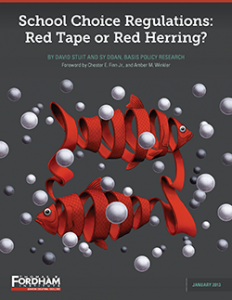 The Fordham Institute may be the closest thing to an honest academic broker in the contentious private school choice arena these days, and its latest report will no doubt enhance that reputation. "Red Tape or Red Herring?", released today, provides strong evidence that private schools are not averse to academic or financial oversight – a finding that runs counter to a longstanding libertarian narrative.
As Fordham president Chester Finn Jr. acknowledged in the forward: “Many proponents of private school choice — both the voucher and tax credit scholarship versions — take for granted that schools won’t participate (or shouldn’t participate) if government asks too much of them, regulates their practices, requires them to reveal closely held information and — above all — demands that they be publicly accountable for student achievement.”
The report looks at the participation rate of private schools in voucher and tax credit scholarship programs in 11 states and surveys from 241 private schools that do and don’t participate, and it finds that testing requirements are not a significant deterrent. Only a quarter of the schools ranked state-required testing as a “very” or “extremely” important factor. Among the schools not participating in voucher or scholarship programs, testing was the fifth most-cited concern – behind such issues as protection of religious activities and admission processes and government paperwork.
This is not to suggest that private schools are eager to embrace more government regulation. The report did find a modest negative correlation between the degree of regulation in a state and the rate of schools participating. But the survey is a reality check on private schools and the educators who run them. Catholic schools remain a major player in the voucher-scholarship market, in part because their mission is to serve poor children, and they also demonstrate remarkable leadership on the issue of testing and academic accountability.
The report echoes similar on-the-ground work in Florida. (more…)

Second-graders at the Academies of RCMA in Wimauma, Fla., enjoy a favorite for lunch: tostadas. It's the little things that help school leaders forge bonds with the children and their parents.
As dusk settled on the Academies of RCMA, students sat in classrooms while more than 150 moms and dads filled long tables inside the cafeteria.
It was Parents Night at the Wimauma charter school and even though many worked all day picking crops in nearby fields, they stayed for the whole hour.
Teachers and administrators at the coveted school say they have more freedom than most traditional public schools to develop programs that address the needs of their mostly Hispanic population.
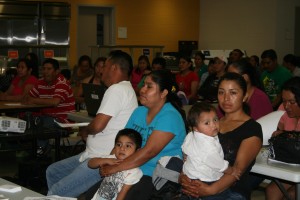
More than 150 moms and dads come to Parents Night, where they learn how to help their children - and themselves.
But the school doesn’t limit its help to students. Founded by the Redlands Christian Migrant Association, it’s committed to reaching out to parents, as well.
“They know they struggle,’’ said Marcela Estevez, the academies’ parent liaison and director of student affairs. “They work hard. But they know the school. They rely on the school.’’
More than 80 percent of RCMA’s 258 middle and elementary students live in households headed by single moms, and 35 percent to 40 percent are from migrant farmworker families, Estevez said. Practically every child qualifies for free breakfast and lunch.
RCMA, which is located behind the Beth-El Farmworker Ministry, focuses on students’ basic needs first, such as food and clothing. Then the goal is on acclimating them to English while still celebrating their culture, said Mark Haggett, director of the academies.
It takes creativity and ingenuity, Haggett said. RCMA receives about $5,300 in state funding for each student – a few thousand less than district schools get once construction costs are considered. To make up for it, the school actively seeks donations. (more…)
 In 2010, Doug Tuthill took a look around and realized he was living in a new era.
“Florida had this rapidly expanding portfolio of school choice options,” said Tuthill, the president of Step Up For Students, which administers the state’s tax credit scholarship program. “Yet there was little dialogue among the groups representing those choices. We weren’t talking to each other about what was working, what wasn’t, and why.”
Several important players in this bourgeoning movement recognized the need for more collaboration. Florida Virtual School and Step Up For Students, among others, wanted to see the school choice movement united, so they could learn from each other and talk through any differences.
Thus, FACE was born.
Florida Alliance for Choices in Education, or FACE, is comprised of more than 50 members, representing a diverse coalition of organizations dedicated to providing Florida school children with more educational options. Such organizations include National Coalition of Public School Options, Florida Charter School Alliance, Foundation for Florida’s Future, and StudentsFirst - all coming together with the belief that, as the FACE website says, “State policy should enable all parents to be fully engaged in their children’s education and to access those learning options that best meet their children’s needs.”
Step Up For Students (which co-hosts this blog) staffed the initial effort. Three individuals - Wendy Howard, a parent advocate from Tampa; Jim Horne, a former legislator and state education commissioner; and Julie Young, president and CEO of Florida Virtual School - spent a year facilitating outreach and diplomacy, eventually bringing all components of choice together in one organization.
Florida is the first state to do this. (more…)
 The Friedman Foundation’s latest “ABCs of School Choice” guide is out, and the numbers go like this: 21 states, 39 programs, 255,000 kids.
The guide offers a state-by-state rundown of the publicly funded, school choice options that are a vital piece of the overall school choice picture. It includes profiles of the students, parents and teachers who benefit from them. And it presents some thought-provoking stats, like how the value of each choice option compares to per-pupil funding in traditional public schools.
In Florida, a tax credit scholarship for low-income students is 34 percent of what’s spent on a traditional public school student, according to the Friedman analysis. Our own back-of-the-envelope calculations would put the percentage slightly higher, but the point is spot on: “voucher” students receive far less for their education than their public school peers. It’s a relevant detail that deserves more attention as the debate unfolds over testing for scholarship students and regulatory accountability measures for the private schools that enroll them.
The Florida section of the guide also includes a mini-profile of Davion Manuel-McKenney, a former tax-credit scholarship student who is now a freshman at Florida State College at Jacksonville. (Full disclosure: the tax-credit program is administered by Step Up For Students, which co-hosts this blog.) The story of Davion and his mother is a moving one. Click here to read more about it.
 It’s only fitting: Florida, a trailblazer in expanding school choice, will be among the busiest states during National School Choice Week.
This year’s celebration, which officially begins Sunday, is by far the largest ever, with more than 3,500 events in 50 states, up from 406 last year. Florida has at least 134 events on the schedule.
One of the highlights will be here in Tampa - a panel discussion featuring two nationally recognized education leaders. One is new Education Commissioner Tony Bennett. The other is MaryEllen Elia, superintendent of Hillsborough County Public Schools, the third largest school district in Florida and eighth largest in the country.
The pair will join other panelists representing the charter, magnet, private, virtual and home-schooling sectors. The event is set for Tuesday at 3:30 p.m., at the Boys Preparatory Academy at Franklin Middle Magnet School, one of the state’s first single-gendered public middle schools.
Other speakers include selected students, parents and teachers who will talk about the need to provide all children with more access to educational options. The event is sponsored by the Florida Alliance for Choices in Education, a group of school choice advocates that includes Step Up For Students, the nonprofit that oversees Florida’s tax credit scholarship program and co-hosts this blog.
Organizers are calling this year’s National School Choice Week “the world’s largest celebration of education reform.” The idea behind it is to raise awareness about the value of school choice, the need for more of it and the broad coalition that backs it.
“A quality education can be the ticket to the American dream for children across America,” Andrew Campanella, president of National School Choice Week, said in a prepared statement. “We must fight to ensure that every child has the ability to go to a great school.”
School choice in Texas is getting a big push this year from a key lawmaker who has made it a top priority.
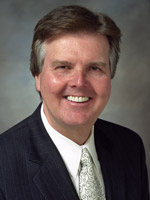
Texas Sen. Dan Patrick
“I’m the new chair of the Senate Education Committee and this is important to me,’’ state Sen. Dan Patrick, who has served on the committee for six years, said in a telephone interview with redefinED. “Here’s an issue that I’ve decided we need to push, but now I’m in a position that I can move it forward.’’
Patrick, R-Houston, and other school choice advocates in Texas are looking to create a tax credit program similar to the one in Florida that allows corporations to redirect a portion of state taxes to a scholarship fund in return for a tax credit. Low-income families who qualify can use the scholarship to help pay tuition at private schools.
Patrick has included the measure in an ambitious education plan that also calls for doing away with the 215-school cap on charter schools; incorporating a school rating system modeled after Florida’s A-F grades; and giving students the ability to enroll in any school within their district or in another district that has space.
In the interview, Patrick called school choice a civil rights issue and a “moral right.” He also offered a feisty response to an ad campaign, launched last fall by school choice opponents, that suggested “vouchers” would jeopardize Friday night football.
“With all due respect, that campaign is idiotic,’’ he said. “Texas would cut out math before they would cut out football.’’
Here’s more from the interview: (more…)

