 Nearly $2.5 million in Reading Scholarships were awarded to 4,961 Florida students during the 2020-21 school year according to a report prepared by the state-approved scholarship funding organization that helps administer the scholarship.
Step Up For Students, which hosts this blog, disclosed that families spent about 82%, or $1.5 million, of the scholarship funds, on instructional materials. Part-time tutoring and afterschool programs were the next most popular options at $260,374 and $53,034, respectively. In total, parents spent nearly $1.9 million to help improve their childen’s literacy.
Two-thirds of the students who used a Reading Scholarship were either white or Hispanic; 28% were Black. Seven percent were considered English Language Learners.
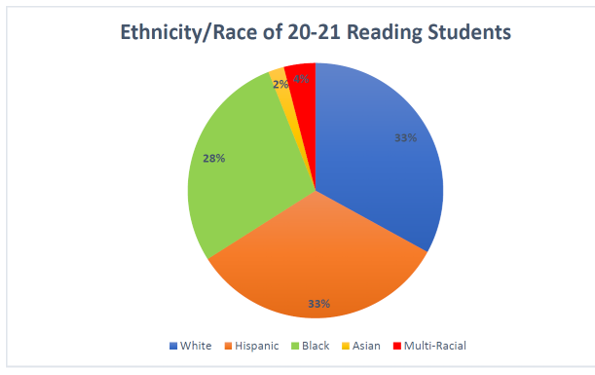 The Reading Scholarship was most popular among parents in Broward County, who accounted for 9% of the total, followed by Palm Beach and Marion counties, each of which accounted for 7% of the total.
Created in 2018, the program provides students with a scholarship worth $500 that can be spent on tutoring, textbooks, reading curriculum, reading programs and more. It is available to public school students in grades 3-5 who scored below grade level on the third- or fourth-grade English Language Arts section of the Florida Standards Assessment in the prior school year. Students classified as English Language Learners receive priority funding.
Changes likely are coming to the program for the 2022-23 school year. The Florida Legislature during its 2022 session voted to rename the program the New Worlds Reading Initiative and expanded eligibility to include students in grades K-2.
Both changes await Gov. Ron DeSantis’s approval.
 The global pandemic may have caused a decline in graduation rates among Florida’s scholarship students, according to a recently released report from Step Up For Students. Graduation rates for seniors on the Florida Tax Credit Scholarship fell 3.2 points during the first pandemic school year.
In school year 2020-21, 4,344 tax-credit scholarship students entered their senior year at 586 private schools. Among those seniors 3,744, or 91.7%, graduated. Though still a respectable graduation rate, it is the lowest reported since the scholarship funding organization Step Up For Students, which administers state scholarships, began tracking graduation rates in 2015.
Step Up For Students uses a senior graduation method which counts the percentage of students who began the year as a senior and graduated. Graduates are defined as students who received a standard diploma, special education diploma, or certificate by the end of the school year.
Students who dropped out or did not complete 12th grade are counted as not graduating. This graduation rate cannot be used to compare with public school graduation rates, which use a four-year cohort method.
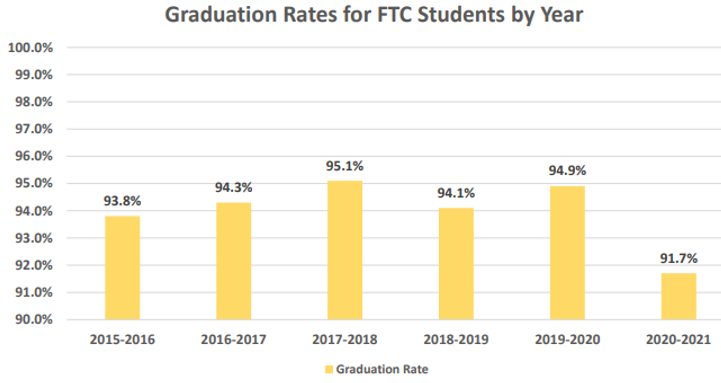
Graduation rates among scholarship students varied by race, income, and religious denomination of school where the student attended.
Catholic schools saw the most success, graduating 99.3% of seniors, while non-denominational schools graduated 90.2% of students.
Black students had the lowest graduation rate at 85.4%, compared to 95.5% of white students and 98% of Asian students.
Students eligible for the free or reduced-price lunch program, a proxy for the lowest-income students, graduated at a rate of 90.4% compared to 95.3% of students who were not eligible for the program.
For the 2020-21 school year, Step Up For Students awarded tax-credit scholarships to 103,985 students who attended 1,931 private schools across the state. A total of $645.6 million in scholarships was awarded, with the average scholarship worth $6,646.

Support for school choice has increased since April 2020 by 8 percentage points, from 64% to 72%, according to a new poll from RealClear Opinion Research.
The largest increase in support for school choice came from Democrats (up 9 percentage points) followed by Republicans (7 percentage points) and registered Independents (7 percentage points). Overall Democratic support also was higher than registered Independents (68% compared to 67%) but lower than Republicans (82%).
Hispanic Americans were the most likely to support school choice (77%) compared to white Americans (72%) and Black Americans (70%). Asian Americans showed the least support (66%) and were more likely to oppose school choice (26%).
Tommy Schultz, CEO of the American Federation for Children, called the poll numbers “stunning.”
“The past two years have exposed to the world what many in the parental choice movement have known for decades: no single educational environment is right for every child,” Schultz said. “As the battle over educational freedom continues, party affiliation is secondary to ensuring all families are empowered to choose the best educational setting for their children.”
Schultz warned policymakers:
“As these poll numbers show, there will be consequences if you go against the staggering majority of parents who support this issue.”
RealClear Opinion Research polled more than 2,000 registered voters Feb. 5-9 for the survey.
Other demographic research shows that in Florida, 48% of K-12 students utilize some form of school choice, up 45% from the previous year.
Public options, such as charter schools and district open enrollment, are among the most popular choices, but private school scholarships have been among the fastest growing. This year, 188,774 students received scholarships from Step Up For Students.
The scholarship administration nonprofit, which hosts this blog, manages four scholarship programs that allow students to attend private schools, including the Florida Tax Credit Scholarship, the Family Empowerment Scholarship for Educational Opportunities, the Family Empowerment Scholarship for Students with Unique Abilities, and the Hope Scholarship for victims of bullying, harassment and sexual assault.
Step Up also administers transportation scholarships allowing students to attend other public schools, as well as a Reading Scholarship to help public school students who struggle with reading and reading comprehension.
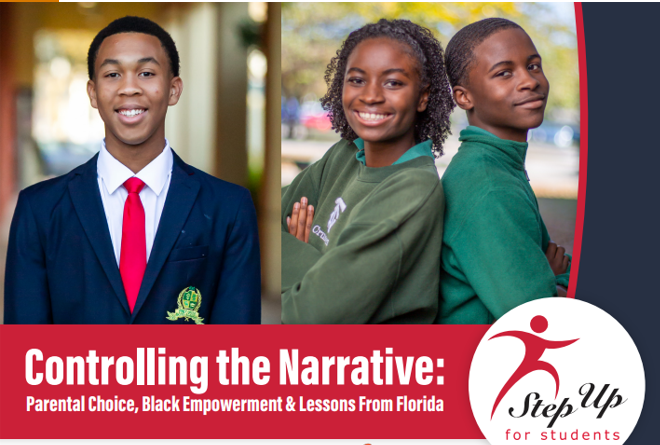 On this episode, Tuthill speaks with Denisha Merriweather, founder of Black Minds Matter and director of public relations and content marketing at the American Federation for Children, and Ron Matus, director of policy and public affairs at Step Up For Students, about their new report, Controlling the Narrative: Parental Choice, Black Empowerment, and Lessons from Florida.
(Dava Hankerson, director of enterprise data and research at Step Up For Students, and Nathaniel Cunneen, a communications associate at the American Federation for Children, also contributed to the report.)
The three discuss how Florida has become a boom for Black families seeking alternative education options through choice. More than 100,000 Black students – one in six – participate in some type of non-district choice program, such as a charter school or a private school through state sponsored scholarships.
Tuthill, Merriweather and Matus also discuss the degree of empowerment that education choice provides Black educators through autonomy and small business opportunities, such as microschools, as flexible spending programs like education savings accounts take hold nationally.
"It's a story that's been unfolding in front of us, which I don't think people realize the extent of – the degree to which Black families have embraced education choice in all its forms ... This was an opportunity to put a strong spotlight on something that's been going on for 20 or 25 years."
EPISODE DETAILS:

