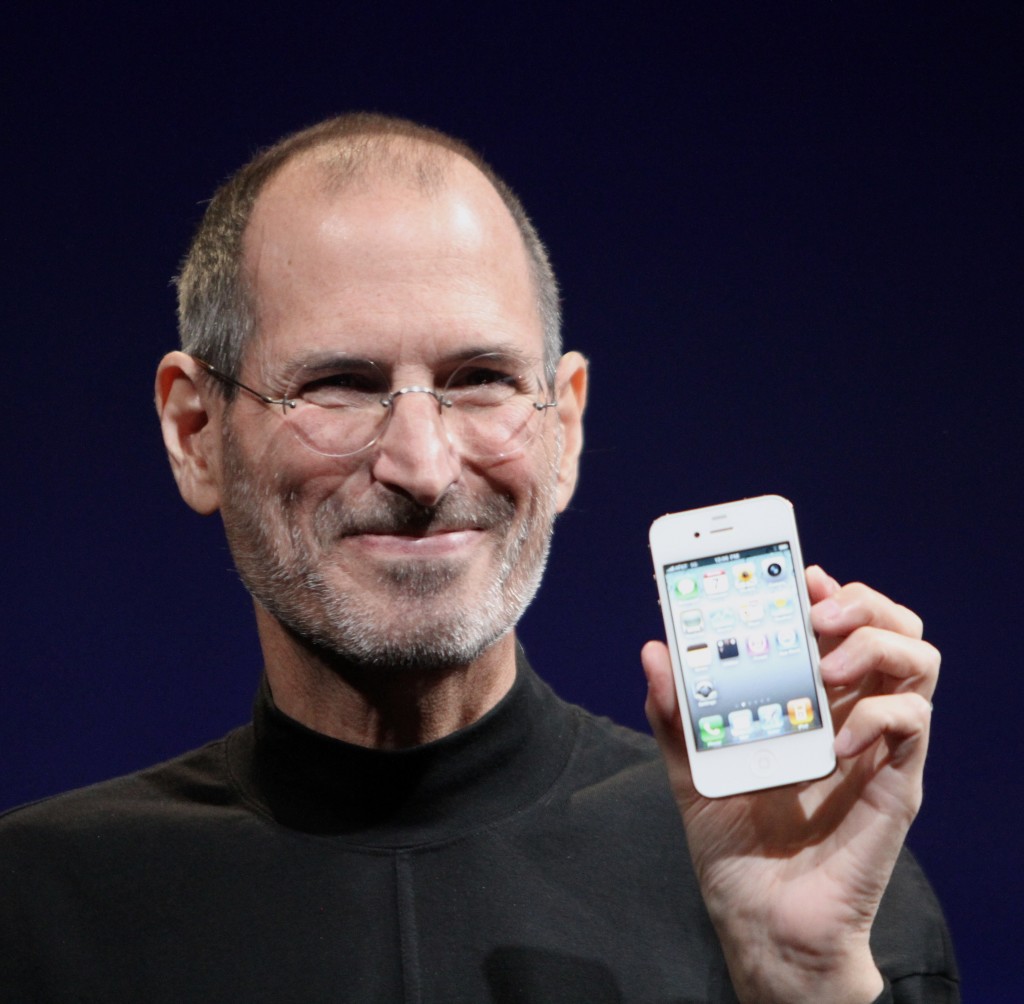
Steve Jobs (photo by Matthew Yohe, accessed from Wikimedia Commons)
This is the latest in our series on the Voucher Left.
Five years after his death, we’re still talking about Steve Jobs. The 2015 movie about him just won two Golden Globes, including one for Aaron Sorkin’s script. His quotes still spur stories. His connection to the San Francisco 49ers somehow inspired an angle for Super Bowl 50.
So now seems as good a time as any to highlight (as other folks rightly did after his death) that Jobs, the Apple visionary, was a passionate supporter for school vouchers, and to add what hasn’t been explicitly noted, which is that he was, by conventional perceptions, an especially liberal one.
Skeptical? Jobs, the adopted son of a repo man, took a deep, lifelong dive into Eastern religions. He cultivated an organic garden. He was pretty much vegan (and at one point, a fruitarian). In his younger days, he dropped a lot of acid, dropped out of college and went to work barefoot. For years, he avoided deodorant. His company was all in for gay rights. He couldn’t get enough of Bob Dylan. And the kicker to his most famous speech, his 2005 commencement address at Stanford, was a quote from the crunchy-granola “Whole Earth Catalog.”
To be clear, I don’t care if Jobs was “conservative” or “liberal.” But tribal politics being what they are, I know many people do put stock in labels, including folks on the left who have somehow come to believe that expanding opportunity through school choice is out of synch with their “progressive” values. So, for them, it’s worth noting what Jobs, this counterculture kind of guy, had to say about school choice:
I believe very strongly that if the country gave each parent a voucher for $4,400 dollars that they could only spend at any accredited school several things would happen. Number one schools would start marketing themselves like crazy to get students.
Secondly, I think you'd see a lot of new schools starting. I've suggested as an example, if you go to Stanford Business School, they have a public policy track; they could start a school administrator track. You could get a bunch of people coming out of college tying up with someone out of the business school, they could be starting their own school. You could have 25-year-old students out of college, very idealistic, full of energy instead of starting a Silicon Valley company, they'd start a school. I believe that they would do far better than any of our public schools would. The third thing you'd see is I believe, is the quality of schools again, just in a competitive marketplace, start to rise. Some of the schools would go broke. A lot of the public schools would go broke. There's no question about it.
It would be rather painful for the first several years, but far less painful I think than the kids going through the system as it is right now. The biggest complaint of course is that schools would pick off all the good kids and all the bad kids would be left to wallow together in either a private school or remnants of a public school system. To me that's like saying "Well, all the car manufacturers are going to make BMWs and Mercedes and nobody's going to make a $10,000 car." I think the most hotly competitive market right now is the $10,000 car area.
It’s worth reading Jobs’ remarks about public education in full (thanks to the Heartland Institute for culling them), because he also says interesting things about unions, monopolies, parents and consumers. For now, a few things worth noting …
First, as Jay P. Greene pointed out after Jobs died in October 2011, the Apple CEO made similar comments as late as 2007. So these snippets above, from a 1995 interview with the Smithsonian Institution, aren’t an anomaly.
Second, Jobs came of age in an era where parental choice wasn’t saddled as it is now with the “right wing” label slapped on by critics and sealed by the press. In fact, he and Cupertino, Calif.-based Apple would have been right there, at the epicenter of a voucher quake, when liberal Berkeley law professors Jack Coons and Stephen Sugarman led a late ‘70s effort to make school choice the law of the land in California. (more…)
Editor's note: This entry comes from Fawn Spady, the chairwoman of the American Center for School Choice
This past week, I spoke to an “Introduction to Teaching” class at Green River Community College just south of Seattle.
I was asked to speak by a teacher who had been following the work my husband and I have done over the past 17 years to bring education choice to Washington State. She had already shown her students the movies “Waiting for Superman” and “The Lottery.” Interesting.
I thought it might be fun to take the pulse of these future teachers. Has anything changed here over the past four years that we have taken a hiatus from our education choice work? We have a liberal president in the White House who supports charter schools. Many high-tech leaders in Washington have dipped their toes in the water of education reform by lobbying the legislature for small reforms. Schools haven’t improved. The state budget is a deficit mess. Teachers union credibility has been damaged by strikes and their irrational unwillingness to consider merit pay.
Were future teachers going to be open to the possibility of education choice?
I began my presentation with a quote from one of their heroes, Steve Jobs:
I believe very strongly that if the country gave each parent a voucher … several things would happen. Number one, schools would start marketing themselves like crazy to get students. Secondly, I think you’d see a lot of new schools starting ... I believe that they would do far better than any of our public schools would. The third thing you’d see is ... the quality of schools again, just in a competitive marketplace, start to rise.
They were receptive. As in the old Life cereal ad, I thought to myself, “Hey, Mikey! They like it!”
I summarized our 14-year battle, gave out union dues statistics and showed them education choice Web sites from around the country. The online maps showed the spread of choice programs nationwide and provide a stark contrast to the absence of choice in Washington State.
I also showed them how their future union is willing to break campaign laws and use their money to keep them from having choices, merit pay and removing ineffective teachers.
In the end, they wanted to know what they could do. We talked about the importance of elections and picking candidates wisely based on information and not party. I told them not to let “the blob” lie to them or the public, and to help spread the truth about education choice among their friends and family. I told them that when they become teachers they need to hold their union accountable, even though it will be hard.
I feel hopeful. We will have to see how the 2012 election goes in Washington State.
The Huffington Post got a copy of Walter Isaacson's forthcoming biography of Steve Jobs, focusing particularly on a revealing conversation between Jobs and President Obama. In his meeting with the president, during which he said Obama was "headed for a one-term presidency," Jobs criticized America's education system, saying "it was crippled by union work rules," Isaacson reports. "Until the teachers' unions were broken, there was almost no hope for education reform."
Lest this be a surprise to the center-left, Jobs embraced education reform generally and school vouchers specifically with even more vigor during a 1995 interview with the Smithsonian Institution:
I've been a very strong believer in that what we need to do in education is to go to the full voucher system ... One of the things I feel is that, right now, if you ask who are the customers of education, the customers of education are the society at large, the employers who hire people, things like that. But ultimately I think the customers are the parents. Not even the students but the parents ...
... in schools people don't feel that they're spending their own money. They feel like it's free, right? No one does any comparison shopping. A matter of fact if you want to put your kid in a private school, you can't take the forty-four hundred dollars a year out of the public school and use it, you have to come up with five or six thousand of your own money. I believe very strongly that if the country gave each parent a voucher for forty-four hundred dollars that they could only spend at any accredited school several things would happen. Number one schools would start marketing themselves like crazy to get students. Secondly, I think you'd see a lot of new schools starting. I've suggested as an example, if you go to Stanford Business School, they have a public policy track; they could start a school administrator track. You could get a bunch of people coming out of college tying up with someone out of the business school, they could be starting their own school. You could have twenty-five year old students out of college, very idealistic, full of energy instead of starting a Silicon Valley company, they'd start a school. I believe that they would do far better than any of our public schools would. The third thing you'd see is I believe, is the quality of schools again, just in a competitive marketplace, start to rise. Some of the schools would go broke. A lot of the public schools would go broke. There's no question about it. It would be rather painful for the first several years.

