Legislation: Universal school choice is a top priority of House Speaker Paul Renner and Rep. Ralph Mussullo, chair of the House Education and Employment Committee, supports multiple education bills, including changing high school start time to no earlier than 8 a.m. The 2023 legislative session begins this week. Florida Politics. Sen. Bryan Aliva is backing several new bills this legislative session, including one that would revamp the teacher recertification requirements and cut down the time it takes teachers to complete the process. Florida Politics. A series of proposed laws would transform the state's public K-12 education system. Critics say the state has too much control over the classrooms. Tampa Bay Times. Politico. Washington Post.
Opinions: Paula Montgomery of the League of Women Voters of the Pensacola Bay Area opposes charter schools and school vouchers, claiming that charter schools are not required to employ certified teachers, that private schools accepting vouchers are not required to test students and that public schools must accept everyone. However: Charters schools are required to employ certified teachers unless the school is approved under the "Schools of Hope" law that passed in 2017. Private schools have been reporting scholarship student test scores to state researchers since 2007-08. Finally, public schools can exclude students from attendance through zoning and deny students due to lack of accommodations for children with special needs. Pensacola Daily News Journal. Could chatbots be part of the future of education? Anne Trumbore, the Chief Digital Learning Officer at the Sands Institute for Lifelong Learning at the University of Virginia believes that chatbots could be effective and affordable private tutors. The 74. Teacher pay could be higher, says Chester E Finn, Jr. but the teacher unions and parents want smaller classrooms instead. Education Next. Parental backgrounds can have major impacts on their children's educational trajectory. For example, children living in a one-parent household are significantly more likely to be suspended from school or required to repeat a grade. Anna J. Egalite, a professor at North Carolina State University, offers some policy prescriptions to help students overcome these disadvantages. Education Next.
Book bans: Collier and Lee County public schools have banned or restricted 42 books. Naples Daily News published a list of these books. Flager County public schools will hold a hearing today over the request to ban or restrict Patricia McCormick's book "Sold." Flagler Live. Students in Pinellas County Public Schools are pushing back against efforts to ban books in school libraries. WUSF. Alachua County Public Schools says it has catalogued books in the libraries for years and has already established a process for parents to express concerns about books. Gainesville Sun.
Elections: Florida Republicans are looking to oust several school board members in 2023. WPTV.
Sarasota: The Sarasota County School District removed Duane Oakes, the chief of the district's police department from his role late Friday afternoon. No reason for the abrupt departure was given. Herald-Tribune.
Palm Beach: A Lake Worth High School AP math teacher was removed from the classroom after posting pictures of three students and comparing their skin color to shades of coffee. Palm Beach Post.
Polk County: A Lakeland mom wants Spessard L. Holland Elementary School renamed. She says the school is named after a man who supported racial segregation in schools. Bay News 9.
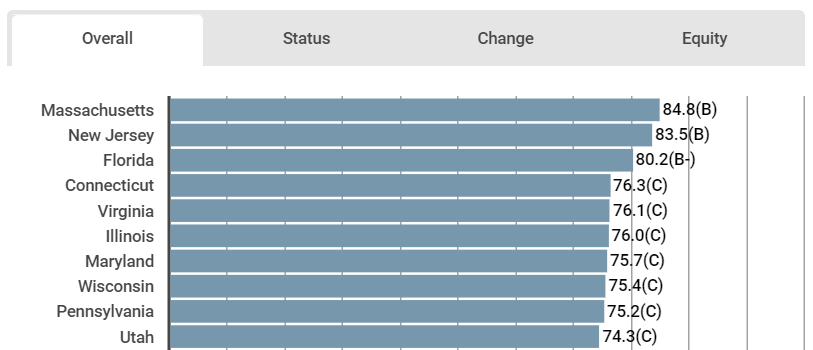
 Florida, a national leader in education choice, ranks No. 3 in K-12 achievement for a second year in a row, trailing only Massachusetts and New Jersey, according to the latest rankings report from Education Week.
This shouldn’t be a surprise.
For one thing, Education Week based most of its 2021 rankings on the same achievement data it used last year, with updates only for graduation rates and Advanced Placement results.
For another, Florida has been killing it in the “K-12 Achievement” rankings for more than a decade.
Since 2009, Florida has ranked No. 7, No. 7, No. 6, No. 12, No. 12, No. 7, No. 7, No. 11, No. 11, No. 4, No. 4, No. 3 and No. 3.
Not a bad run, no?
I do feel like a broken record pointing this out. But as long as opponents of education choice continue to play their own broken record, it seems appropriate. (Remember, this year’s expansion of choice in Florida was “the death knell for public education.”)
It also seems appropriate to keep noting Florida continues to rock the Education Week rankings despite having:
Here are the top 10 states in terms of achievement according to this year's Quality Counts report, based on three measures, Status, Change and Equity, explained in detail in the report.
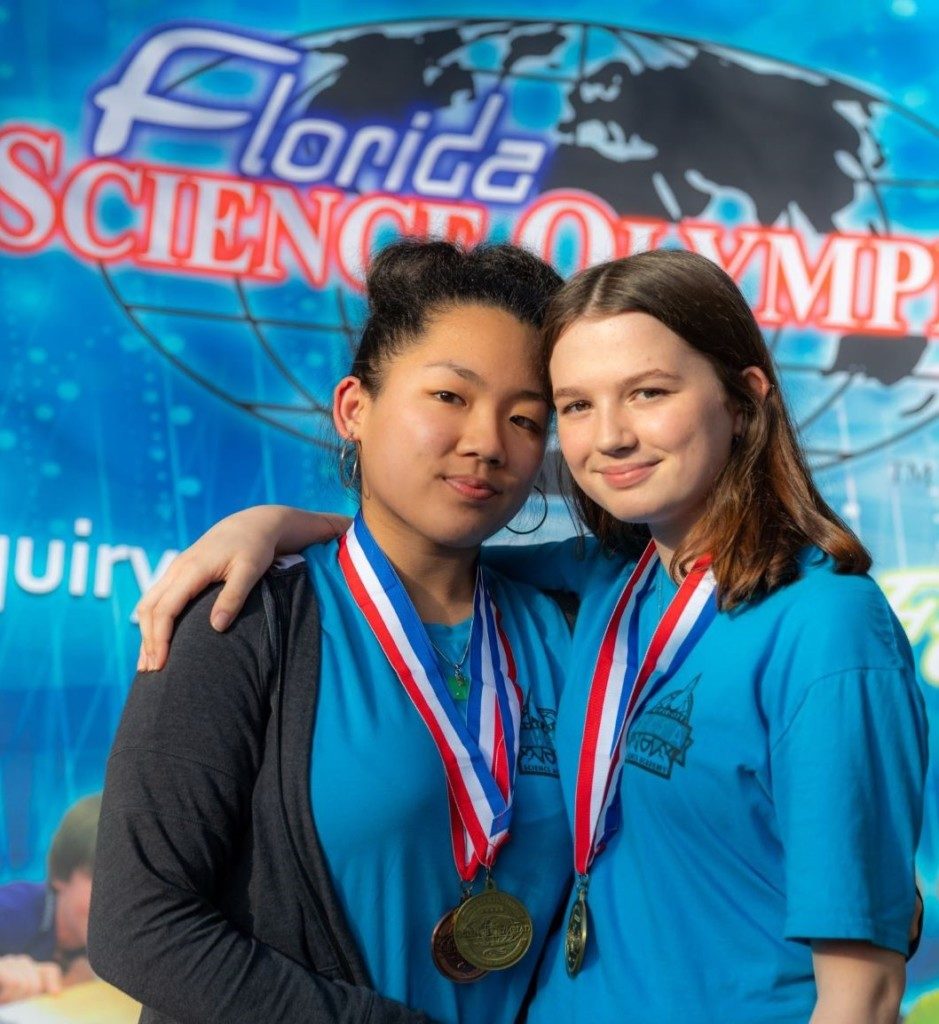
Faith Canlas, left, and Amelia Amarrador, both 15-year-old ninth-graders at River City Science Academy in Jacksonville, will represent their school Saturday at the Science Olympiad National Tournament at Cornell University. PHOTO: Geoff Fox
JACKSONVILLE, Fla. – They may call themselves “The Nerds,” but to their peers at the River City Science Academy charter school, the group of 15 dedicated bookworms is as celebrated as any championship-level athletics team.
On Saturday, River City’s science team will compete for the second consecutive year at the Science Olympiad National Tournament held at Cornell University in Ithaca, N.Y. River City’s squad is one of two teams from Florida, and one of 60 middle school teams from around the country that will compete, along with a Japanese team also vying for the championship. There are nearly 8,000 Science Olympiad teams in the country.
River City Science Academy is an independent, A-rated K-12 charter school that serves 2,800 students at four Jacksonville campuses. The school focuses on a STEM (science, technology, engineering and math) curriculum. It’s also a Title I school, with over 50 percent of its students on a free- and reduced-price lunch program.
It will cost $25,000 to fund the trip, and the school continues to seek tax-deductible donations from parents, community partners, STEM organizations in Jacksonville and a local Rotary club.
River City’s middle school team, which is allowed five ninth-graders, is jubilant at earning another shot at the national title after performing well in state and regional competitions. But Coach Ahmet Dastan said his squad is keenly aware of the challenges it will face.
“This is the hardest competition,” Dastan said. “The top 10 or 15 teams are always there. They know what they’re going up against: the best students from around the country.”
Competitors will be tested on subjects such as anatomy and physiology, the solar system, thermodynamics and water quality, while others will participate in building events.
Faith Canlas, a 15-year-old ninth-grader, said Dastan assigned students to study specific subjects in which they specialize. Faith and teammate Amelia Amarrador, also 15 and in ninth grade, say they are well-prepared for an onslaught of anatomy and physiology questions pertaining to the lymphatic, cardiovascular and urinary systems.
“I’ve always liked science better than the other subjects,” said Faith, the team’s co-captain. “There will be packets of tests and you usually have to answer about 200 questions in 50 minutes. It’s mostly written answers and multiple choice.”
Amelia, the team’s captain, said the questions are similar to tests medical professionals must pass.
“You may have to diagnose (illnesses) and prescribe drugs,” she said.
Gathered in a quiet classroom on a recent morning, the team reflected on the long hours of study and training they have undertaken to represent River City.
Throughout the year, they have stayed until 6:30 almost every Wednesday night and come to school from 9 a.m. to 1 p.m. on Saturdays to prepare.
Mustafa Bektas, 15, said he is excited for the Battery Buggy competition.
“It’s basically a small car that has to go from Point A to Point B using batteries,” he said. “There’s a braking system and it’s self-steering.”
Critical thinking skills may be tested in other ways. For instance, students may be given three sheets of tin foil, pennies, and a bucket of water. They must then figure out how many sheets of foil can hold the most pennies while floating in water.
Seventh-grader Keira Eastham, 13, is among three team members who will compete in the Experimental Design event.
“You’re given a bunch of materials and a goal for what your experiment should (accomplish),” she said. “It’s like a science fair project you have to do in 50 minutes.”
Last year was a learning experience for the team, said Alex Dreyer, an outreach assistant at River City.
“They were really confident to make it and to place first in Florida,” she said. “Then, when they got there, they realized how (stern) the competition was.”
This year, Dreyer said, the goal is to advance far enough to make it on stage to receive a medal for at least one event.
According to Dastan, who also has led an Atlanta-area school to the Science Olympiad, it’s not easy for a Title I school such as River City to earn a berth at the national competition.
“We have limited resources,” he said. “We have three or four parents who have supported (the team), but we expected more. It really helps to have the parents’ support. The more support we have, the more successful we’ll be.
“It’s been a long journey,” he said.
And it’s not over yet.
[Best_Wordpress_Gallery id="9" gal_title="Raising Knowledge relief"]
Last fall, as she started her senior year in high school, IvonD’liz Chernoff was full of love and gratitude. She was excelling in school. She had overcome years of ridicule. She was headed for college.
Tracking a monster hurricane was the last thing on her mind.
But there it was. Maria. Tearing through her beloved Puerto Rico.
“I couldn’t look away,” IvonD’liz recounted. “Houses with roofs coming off, water coming in from the ocean. It was terrifying … heartbreaking. The worst part was the aftermath, seeing people suffering, kids crying because they don’t have a home or food or because their dolls are gone with the storm.”
I have to do something, she thought.
So she did. The girl who failed third grade was now student body president. The girl rescued by a Step Up For Students scholarship now found the strength to rescue others.
I can move mountains, she thought. (more…)
 Between 1992 and 2009, the number of public school students nationwide grew by 17 percent while full-time school staff increased by 39 percent, according to a report released today by the Friedman Foundation for Educational Choice. But the extra employees didn't seem to do much good, the report continued, because student achievement nationally is flat.
The report suggests public schools could have saved tens of billions of dollars each year had staffing levels grown more modestly, with the savings plowed into higher teacher salaries, early childhood education or vouchers for low-income students.
Florida's public school student population increased 36 percent over that span, the report points out, while its teaching corps grew by 70 percent.
There's no doubt Florida's class-size reduction amendment, which voters approved in 2002, played a role. Unlike their national counterparts, Florida students have made respectable gains over the past 10 to 15 years, due to many factors that are tough to untangle.
In this era of expanding school choice, the report leaves us wondering: Will public dollars be spent more effectively in a system organized around customization?
More on staff growth in public education at the EdFly Blog and this recent Jay P. Greene op-ed in the Wall Street Journal.

