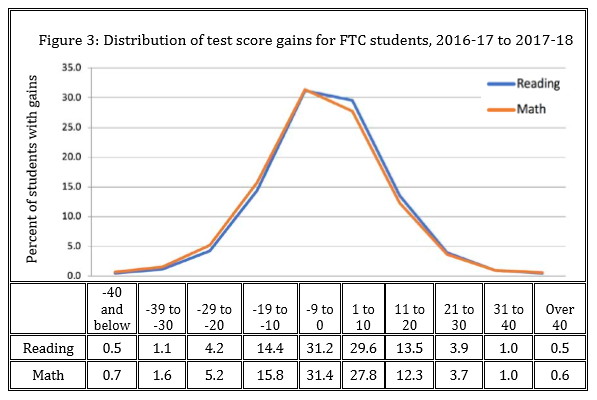
This graph, which shows the basic distribution of reading and math gain scores of Florida Tax Credit students participating in the program in 2017-18, indicates that the typical FTC student tended to maintain his or her relative position in comparison with other students nationwide.
The Florida Department of Education released the latest evaluation of the Florida Tax Credit Scholarship Program this week, and the results remain remarkably consistent over the last decade. For 11 consecutive years, low-income students on the Florida Tax Credit Scholarship are experiencing the same annual learning gains as all students nationwide.
“The typical FTC student tended to maintain his or her relative position in comparison with others nationwide,” wrote the researchers from the Learning Systems Institute at Florida State University. “It is important to note that these national comparisons pertain to all students nationally, and not just students from low-income families.”
Researchers reviewed testing data of nearly 60,000 students in grades 3 through 10 in 2017-18.
The average student on the program scored the 47.4th percentile in reading and 45.2nd percentile in math, and on average maintained their percentile rank from one year to the next when compared to a wealthier and whiter national average.
Of the students on the Tax Credit Scholarship, 67 percent are black or Hispanic and another 4 percent are mixed-race. The average household income is just $25,755 per year (about 9.2 percent above the poverty level), while 55 percent of students live in single-parent households.
As with past years, students on the scholarship are more likely to be black, come from lower-income families, and been enrolled in a lower-performing public school than eligible students that do not participate. Scholarship students also tend to have lower scores on the Florida Standards Assessments than eligible non-participating students prior to enrolling in the scholarship program.
Overall, nearly 44 percent of scholarship students come from public schools rated “A” or “B;” just 11.8 percent of students came from schools rated “D” or “F.”
Students returning to public schools from the program saw lower academic performance than students who remained. Once back in public schools, these students performed worse than eligible students who never entered the program.
“Findings indicated that poorly performing public school students are more likely to participate in the program in the first place,” wrote the researchers. “Moreover, FTC students who return to public schools tend to be those who are performing worse than the average FTC student. Based on these observations, we cannot associate poor performance of FTC returnees with possible negative effects of the FTC Program on participating students.”
The report also reviews gain scores for 418 schools with 30 or more scholarship students in grades 3-10 who have test scores in consecutive years. Researchers examine a three-year period instead of one because “the average gain score for a school in a single year can be an extremely noisy measure of a school’s contribution to student test scores.”
Results are listed in the report’s index. Schools that have “statistically significant” (meaning the researchers are 95 percent confident the observed results did not occur at random) gains or losses over a three-year period are highlighted.
School scores reflect the gain or decline in the average student’s percentile rank in math or reading within the school. Results that are not highlighted should be treated as having students maintain their position relative to the national average. Again, this comparison is between low-income, mostly minority students with a wealthier and whiter national average.
 At least 13 private schools that accept the Florida Tax Credit Scholarship have applied to administer the FCAT and end-of-course exams next year.
The schools, mostly faith-based and in South and Central Florida, have submitted their applications to the Florida Department of Education, which will decide in August whether to approve them.
DOE spokeswoman Tiffany Cowie said there may be more schools that made the March 1 deadline, but the department won’t know the final number until the mail is cleared towards the end of the week.
A state law passed in 2012 allows private schools with at least one student receiving the tax credit scholarship to offer the Florida Comprehensive Assessment Test and/or end of course exams, which are required in public schools.
Of the 13 schools that applied, eight signed up only for EOCs.
“The FCAT is a dinosaur,’’ said Principal Sandra Basinger of St. Mary’s Catholic School in Brevard County, where her seventh- and eighth-graders hope to take EOCs in Algebra I and Geometry next spring.
Like a lot of Catholic schools, St. Mary’s administers the Iowa Test of Basic Skills to its students in grades 2-8. The test is as good as if not better than the FCAT, Basinger said. And with Florida phasing out the state assessment for other tests in line with the new Common Core standards, “really, I just don’t think it would be worth it,’’ she said.
James Herzog, associate director of education for the Florida Catholic Conference in Tallahassee, said in an email to redefinED that he has heard the same sentiment from other Catholic schools.
“From a practical standpoint, it would … not make any sense for Catholic schools (or most other nonpublic schools) to offer the FCAT for a year or two only and then have to switch again to something else … ,’’ he said.
Herzog originally anticipated 30 to 40 Catholic schools would apply to give the FCAT.
“Obviously, I was way off,’’ he said. (more…)
Eleven states currently offer tax credits to specified taxpayers who make contributions to tax-exempt non-profit organizations that in turn use those contributions to fund scholarships for qualifying, financially-needy, elementary and/or secondary school students attending private schools. This fairly recent development is currently empowering perhaps 150,000 lower-income families, who generally are unable to afford private schools, to make this sort of school choice for their children. To be clear, these plans provide benefits for taxpayers who make contributions that help other people’s children attend private schools.
Sen. Rubio
Sen. Marco Rubio, R-Fla., has just introduced a bill that would expand this tax credit scholarship initiative nationwide. To understand the good (and dubious) features of Senator Rubio’s proposal, it is important to appreciate the state law background against which it is set.
Florida has the financially largest of these 11 state tax credit programs, with about 50,000 children currently participating. It restricts the scholarships to children from truly low-income households; the child must be eligible for a free- or reduced-price school lunch – currently just over $40,000 a year for a family of four. Other states are more generous, with Oklahoma reaching well into the middle class since there a family of four can still qualify with $120,000 in annual income. Senator Rubio’s plan, while not as tightly restricted as Florida’s, focuses the scholarships on families with income no more than 250 percent of the poverty level, which is a bit over $50,000 today. The main thing to emphasize here is the senator clearly seeks by his bill to empower the least well-off Americans who are currently least able to exercise school choice – a choice that more well-to-do families make by either moving to a better public school district or paying for private schools on their own.
Several state plans give tax credits to both individual and corporate donors (and for corporate donors the plans sometimes allow credits against a variety of state taxes). Senator Rubio’s bill does the same – allowing married couples and single taxpayers both to obtain a federal income tax credit for an annual contribution of up to $4,500, and allowing corporations an annual corporate income tax credit of up to $100,000. Florida by contrast only allows corporate tax credits and Arizona (which was the first state to adopt this program) initially granted only individual tax credits. Senator Rubio’s proposed tax credit limit for couples and individuals is about twice that now allowed in Arizona. Some states have no cap on donations, and indeed in Florida a few very large corporate donors contribute millions each year to the plan.
Senator Rubio’s proposed tax credit is a 100 percent credit, as is true in both Florida and Arizona, for example. This means that for every qualifying dollar contributed, federal income taxes would be reduced by a dollar. This essentially makes contributions costless to the donors. They, in effect, are able to re-direct their tax dollars to this specific cause – helping needy families send their children to private schools. It is worth nothing, however, that some states grant only a partial tax credit, such as the 65 percent credit allowed in Iowa and the 50 percent credit allowed in Indiana. In those latter states, donors must put up some of their own money.
Most states that adopted these plans imposed a maximum overall limit on the amount of tax credits that may be claimed each year in support of the program. These maxima vary enormously and even so are often not reached. Senator Rubio’s plan has no such limit. It probably would be complicated and costly, but clearly not impossible, for the IRS to administer an overall ceiling in a way that allowed would-be donors to know whether their contribution was within the national maximum and hence truly eligible for the credit.
One important difference between many state plans and Senator Rubio’s proposal is there is no limit on the amount of the scholarship that may be awarded. Florida, for example, caps scholarships at $4,335 at present; in Georgia the limit is just over $9,000. Hence, as appears to be the case in states like Iowa and Indiana, it would be legally possible under the senator’s plan for a child to win a full scholarship to a very high cost, elite private school and hence indirectly obtain government financial aid well beyond what is now being spent on public schools. This is perhaps unwise. Note, however, that nothing in Senator Rubio’s bill would require scholarship granting organizations to award full scholarships or high-value scholarships. In many states at present, the average scholarship is less than $2,000 a year. Since it would be rare to find a school with tuition that low, either the families must find some way to come up with the difference, or the schools must use their own financial aid plans to make up some or all of the gap.
The most striking difference between most state plans and Senator Rubio’s is children already enrolled in private schools would be eligible for scholarships. (more…)
Vouchers and testing. A new report from the Fordham Institute finds that mandated testing - and even public reporting of test results - isn't that big a concern for private schools worried about government regs tied to vouchers and tax credit scholarships. Coverage from redefinED, Choice Words, the Cato Institute's Andrew J. Coulson and Gradebook. AEI's Michael McShane says Florida's tax credit scholarship program (which, altogether now, is administered by Step Up For Students, which co-hosts this blog) finds the "sweet spot" with its testing and financial reporting requirements: "These regulations don’t sound too crazy to me; they seem to strike a good balance of accountability for safety, fiscal responsibility, and academic performance without being overly dictatorial in how schools must demonstrate any of those."
 Shooting rockets. Senate President Don Gaetz tells the Associated Press that Florida needs to slow down on ed reforms until it rights the new teacher evaluation system and other changes in the works: "We need to quit shooting rockets into the air. We need to give schools and school districts, teachers and parents time to institutionalize the reforms that have already been made. We need about a two-year cooling off period."
Ford Falcons. Schools need competition. EdFly Blog.
School choice. Education Commissioner Tony Bennett says at a National School Choice Week event in Tampa that some Florida districts deserve credit for expanding public school options such as magnets and career academies, reports redefinED. More from Tampa Tribune.
Charter schools. The National Alliance for Public Charter Schools ranks Florida fifth for its charter laws. SchoolZone. Gradebook. South Florida Sun Sentinel. StateImpact Florida. The Pinellas school district postpones a decision on whether to close a long-struggling Imagine school in St. Petersburg, reports the Tampa Bay Times and Tampa Tribune. The Volusia district's decision to shut down a struggling charter in Deland is headed to appeals court, reports the Daytona Beach News Journal. (more…)
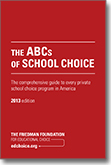 The Friedman Foundation’s latest “ABCs of School Choice” guide is out, and the numbers go like this: 21 states, 39 programs, 255,000 kids.
The guide offers a state-by-state rundown of the publicly funded, school choice options that are a vital piece of the overall school choice picture. It includes profiles of the students, parents and teachers who benefit from them. And it presents some thought-provoking stats, like how the value of each choice option compares to per-pupil funding in traditional public schools.
In Florida, a tax credit scholarship for low-income students is 34 percent of what’s spent on a traditional public school student, according to the Friedman analysis. Our own back-of-the-envelope calculations would put the percentage slightly higher, but the point is spot on: “voucher” students receive far less for their education than their public school peers. It’s a relevant detail that deserves more attention as the debate unfolds over testing for scholarship students and regulatory accountability measures for the private schools that enroll them.
The Florida section of the guide also includes a mini-profile of Davion Manuel-McKenney, a former tax-credit scholarship student who is now a freshman at Florida State College at Jacksonville. (Full disclosure: the tax-credit program is administered by Step Up For Students, which co-hosts this blog.) The story of Davion and his mother is a moving one. Click here to read more about it.
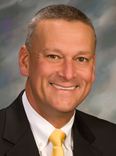
Bennett
In this lengthy exit interview with the Indianapolis Star, new Florida Education Commissioner Tony Bennett adds to a simmering debate, sparked last month by Gov. Rick Scott, about whether students using vouchers and tax credit scholarships to attend private schools in Florida should be required to take the same standardized tests as their public school counterparts.
By law, tax credit scholarship students in Florida are required to take a nationally norm-referenced test approved by the state Department of Education. But Bennett suggests that's not enough:
"I do believe we should assess all students who get state money. I believe that in my heart. I keep having people asking me why I believe that in Florida. For voucher schools, I’ve been asked why can’t we accept just a nationally-normed test? But if IPS said let me choose a test and let me choose a performance level to determine if its schools were any good or not, would I accept that? No. So why should I buy that from them? What makes them more creditable than IPS?"
Bennett was also asked if there's anything about expanding school choice that he fears could "in any way threaten what's good about the traditional public school system." His response:
"No. I think it will enhance it. It never worries me because I believe good schools will flourish regardless, whether they are public, private or charter. I believe it will force schools to get better. I just believe that. It’s never kept me up at night. I just believe in the force that the market creates. We’ve seen it. We’ve seen (Indianapolis Public Schools Superintendent) Dr. (Eugene) White make some pretty innovative changes. I maintain he wouldn’t have done those things."
Count newly-elected Florida Rep. Manny Diaz, Jr. among a number of state lawmakers who are public school district employees. But Diaz, an assistant principal in the Miami-Dade public school district, isn’t just a cheerleader for traditional public schools.
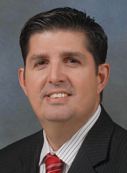
Rep. Diaz
He’s also a huge – and very vocal - advocate for school choice.
“We have an evolving student body – different than what it was five years ago,’’ Diaz, a Republican who represents his hometown of Hialeah, said during a recent telephone interview with redefinED. “I do believe we have to look at all the options.’’
Diaz has been appointed to the House Education Committee, as well as the K-12 and Choice & Innovation subcommittees. Among his goals there: to help guide fellow lawmakers and education leaders toward reform that is “student-centered and parent-centered.’’
To that end, Diaz said he fully supports district programs, such as magnet schools; high-quality charter schools; and other nontraditional options, such as tax credit scholarships.
“I think the competition makes our educational choices better,’’ he said. And better can only be defined by results. “I’m big on the accountability side,’’ Diaz said. “It’s a matter of having the political courage to move forward, to take measures already in the law.’’
If a district school isn’t helping students succeed academically, bring in interventions, he said. If a charter school isn’t operating ethically, shut it down.
Diaz also responded to recent news reports in which Gov. Rick Scott called for private schools that accept tax credit scholarships to give those students the same tests as their public school peers. (more…)
 Florida: Incoming Florida Education Commissioner Tony Bennett talks about the idea of voucher students being required to take the same standardized tests as their public school peers (Tampa Bay Times' Gradebook blog).
Texas: Lt. Gov. David Dewhurst sees expanded school choice as part of a legislative agenda that aims to make Texas the most conservative state in the country (Associated Press). The pending fight over vouchers highlights a difference over the best way to fund schools (Dallas Morning News).
Tennessee: A possible school voucher program will be a top issue for Gov. Bill Haslam and state lawmakers next year (The Tennessean).
New Hampshire: The state's new tax credit scholarship program will again be the subject of debate - and potential legislative action - next year (New Hampshire Public Radio.)
Indiana: The state's school districts turned to marketing efforts in 2012 to compete with private school vouchers (Evansville Courier & Press). Charter school administrators say they have the flexibility to quickly respond to make improvements (Evansville Courier & Press).
Massachusetts: A new Pioneer Institute report opens a debate over the value of school choice options, specifically tax credit scholarships and education savings accounts, for Jewish day schools (Masslive.com)
Louisiana: Education reform,including creation of a statewide voucher program, ranks as one of the year's biggest stories (Houma Comet). Gov. Bobby Jindal's education reforms have reliable backing from the state education board, including its elected members (Baton Rouge Advocate).
Ohio: A long-troubled charter school moves again (Cincinnati Inquirer).
Washington D.C.: Fewer than half of the city's charter schools employ nurses (Associated Press).
Pennsylvania: Charter schools aren't just small, independent operations any more (Pittsburg Post Gazette). The western part of the state is seeing a rapid increase in charter school enrollment (Trib Live).
Delaware: Three charter schools delay opening next year, citing start-up costs and problems securing locations (Delaware Online).
Testing for “voucher” kids. The Orlando Sentinel editorial board concludes tax credit scholarship students should take the same standardized tests as their public school peers: “Comparing apples to apples, scholastically speaking, will enhance transparency and accountability.”
 From Florida with love: A Florida education advocate named Lowell Levine gets extended mention in the latest Rick Hess column, a follow-up to a piece about the unfortunate politicization of Newtown. Levine tells Hess, in part: You just do not want to hear the truth ---it is writers like you who are in denial and contribute to violence in schools. You are a shame to your profession. Good by and have a great life------A$$@#%&!!!!!... I’m not sure if it’s the same guy, but a Lowell Levine in South Florida applied to be Florida ed commish and, according to the Palm Beach Post, founded an anti-bullying foundation.
Education funding. From a Miami Herald year-end-wrap-up editorial: “Investments in education pay off. That’s a lesson Gov. Rick Scott seems to be learning as he pushed to restore some of the K-12 funding that he previously cut.”
“Lower ed.” Former Florida Education Commissioner Gerard Robinson makes the year-in-review from Tampa Bay Times columnist John Romano.
Class size. Do districts need more flexibility? asks Gradebook. SchoolZone looks at compliance in Central Florida districts.
The year’s biggest education stories. According to StateImpact Florida. Amendment 8 is in there.
End of course exams. DOE will study the possibility of concordant scores for the Algebra I test, reports SchoolZone.
More Newtown repercussions. Armed deputies may be patrolling Alachua County elementary schools when students return Jan. 3, reports the Gainesville Sun.

