CLEARWATER, Fla. — A check recently arrived in the mail for Landon Green, his compensation for the two hours he spent autographing baseball cards of himself one day last summer.
He signed 2,000 cards and was paid $1 for each signature.
That’s a nice payday for anyone, especially a 17-year-old high school junior who is among the top pitching prospects in the nation, one who is very much on the radar of top collegiate programs and Major League Baseball teams.
The landscape of amateur sports has shifted dramatically over the last few years, allowing athletes to benefit financially from their Name, Image, and Likeness (NIL) without jeopardizing their amateur status.
Likewise, the landscape of K-12 education in Florida has changed significantly with the expansion of education choice scholarship programs.

Landon, who is home-educated, receives a Personalized Education Program (PEP) scholarship available through the Florida Tax Credit Scholarship Program managed by Step Up For Students.
PEP, now in its third year, provides parents flexibility in how they spend their scholarship funds, allowing them to customize their children’s learning to meet their individual needs and interests.
“It allows us to select his academics based on his future, to study what we think will help him in his future,” Landon’s mom, Michele Donton said.
For Landon, that’s finance, business, and leadership – courses that will guide his financial potential. The scholarship also covers the cost of strength, conditioning, and mobility training – sessions that will help him improve athletically. Landon spends two to four hours a day either playing baseball or working on some aspect of his game.
“PEP gives us the flexibility to work around his schedule,” Michele said.
Morning workouts mean afternoon classes and vice versa. Also, Landon can still complete his schoolwork when he travels out of town for a tournament.
“I think (the PEP scholarship) is very beneficial for him, because he's not the typical go to school type of kid,” Landon’s father, Lamon Green, said.
Stacked among the textbooks on a table in the family’s Clearwater home is one published by the financial services firm Morgan Stanley titled “The Modern Athlete's Guide to Life, Money and NIL.”
Yellow sticky notes earmark chapters on “Smart Money Savings,” “The Business of You,” “Investing in Your Future,” and “Philanthropy & Legacy.”
It’s an important resource for someone like Landon, because the check he received for autographing baseball cards will be the first of many. He also has two NIL deals with athletic apparel companies. Opportunities for more deals can increase over the next two years as his career progresses.
“This kind of helps him and guides him through all of this,” Michele said. “It's the NIL bible, to be honest with you. It teaches you everything and anything you need to know.”

The days of teen-age baseball players being scouted during high school games by representatives from college and professional teams ended years ago. Now, top college and pro prospects like Landon attend showcase events around the country that draw scouts and evaluators from all 30 Major League Baseball teams as well as college coaches. Prospects play for travel teams, some of which draw from a nationwide talent pool.
Landon is also a regular at the USA National Baseball Training Complex in Cary, North Carolina. That’s where he autographed those baseball cards, and that’s where he attended financial seminars.
The National Collegiate Athletic Association (NCAA) changed its rules in 2021 by recognizing athletes as a brand and allowing them to profit from their identity. It wasn’t long before that trickled down to high school athletes.
So, not only is Landon a baseball prospect, but he is also a brand.
To that, he shrugged his shoulders.
Landon runs toward the quiet. He’s very businesslike on the pitcher's mound, retiring batters with not much fanfare.
“He’s very humble,” said his mom.
Landon’s answer when asked about his future was this: “Whatever happens, happens.”
Here’s what could happen:
If all goes according to plan, it will include either a scholarship to a Division I-A university with a top-flight baseball program or a contract with a Major League Baseball team after he is selected in the 2027 baseball draft. He has already had a workout with the Chicago Cubs.
Landon is already rated as one of the top pitchers eligible for the 2027 draft, which will be held after he graduates high school. A right-hander, his fastball has been timed at 98 mph, and it is expected to get faster as he adds bulk to his 6-foot-1, 174-pound frame.
The higher he is selected in the draft, the more money he will receive as a signing bonus.
If Landon chooses to play college baseball before turning pro, he stands to increase his NIL deals since he will be pitching for a prominent program. He is being recruited by a number of colleges, including blue bloods like the universities of Florida, Texas, and Miami, and Louisiana State University.
“I was one of his T-ball coaches back in the day. Watching him play on the grass, I would have never thought all this could happen. This is awesome,” said Lamon, who has been a Clearwater police officer for nearly 25 years.
“That’s why I tell him to stay out of trouble, do the right thing. I push him in his education to learn about money. Don’t blow it because you want a necklace. You have a future to think about.”
This is Landon’s third year of home education. Michele said the move was made to better control his learning environment. The fewer distractions made for a better student.
She was thrilled when she learned about the PEP scholarship and how it works. Many families who receive the scholarship are tailoring their children’s education based on their interests and needs, choosing options a la carte style. A growing number of parents are looking to the future when customizing their child’s education.
For Landon, that means his curriculum is evolving.
“We're always listening,” Michele said. “I'm constantly looking for material that can help him, that I think is going to help him in his future, whether it be financial literacy, learning how to invest. I really want him to learn how to invest. That's a big thing we're going to focus on this school year.”
MIRAMAR, Fla. — William Ivins moved his family to South Florida ahead of his retirement from the United States Marine Corps and enrolled his children at Mother of Our Redeemer Catholic School, hoping they would reap the same rewards as he did from a faith-based education.
But, as William and his wife, Claudia, would soon learn, that was easier said than done.
A lawyer for much of his 20-year career in the Marines, William needed to pass the Florida Bar Exam before he could enter the private sector. It was a long process that left him unemployed for 19 months.
“It was a struggle,” he said. “My retirement income was not enough to pay for the cost of living and tuition for my children.”
The Ivins' faced a few choices: continue with the financial struggle, homeschool their children, send them to their district school, or move out of state. None were appealing to the Ivins, and fortunately, they didn’t have to act on any.

Florida's education choice scholarships managed by Step Up For Students allow his four children to attend Mother of Our Redeemer, a private K-8 Catholic school near the family’s Miramar home.
“It was a perfect storm of having to retire from the Marines and not really having a job lined up,” William said. “The transition was more difficult than I thought it would be. The income just was not available for us to continue our kids’ education in the way we wanted. Had the scholarship not been there, we would have been forced to move out of state or homeschool them or move them to (their district) school.”
In July 2020, the Ivins moved to South Florida from Jacksonville, N.C., where William had been stationed at Camp Lejeune. William contacted Denise Torres, the registrar and ESE coordinator at Mother of Redeemer, before making the move. She told William the school would hold spaces for his children. She later told him about the education choice scholarships managed by Step Up For Students.
“That was a big relief for him,” Torres said.
At his mother’s urging, William began attending Catholic school in high school.
“That was a life-changer for me,” he said.
He converted to Catholicism and vowed if he ever had children, he would send them to Catholic school for the religious and academic benefits.
Rebekah graduated in May from Mother of Our Redeemer. She had been an honor roll student since she stepped on campus three years ago.
“Rebekah likes to be challenged in school, and she was challenged here,” Claudia said.
Rebekah, who received the High Achieving Student Award in April 2022 at Step Up’s annual Rising Stars Awards event, is in the excelsior honors program as a sophomore at Archbishop McCarthy High School.
“She's an amazing, amazing student,” Torres said. “It’s incredible the way she takes care of her brothers. She's very nurturing. Every single teacher has something positive to say about her.”
Rebekah’s brothers, Joseph (seventh grade) and Lucas (fourth grade), do well academically and are active in Mother of Redeemer’s sports scene, running cross-country and track. Nicholas, the youngest of the Ivins children, is in second grade. He was allowed to run with the cross-country team while in kindergarten, which helped build his confidence.

William had been in the Marines for 20 years, eight months. He served as a Judge Advocate and was deployed to Kuwait in 2003 for Operation Iraqi Freedom, to Japan in 2004, and then to Afghanistan in 2012 for Operation Enduring Freedom.
He retired in May 2021 but didn’t find employment until December 2022. The Florida Bar Exam is considered one of the more challenging bar exams in the United States. He took the exam in July 2021 and didn’t learn he passed until September. It took William more than a year before he landed a position with a small law firm in Pembrook Pines.
Claudia, who has a background in finance, works in that department at Mother of Our Redeemer Catholic Church, located next to the school.
“They have really become part of our community,” Principal Ana Casariego said. “The parents are very involved and are big supporters of our school and church.”
In Mother of Our Redeemer Catholic School and Church, Willian and Claudia found the educational and faith setting they wanted for their children.
“It is a small community environment where you know all the teachers and staff by first name,” William said. “My kids have received a wonderful education in an environment where they don’t have to worry about bullying, and they can really strive to grow and do their best academically.
“The scholarship kept us in the state and kept our kids in the school system that we wanted them to be in. It’s been a great blessing to us.”
Perun, the rock star of Australian defense economists doing awesome hour-plus hour PowerPoint presentations on YouTube, recently did two such presentations on “game-changing” weapon systems in the ongoing Ukraine-Russian war. Perun observed:
It seems like every time a new weapon system, be it Russian or Western, is sent to Ukraine, there are always going to be at least some voices in the media that amp this thing up as the next great game-changer, the system that will finally change the dynamics of this long and bloody war. For some systems the hype dies out, whereas for others it builds and builds until eventually the system arrives in Ukraine, and reality and expectations finally collide.
Some get to Ukraine and turn out to be utter disappointments. Others turn out to be solid, useful performers that do the job they were intended to do, but don’t exactly quickly or efficiently move the needle. And others swing in like a damn wrecking ball and on their first day of operations wreck two Russian airfields and deal the Russian aerospace forces their worst single day defeat since they were the Soviet Air Forces during the Second World War.
Inspired by the great Perun, we will here rank policy interventions designed to increase family options in K-12:
Magnet Schools: Introduced in the 1970s in the hopes of reducing racial segregation in public schools. Below is a placement of every magnet school in the nation with data included in the Stanford Educational Opportunity Project on Grades 3-8 academic growth:
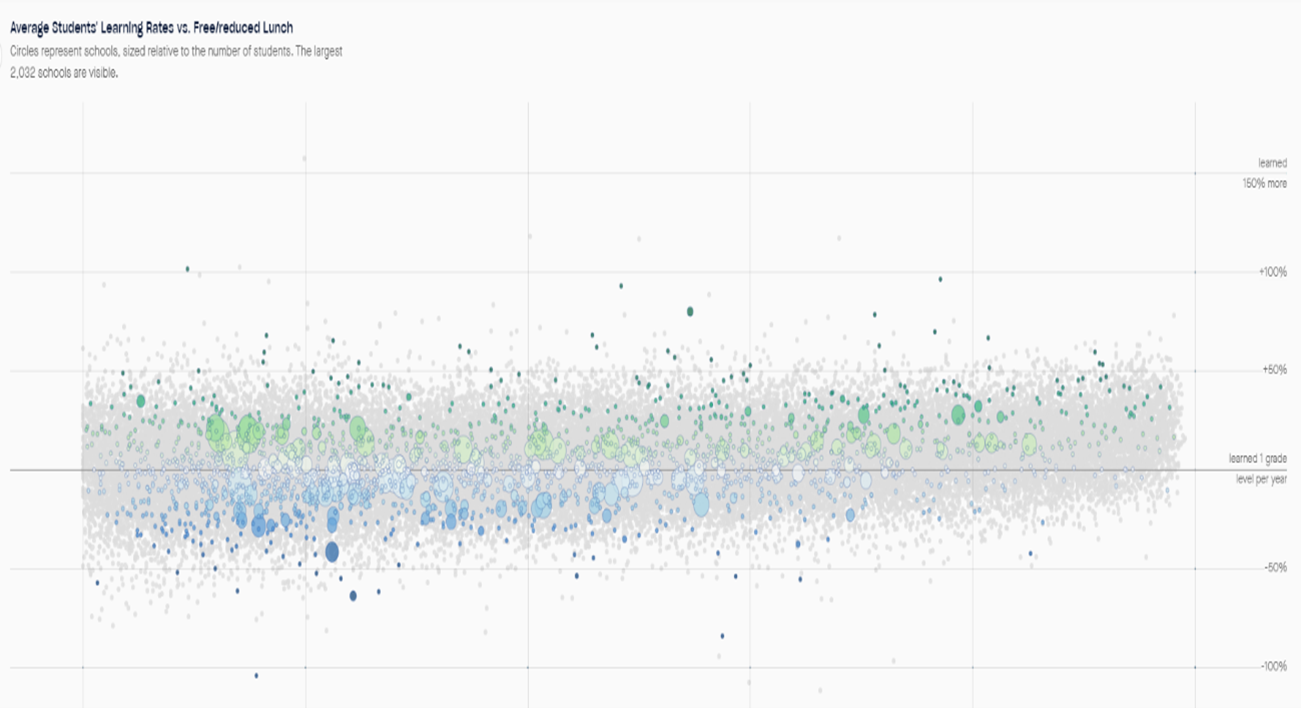
That’s a lot of schools, but their average rate of academic growth is approximately equal to the nation as a whole (half above and half below the “learned one grade level in one year” line. There are many fantastic magnet schools, but the system suffers from a fatal flaw: the schools are ultimately under the control of elected school boards. Many magnet schools have waitlists of students, but districts, for the most part, do not replicate or scale high-demand schools. Unless someone can demonstrate otherwise, let’s assume that Political Science 101 is controlling here and the people working in other district schools don’t want to scale high-demand magnet schools for the same reason they dislike other forms of choice: they view it as a threat. RANKING: TAME HOUSE PET
Charter Schools Introduced in the early 1990s by Minnesota lawmakers, charter schools eventually overtook magnet schools in numbers of schools, as you can see in the same chart as above for charters nationally:
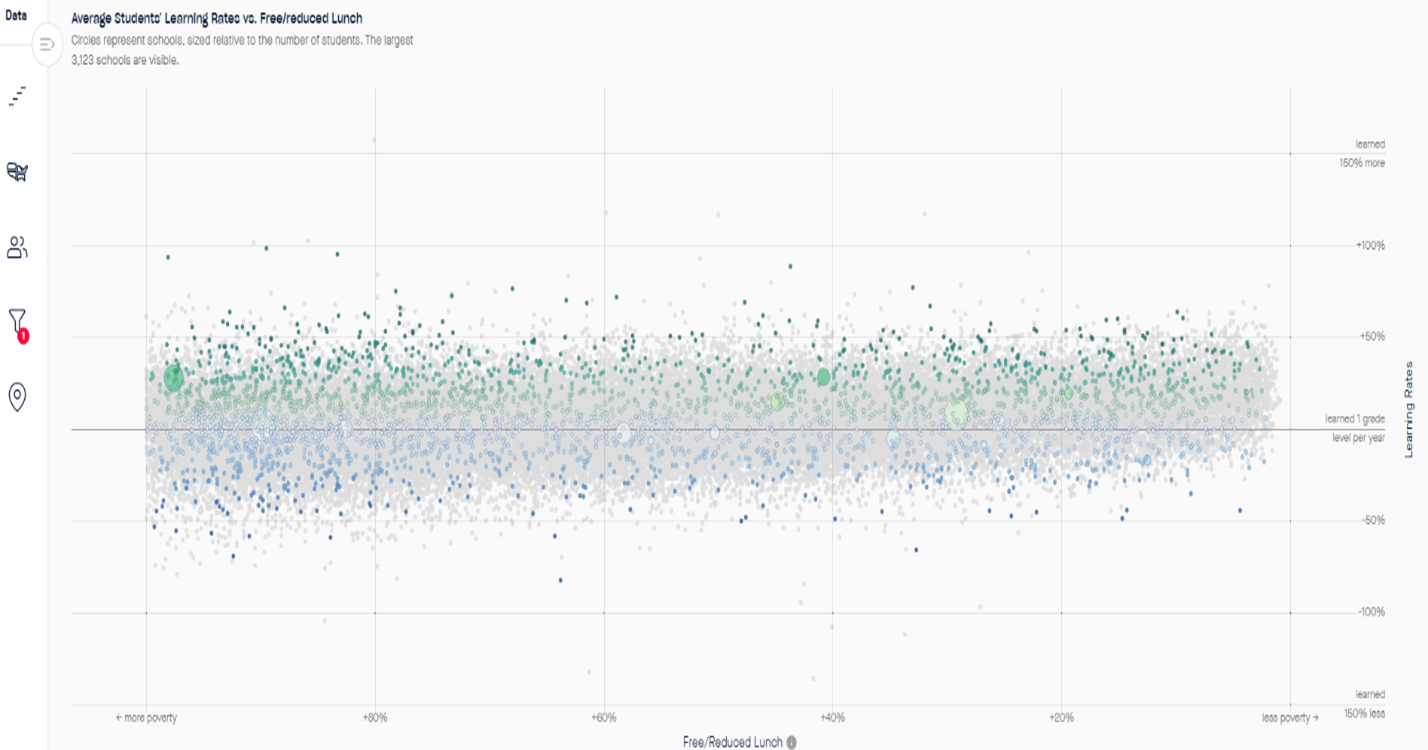
Charters were the leading form of choice for years after their debut, but more recently, it has become sadly clear that they suffer from a problem not terribly dissimilar from magnet schools: a political veto on their opening. Sometimes this veto is delivered by the same districts that fail to replicate high-demand magnet schools, in other instances, it happens because of Baptist and Bootlegger coalitions controlling state charter boards. What the Baptist and Bootleggers started, higher interest rates, building supply chain issues and the death of bipartisan education reform seems to have finished. RANKING: Varies by state but mostly TAME HOUSE PET
District Open Enrollment: Potentially an immensely powerful form of choice, but one which only realizes that potential if other forms of choice create the necessary incentives to get districts to participate. In most places, it looks far too much like this:
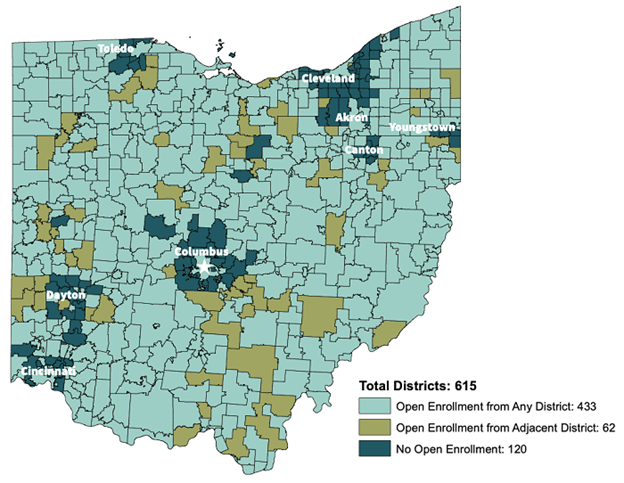
See any fancy suburbs willing to take urban kids in this map? Me neither. RANKING: Varies by state but mostly TAME HOUSE PET, could grow to become much, much more
School Vouchers/Scholarship Tax Credit: The modern private choice movement debuted in Wisconsin in 1990, the year before the first charter school law passed in 1991. Voucher adoption proceeded more slowly than charter school laws, and one of the accomplishments of the voucher movement may indeed have been to make charter schools seem safe by comparison. Scholarship tax credits, first passed in Arizona in 1997, expanded around the country more quickly than vouchers. While lawmakers passed several voucher and scholarship tax credit programs, few of them were sufficiently robust to perform critical tasks such as spurring increased private school supply, which requires either formula funding or regular increases in tax credit funding.
Scholars performed a tremendous amount of research on voucher and tax credit programs, and those programs led directly to the creation of education savings accounts (discussed next). Overall, however, these programs did not in and of themselves move the needle, although at times, the deployment of strong private and charter school programs did move the needle. RANKING: Vital Intermediate Step

Education Savings Accounts: First passed by Arizona lawmakers in 2011 and going universal only in Arizona and West Virginia in 2022, ESA programs remain a work in progress. The flexibility of accounts contains the prospect of a less supply-constrained form of choice, less dependent upon the creation of one-stop shopping bundles known as “schools.” The largest first-year private choice programs have all been recently passed ESA programs, which seems promising. ESAs, however, have yet to become a teenager, and the technologies necessary to administer them at scale remain an evolving work in progress. RANKING: Promising but To Be Determined
Barely Off the DRAWING BOARD PLATFORM
Personal Use Refundable Tax Credits: Older but tiny programs exist that deliver small amounts of money and accomplish little. Oklahoma passed a more robust program of this type last year, but it remains far too early to draw any conclusions. RANKING: Totally TBD
Homeschooling:
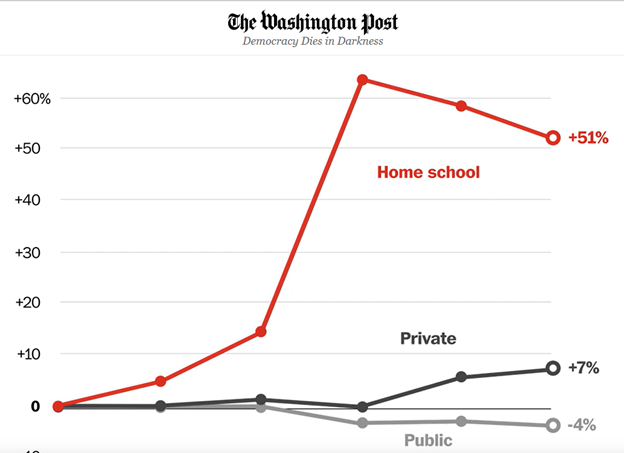
The homeschool movement has grown quickly is sufficiently organized to make lawmakers think long and hard before starting a quarrel with its supporters and has become more accessible with the advent of homeschool co-ops, which provides a measure of custodial care. RANKING: Wrecked two Russian airfields on the first day of deployment, unclear how high the ceiling will reach.
Conclusion: You should be seeking a combined arms operation in your state rather than a panacea-like super-weapon system that will deliver instant victory. You will know you are winning when your fancy, suburban districts start taking open-enrollment students. You will never achieve this with means-tested or geographically restricted private or charter school programs.
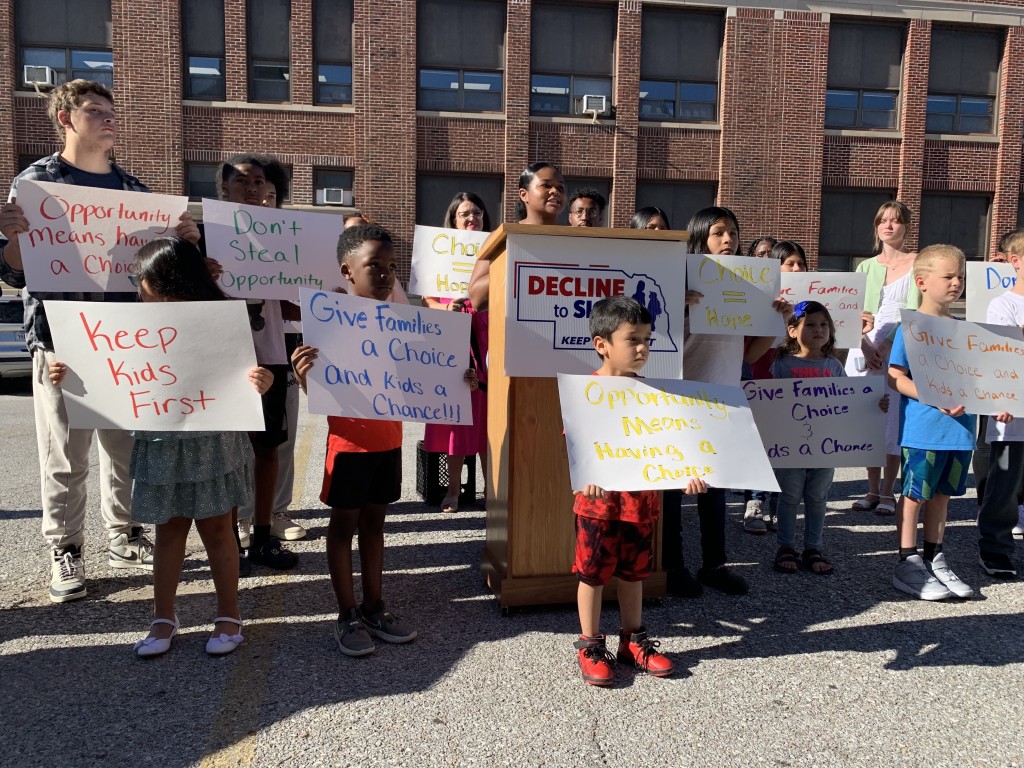
Jayleesha Cooper, center, a school choice beneficiary and member of the American Federation for Children Future Leaders Fellowship program, will return next year to fight for the future of school choice in Nebraska.
The big story: Opponents of Nebraska’s first K-12 school choice scholarship program that would allow the state’s neediest families access to the school that best fits their child’s needs say they have collected 117,000 petition signatures, enough to put the measure on the 2024 ballot.
Yes, but: Despite claims of victory from the teachers union-backed Support Our Schools, the petition campaign fell short of reaching the threshold needed to suspend the program. That means the program can get up and running for the 2023-24 school year.
How it works: The law creates a dollar-for-dollar state tax credit for individual and corporate donors to scholarships that state lawmakers prioritized for low-income families, similar to the program that has existed in Florida for more than two decades. The state has capped the program at $25 million a year for three years. For context, the state spends $1 billion per year on district schools.
Heat advisory: Opponents will be trying to repeal the program on the November ballot, just months after the first scholarship families reap the benefits of school choice. The timing could create more intense exchanges as both sides try to sway voters. Last year, Keep Kids First Nebraska, a group formed to support the law, accused SOS of spreading misinformation about the program. In a statement released Wednesday on X, formerly Twitter, the group pledged to keep up its campaign.
They’ll be back: A group of now battle-tested young advocates who benefited from school choice scholarship programs themselves pledged a return to the Cornhusker State next year to help save the new program despite being taunted by opponents and tailed by police while volunteering as signature blockers over the summer.
“I don’t believe we should just give up on Nebraska’s families,” said Jayleesha Cooper, a student at the University of Chicago and a member of the American Federation for Children’s Future Leaders Program.
Originally from Nebraska, Cooper used a privately funded scholarship fund to attend Catholic schools and become the first in her family to attend college. “Many people who signed the petition weren’t fully aware of what they were doing, so I believe it is a matter of continuing to educate people so they can make an informed vote.”
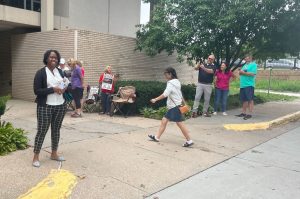
Sherlean Roberts, left, and other American Federation for Children Future Leaders fellows, volunteered this summer to help block school choice opponents' petition campaign against Nebraska's new school choice law.
Myles Slade-Bowers and Sherlean Roberts, Black college students who left a jazz concert after noticing a group of police officers standing behind them, said they won’t be silenced despite the harassment they experienced during the petition drive. For them, school choice is a matter of conscience.
“I’ll be willing to do anything and everything because Nebraska needs it,” said Roberts, who attended charter schools in Wisconsin and is now a student at Marquette University. She acknowledged the possibility of “difficult conversations” with SOS supporters, whose paid petitioners were overheard telling voters that the program benefited the wealthy.
“Any time you are involved in social justice, there are going to be those types of situations, and now that I’ve dealt with it, I won’t be too worried about it.”
U.S. Supreme Court Justice Louis Brandeis coined the notion of American states serving as “laboratories of democracy” in New State Ice Co. v. Liebmann, a 1932 Supreme Court decision.
“A single courageous State may, if its citizens choose, serve as a laboratory; and try novel social and economic experiments without risk to the rest of the country,” Brandeis wrote.
With regards to education freedom, Arizona and Florida have been collaborative laboratories.
Arizona lawmakers created the nation’s first scholarship tax credit program in 1997. This law allows individual taxpayers to donate to a non-profit scholarship granting program and receive a dollar-for-dollar credit against state income taxes for the donation. A few years later, Florida lawmakers created the nation’s largest scholarship tax credit program.
In 1999, Florida lawmakers passed the McKay Scholarship Program, the nation’s first private choice program for students with disabilities. A few years later, Arizona lawmakers attempted to emulate the McKay program. Arizona choice opponents killed this program in the Arizona court system, prompting Arizona choice supporters to develop the nation’s first account-based choice program, the Empowerment Scholarship Account Program. Empowerment Scholarship Accounts withstood a court challenge, and a few years later Florida created what remains the nation’s largest account-based choice program.
Arizona and Florida’s innovators have learned and borrowed from each other. Thousands of unsung heroes from across the country also contributed to the development of this experiment, which remains ongoing. Teams in multiple states will work to optimize the use of accounts in a decentralized learning process. Oklahoma lawmakers have become the first state to adopt a large refundable tax credit for private education. This program likewise bears close examination over time; you never know what the next trend might go.

America has entered a difficult period with Baby Boomers exiting the labor market and a baby-bust diminished cohort of (mostly) their grandchildren entering the education system. Currently the baby bust is approaching the age of 16, so get used to seeing those “Help Wanted” signs. America’s two major political parties seem entirely incapable of reaching a consensus on reforming immigration. Something must give, but it remains unclear what it will be.
All of this is the background soundtrack to America’s public-school system as it grows increasingly dysfunctional and controversial. A complex web of local, state and federal authority attempting to govern a system of local monopolies marked by regulatory capture by unions and major contractors was also an experiment, but not a happy one. Our outcomes do not suggest that our experiment in bureaucracy represents the optimal method for educating students or in recruiting and fulfilling the aspirations of educators.
Our experiment in educational freedom must continue to conclude our experiment in educational frustration. Arizona and Florida have played crucial roles thus far, but new states have entered the collaboration. Young people are the future of any society, and they are getting to be in short supply. Some states are far more eager to give families a better return on their investment than others. America’s ongoing experiment with competitive federalism will soon merge with the experiment in educational freedom.
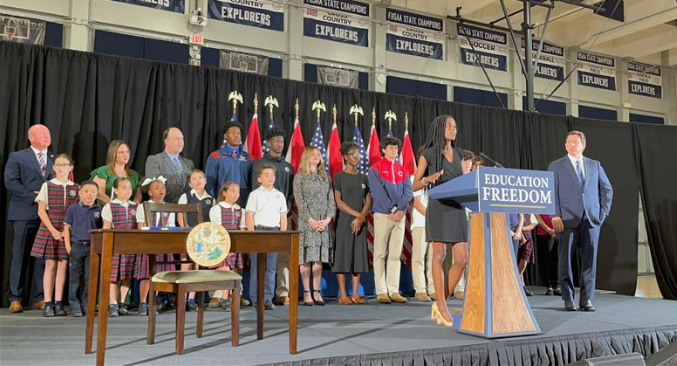
Herah Varmah, who received a Florida Tax Credit Scholarship, speaks at the bill signing ceremony for HB 1, which established eligibility for education savings accounts for all Florida students. She now serves on the staff of the American Federation for Children.
Editor's note: The following column by Hera Varmah, a beneficiary of the Florida Tax Credit Scholarship and the communication and events assistant at the American Federation for Children, originally appeared June 16 in the Florida Courier.
All Florida families with children in grades K-12 are now eligible to receive a state scholarship to find the best education setting for their kids – the kind that made a huge impact on my life, and the lives of my siblings.
I am one of 12 children whose parents are immigrants from Liberia and Jamaica, and in my assigned public school, I was a failing, unmotivated student. I never thought that I would go to college, and thus I would end up just like my parents in poverty. This was the life I envisioned for myself.
Everything changed when my parents enrolled me in Academy Prep Center of Tampa, a private, nonprofit middle school where three of my siblings were already attending. Its rigorous college-track curriculum proved to be the challenge that I needed. With the help of several teachers and their personalized instruction, I thrived in my new environment.
I then went on to Tampa Catholic High School, where I again successfully met high expectations. After graduating in 2017, I went on to earn a bachelor’s degree in food science and technology from Florida A&M University in Tallahassee.
To continue reading, go here.
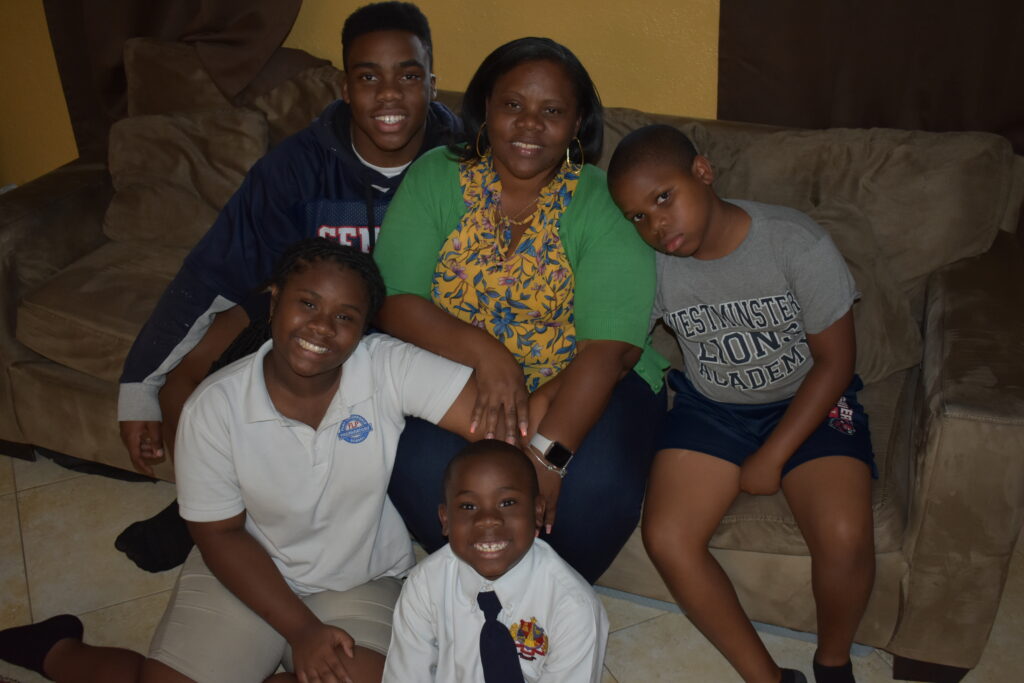
Yanique Dunkley and her children: JR and Mason (on the couch), Maleah and Myles on the floor. Each child receives a Florida Tax Credit Scholarship.
PLANTATION, Florida – There was no way William “JR” Moreland was taking AP Language and Composition as a junior, or so he thought. He heard it was hard, harder than Honors English, which he aced.
“The difference between honors (classes) and AP is completely night and day,” JR said. “You think it’s one step up. No. it’s completely night and day. There was no way I was going to do well in that class.”
But the teachers at Westminster Academy, a private PK-12 school in Fort Lauderdale, can be very persuasive. Despite his pleas to not take the course and, yes, he admitted, some begging, JR was told, “You’re absolutely doing it.”
And he absolutely did.
He aced it.
“That’s my greatest accomplishment in school,” he said.
JR, 17, graduated this spring in the top 10 of his class from Westminster, which he attended since sixth grade on a Florida Tax Credit Scholarship made possible by donations to Step Up For Students. Before that, JR attended Gateway Christian Academy in Fort Lauderdale on the FTC scholarship.
“I do understand that without the scholarship I wouldn’t be where I am,” JR said, “so I don’t take that for granted.”
JR, who lives with his family in Plantation, is headed to the University of Central Florida, where he will major in computer science. After that, he plans to enter the United States Army.
The Army recently resurrected its “Be All You Can Be” slogan. JR said the teachers and administrators at Westminster expect the same from the students.
“Even when you don’t see the potential in yourself, they see the potential in you. It just elevates you to want to do better,” JR said.
To continue reading, go here.

Editor's note: This commentary by Kevin Mooney, senior investigation journalist at the Commonwealth Foundation, Pennsylvania's free-market think tank, originally appeared June 16 in the Daily Caller.
By following through on his campaign commitments to expand school choice, Pennsylvania Gov. Josh Shapiro can distinguish himself from other elected officials cowed by the teachers’ unions, according to education policy analysts.
But he only has a few weeks to make good on his pledge to increase the supply of scholarship funds available to students in failing schools since lawmakers will potentially finalize the 2022–23 budget on June 30. If Shapiro can persuade some of his fellow Democrats to embrace school choice initiatives as part of the ongoing budget negotiations, he could have a transformative impact on the state’s educational system.
Marc LeBlond, the director of policy for EdChoice, a nonprofit that favors a wide range of options for K–12 education, is optimistic that Shapiro will support some form of “Lifeline Scholarships” for students in the worst-performing school districts while also accommodating an increase in the existing tax credit scholarship program.
To continue reading, go here.
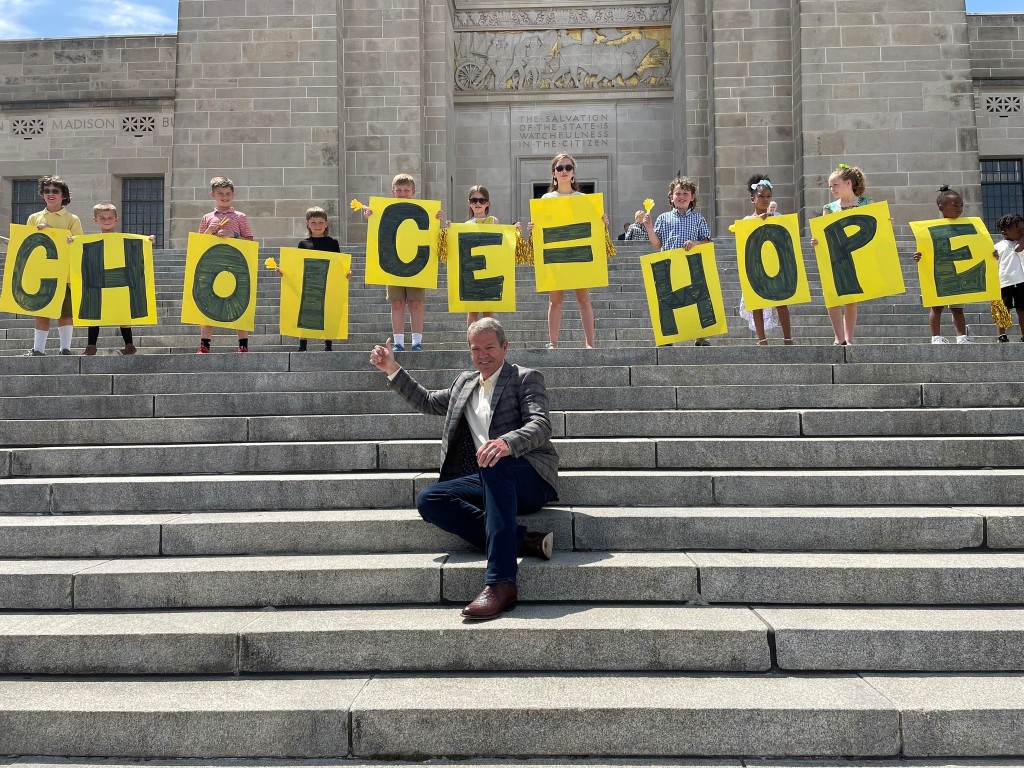
Editor's note: On May 30, Nebraska Gov. Jim Pillen signed legislation establishing the first education choice program in the state's history. The passage met with immediate resistance from opponents, who are working to repeal the program by gathering enough signatures to put the measure on the 2024 ballot. They need to get about 61,000 valid signatures from registered voters within 90 days to do so.
A committee of community leaders and elected officials in Nebraska known as Keep Kids First has launched a decline to sign campaign in response to the teachers union’s attempt to repeal recently passed LB753 – the Opportunity Scholarships Act.
Nebraska’s first school choice program, LB753, which was supported by Gov. Jim Pillen and a supermajority of state senators, will provide scholarship opportunities for students from lower-income and military families, students who have special needs, students who have been bullied, students who are in the foster care system, and students who have been denied public school option enrollment.
For more than a decade, advocates and families have been fighting to pass a school choice program in Nebraska. Those efforts have consistently been met with resistance from special interest groups like the NSEA – the state’s teachers union.
Keep Kids First says it will work to educate Nebraska voters about the Opportunity Scholarships Act, correct misinformation about the program from the teachers union and their well-funded political allies, and urge Nebraskans to decline to sign the petition. Initial members of Keep Kids First include Senators Lou Ann Linehan, Justin Wayne, Dave Murman, Rob Clements, Tom Brewer and Joni Albrecht, as well as community leaders Clarice Jackson, Omaha; Dr. Britt Thedinger, Omaha; Kim Schroll, North Platte; and John M. Dinkel, Norfolk.
On May 30, the 33 state senators who voted for the bill released a statement: “We are deeply disappointed that some in the Nebraska public education establishment are pursuing a multi-million dollar ballot initiative denying opportunities to vulnerable and at-risk children.... We stand united with families and students and are committed to defending the educational opportunities created by the historic passage of the Opportunity Scholarships Act.”
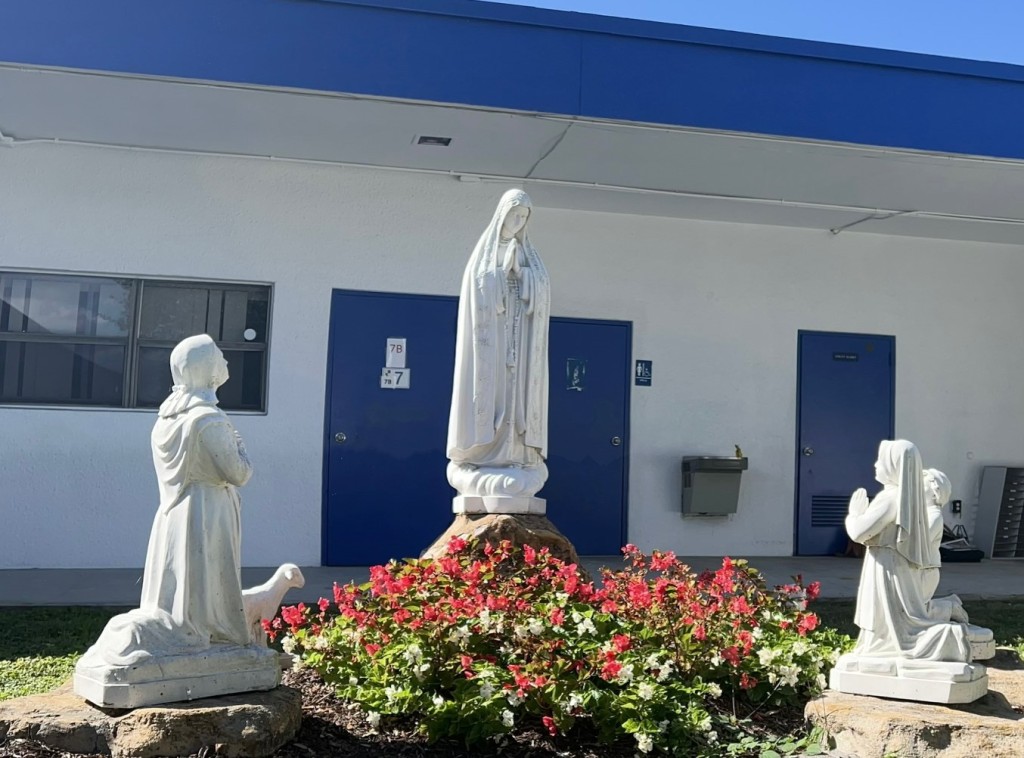
This replica statute of Our Lady of Fatima stands in the courtyard of St. Malachy Catholic School in Tamarac, Florida. Even after the school closed in 2009, the two charter schools that leased the campus never removed it. As the school reopens as a parish school in August, the statue has inspired those working to prepare the school for reopening. Photo courtesy of the Archdiocese of Miami
Since it closed in 2009, a victim of the Great Recession that wrecked family finances across the United States, the campus on the grounds of St. Malachy Catholic Church in Tamarac, Florida, has housed secular charter schools.
However, despite the focus those learning institutions placed solely on academics, one sacred element remained: the statue of the Virgin Mary. She stands in a courtyard atop a stone pedestal, in front of three children who kneel in reverence. The statue is a replica of Our Lady of Fatima, which, according to the Catholic church, the Virgin Mary appeared six times to three Portuguese shepherd children starting in 1917 and shared visions and messages. The church declared the visions of Fatima as “worthy of belief” in 1930.
As St. Malachy Catholic Church prepares to reopen its parish school after a 14-year hiatus, the statue is a powerful symbol of what a community’s faith and teamwork can accomplish.
“They never removed the statue of Our Lady,” said Zoraida Perez, the school’s registrar and first employee hired for the reopening. She said the fact that the statue remained feels like a miracle to her. “I did work in another parish where a charter school took over, and the first thing they did was remove all the images.”
Perez, who was not working for St. Malachy in 2008 but who lived in the area, recalled the strong emotions people felt when the economy forced the school, along with seven other area Catholic schools, to close due to low enrollment.
“Many of those families were so sad, and they had to decide between providing a home and food for their children or a private, parochial education,” said Perez, whose three children attended Catholic schools. Many of them had to make the decision to school and go to public school.”
Those who were able to continue in Catholic schools were offered seats at other area schools.
The transition to new schools was tough for some families, who missed the sense of community that a smaller school like St. Malachy, which first opened in 1984, provided. The school and the church are named for St. Malachy, an Irish Saint who lived during the 1100s.
The church leased the campus to a charter school, which closed in 2018. Another followed but closed in 2021 amid the coronavirus pandemic.
When leaders announced in March that the parish would reopen the school, a woman whose two children had to transfer to another Catholic school when St. Malachy closed showed up immediately with donations of backpacks and school supplies.
“She said her kids felt lonely because they were the new people at the school,” Perez said. “She said what they had at Saint Malachy was a family.”
Parish and school leaders said they based the decision to reopen on a population boom that included many young families moving to the area. Tamarac boasted a population of nearly 72,000 in 2020, according to the latest U.S. Census figures. That’s an increase of more than 10,000 from 2010, when the census showed a population of 60,427.
“The decision to reopen St. Malachy followed a feasibility study in which we looked at local demographic trends, educational options and other factors. Through this study, we determined that a viable Catholic school could reopen at St. Malachy without operating to the detriment of nearby Catholic schools,” said Jim Rigg, superintendent of schools for the Archdiocese of Miami.
Rigg, who as superintendent oversees 63 Catholic schools, doesn’t need statistics to show him what he has observed.
“People are moving here from all over the world, from the United States and Latin America and the Caribbean,” Rigg said. “We’re in growth mode.”
Figures from the 20222-23 school year confirm Rigg’s statement.
Total enrollment came in at 33,577, the highest in more than five years.
In Key West, the Basilica School of St. Mary Star of the Sea is expanding to offer high school in August. It will be the first time since 1986, when Mary Immaculate High School closed, that the county has had a Catholic high school. Also, Cristo Rey Miami High School, an independent Catholic school, opened in 2022.
Across the Sunshine State, Catholic school enrollment rose 6.3 percent in 2021-22, the biggest jump of any of the 10 states with the biggest Catholic enrollments and outpacing the 3.8 percent hike nationally, according to state-by-state figures from the National Catholic Educational Association.
Leaders attribute Florida’s trend-defying figures over the past several years to its robust education choice laws, which offer families access to scholarships to attend private schools.
“Catholic schools in states that have school-choice programs…had greater enrollment stability over the past two years than Catholic schools in states with no private-school choice,” according to a study by the Manhattan Institute. “That is, Catholic schools in states with multiple choice programs (two or more) lost far fewer students in the first year of the pandemic (–4.9%) than states with no private-school-choice programs (–7.6%), but both the robust choice and the nonchoice states rebounded in 2021–22 by the same percentage (+4%).
The six states with education savings accounts, which give families the ability to use funds to customize their students’ education, also saw enrollment increases that were twice as large as states that had no ESAs. This year, the Florida Legislature expanded education choice by granting automatic eligibility to all students regardless of income.
Even so, Archdiocese of Miami leaders are starting small at St. Malachy, with seats only for 4-year-old kindergarten and voluntary pre-kindergarten students as well as kindergarten. They expect to have about 45 students the first year. The next year, they plan to begin adding other grades, eventually capping out at eighth grade. (To learn about registration and careers, go here.)
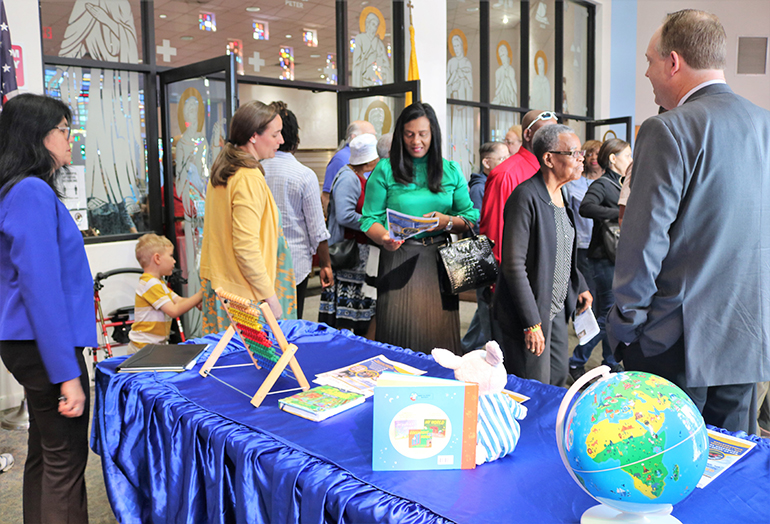
Jim Rigg, superintendent of schools for the Archdiocese of Miami, answers questions and hands out information about the soon-to-reopen St. Malachy School after church services at St. Malachy Church. Photo by Linda Reeves of Archdiocese of Miami
Perez said the community response has been overwhelming since word got out about the reopening plans. The Knights of Columbus St. Malachy Council 13355 have been doing handywork to help get the school ready to open in August. Nearby St. Bonaventure School reached out with guidance and local companies have donated and installed technology as well as offered free uniforms in the school’s blue and gold colors for incoming students.
In the areas of the school that will be occupied this fall, community members have installed new flooring, provided new furniture, moved the administrative offices to the front of the building and built a new canopy for the playground to provide shade. A parliament of owls found living in one part of the building provided inspiration for the school mascot: the owl.
“It takes a village to raise a child,” Perez said, quoting the African proverb. “This is where you find it.”

