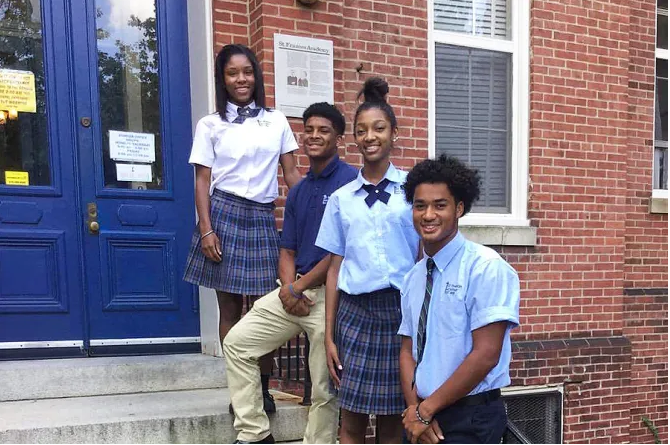
St. Francis Academy in Bally, Pennsylvania, is one of 1,845 private schools in the state serving more than 262,600 students. The academy boasts a student-teacher ratio of 10 to 1.
Editor’s note: This commentary from Nathan Benefield, senior vice president of the Commonwealth Foundation, appeared Sunday on pennlive.com.
Pennsylvania’s new state budget includes a historic $125 million expansion of two successful scholarship programs—the Educational Improvement Tax Credit (EITC) and the Opportunity Scholarship Tax Credit (OSTC). This expansion will provide 31,000 more students with scholarships to the academic environment that best fits their needs.
These vital programs are a drop in the overall $44 billion 2022–23 state budget—which included an additional $1.6 billion in public school funding.
Tax credit scholarship programs have a long track record of success. The EITC engages the business community in education, as businesses donate to scholarship organizations, providing educational opportunity to low- and moderate-income students.
As a result, more than 200 scholarship organizations have awarded 767,000 scholarships since the program’s inception in 2001, with an average scholarship amount of $2,200. They represent a tiny fraction of the nearly $20,000 per student spent by school districts, which, despite massive funding increases, have lost students and seen performance drop.
Because of this disparity, tax credit scholarships have saved taxpayers more than $4 billion in averted costs. And an economic impact analysis found scholarship expansion in Pennsylvania would generate billions of dollars from increased lifetime earnings and reduced criminal justice costs.
To continue reading, click here.
 Editor’s note: This article appeared Wednesday on the Oklahoma Council of Public Affairs’ website.
For more than a decade now, the state’s Lindsey Nicole Henry Scholarships for Students with Disabilities (LNH) program has been helping children with special needs thrive by paying for them to attend private schools that better serve them.
For many children and families, the program has been life-changing. Candace Cronin’s six-year-old daughter is among them.
“She can communicate,” Candace Cronin said. “She understands. She is awesome at reading. I mean, she is like one of the top five in her class in reading. And just two years ago, the girl couldn’t even talk.”
The Cronins’ daughter was diagnosed with sensorineural hearing loss and enlarged vestibular aqueducts (EVA). She was also born with torticollis, a condition affecting the neck that also affects hearing. Because her hearing is so compromised, the child struggled to learn to speak.
Throughout much of her young life, the Cronins’ daughter has been involved in occupational therapy, physical therapy, and speech therapy. And while she has made dramatic strides, most of her progress occurred after becoming an LNH scholarship recipient and attending a private school where she received much more personal attention.
“When she started (private school), she couldn’t even say, ‘Daddy,’” Candace Cronin recalled. “That didn’t come until later.”
The Cronins’ experience is typical of many LNH families. But the LNH program, and efforts to create similar school-choice opportunities for other children across Oklahoma, continue to face strong resistance.
Among the opponents is the Oklahoma State School Boards Association (OSSBA), an organization whose national affiliate famously urged the Biden administration to prosecute parents under anti-terrorism laws when families began speaking out about their education concerns at school board meetings.
On its website, the OSSBA claims that programs like LNH “erode public school funding and harms the 700,000 students who attend public schools”—even though the state actually spends less money per student on LNH recipients than what would be spent on those same students in the public school system.
The OSSBA also states that the LNH program “has shifted more than $38 million away from public schools to private schools over the last decade.”
However, state financial records show that figure represents a tiny fraction of total school spending during that time.
To continue reading, click here.
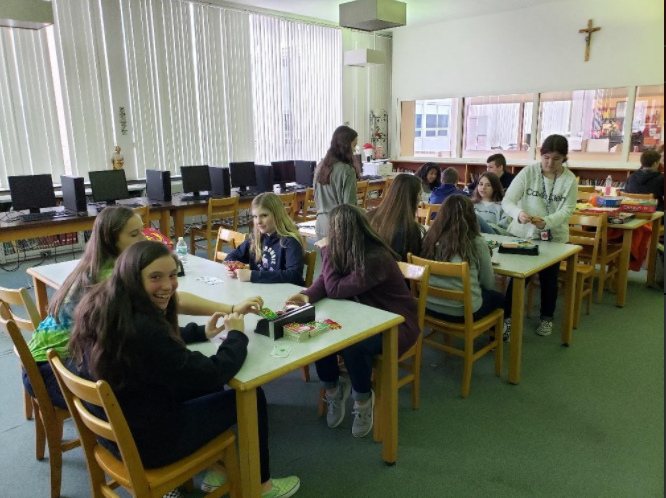
Bishop McCort Catholic High School in Johnstown, Pennsylvania, boasts a 13-to-1 student-teacher ratio, allowing faculty to challenge students to reach their academic potential. Recent graduating classes have achieved a 100% graduation rate, with 95% of students accepted to four-year colleges and universities. The school welcomes students participating in Pennsylvania’s Opportunity Tax Scholarship Program.
Editor’s note: This first-person essay from Pennsylvania father Jeremy Spontak was adapted from the American Federation for Children’s Voices for Choice website.
I am a single dad with full custody of my two children living in southwestern Pennsylvania. Raising two boys on my own is challenging, but our lives got so much better when I found out about Bishop McCort Catholic High School and our state’s Opportunity Scholarship Tax Program.
My son Joshua struggled academically for three years at our zoned public school before we found out about McCort. At one point, I requested that he be held back to give him a chance to catch up with his peers. School administrators told me that was not my decision, so they promoted him yet again, even though he could not master the material for his grade level.
The following year, he failed every subject. That’s when I decided to have him tested to see if he had a learning disability that was interfering with his progress. We did get a documented diagnosis, which I took to the school, but nothing changed. There was no additional help, no tutoring. Joshua continued to flounder.
Then COVID hit. Our public school was closed for almost two years to in-person instruction. The lack of structure – getting up every morning, getting dressed, going to school – was devastating to Joshua. He struggled for another year.
I had heard that Bishop McCort Catholic High School was offering in-person instruction. I visited the school and was impressed that it had been in operation since 1922, after Catholic parishioners in Johnstown raised $100,000 to launch it.
As much as I wanted to send Joshua to McCort, I didn’t see how I could afford private school tuition. Then school staff told me I probably was eligible for a state school choice scholarship. I applied for the A Opportunity Scholarship and was approved.
Since Joshua transferred to McCort, his grades have improved dramatically. I attribute that to the fact that class sizes are much smaller than at his previous school. The teachers have a chance to get to know every student – their strengths, their weaknesses, everything about them – and tailor instruction accordingly.
The school also provides the rigor and structure that Joshua needs. From Day 1, Joshua had the opportunity to join a community of students and teachers who are committed to advancing the rich Catholic mission of “learning to think rigorously so as to act rightly and to serve humanity better.”
With 10 Advanced Placement courses and 23 Honors courses, Joshua has lots of incentive to strive. And I am encouraged as a parent that, as the school website says, McCort empowers young generations to unlock their potential through a program of academic excellence, character building, social development, and leadership training.
Maybe best of all, Joshua has regained his love of learning. He is an all-around happier kid. This alone is assurance that moving my son to McCort was the best decision I’ve ever made for him.
I wish every parent could experience the benefit of choosing a great school for their child. If money is a barrier, I wish they would consider applying for whatever choice scholarship program their state supports.
Every child should have the opportunity Joshua has had to find educational success that I know will lead to lifelong career options and satisfaction.
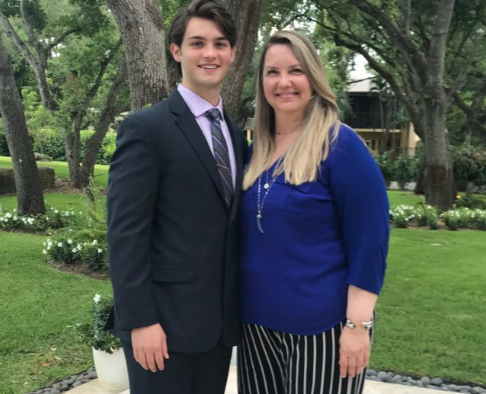
Josep Amiguet, pictured here with his mother, Kathy, overcame personal challenges to graduate from a Miami private school with a 3.75 grade point average and eventually earn acceptance at the University of Florida.
On a Wednesday morning in early January, a day after he turned 20, Josep Amiguet walked into a classroom inside Matherly Hall on the edge of campus for his intermediate microeconomics class, his first as a student at the University of Florida.
“OK,” he remembers thinking, “I’m here.”
It took three years of laser-like focus on his studies at Christopher Columbus High School in Miami and three semesters of work at Santa Fe College in Gainesville before Josep reached his goal of enrolling at Florida and studying economics.
“It really was a good feeling,” he said.
Josep’s path to Florida wasn’t as straight as he would have liked. A poor year academically as a freshman at Columbus, which he attended on an education choice scholarship, forced the South Miami native to play catchup during his final three years at the private Catholic high school.
He was not accepted to Florida after graduating Columbus in the spring of 2020. So, he attended Santa Fe to work on an associate degree, graduating in December 2021.
He reapplied to Florida and was accepted, receiving the confirmation email last November while studying for a psychology exam.
“It was a cool moment,” he said.
What wasn’t cool, Josep will tell you, was what he called the “below staller” grades on his report card as a Columbus freshman and the weeks he spent in summer school.
“Why am I here?” he remembered asking himself.
To continue reading, click here.
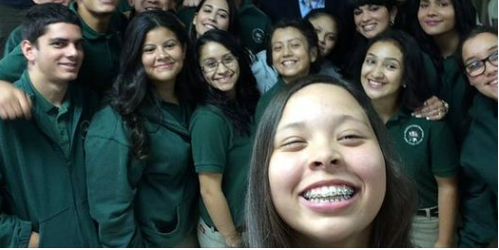
The foundational belief of La Progresiva Presbyterian School in Miami, which has roots dating to 1900 in Cardenas, Cuba, is that all children should have the opportunity to dream, congregate in a spirit of cooperation, and actualize their dreams while attaining the wisdom, knowledge, and skills necessary to transform the communities in which they will live and work.
For Leidiana Candelario, moving from the Dominican Republic to Miami at age 8 was a major lifestyle transition.
It didn’t go very well at first — until an education choice scholarship changed everything.

Leidiana Candelario
Leidiana was miserable in her assigned elementary school, describing herself as an “outcast.” Her unfamiliarity with English made her a target of bullying.
“Every weekday I anxiously waited to go home from school, as home became my shelter,” she says.
Home for the family of five was a small room behind her father’s shop. Those cramped quarters were preferable to the misery she was enduring in school. But her future was grim.
“I was unable to see a light at the end of the tunnel,” she says.
A ray of hope appeared in the form of the Florida Tax Credit Scholarship for low-income students, administered by Step Up For Students. After her parents applied and were awarded the scholarship, they now had options: They could afford to send Leidiana and her two sisters to the school they chose because it was the best fit for their needs – La Progresiva Presbyterian School.
“The moment my father, with excitement in his eyes, told me ‘Mi hija, nos dieron la beca!’ (“My daughter, they gave us the scholarship!”), I knew the best of changes would come,” Leidiana said.
At La Progresiva, Leidiana blossomed. No longer an outcast, she was warmly received, and thrived. The school’s principal, Melissa Rego, is a former public school teacher who also is the daughter of Cuban exiles. The student body includes many descendants of Cubans, Nicaraguans, Salvadorans, and Dominicans. More than two-thirds don’t have parents who attended college.
To continue reading, click here.
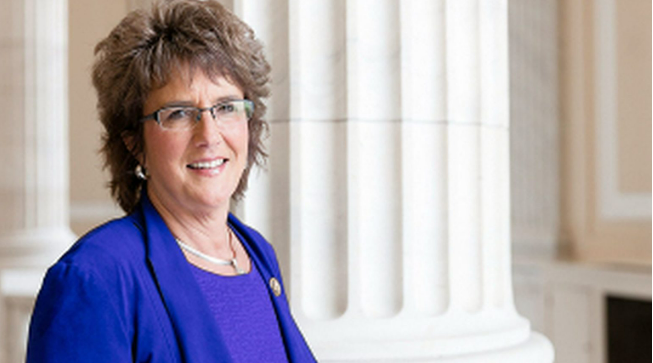
Rep. Jackie Walorski, co-sponsor of a bill that would create a program to incentivize donations to scholarship-granting organizations that could be used to cover expenses related to public and private K-12 education, said the legislation will restore power to parents and equip every American child to thrive.
Editor’s note: This article appeared Thursday on washingtonexaminer.com.
Republican lawmakers introduced twin bills in Congress Thursday that would establish a federal school choice program by enacting a $10 billion tax credit program to fund education scholarships.
The Educational Choice for Children Act was introduced by Rep. Jackie Walorski (R-IN) in the House of Representatives and by Sen. Bill Cassidy (R-LA) in the Senate, and it has several high-profile co-sponsors, including Sens. Tim Scott (R-SC) and Steve Daines (R-MT), as well as Reps. Virginia Foxx (R-NC), Jim Jordan (R-OH), Jim Banks (R-IN), Burgess Owens (R-UT), and House Republican Conference Chairwoman Elise Stefanik (R-NY).
“Our children’s education is the key to America’s future success," lead sponsor Walorski said in a statement exclusively provided to the Washington Examiner. "Every child should have the opportunity to live the American Dream — regardless of their ZIP code or socioeconomic background.
“Offering families school options will help millions of children access the best possible education for them. As we look to our nation’s future, this investment will restore power to parents and equip every American child to thrive.”
The legislation would create a $10 billion federal tax credit program to incentivize donations to scholarship-granting organizations that would then be used to cover expenses related to public and private K-12 education.
To continue reading, click here.
 Editor’s note: This commentary from William Mattox, a resident fellow at the James Madison Institute and a reimaginED guest blogger, originally appeared in the Summer 2022 issue of Education Next.
My son Richard has the chutzpah of Hank Greenberg, the greatest Jewish baseball player of all time. So, soon after we moved to Florida, Richard tried out for the baseball team at Tallahassee’s Leon High, even though he didn’t go to school there.
Richard was considered a home schooler at the time, but “hybrid schooler” would have been more accurate: He took classes from an online provider, a small private school, and a performing arts program.
Richard made the team, and by midseason lots of new baseball buddies were hanging around our house on weekends. Soon we discovered that Richard wasn’t the only “hybrid student” on the ball club that year.
Leon’s first baseman spent his mornings taking online courses through the Florida Virtual School, the knuckleball pitcher was taking a “dual enrollment” English class through the community college, and the left-handed pro prospect had enrolled in a financial management course at a local college (in case he was drafted).
Moreover, one of Leon’s outfielders had figured out an ingenious way to get a music education few families could afford out of pocket. This kid took mostly music classes at Leon by day and then several online courses at night and during the summer. He ended up being a four-time All-State musician and getting a college offer from Juilliard.
When I first encountered all these hybrid students, I figured there must be something in the water at Leon High. But I came to realize that many of these unconventional schooling options were the by-product of reforms former governor Jeb Bush had initiated, especially the creation of the Florida Virtual School.
The rise of hybrid schooling bodes well for students whose needs, gifts, interests, and learning styles do not align with the factory school model of the 20th century, and for parents who know that no school can maximize the potential of every child every year in every way.
There is a Magic School Bus, but no magic school.
Customized education is good for all kids and not just for academic reasons. Several years ago, Richard entered a local talent competition structured much like American Idol. Different singers would perform at big community gatherings and then people would vote for the ones they considered the best.
Richard kept advancing week after week, until on the night of the finals, one of the organizers took me aside and said, “I don’t get it. You guys just moved here a year or so ago, and yet Richard seems to have a really strong base of support.”
As Richard’s proud papa, I wanted to tell this guy, “Of course, Richard’s got lots of support—he’s the best one.” But I knew what this guy was getting at, so I explained, “See that guy over there? That’s Richard’s drama teacher at Young Actors Theatre. He gets all his thespian friends to vote for Richard.”
Then I said, “See that family over there? They know Richard from baseball. Those kids over there took classes with Richard at the classical Christian school. The college students way back there know Richard from Young Life youth ministry. And those kids over there are in the AP classes Richard is taking at Leon.”
The contest organizer realized that Richard’s social network was far larger than he’d expected. What I marveled at was how diverse his friendship network was. Gay. Straight. Christian. Non-Christian. Jocks. Thespians. Nerds. Cool kids. Richard’s friends reflect the diversity of his hybrid-schooling life.
Now, I’m not so naive as to think that hybrid schooling will eradicate high school cliques or classroom bullying. But customized schooling can offer kids a far richer, and more varied, social experience than they might otherwise get.
And when you add these social benefits to the educational advantages of customized schooling, you can see why I’m glad that Jeb Bush and other reformers had the Hank Greenberg–like chutzpah to change the way Florida does education.
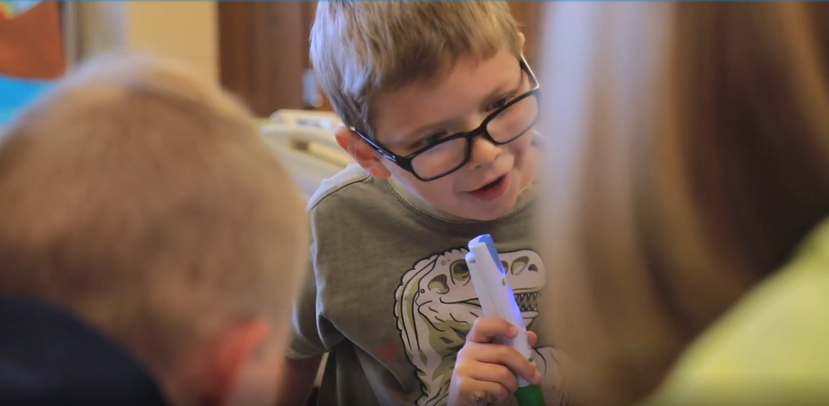
Grand Rapids Christian Schools provides high quality, faith-based education to Michigan students in preschool through 12th grade on five campuses to educate nearly 2,300 students annually. The school offers programs in Spanish immersion, fine arts, and instructional technology.
Editor’s note: This commentary from Ben DeGrow, director of education policy at the Mackinac Center for Public Policy based in Michigan, appeared Monday on the center’s website.
There is an understandable challenge in writing about Michigan’s attempt to expand parental choice in education. Until recently, journalists who cover state issues and debates have had little reason to investigate the larger movement, even as Michigan remains surrounded by states that have adopted private education choice programs.
Providing accurate coverage of Student Opportunity Scholarship accounts is also complicated by the policy’s numerous moving parts. The proposal is designed to give parents greater flexibility and meet many students’ educational needs. It is also carefully crafted to clear the formidable legal barrier the state maintains through its “Blaine Amendment.” Grasping the full mechanics of the proposal takes significant effort.
As time goes on, though, there’s less justification for labeling the proposal as a “voucher-like” program, as a recent Bridge Michigan article describes it. (Chalkbeat Detroit earlier had to correct misrepresentations in its description of the proposal.)
The term “voucher” elicits a negative reaction from a sizable segment of voters otherwise favorable to choice. Yet Michigan’s proposal differs from school vouchers in two key respects: Funds come from incentivized private donors rather than a government treasury and unlike vouchers, they can be used for a wide variety of educational expenses, rather than just private school tuition.
To continue reading, click here.
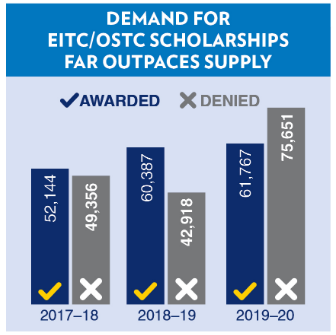
Arbitrary program caps denied more than 75,000 Pennsylvania K-12 student applications and turned away $116 million in business donations in 2019-20, prompting the Commonwealth Foundation to recommend that the state implement an escalator that allows credits to automatically grow in proportion to student need.
Editor’s note: This article appeared Monday on City & State Pennsylvania’s website. You can read the Commonwealth Foundation’s full plan here.
A Harrisburg free-market think tank unveiled its 2023 legislative agenda this week, which proponents say is backed by polling data and could help revitalize the commonwealth – if lawmakers adopt its recommendations.
The Commonwealth Foundation’s “Better Pennsylvania” plan proposes a raft of reforms to how the state approaches education, tax policy, criminal justice and labor unions, among other topics.
“It’s a 23-point agenda that equips lawmakers and state officials with a very practical roadmap to get Pennsylvania back on the right track, restore hope to our citizens across the Commonwealth, and set us on a better path that allows all Pennsylvanians to flourish,” said Jennifer Stephano, the Commonwealth Foundation’s executive vice president.
The policy plan includes a slate of recommendations that have become hallmarks of the think tank’s work in state government. The plan calls for an expansion of the state’s tax credit scholarship programs, the creation of restricted-use Education Opportunity Accounts, and a report card-style grading system for public schools.
The Commonwealth Foundation also calls for the implementation of spending limits on state government, replacing certain tax credits with broader business tax cuts and pulling the state out of the Regional Greenhouse Gas Initiative, a multistate carbon pricing initiative.
To continue reading, click here.

Polk County Sheriff Grady Judd holds up an imitation $5,000 bill emblazoned with the image of Florida Gov. Ron DeSantis at a press conference at the Sheriffs Operation Center in Winter Haven at a promotional event for House Bill 3, which provides signing bonuses of up to $5,000 for recruits who are new to the law enforcement profession or are moving to Florida from a law enforcement agency in another state. PHOTO: Ernst Peters/The Ledger
On this episode, reimaginED Senior Writer Lisa Buie talks with Shawn McCormick, a Florida law enforcement officer, husband, and father of four. McCormick’s children became eligible for a Family Empowerment Scholarship for Educational Options after the passage of House Bill 3, which extended eligibility to law enforcement families regardless of household income.
Among the bill’s incentives:
“I learned about (the expansion of scholarship eligibility to law enforcement officers) through one of the teachers at our school. They were very excited to ask me if I knew about it. I thought, ‘That’s great, but there’s no way I would qualify, or it would work out for me.’ Once I started to do a little research into it, I was dumbfounded.
“It was a blessing … it’ll allow me to have more time for my kids. It translates into a nicer, more friendly dad who is around more often, less stressed. You blink your eyes, and your kids are grown, and I’m realizing that every minute I can spend with my kids and not working is huge.”
EPISODE DETAILS:

