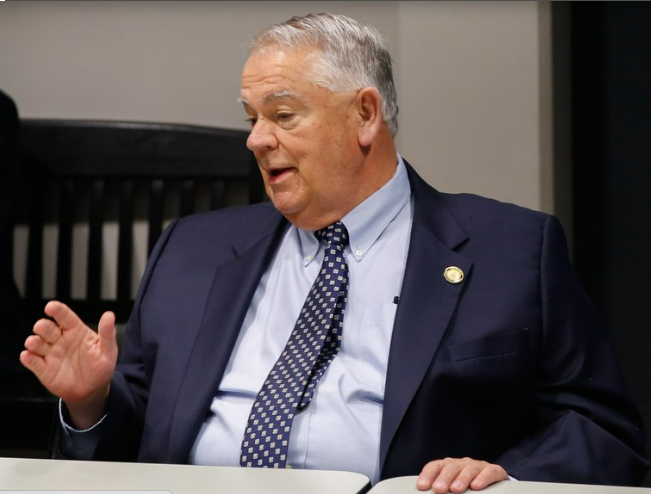
Georgia House Speaker David Ralston called the measure to increase the current $100 million cap “a further investment to provide students and their parents with greater school choice.”
Editor’s note: The following is the text of a news release issued earlier today by the AAA Scholarship Foundation.
On behalf of the many families and students it serves, AAA Scholarship Foundation today offers sincere thanks to Georgia Gov. Brian Kemp, Lieutenant Gov. Geoff Duncan and House Speaker David Ralston on the passage yesterday of HB 517, a bill that will increase the Georgia K-12 education tax credit program to $120 million from $100 million.
The legislation would also make permanent an increase to the program that was set to expire soon and expand the types of entities that can contribute to these important educational scholarships. HB 517 will allow the AAA Scholarship Foundation to serve more families through critical needs-based scholarships and help these students accomplish their educational goals with greater success.
"I am very proud of my fellow lawmakers in approving an increase in Georgia's tax credit scholarship program,” said bill sponsor Rep. John Carson. “Under HB 517, more families will be able to choose the school that best meets their child's needs, Georgia taxpayers will be able to contribute more per family, and the state will have increased transparency, disclosure and cost savings. Truly a win for everyone, especially Georgia's kids in need of educational opportunities."
HB 517 has been transferred to the Office of Gov. Brian Kemp and is awaiting signature.
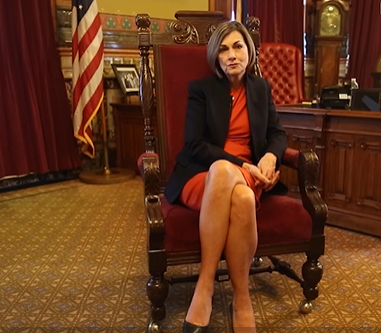
Iowa Gov. Kim Reynolds says she will continue to work to build support for school choice as the annual legislative session moves into its final weeks: “I’m going to continue to be optimistic right until the end.”
Editor’s note: This article appeared March 30 on desmoinesregister.com
The Iowa Senate has passed one of Gov. Kim Reynolds' key education priorities — a bill to give families taxpayer-funded scholarships to pay for private school expenses — in a move that puts pressure on the House to act.
Reynolds, a Republican, has made the issue one of her top legislative priorities for the year. It's also proven one of the most controversial proposals in the Legislature. Democrats are universally opposed and say the measure will harm public schools. Meanwhile, Republicans are divided, particularly in the House, with some of their members expressing similar concerns.
The Senate passed the measure, Senate File 2369, on a 31-18 vote. Every Republican voted in favor except Sen. Annette Sweeney, R-Alden, who joined every Democrat in voting no.
"There is no one size fits all when it comes to student success," said Sen. Amy Sinclair, R-Allerton, the bill's floor manager. "And only parents — only parents — should be the ones to have the opportunity to determine their child’s educational future."
To continue reading, click here.
 With uniformed sheriff’s deputies looking on, Florida Gov. Ron DeSantis on Friday signed HB 3, a bill aimed at recruiting and retaining law enforcement officers with a variety of perks, including state K-12 scholarships for their dependents.
“There’ a lot of great stuff in here, and I’m just proud that it all came together,” DeSantis said just before signing the bill during a ceremony at the Brevard County Sheriff’s Office in Titusville. A second ceremony was held at the Polk County Sheriff’s Office in Winter Haven.
The bill will make dependents of all law enforcement officers eligible to receive a Family Empowerment Scholarship, one of the state’s several K-12 education choice scholarship programs. The Family Empowerment Scholarship for Educational Options is income based and allows a family of four with an income of about $100,000 to qualify.
(Step Up For Students, which hosts the blog, manages the FES program.)
“We are making dependent children of law enforcement officers eligible for our Family Empowerment Scholarships and so that’s a school choice program where primarily low-income families are able to access a scholarship and access the school of their choice,” DeSantis said. “Now, regardless of income, dependents of law enforcement officers are eligible … and we think that’s something that’s really, really significant.”
Among the bill’s other incentives:
“We never once backed down from supporting the folks who wear the uniform, who wear the badge, who put themselves at risk to keep us safe,” DeSantis said. “We wanted to say that this law enforcement profession is a noble calling, and we want to support you if you make that decision to protect and serve.”
State Rep. Tom Leek, R-Ormond Beach, who sponsored the bill, said the legislation shows Florida’s commitment to law and order.
“In Florida, we don’t defund the police,” he said. “Not today, not tomorrow and not ever.”
The new law is drawing praise from education choice advocates who see it as an opportunity to allow those who serve communities to choose the learning environment that best serves their child.
“State school choice scholarships enable so many students with the ability to reach their goals,” said Jen Swain, principal at San Jose Catholic School in Jacksonville. “Within our San Jose Catholic community, the new bill rewarding law enforcement officers will have such a positive impact. This is truly changing lives.”
HB3, which passed with bi-partisan support, takes effect July 1.
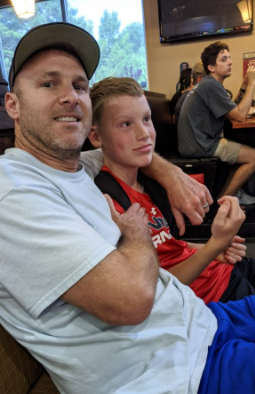
Ryan Robins, shown here with his father, struggles with a form of dyslexia that caused him to fall far behind his classmates before his parents found out about the Academy of Innovation in Gainesville, Georgia, and the Georgia Special Needs Scholarship Program.
Editor’s note: This first-person essay from Georgia mother Karen Robins was adapted from the American Federation for Children’s Voices for Choice website.
My name is Karen Robins, and my son Ryan struggles with dyscalculia, or math dyslexia. It affects his ability to understand numbers – in dates, when telling time, when counting money, and when learning math facts.
Throughout his elementary school years, my husband and I moved Ryan from a public school to a private Montessori school and back to a public school. He continued to fall further and further behind his peers. He was fortunate to have some talented special education teachers who did their best to serve him, but it just wasn’t enough. He continued to decline. He felt like a failure.
As a fifth grader, his test scores showed he was performing in math at a pre-kindergarten level. There was no way he could understand fractions, let alone master them. His struggles carried over to other subjects, including reading, where he was performing at a first-grade level.
Ryan would come home from school feeling frustrated. Homework assignments that should have taken an hour to complete dragged on for four hours. His self-esteem plummeted and he became convinced he was stupid. His friendships and social interactions suffered because so many of the games his friends enjoyed required counting and numbers.
It didn’t help that he had been held back twice and was older than his classmates.
His teachers meant well, but they didn’t know what to do for him. By the time he was old enough for sixth grade, I knew he needed a specific dyslexia program to be successful, but our school district didn’t offer it. That’s when I found out about the Academy of Innovation in Gainesville, Georgia, about an hour from our home.
The Academy of Innovation is a non-profit, accredited private school with a personalized and positive approach to teaching children in grades 1 through 12. It compliments, rather than competes, with the community’s public education system, offering innovative approaches and proven, research-based teaching methods that address the individual needs of students like Ryan who face learning barriers.
And fortunately for us, the school accepts the Georgia Special Needs Scholarship Program, a school choice program available for special needs students attending Georgia public schools who are served under an Individualized Education Plan. I’ve been able to factor the substantial commute into my schedule, but there would have been no way we could have sent Ryan to the academy without the scholarship.
Ryan has been at the school for a year, and he’s experienced a complete turnaround. He can spell, he can read, and he’s working on math skills, all because teaching and learning is achieved in a different manner at this amazing school. I always suspected that Ryan’s challenges weren’t due to a lack of intelligence; he just required a different teaching method, and that’s what we’ve found at Academy of Innovation.
A couple of weeks ago, all the students in Ryan’s class were assigned book reports. Each of them chose a famous person who had dyslexia, like George Washington and Albert Einstein. Just recently, Ryan said to me, “Ask me how to spell anything. I know how to spell now because I understand how letters work.”
Knowing my son is at a school that offers children with dyslexia the support they need is so reassuring. It’s a joy to see Ryan thriving, to know that he no longer considers himself stupid. And he loves being with other kids like him, children who learn differently like he does.
School choice to me means being able to select the school that’s the best fit for your child and being helped with the resources so he or she can attend that school. Not every school fits every child. I’ve seen that over and over, with my own child and with children in other families.
Looking back, I wish we had found the Academy of Innovation when Ryan was in first grade, but I’m grateful Ryan got there when he did.

Maclay School is a non-profit college preparatory school in Tallahassee, one of 36 private schools in Leon County that serve more than 5,250 students. With a 12:1 student to faculty ratio and a 100% graduation rate, Maclay is dedicated to developing the full potential of every student.
Editor’s note: This commentary from Michael Barrett, Associate for Education for the Florida Conference of Catholic Bishops and a reimaginED guest blogger, appeared originally in the Tallahassee Democrat.
Throughout most of the country, families of limited financial means have no choice other than to enroll their children in public school.
However, in Florida, families can choose the best educational setting for their child whether it be public, charter, private, or homeschool. For many families, sending their child to a private school would be outside the realm of possibility but for the Family Empowerment Scholarship and the Florida Tax Credit Scholarship.
In Florida, state education funding follows the student. The formulation known as the Florida Education Finance Program (FEFP) determines the amount that a public school will receive from the state for each full-time enrolled student.
The FEFP amount varies depending on location but usually it is between $7,000 or $8,000 per student. If a student leaves one public school district and moves to a different public school district, the FEFP money follows the student to the new district.
If a student qualifies for a Family Empowerment Scholarship the student receives an amount equivalent to the FEFP as a scholarship and is free to use that scholarship at a private school of his or her choice.
Regardless of where a student ultimately enrolls, if a student leaves a public school district, the FEFP funding attached to that student also leaves because the school district no longer needs the tax dollars allocated for that student’s education.
Over the past several decades, Florida’s student-centric education system has primarily funded students and their families rather than institutions.
However, in the (Tallahassee Democrat) March 22 article, “School choice expansion leaves Leon County Schools in $11.5M budget deficit,” Leon County Schools inverts the underlying logic of Florida’s education funding policy and blames a significant institutional budget deficit on low-income and unique ability students.
Students and families who are most in need should not be blamed for bureaucratic budget holes created by inaccurate enrollment forecasting.
Did anyone at LCS ask these students and families why they left and enrolled in other schools? If LCS is concerned about student enrollment declines shouldn’t the burden be on LCS to determine why students are leaving, remedy any problems they identify, and pursue more dynamic methods to attract and retain students?
Perhaps LCS could use some of its $60 million in federal emergency relief money to implement some of these new methods.
The proper response is certainly not to force these students to remain in public schools by eliminating the programs that allow these students to attend the school that best suits them. Public schools are not one-size fits all education factories from which only the affluent should be free to opt out.
Let’s not disparage this achievement and the freedom it offers by leaning on outdated tropes. Instead, let’s celebrate Florida as the national leader in ground-breaking education policies that empower families regardless of income or need.
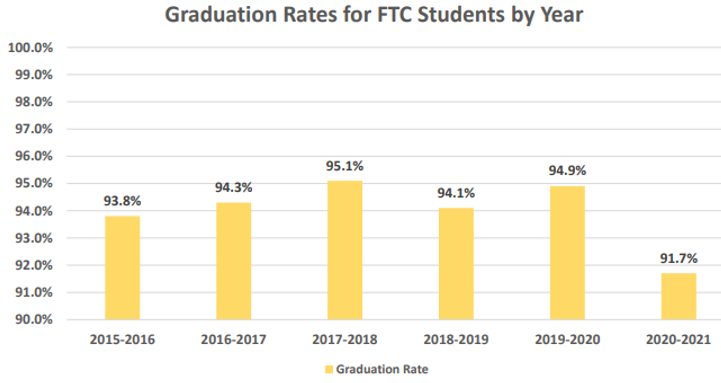
 The global pandemic may have caused a decline in graduation rates among Florida’s scholarship students, according to a recently released report from Step Up For Students. Graduation rates for seniors on the Florida Tax Credit Scholarship fell 3.2 points during the first pandemic school year.
In school year 2020-21, 4,344 tax-credit scholarship students entered their senior year at 586 private schools. Among those seniors 3,744, or 91.7%, graduated. Though still a respectable graduation rate, it is the lowest reported since the scholarship funding organization Step Up For Students, which administers state scholarships, began tracking graduation rates in 2015.
Step Up For Students uses a senior graduation method which counts the percentage of students who began the year as a senior and graduated. Graduates are defined as students who received a standard diploma, special education diploma, or certificate by the end of the school year.
Students who dropped out or did not complete 12th grade are counted as not graduating. This graduation rate cannot be used to compare with public school graduation rates, which use a four-year cohort method.
Graduation rates among scholarship students varied by race, income, and religious denomination of school where the student attended.
Catholic schools saw the most success, graduating 99.3% of seniors, while non-denominational schools graduated 90.2% of students.
Black students had the lowest graduation rate at 85.4%, compared to 95.5% of white students and 98% of Asian students.
Students eligible for the free or reduced-price lunch program, a proxy for the lowest-income students, graduated at a rate of 90.4% compared to 95.3% of students who were not eligible for the program.
For the 2020-21 school year, Step Up For Students awarded tax-credit scholarships to 103,985 students who attended 1,931 private schools across the state. A total of $645.6 million in scholarships was awarded, with the average scholarship worth $6,646.
 Editor’s note: This article appeared Thursday in the National Review.
According to a new poll released this morning by the American Federation for Children and Invest in Education, support for school choice continues to rise among Americans of all political views and across racial demographics.
The results contain several notable findings, but the theme is clear: Americans of all stripes are beginning to reach a consensus in favor of school choice and of education policy that favors parental rights.
The survey asked respondents about four key areas of the education debate: the role of parents, education-savings accounts, education-freedom scholarships, and failing schools. On each question, a majority of all respondents believed that greater education freedom is the correct policy.
The survey was conducted by OnMessage Inc. in telephone interviews between Feb. 14 and Feb. 17, surveying 1,000 voters likely to vote in the upcoming general election. The sample was stratified to reflect voter trends and had a 3.1% margin of error.
“As we mark two years since the beginning of the pandemic, there has been a seismic shift in how parents think about education,” said Luke Messer, president of Invest in Education, and Tommy Schultz, CEO of the American Federation for Children in a joint statement. “Voters are also prioritizing education freedom and standing ready to make their views known at the ballot box.”
Messer and Schultz also emphasized that growing support for school choice is a response to “egregious achievement gaps” in public schools and the fact that “disadvantaged children [are] systematically assigned to schools that have been failing students for decades.”
To continue reading, click here.
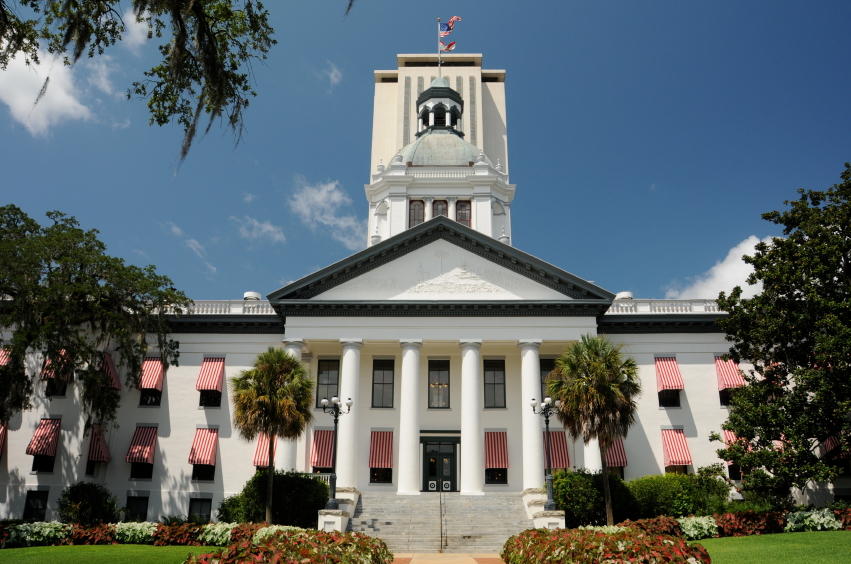
On this episode, Step Up For Students President Doug Tuthill and Legislative Affairs Manager Alexis Laroe discuss the changes coming to education choice programs in Florida following the 2022 legislative session in Tallahassee. The education budget passed by the legislature this year is the largest in the history of the Sunshine State.
While education choice programs did not greatly expand as in prior years, many smaller changes did occur. The two discuss those changes and the impact they will have on Florida’s choice families.
They also discuss the heated debate that took place this year surrounding parental rights in education, and the role public education has historically played in the social engineering of society.
"I believe public education was really tremendously funded this session for everybody … If you look around, there are really a lot of great things to celebrate."
EPISODE DETAILS:
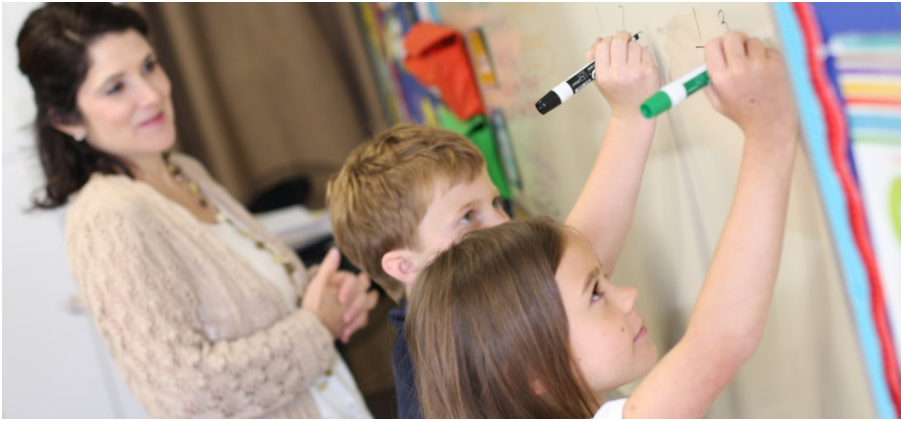
Eastwood Christian School, one of 417 private schools in Alabama serving just over 80,000 students, places its educational emphasis on the “trivium” – grammar, logic, and rhetoric – taught from a Biblical worldview.
Editor’s note: This article appeared this morning in the daily newsletter of the Energy Institute of Alabama.
Sen. Dan Roberts, R-Mountain Brook, led legislation passed yesterday by the Alabama State Senate amending the Alabama Accountability Act of 2013 to increase the income tax credit claimed by an Alabama taxpayer.
“Since the Accountability Act was passed into law in 2013, it has been a resounding success raising over $176 million from the private sector to provide for educational opportunities that students otherwise could not afford,” said Roberts. “However, private sector funding of Scholarship Granting Organizations (SGOs) has ebbed and flowed over the years for various reasons, including changes in the federal tax code.
“One of the most important elements of this bill is that it allows SGOs to have financial consistency in their budgeting and planning. This means that once a child is accepted into a participating school, the parents will have the peace of mind now in knowing that their child’s scholarship will be there to support them for years to come.
“The Alabama Accountability Act creates life-changing situations for students and their families, enabling an opportunity for school choice and enhancing the quality of life and learning for so many Alabamians. More than 97 percent of students who receive these scholarships renew them annually. That statistic alone is a true testament to the meaningful benefits this program offers to our school children,” Roberts continued.
To continue reading, click here.
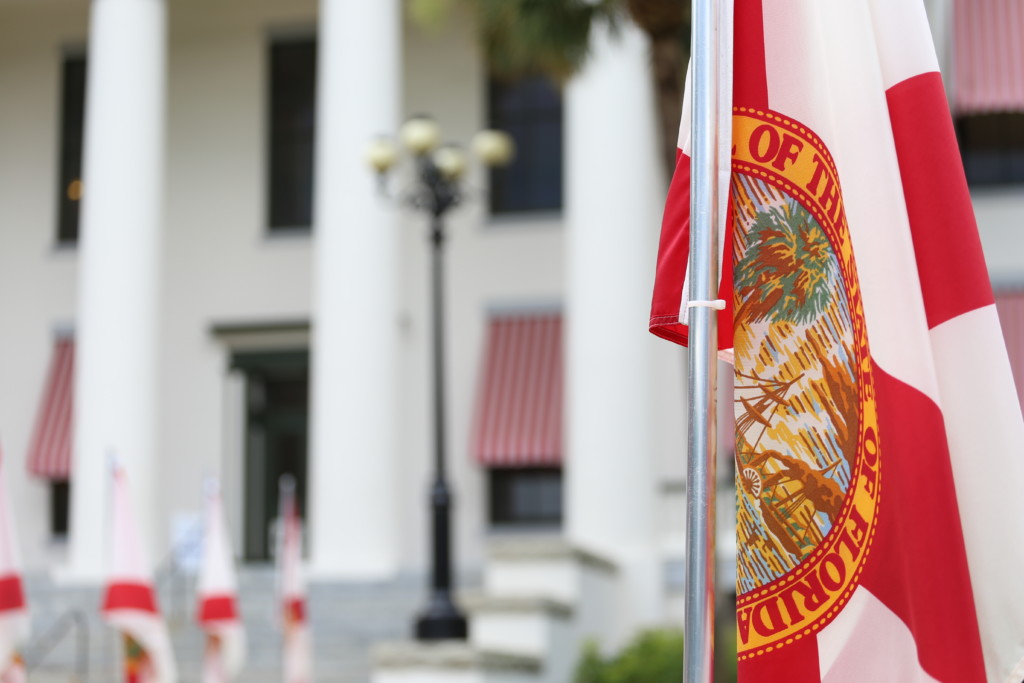 The 2022 Florida legislative session drew to a close Monday with lawmakers passing a record $112.1 billion budget for the fiscal year that will start July 1.
Many education-related items were included in bills tied to the budget, including changes related to state school choice scholarship programs:
HB 3, related to law enforcement, also passed both chambers and is headed, along with the budget, to Gov. Ron DeSantis for his approval.
This bill will allow the dependents of law enforcement officers to qualify for Family Empowerment Scholarships for Educational Options and to be excluded from the caps for both that scholarship and the Family Empowerment Scholarship for Students with Unique Abilities.

