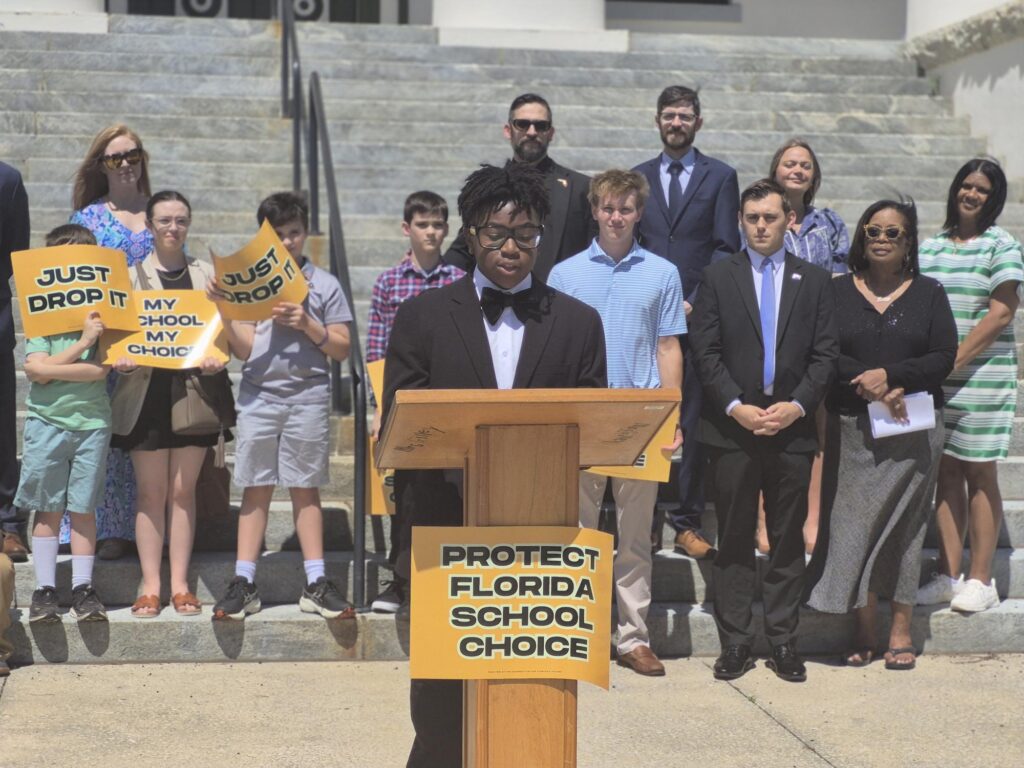
Nine days after the state teachers union sued to strip Florida families of the right to choose their children’s education, the pushback began when supporters of state K-12 scholarships and charter schools gathered in Tallahassee on the steps of Old State Capitol to protest.
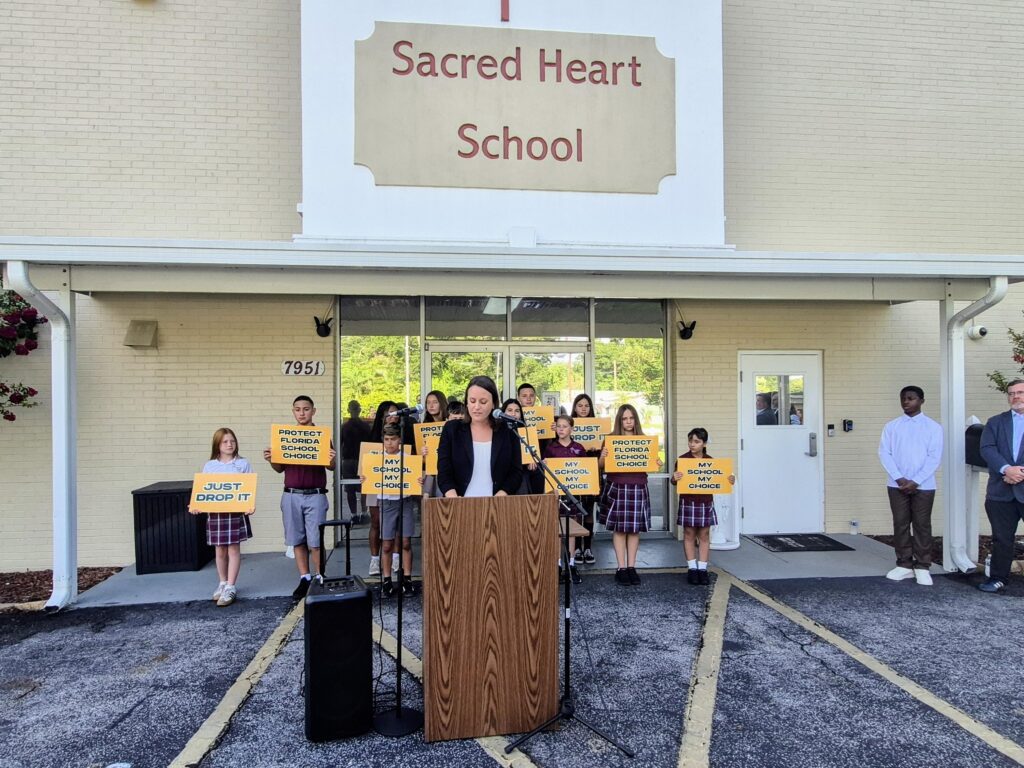
Two weeks later, choice supporters stood outside Sacred Heart Catholic School in the Tampa Bay area holding signs with the slogans, “My Child, My Choice” and “Just Drop It.”
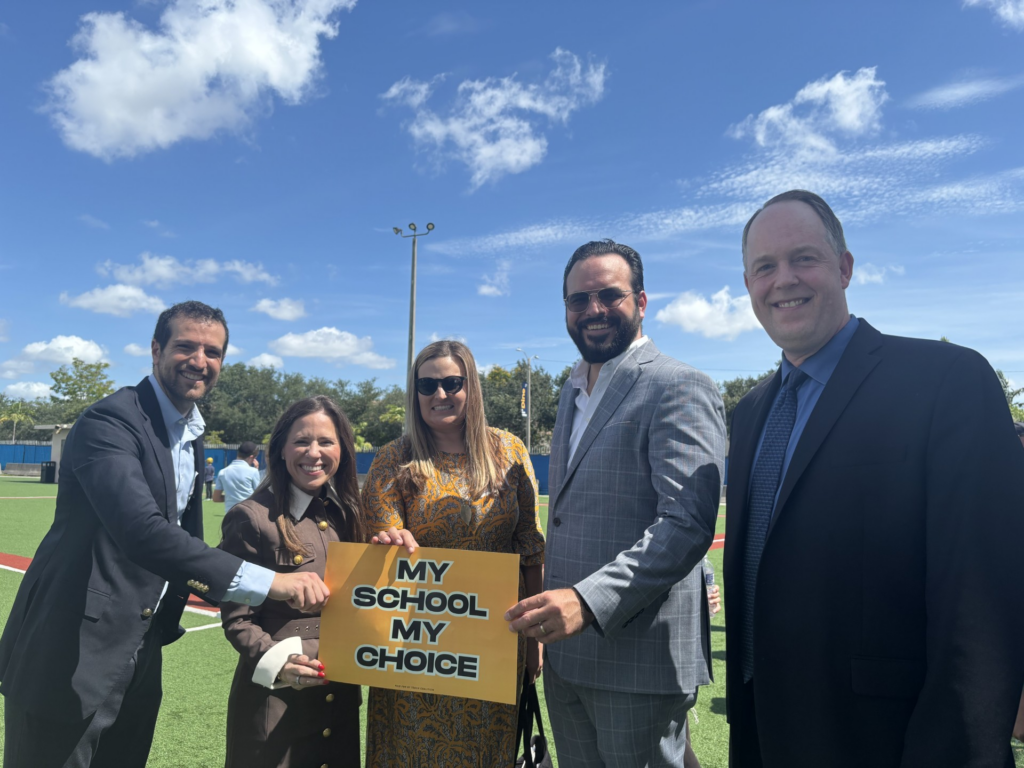
This week, the protests got louder. Students, parents, charter, and private school leaders stood outside Lubavitch Educational Center, the state’s largest Jewish day school, on Thursday and pledged to defend the decades-old policies and programs that have empowered families to choose the best educational fit for their children from a rapidly growing number of options.
“It’s not easy to pay private school tuition,” said Ailyn Weisleder, whose three sons are thriving at a Jewish day school. “But universal school choice has made that possible for our family. It gave us, and thousands of other families across Florida, the ability to choose the education that fits our children, not just the school assigned to us by a ZIP code.”
Audrey Maman Bensoussan said her family can’t afford to give her four children a Jewish education without the scholarships. She said the school feels like “a second home” to her children.

“If this lawsuit succeeds, it will not hurt politicians or special interests. It will hurt families like mine. It will hurt children like mine. It will take opportunities away from parents who simply want the freedom to choose the school that best meets their children's needs.”
Yonah Schwartz, 11, said at the news conference that if the lawsuit succeeds, then he won’t be able to afford to transfer to a school that better suits his learning needs.
“Not every kid learns the same way,” he said. “For me, changing schools means getting the chance to learn in a place that’s a better fit for me.”
The lawsuit, filed May 5, asks a judge to eliminate the state’s education choice scholarship programs based on the Florida Constitution, which says the state “shall make adequate provision for a uniform, efficient, safe, secure, and high-quality system of free public schools.” The lawsuit also seeks to end state funding of charter schools.
Faith leaders, charter school and private school leaders, as well as former Florida Gov. Jeb Bush’s Foundation for Florida’s Future, have supported the news conferences. Step Up For Students, the nation’s largest education choice scholarship funding organization, led the Tampa Bay area event. Teach Florida, a nonprofit school choice advocacy organization for Jewish education, organized and led the Miami event.
“The lawsuit brought by the Florida Education Association threatens everything these programs have made possible,” said Melissa Glaser, Teach Florida’s executive director. “This is about protecting families, protecting opportunity, and protecting a parent’s fundamental right to choose the best educational path for their child.”
She said more than $130 million annually in state scholarship funding helps ensure that Jewish children throughout Florida receive “the education they deserve — in schools that reflect their values and strengthen our communities.”
Their comments echo those made at the previous news conferences, where families described how scholarships had changed their lives. A charter school leader also spoke about how tuition-free charter schools ( which, like district schools, are public) have benefited students, including many from low-income households. Faith leaders also described how their schools uplift communities and welcome students with special needs.
Jim Rigg, superintendent of schools for the Archdiocese of Miami, said the lawsuit could damage “a thriving educational ecosystem in South Florida that attracts people from all over the world.” That includes the 37,000 students who attend Catholic schools in the diocese’s three counties. He said each school is accredited, gives standardized tests, complies with applicable state requirements, and employs highly qualified and certified teachers.
“But at its heart, the issue is not about institutions. It’s about children and families. Everyone wins with meaningful school choice, ultimately making our state the ideal place to raise and educate a child.”
A new state law has replaced Florida’s patchwork of local zoning rules that had prevented some small private schools from opening, paving the way for robust school choice options to expand.
Gov. Ron DeSantis signed Senate Bill 182 on April 20. In addition to a broad swath of education changes, from a cursive writing mandate to a teacher mentoring program, it includes a provision that exempts private schools with 150 or fewer students from applying for costly rezoning and land use changes when operating in commercial or mixed-use zones and in nontraditional buildings, provided they meet fire safety standards or similar checks.
The new law takes effect on July 1. It benefits private schools of all sizes by expanding legislation passed in 2024 that allowed them to operate in houses of worship, museums, theaters, colleges, and former schools or day care centers without needing these changes.
SB 182 also lets them build new facilities on these properties or on land owned by Florida College System schools and state universities without zoning changes.
The new law covers faith-based and secular schools, with Jewish education leaders leading the push for its passage. According to the Florida Department of Education, 15,679 students are enrolled in 85 Jewish schools across the state.
Demand for Jewish day schools has soared as families primarily from the Northeast move to Florida because of its robust education choice scholarship programs. The migration has meant fewer available seats for those seeking schools that provide academic and Judaic instruction.
Teach Florida, a division of the Teach Coalition, which advocates for Jewish nonpublic schools and parents, praised the law as “a transformational moment” for all Florida families.
“Today, Florida confirmed its commitment to students by removing one of the biggest barriers standing between Florida families and the education they want for their children,” said Melissa Glaser, executive director of Teach Florida. “For too long, local zoning restrictions have prevented schools from opening where demand is greatest. This law will help more schools grow, create more classroom seats, and ensure that more students can access the education they deserve.”
Last year, the group published a report on regulations governing the opening of private schools across South Florida. It concluded that local zoning restrictions were a major barrier to opening a new school, due to a patchwork of local laws that limit where schools can open, allow public schools to open in the same areas where private schools are prohibited, impose extra requirements on new private schools such as costly traffic studies regardless of school size, nebulous standards for “compatibility” and “scale,” and arbitrary requirements for lot size, fence height, building sharing and more.
As a result, the typical time to obtain zoning approval for a new school in South Florida was 12 to 18 months, and the process cost more than $150,000 in legal, architectural, and study fees.
“All nonpublic schools should receive the same protections and flexibilities as public schools,” the report said.
For microschools that register as private schools, the law exempts them from fire code complications that limit them to a maximum of five students.

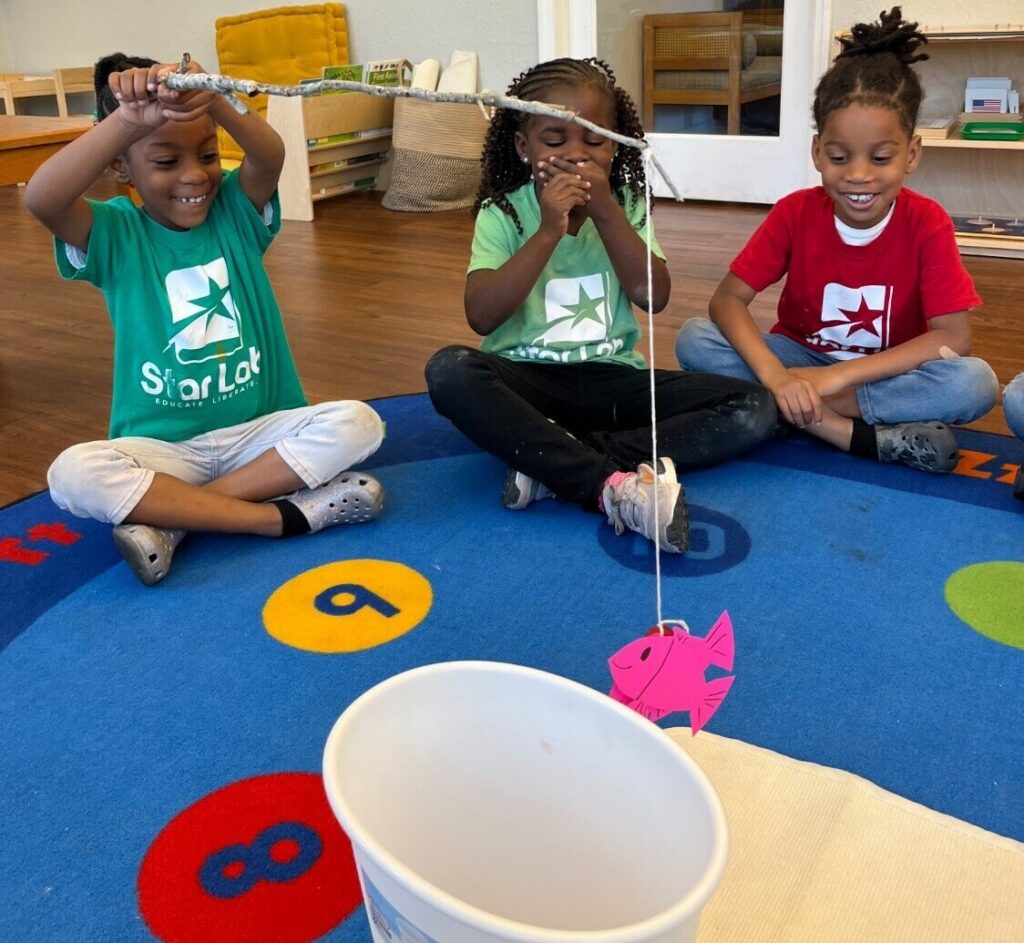
Alison Rini, the founder of Star Lab in Sarasota, could serve only five students during her first year due to fire codes that would require her to spend $97,000 on a sprinkler system for the rec center of a public housing complex where Star Lab operated. A local philanthropy stepped forward to help the housing authority pay for the system, but many founders are not as fortunate.
“The new law is a major win for diverse educational options,” Rini said. “The zoning process is incredibly burdensome.” In addition to the sprinkler system, Rini said she spent $10,000 to apply for a minor conditional use permit to use a one-story building less than 3,000 square feet that had previously housed a day center. The whole process took nearly two years and cost a total of $130,000.
“All of that time and money could have gone into our students and our curriculum; it was so frustrating,” Rini said.
Rini said she had to invest all the time and money with no guarantee of success. However, she said the planning commission easily approved her proposal when she was finally able to present it after 22 months of preparation.
After the vote, Rini said the chairperson commented, “I don’t know why this had to be so hard for her. I’m from Europe, and we have schools in apartment complexes all the time. This is a very compatible use.”
Danny Aqua, projects director for Teach Florida, recently told EdChoice the law adopts common sense fire code reform by 1) requiring fire officials to recognize alternative fire safety methods that are already in the code, and 2) treating similar facilities like day cares and churches as existing schools when applying the fire code.
“The goal is not to reduce safety, but to ensure that regulations designed for large, traditional schools are applied more appropriately to smaller educational environments,” he said.
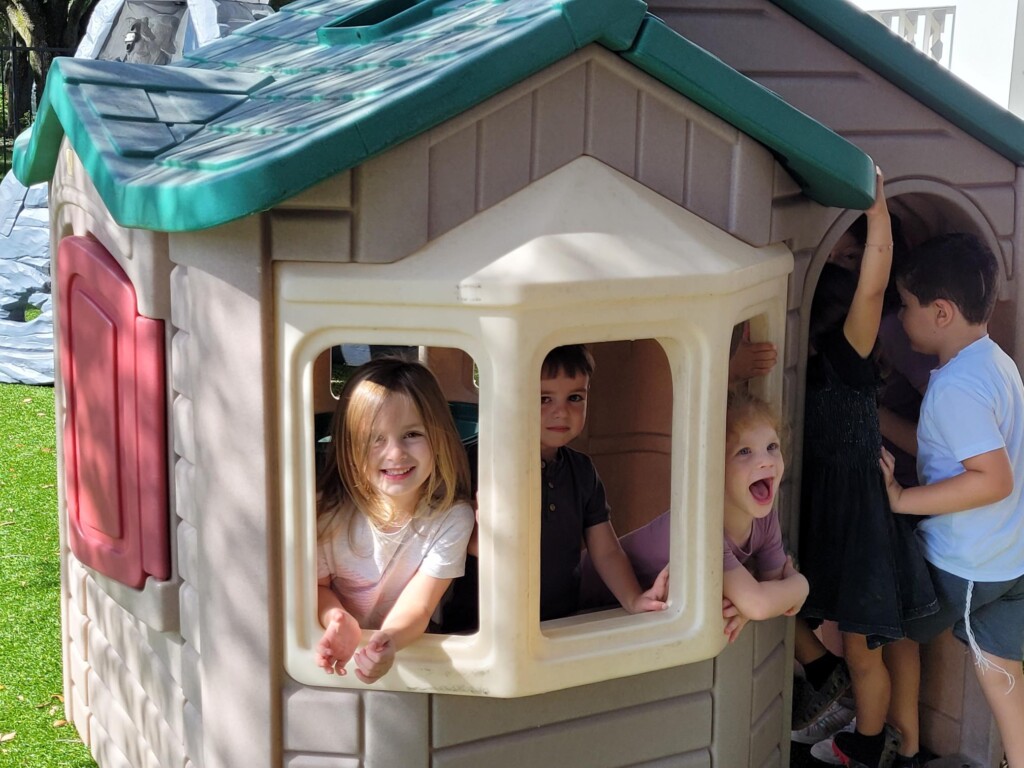
Students enjoy recess at Tampa Torah Academy.
TAMPA, Fla. — With 16 dormer windows that peek out from all sides of the roof and a wrap-around porch, the building looks more like a place to relax than study. Shaded by a canopy of oaks, the only noise comes from chirping birds and water spraying from a fountain in a nearby pond.
“It’s very quiet out here,” said Rabbi Ariel Wohlfarth, one of two deans at Tampa Torah Academy, which opened two years ago in a building that once housed a day care center and community clubhouse for a leafy suburb of Tampa.
But through the front door was a buzz of activity. During a recent visit, kindergarten students seated at two tables worked on crayon  drawings of their families. In another, a teacher prompted third graders to examine the text of “Charlotte’s Web” for clues about the characters. In a third room, older boys listen to a rabbi explain the importance of Israeli kings’ reigns as historical markers. Nearby, older girls learn the origin story of the prophet Samuel.
The school, whose mission is to offer an authentically Orthodox Jewish education, is one of only four Jewish day schools in the Tampa Bay area. Jewish day schools are booming in South Florida, and the greater Tampa Bay area is also seeing a resurgence after years of decline.
A report released this year by Teach Coalition and Step Up For Students showed that the number of Jewish schools in Florida nearly doubled over the past 15 years, boosted by parents using state school choice scholarships and the migration of families from New York.
The report attributes much of the enrollment decline in the Tampa Bay region to the 2010 closing of Pinellas County’s only Jewish day school. A casualty of the Great Recession, Pinellas County Jewish Day School could not secure enough operational funding from donors affected by stock market woes. At the same time, many families hit by the recession could no longer afford tuition, so enrollment dropped from more than 200 to 140.
The closing left the state’s second-largest Jewish population with few options: Hillel Academy in Tampa, which offers a track for Orthodox students but is also open to non-Jewish students, and Hebrew Academy of Tampa, a Montessori school for students in preschool through eighth grade. A charter Hebrew language school offered a Judaic after-school program but closed in 2013 after one year.
Eventually, the dearth of choices prompted parents seeking an Orthodox education for their children to contact Yeshivas Chofetz Chaim, also known as the Rabbinical Seminary of America. Based in Queens, New York, the organization starts Orthodox Jewish day schools across the United States. The organization had established successful schools in Orlando and Boca Raton.
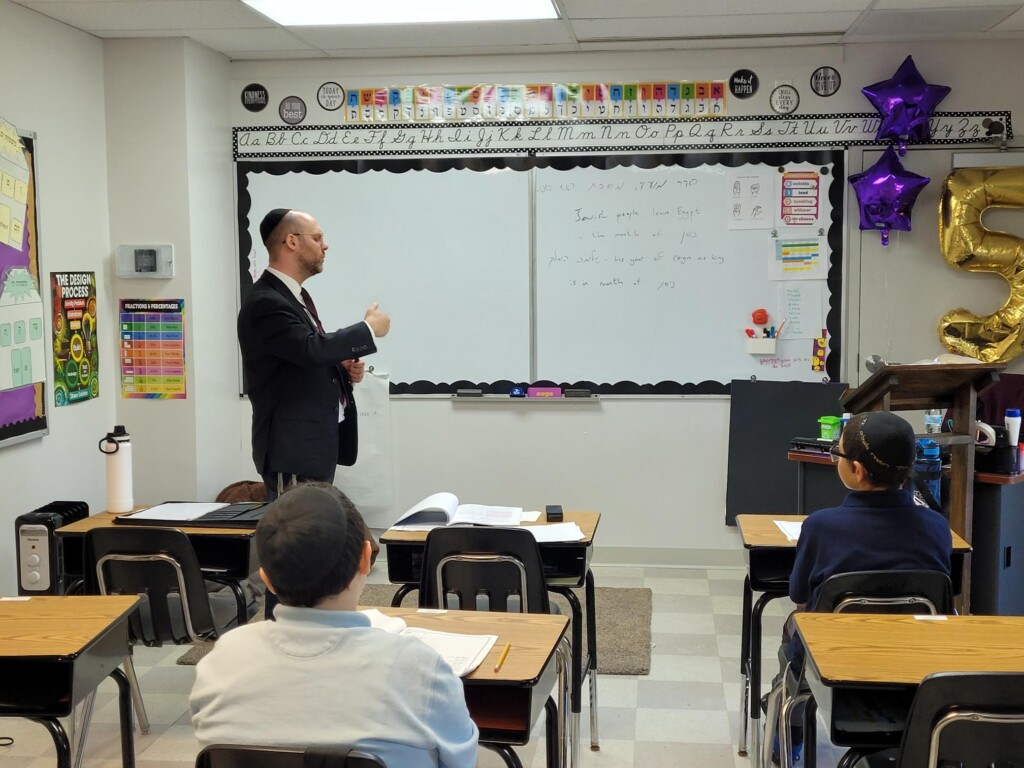
A boys' Torah class learns about Jewish history.
“In most communities, there’s usually a Jewish day school that creates an environment that is completely Jewish,” said Rabbi Jeremy Rubenstein, who along with Wohlfarth is co-dean of Tampa Torah Academy. “And parents were looking for that, and it didn't exist in Tampa.”
So, in 2022, Rubenstein, his wife, their kids, and eight other families moved to the Tampa Bay area to start an Orthodox school. A property search revealed the 10,000-square-foot building in a Tampa suburb that a day care center had recently vacated. After extensive renovations, they opened the school to 33 students in preschool through seventh grade. The wives of those who moved to Florida comprised most of the school staff. Two years later, school leaders added an eighth grade.
Tampa Torah Academy now has 80 students from more than 30 families. Some live within 15 to 20 minutes of the school, but most live closer to Tampa’s core. Some even come from Clearwater, a 36-mile trip that can expand to a two-hour drive during rush hour. Others drive up from Sun City Center in the southernmost part of the county, which is 40 miles from the school.
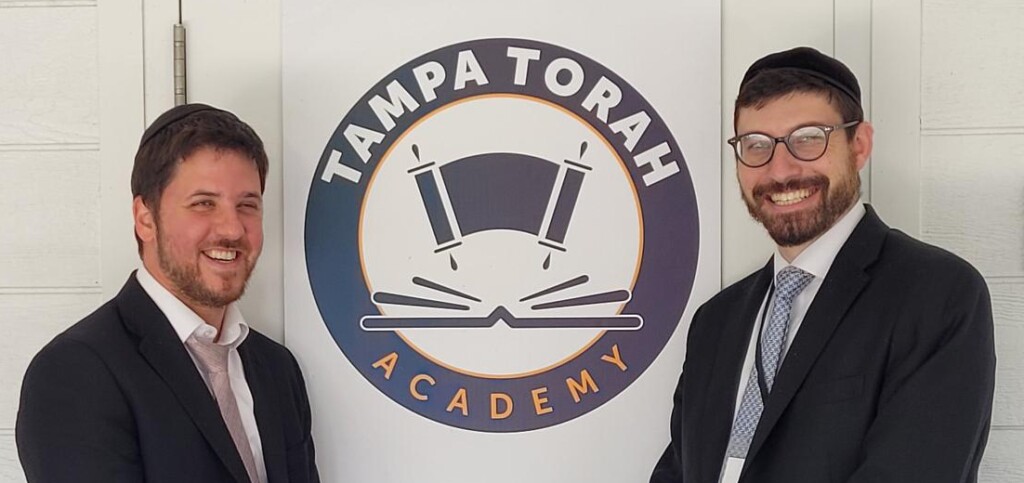
Rabbi Jeremy Rubenstein, left, and Rabbi Ariel Wohlfarth are the deans of Tampa Torah Academy.
Leaders contracted with a busing service this year to provide transportation.
“We have students coming from all different, all sorts of places,” Rubenstein said.
This year, leaders expanded again, with high school programs for boys and girls. The boys are meeting at a Tampa Kollel and the girls at Tampa Torah Academy. Like the other Jewish schools, Tampa Torah Academy accepts Florida’s school choice scholarships.
“Switching our kids from public schools to TTA was one of the best decisions we made,” parent Danny Betesh said in a school video. “We love the fact that our kids came to TTA because of how warm it is, how they know everyone. They know the staff; they know the kids from all the grades…they feel like a family.”
Local Jewish leader Jeffrey Berger welcomes the expansion of education opportunities for Jewish families and says the uptick in school growth is expected as Jewish families move in from other states.
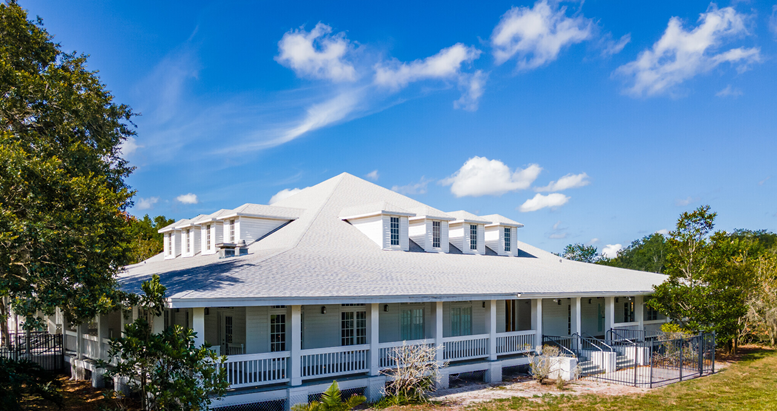
Tampa Torah Academy
Before Tampa Torah Academy opened, “we had a gap in certain segments of the community,” said Berger, a retired real estate attorney and president of the Tampa Jewish Community Centers & Federation. “There was a need for their brand of Orthodox Judaic religious institution.”
He said Hillel Academy, which opened in 1970, plans to open a high school next year. Tamim Academy of Pinellas, which opened this year at the Chabad of Pinellas, also fills a void that existed for too long in that area.
Berger said he was excited to see 100 people turn out at a recent open house for Tampa Torah Academy. He believes families will continue to be drawn to the area for its warm climate and lower cost of living than its northern neighbors.
“The availability of scholarship money has certainly made all private schools more affordable, and I think Jewish day schools are a part of that,” he said. “Affordability is a big issue for a lot of people across the board, including those who want their children to have a Jewish education.”
 Editor’s note: You can watch a livestream of the celebration here.
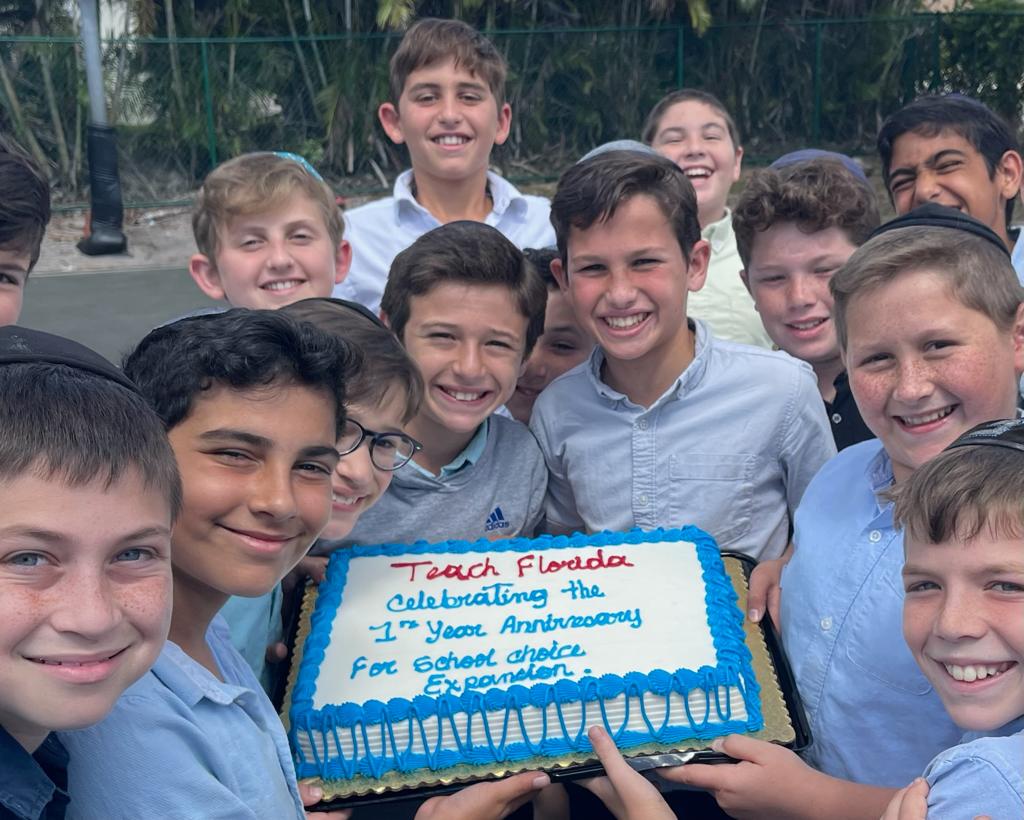
Like most birthday parties for 1-year-olds, this one had cake. It featured remarks from guests who were impressed with the past 12 months of growth. It included predictions about continued growth.
What was unusual about this birthday party was that its purpose was to mark the first anniversary of a piece of landmark legislation – Florida House Bill 7045, the nation’s largest expansion of education choice.
“Amazing things are happening, and we’re here to celebrate those amazing things,” said Daniel Aqua, the executive director of Teach Florida, a division of Teach Coalition, a national Jewish organization that promotes secure, strong, and affordable nonpublic schools.
The organization sponsored the event, held at Yeshiva Elementary School in Miami, to thank lawmakers and others who supported the bill and to encourage support for expansion.
Speakers included state Rep. Randy Fine, R-Palm Bay; state Rep. James Bush III, D-Opa Locka; Jim Rigg, superintendent of schools for the Archdiocese of Miami; Dr. Martin Karp, a former vice chairman of the Miami-Dade School Board; and John F. Kirtley, chairman of Step Up For Students, the nation’s largest scholarship funding organization and the host of this blog.
Fine, who sponsored HB 7045, retold a story he has shared on the House floor about his reasons for championing education choice.
“This is the story of two 13-year-old Jewish boys,” he said. The first boy “was the only Jewish boy who went to his government-run school. People would tease him and pick on him. They would beat him up.”
Fine said the bullying escalated to the point that it was no longer safe for the boy to eat lunch in the cafeteria or use the student restrooms. The boy begged his parents to “get me out of this school.” His parents were great parents, Fine said, but “they didn’t have a lot of money.” The boy “had to tough it out” but later graduated and enjoyed a successful career.
Fine said the second boy told his parents that a student had made an anti-Semitic comment, but the school didn’t do much to help. The boy’s parents had money and were able to transfer him to a school where he thrived.
“The first boy was me,” Fine said. “The second boy was my son.”
He added: “That’s not the world we should live in. We should not live in a world where you have to be rich to have options.”
Fine used the story to illustrate his belief that education choice programs should be further expanded to be accessible to all families.
“Every family needs to have the same options,” he said.
Bush, who was one of five House Democrats who supported the Republican majority in voting for HB 7045, thanked all those who supported it.
“I believe we must empower our parents so that they will have the opportunity in the future to determine what is best for their child and their student, and I believe that one size does not fit all,” he said, pointing out that the legislation gave 3,900 students in his district the opportunity attend a school that can address their specific needs.
Rigg, who moved to south Florida from Chicago after the bill had been approved, said it is gratifying to be part of a state that affirms parents’ right to make decisions for their children.
“I’m thrilled to see what happened when our wonderful choice programs were expanded even further,” he said, referring to House Bill 3, which granted automatic eligibility to dependents of law enforcement officers and was approved during the 2022 session.
Kirtley, who helped found the education choice movement in Florida two decades ago, said choice has improved Florida’s overall performance over the past 20 years, even though it drew strong opposition in the beginning.
He recalled how the state’s redefinition of public education prompted a 2014 court challenge. A massive rally two years later clearly showed how popular choice had become for families when more than 10,000 supporters arrived at the state Capitol in Tallahassee to defend their rights.
Kirtley pointed to the crowd's diversity, which represented a variety of races, faiths, and philosophies.
“Your Orthodox community responded. You joined 10,000 people to march and protest this lawsuit, he said. “You are on the edge of a revolution. You are revolutionaries.”
The lawsuit failed in two lower courts and was rejected by the Florida Supreme Court in 2017. Despite the win, Kirtley encouraged audience members to continue to advocate for their right to make the best educational choices for their children.
“We won, but we’ve got to be vigilant,” he said. “We can’t relax.”
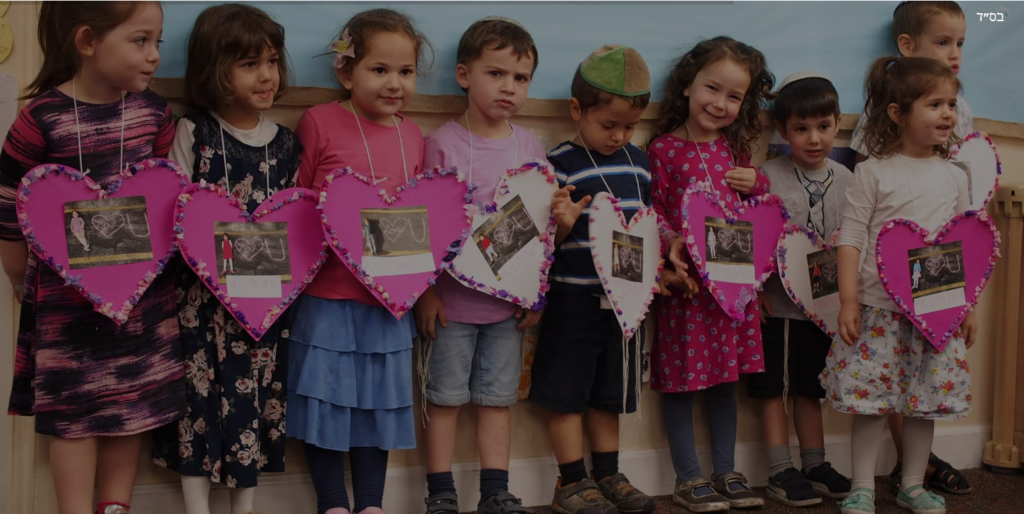
Hebrew Academy Community School began the 2020-21 school at near maximum capacity thanks to an influx of 60 new families, many from out of state.
At Hebrew Academy Community School in the North Broward County city of Margate, students in early childhood classes are learning about germs by spreading glitter glue on their hands and washing it away. In the upper grades, socially distanced students wearing masks are watching out for each other’s health. Meanwhile, school staff members are welcoming new families with care packages of challah bread and wine for the Sabbath.
A recent post on the academy’s Facebook page to launch the 2020-21 year is evidence of a new excitement at the Early Childhood-Grade 8 Jewish school founded in 1987: “From Los Angeles to Crown Heights and beyond, we are thrilled to have so many fresh faces to greet each day!”
Hebrew Academy has good reason to be thrilled. Originally serving four early childhood youngsters in the living room of a young Jewish couple, the school now boasts a 32,500-square-foot main building and a 5,000-square-foot state-of-the-art gymnasium. More than 375 children are enrolled this year, each one benefiting from school leaders’ belief that all Jewish children should have access to Torah learning.
“We’re pretty much at maximum capacity,” said development director Rabbi Shloime Denburg, who enrolled 60 new students this year. “We’re seeing a lot of families from New York and New Jersey. For the first time, we’re also getting calls from California.”
This influx of interest from Jewish families outside of Florida isn’t limited to Hebrew Academy Community School. Even as enrollment plummets at other private schools across the state, Jewish schools are experiencing massive growth, according to Mimi Jankovits, executive director for Teach Florida, part of the national Teach Coalition advocacy organization for Jewish schools.
Jankovits cites a variety of reasons for the expansion: a lower cost of living, less crowding, a better climate. Not to mention the wide variety of Jewish schools available and the fact many participate in the state’s K-12 scholarship program.
“Whatever your philosophy is, there’s probably a school for you here,” Jankovits said, adding that even if some families don’t need the financial assistance state scholarships offer, it’s reassuring to families to know Florida is friendly to school choice.
“We are excited Florida can offer people moving here these opportunities to get scholarships if they need them,” she said.
Brauser Maimonides Academy in Fort Lauderdale started the school year with about 70 new students.
“That’s the most we’ve ever brought in,” said Eli Hagler, executive director of the Modern Orthodox school. In just five years, Hagler said, school enrollment has increased from 350 to 550 students.
A lot of those families have migrated to South Florida from outside the state.
“I’ve spoken to a lot of people from New York and New Jersey. Companies are going virtual and staying virtual, and so people are looking to get out,” he said.
Like Jankovits, Hagler pointed to lower living costs and scholarship opportunities as magnets drawing Jewish families to Florida. He also praised new legislation that allows more families to qualify and no longer requires them to reapply each year for the Florida Tax Credit Scholarship, a program administered by Step Up For Students, which hosts this blog.
“We don’t view private Jewish day school as a choice,” Hagler said. “It’s a necessity.”
Annual tuition at Brauser Maimonides ranges from $9,475 for 2-year-old nursery students to $18,780 for middle school students. That’s significantly lower than tuition at a Jewish day school in New York, which can cost $30,000 per year.
Student enrollment also is up at Hebrew Academy in Miami, a surprise for school leaders who had expected to see enrollment drop due to COVID-19. But more than 70 new families replaced those who decided not to re-enroll.
“All of a sudden we had these New York families,” said dean of admission Ami Eskanos. “They started referring their friends. One of our alums transplanted back down here, and she started showing homes to all of these New Yorkers coming down, and they started referring people. They just kept referring one another.”
Although most Jewish families are relocating to South Florida, other parts of the state also are experiencing an influx of new residents from the Northeast eager to find seats for their children in Jewish schools.
“We started 10 years ago with 12 kids and are almost at 110 this year,” said Rabbi Avraham Wachsman, dean at Orlando Torah Academy, a Jewish preschool and day school serving Orlando and Greater Central Florida.
Wachsman recently has received inquiries from families in New York, New Jersey and Pennsylvania.
“You hear so much about shrinking schools, but we have the opposite,” he said.
Quality of life and lower tuition are among the main factors that are driving relocation, Wachsman said. Along with one additional benefit.
“I’m from Milwaukee,” he said. “I’ve done my 30 years’ time in the snow.”

