Vice President Harris received more votes from every generation of Americans except Gen X, but as it happens the loss of Gen X proved decisive. Gen X, Americans born between 1965 and 1980 (which includes your humble author) are of an age to have been the parents of school aged children during the COVID-19 fiasco/goat-rodeo.
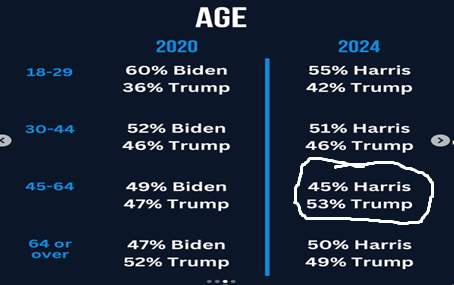
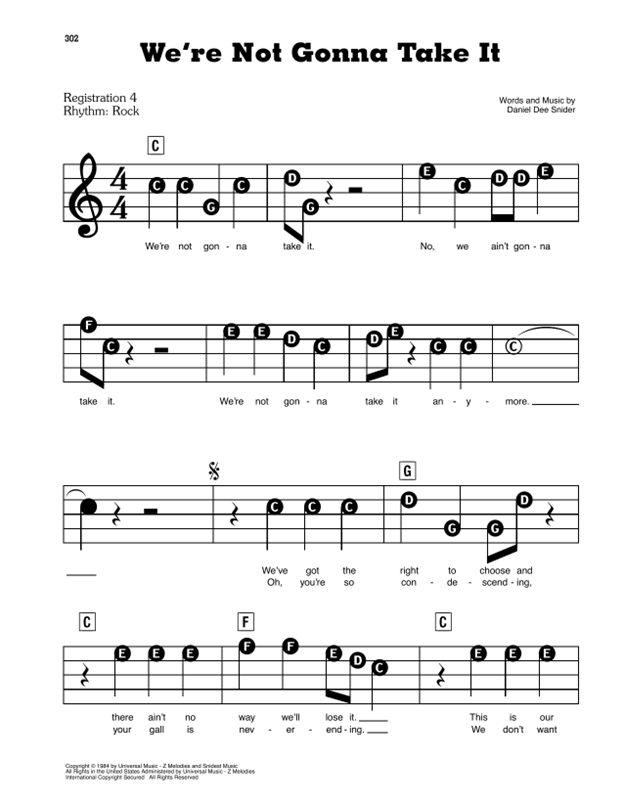
Uniquely among generations, President-elect Trump carried both men and women of Gen X. Right about now readers of a certain Gen Xish age may be humming a certain Gen X anthem. Something about having the right to choose and an unwillingness to surrender it. Feel free to belt it out in your head:
This did not exclusively play out at the national level. Over the past 10 years, for example, donors have sent an unimaginable amount of political funding into Arizona. Much of the resulting rhetoric and activity fixated upon bellyaching about school choice. As the smoke clears on the 2024 election, we find that Arizona’s 11 electoral college votes were never decisive in either the 2016, 2020 or 2024 presidential elections. Meanwhile the three “blue wall states” of Michigan, Pennsylvania and Wisconsin moved in unison to determine the winner for the third election in a row. Opportunity cost is a harsh mistress.

In addition to serving as a costly sideshow in the presidential race for the third time, Arizona’s Republican Party will add to their majorities in both the Arizona House and the Arizona Senate. The battleground legislative races included a number of very tight outcomes. The parents of private choice program children outnumber the membership of the Arizona Education Association by six or more to one.
That ratio will only continue to grow. Having fallen on the losing side of the crucial 2024 legislative races, the president of the Arizona Education Association described her own organization as “union thugs.”
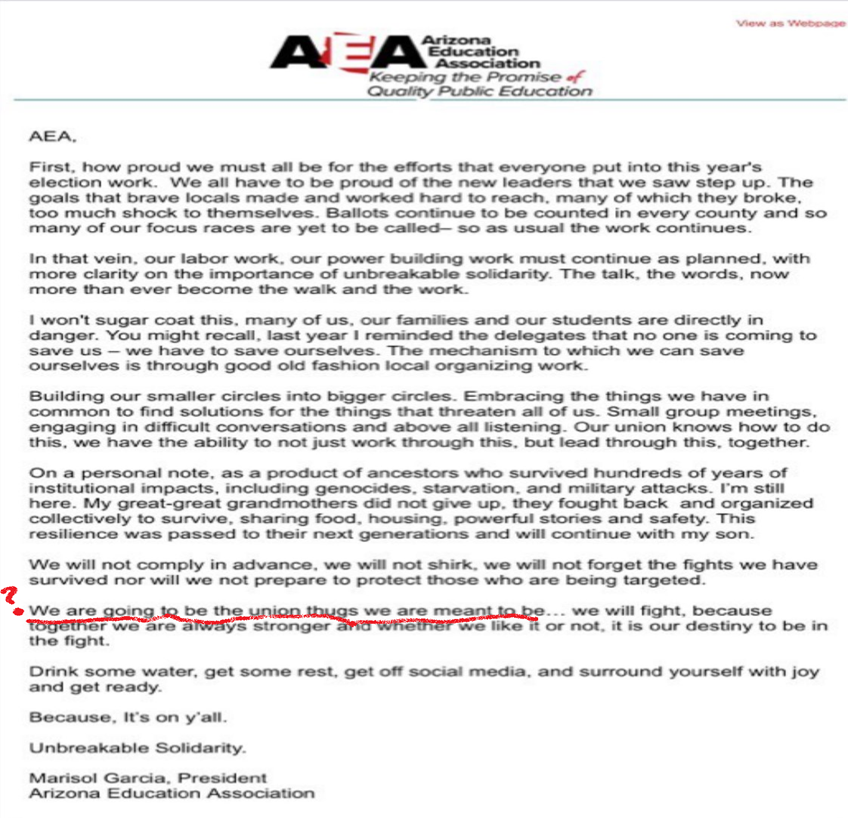
Hmmm…both parties might want to think about competing for the votes of families with school-age children. Those who find themselves aligned with “thugs” might want to consider losing the zeroes and getting with the heroes. If not, the beatings might just continue until morale improves. In the meantime, color this Gen Xer happy that parent power is REAL, and it is SPECTACULAR!
 The story: The nation’s education choice movement suffered its second legal defeat in as many days after the Nebraska Supreme Court on Friday put the fate of a new school choice program in the hands of voters on Nov. 5.
What it means for families: The ruling and the legal tactics on both sides that led to it, throw the fate of 2,500 low-income families participating in a scholarship program that lawmakers approved to start in 2023 into uncertainty until after the November election.
Zoom in: In its ruling, the court rejected supporters’ arguments that the bill, LB 1402, which lawmakers passed as a strategic move to replace a previously approved program and keep it off the ballot, was a state appropriation and therefore exempt from a referendum. The bill was concurrently approved with LB1402A, a separate but related appropriations bill that set aside $10 million to pay for the program. However, education choice opponents purposely omitted the appropriations bill when crafting the language for the referendum. Without LB1402A, the court said, the bill was not an appropriation nor exempt from referendum.
"L.B. 1402 makes no appropriation at all, the Secretary of State has no duty to withhold the referendum based on an alleged violation of article III, § 3." the supreme court opinion said.
Catch up quick: Nebraska lawmakers approved the state’s first school choice program in 2023. It was funded by tax credits and available only to low-income families. Choice opponents fought back by gathering enough signatures to put it on the ballot for repeal. (Nebraska law allows this for bills that do not involve appropriation.) State Sen. Lou Ann Linehan, a longtime education choice champion, then moved to block the referendum by sponsoring a bill for a second program that would repeal and replace the tax credit program. Opponents gathered enough signatures to let voters decide whether to repeal that bill. A scholarship parent then filed a lawsuit asking the state Supreme Court to keep the second bill off the ballot, arguing that it was exempt because it was intertwined with a state appropriation on a second bill. Opponents left the spending bill off the petition. The high court said because the spending bill wasn’t included, the measure wasn’t exempt from a referendum.
What they’re saying: “This ruling puts Nebraska school choice in jeopardy, which is unfortunate: Nebraska families need more power, and the state more freedom, Neal McCluskey, director of Cato Institute’s Center for Educational Freedom, posted on X.
South Carolina students show their support for education choice to Gov. Henry McMaster on the Capitol steps during National School Choice Week.
A rough week for ed choice: The Nebraska high court ruling comes two days after the South Carolina Supreme Court tossed out the state’s fledgling education savings account program as unconstitutional. The court’s majority said an education savings account program violates the state constitutional ban on direct aid to private schools even though funds go to families who make individual choices. The decision leaves nearly 3,000 families scrambling to find options as the state’s education department halted tuition payments to private schools.
For David Warner, choosing a school for his son was a “very personal” decision, he said. The ability to select the place where he could learn near their home in Myrtle Beach, South Carolina, made him and his family feel valued, a stark contrast, David said, to his experience with assigned public schools.
But [yesterday], a state supreme court ruling in a lawsuit supported by teachers unions will cancel the scholarships for some 3,000 children from low and moderate-income families. “It feels like the light has gone out,” David told me, “and we fear being left in the dark again.”
In 2023, South Carolina lawmakers enacted the Education Scholarship Trust Fund Program, which offered children from homes with incomes at 200 percent or less of the federal poverty line (approximately $60,000 for a family of four) the opportunity to use an education savings account. Participating families were awarded accounts worth $6,000 for use on education products and services such as personal tutoring, textbooks, private school tuition, and more. Some 19 states around the U.S. had similar account-style options for families.
Now the number is 18. The state chapter of the National Education Association (NEA), a teacher union, filed a lawsuit against the accounts last October. The South Carolina Supreme Court has ruled the program unconstitutional, saying the accounts are a “direct” benefit to private schools and violate the state constitution, even though the state awards the accounts to parents, not schools.
The ruling is devastating for families like the Warners because their child’s account may end immediately. “In just a few weeks of being in this program, we saw a completely different approach to education. We had more communication from teachers and staff, greater family interaction, and they valued our input in ways the public school never did,” David said.
He explains that the private school aligned with his family’s values and was transparent about what was being taught in the classroom. “The curriculum and teaching were totally transparent, allowing us to know exactly what our children were learning,” he said.
He fears having a “tough conversation” with his son about returning to the assigned school where he struggled to fit in. “He just made new friends, and now he may have to leave them, all because of this decision,” David said. “This ruling implies that low-income families are irresponsible and that the educational elite know better than parents, but that’s not true for us,” he says.
The Warners’ other son has special needs, and David adjusted his work commitments to care for this child. “Just because a family is low-income doesn’t mean they can’t make the best, most responsible choices for their children’s education,” David said.
Thousands of stories like this one should reach state lawmakers this fall as they prepare for the next legislative session. Policymakers can still help South Carolina families by considering other education choice innovations such as the new Parental Choice Tax Credit in Oklahoma. With this state tax credit, parents can receive tax credits worth up to $7,500 for private school tuition expenses and other education products and services. Every K-12 student in Oklahoma is eligible to apply.
Lawmakers nationwide continue to adopt new learning options for students, even in states with existing private school scholarship offerings such as vouchers. Lawmakers in Wyoming and Louisiana approved education savings accounts this year, and Louisiana added these accounts in addition to the state’s existing voucher program. Oklahoma families can “stack” their tax credits on top of the existing voucher options in that state. South Carolina lawmakers should consider solutions such as these as they look for ways to help families.
“We hope that, in the end, families in South Carolina will prevail so we can continue making the best decisions for our children,” David says. Unions shut the lights off for children in the state for now, but lawmakers have plenty of alternatives at their disposal to give families and students a bright future.

Recently, because this is the sort of thing your friendly neighborhood school choice mad scientist likes to do, I examined the Arizona Superintendent of Public Instruction annual reports. Stick with me; this will be more interesting than you might suspect. So, if you go back to the 1994-95 report (the last year before any charter schools or district open enrollment) and go to page 273 you find that the Arizona school system spent almost $1.3 billion on teacher salaries, on a total spend of $3.5 billion. In other words, 37% of Arizona’s K-12 investment went to teacher salaries.
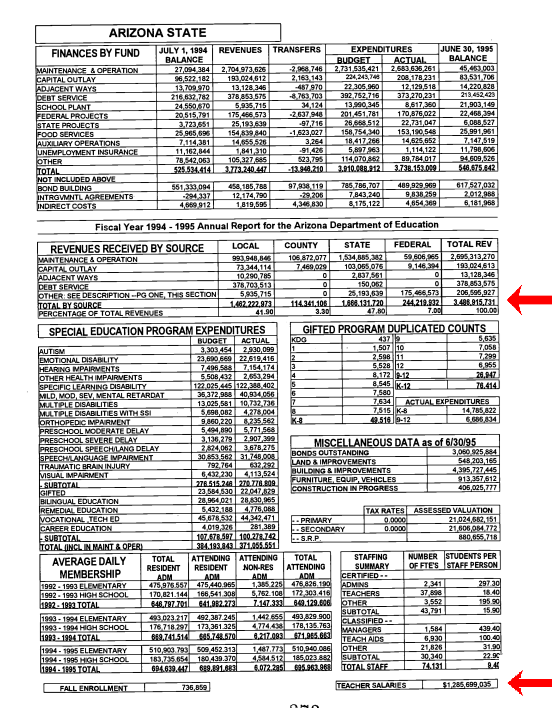
The latest edition of this same report keeps districts and charter schools separate for these calculations. In 2022-23 (see page I-253) Arizona’s total spend on school districts had increased to $13.2 billion, and the line item for district teacher salaries stood at $3.2 billion. Teacher salaries had dropped from 37% of the total spend to 25%. Dividing the total district teacher salary by the number of teachers and then adjusting for inflation revealed that the average teacher salary remained essentially flat in real terms over the 30 years.
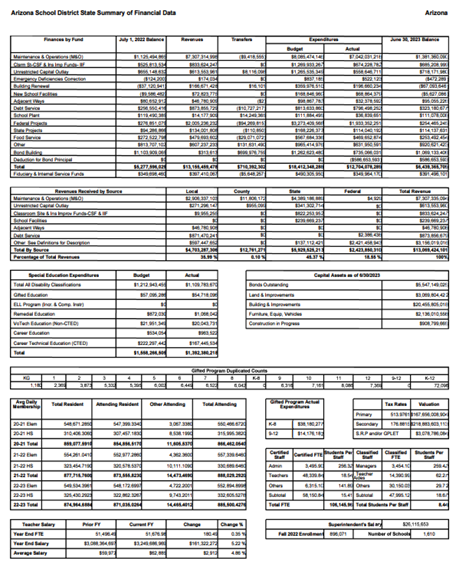
That might seem odd at first. Arizona more than doubled the investment in school districts after accounting for inflation but somehow managed to prioritize every other type of spending except teacher salaries. How does this fit with the notion that school districts have been politically captured by teachers unions?
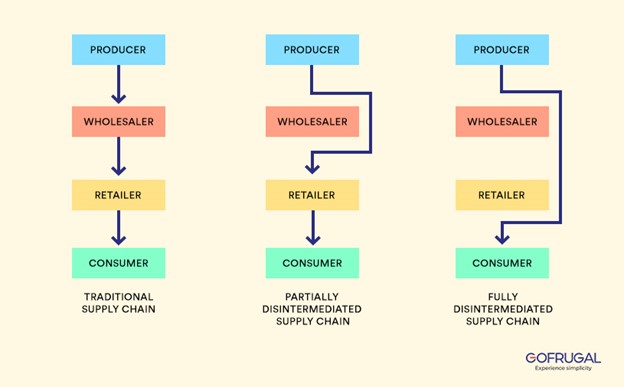
This puzzle is not overly difficult to solve. “Teachers unions” are actually “district employee unions,” and district employee unions can maximize their dues revenue by maximizing the employment of non-teachers. If for example you can hire two non-teachers for the same cost as hiring a single teacher, you can potentially double your dues revenue. The same reports cited above show that Arizona’s district system somehow soldiered on with one non-teacher employee per 19 students in 1994-95, but that had dropped to one per 15 students in 2022-23.
If in fact Arizona’s school districts spent 37% of their revenue on teacher salaries in 2022-23, it would have pushed the average annual teacher salary over $100,000. This could have been achieved without changing student-teacher ratios and would have left 63% of revenue to spend on everything else.
Other factors are at play as well; districts constructing buildings to the 21st century nowhere, etc. Chubb and Moe instructed us back in 1990 that the central problem in K-12 education is politics, a lesson that we seem prone to forget. The K-12 system isn’t just broken. Rather it is broken on purpose, and teachers have been hugely shortchanged in the process. Fortunately, the development of a solution is underway, and choice is key:
As our country was being formed, states such as Connecticut, Georgia, Maryland, Massachusetts, New Hampshire, South Carolina, and Virginia adopted state religions that citizens were taxed to fund and expected to follow. In response to this infringement on personal freedom, the U.S. Constitution was amended to include language, called the Establishment and Free Exercise Clauses, forbidding the establishment of a government religion and guaranteeing individuals the freedom to practice or not practice religion. These clauses read: "Congress shall make no law respecting an establishment of religion, or prohibiting the free exercise thereof.”
Opponents of education choice programs that allow students to voluntarily use publicly funded education choice scholarships to pay for tuition at religious schools assert that these choice programs are unconstitutional primarily because they violate the Establishment Clause. In essence, legally equating families who freely choose to send their child to a religious school using a publicly funded scholarship with a government coercing people to support a state religion. The courts have made clear this argument has no merit and is dead on arrival. But opponents keep trying.
Teachers unions are the most aggressive opponents of education choice programs. The National Education Association (NEA), the nation’s largest teachers union, says, “Voucher programs drain resources from public schools and funnel those resources to private and religious schools, violating the Establishment Clause.” The second largest union, the American Federation of Teachers (AFT), agrees.
Other prominent opponents concur with the teachers unions’ reasoning. People for the American Way believes that "By using taxpayer money to fund private religious education, voucher programs violate the Establishment Clause.” The Freedom From Religion Foundation (FRF) writes that, "School voucher schemes unconstitutionally entangle government with religion by directing public funds to parochial schools, thereby violating the Establishment Clause."
Americans United for the Separation of Church and State (Americans United) asserts that education choice programs violate both the Establishment and Free Exercise Clauses. "School vouchers funnel taxpayer money to private religious schools…This violates the Establishment Clause and the religious freedom of taxpayers."
The Southern Poverty Law Center (SPLC) makes a similar argument. "School voucher programs that funnel taxpayer dollars to private, religious schools violate the Establishment Clause of the First Amendment by compelling taxpayers to support religious instruction and activities. Such programs erode the separation of church and state, a foundational principle of our democracy."
Suggesting that the Establishment and Free Exercise Clauses give individual taxpayers the right to circumvent elected representatives and decide for themselves how government spends their taxes is a rejection of democratic governance. Expecting a fire department to check with its local taxpayers to determine whose taxes may be used to fund putting out fires at churches is impractical.
The American Civil Liberties Union (ACLU) invents a “constitutional principle” when it claims, "Voucher programs, which divert taxpayer dollars to private, often religious schools, undermine the fundamental constitutional principle of separation of church and state.”
The phrase “separation of church and state” is not a constitutional principle. It does not appear in the U.S. Constitution. Thomas Jefferson used this phrase in an 1802 letter to the Danbury Baptist Association in Connecticut to reinforce the intent of the Establishment and Free Exercise Clauses, which is that government should not interfere with citizens’ right to practice or not practice religion unless this practice violates public laws. The state will not allow a religion to construct a building without a government permit or abuse children. The U.S. Constitution requires the relationship between religion and government to be appropriate but not nonexistent.
Beginning with the Zelman v. Simmons-Harris ruling in 2002 and continuing with the 2020 Espinoza v. Montana Department Revenue case and the Carson v. Makin decision in 2022, the U.S. Supreme Court has consistently ruled over the past two and a half decades that programs providing public funds to help families pay for educational services offered by religious organizations are constitutional, provided families make these choices freely. These court rulings suggest an Establishment Clause violation occurs only when a family’s decision to use public funds to pay a religious organization for educational services is influenced by government coercion.
Despite the weakness of their legal arguments, the ACLU, AFT, Americans United, FRF, NEA, and SPLC have supported lawsuits in Arizona, Florida, Indiana, Maine, Montana, Nevada, New Hampshire, North Carolina, Ohio, West Virgina, and Wisconsin challenging the constitutionality of K-12 programs that allowed families to purchase education services from religious organizations using public funds. But these groups have never legally challenged the constitutionality of prekindergarten and higher education students using public funds to attend religious schools.
Why do they support legally forbidding a high school senior from using public funds to pay tuition at a Catholic high school but look the other way two months later when this same student uses public funds to pay for tuition at the University of Notre Dame? The answer is tribal politics.
Humans are tribal. We are all members of multiple tribes, including tribes organized around political beliefs. To remain a tribal member, we must conform to that tribe’s beliefs, no matter how irrational they may appear to those outside the tribe.
Most of the AFT’s and NEA’s dues-paying union members work in K-12 school districts. Consequently, the AFT and NEA are highly motivated to protect the jobs and compensation of these members by opposing students using public funds to attend private schools that employ non-union teachers. Since most private schools are faith-based, these unions use the Establishment Clause violation argument as a legal and political weapon despite its ineffectiveness.
The NEA and AFT have far fewer members working in prekindergarten and higher education institutions. Consequently, they are less willing to spend money and political capital opposing students using public funds to attend religious schools in these two sectors.
Education choice opponents such as the ACLU, Americans United, SPLC, and most Democratic Party elected officials, are in the same political tribe as the NEA and AFT, and these two unions provide much of the money and grassroots activists that give this political tribe its power and influence. Therefore, these groups conform with the AFT's and NEA’s legal reasoning for opposing publicly funded education choice programs and will continue to do so until the unions change their positions.
At a mid-1980s NEA convention, the delegates overwhelmingly rejected a resolution supporting magnet schools. As the floor manager for this resolution, I remember this defeat well. Opponents claimed magnet schools undermine neighborhood public schools and correctly argued that magnet schools are a manifestation of Milton Friedman’s initial school voucher proposal. A few years later, after thousands of NEA members began working in magnet schools, the union reversed its position and embraced magnet schools.
Today the NEA and AFT’s tribal partners all support magnet schools despite their school voucher lineage suggesting tribal loyalty is stronger than ideological consistency, and tribes will rationalize changing core positions to enhance their economic and political strength.
In Florida, teachers unions are slowly bleeding to death as thousands of unionized teachers leave to teach in a rapidly expanding array of new, non-unionized education settings such as homeschool co-ops, hybrid schools, and microschools. To survive, Florida teachers unions need to begin serving these teachers, including those working for religious organizations.
For more than 40 years, I have argued that teachers need to replace their old-school industrial unionism with a model that can serve teachers in diverse and decentralized settings. If they do not evolve, they will not survive. Nor will some of their tribal colleagues.

Steve Malanga writing in City Journal recently made a rather chilling and well-documented case that a growing number of American men are not simply unemployed but are also unemployable. Malanga writes:
But the workforce woes run deeper. Ever more adults are unemployable because of worsening social dysfunction, changing youth attitudes toward work, and university and public school failures to prepare students for labor-market realities. Drug legalization has made it harder to find laborers who can pass drug tests—essential to work in industries like construction and transport—leading to worker shortages for key jobs, including truck drivers. A crime spike, meantime, will likely create a new generation of convicts, among the toughest people to employ when they reenter society. Soaring mental-health problems add to the ranks of the unemployable. And many firms hesitate to hire new college grads because they often lack basic skills, starting with knowing how to communicate and function within a group, and often have unrealistic expectations about pay and benefits.
The male academic disaster has been evident in outcome data for years. To be sure, our society has problems in addition to this disaster, but the deep failure of our education system to equip boys with the habits and knowledge necessary for success exacerbates all of them. POSIWID applies here: Stafford Beer, a British academic, coined the term that the “purpose of a system is what it does,” known as POSIWID for short. Beer explained that the stated purpose of a system is sometimes at odds with the intentions of those who design, operate, and promote it. “There is after all no point in claiming that the purpose of a system is to do what it constantly fails to do.”
The American education system constantly fails to educate boys.
For example, below shows the average academic growth rate by state for female students in grades 3-8 between 2008-09 to 2018-19 from the Stanford Educational Opportunity Project. The horizontal center line denotes learning a grade level worth of math and reading in a year, dots are states, green dots are good, blue dots are bad.
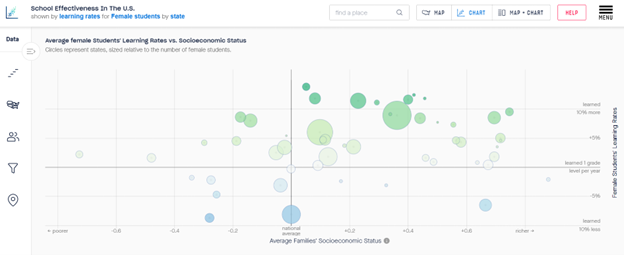
And here is the same data for male students, who obviously learned a great deal less:

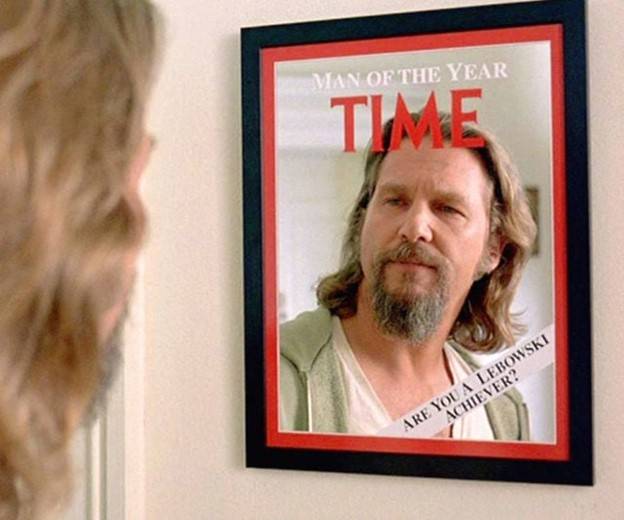
The regulatory capture of American school districts by unionized employee interests began in the 1960s and had more or less been completed by the 1980s. To be sure, some other interests, such as school construction firms, came along for the rent-seeking ride. Perhaps this was all fun and games until someone got hurt, and the now long list of the injured includes a rather large subgroup of students called “boys.”
The Big Lebowski should remain a comedy rather than a prescient documentary.
The headline: Utah’s largest teachers union filed a lawsuit against the nation’s second most expansive program that allows parents to direct their children’s public education funding.
Driving the news: The Utah Education Association challenged the law just weeks before 10,000 students were expected to start using their Utah Fits All scholarship funding, and more than a year after the legislature approved the program. The $82.5 million education savings account program grants eligible students up to $8,000 each that can be spent on private school tuition and approved educational goods and services. Though eligibility is universal, low-income families receive priority. The state also has two other school choice scholarship programs for students with special needs.
The complaint: Union officials, joined by a teacher, parent and a state school board member, allege that the program drains money from district schools and would deprive students with special needs of services guaranteed only in public schools. It asks a judge to declare the program unconstitutional and stop it permanently.
Education choice opponents have used these arguments in lawsuits filed in other states. What didn’t get discussed at the union’s news conference on Wednesday was Utah’s Blaine amendment. These bans on public funds flowing to religious institutions in state constitutions have continued to be among opponents’ legal tools of choice even after two landmark U.S. Supreme Court rulings in the past four years struck them down. Utah’s constitution says:
Neither the state of Utah nor its political subdivisions may make any appropriation for the direct support of any school or educational institution controlled by any religious organization.
Yes, but: Though lawsuit sidestepped the Blaine amendment, it cited another part of Utah’s constitution specifying that the legislature shall provide a public education system that is free and open to all students and “free from sectarian control.”
What opponents are saying: The union blasted the state for giving ESA students more than double the amount it spends on public school students.
"This discrepancy is not just unfair, it is a deliberate undermining of public education,” Utah Education Association President Renée Pinkney said.
However, the reality of how Utah students are funded is more complex. While the state provides direct aid of about $4,000 per student to public schools, it shares costs with local districts through property taxes and motor vehicle fees. The final total ends up being more than $11,000 per student, according to the Libertas Institute, which published a breakdown after opponents made those claims earlier this year. Students who fall into certain categories, such as, those with special needs, English language learners or those who attend high-poverty schools, get more money from the state.
What school choice advocates are saying: “Families in every state deserve the right to choose the best education for their children, and it is shameful but not surprising that the teachers unions are pulling out all the stops trying to block this opportunity in Utah,” said Ryan Cantrell, vice president of government affairs for the American Federation for Children. “The fact that more than 27,000 students applied for 10,000 scholarships in the first year of the program demonstrates the incredible demand for choice in Utah, and the unions are on the wrong side of this issue.”
On defense: The Partnership for Educational Choice, a joint initiative of the Institute for Justice and EdChoice, announced plans to intervene in and defend the program on behalf of participating families.
“Utah Fits All scholarship program empowers parents to choose the education that will work best for their children,” IJ managing attorney Arif Panju said. “The Utah Education Association is trying to deny Utah families that opportunity in order to protect the monopoly on education that it currently enjoys. The union and its allies will not succeed in depriving families of the desperately needed alternatives that Utah Fits All provides.”
Thomas M. Fisher, EdChoice vice president and director of litigation, praised Utah lawmakers for putting families first.
“Utah was right to prioritize students' needs over a state monopoly, and we will eagerly defend its decision to empower families.”
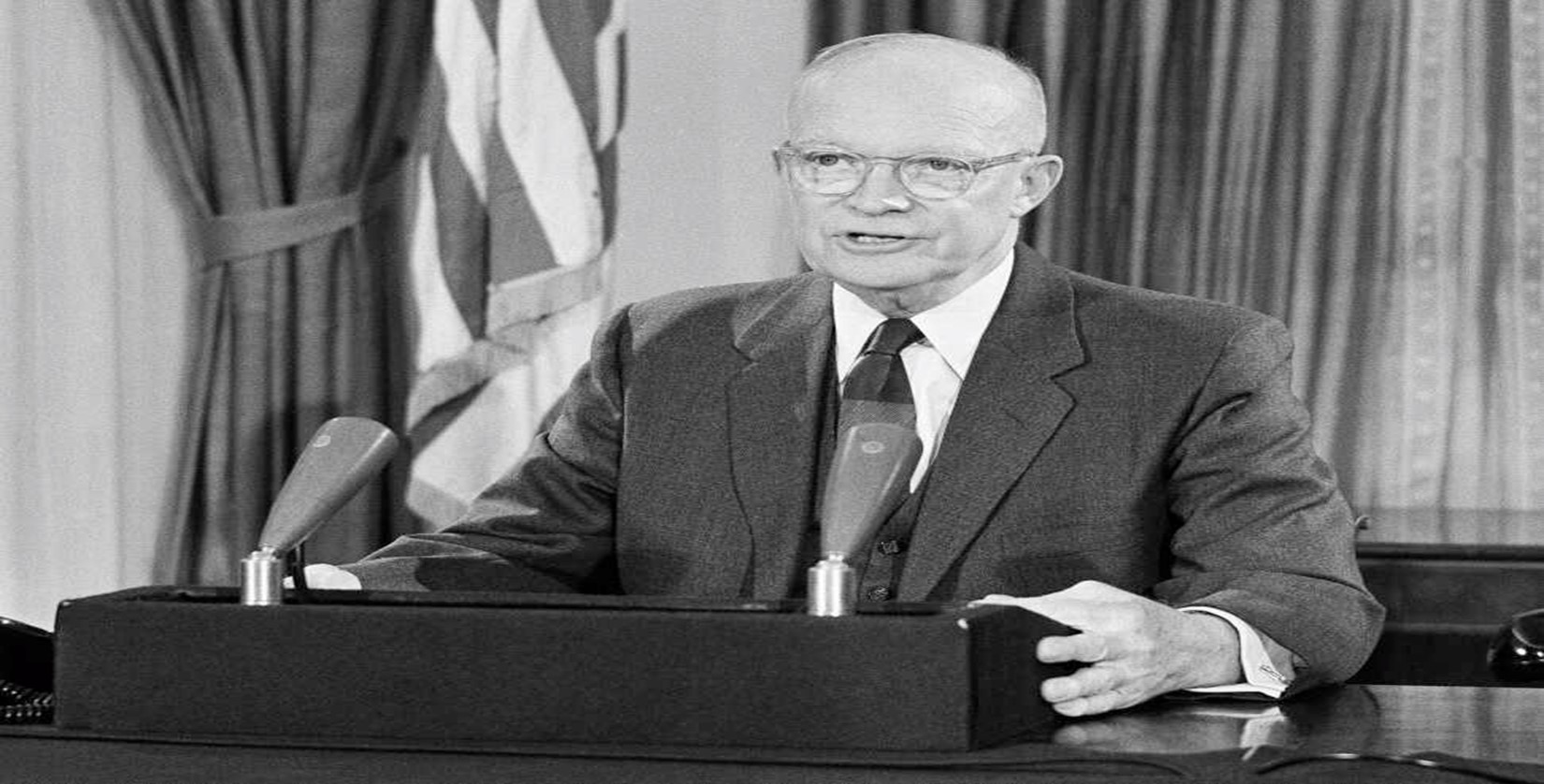
On Jan.17, 1961, President Dwight D. Eisenhower delivered a 10-minute farewell address after having served his nation as president. He had interesting things to say, such as:
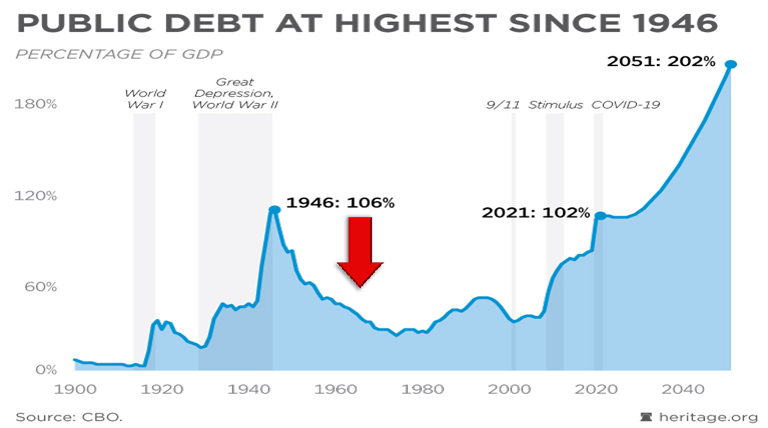
As we peer into society's future, we – you and I, and our government – must avoid the impulse to live only for today, plundering for our own ease and convenience the precious resources of tomorrow. We cannot mortgage the material assets of our grandchildren without risking the loss also of their political and spiritual heritage. We want democracy to survive for all generations to come, not to become the insolvent phantom of tomorrow.
How is the whole not plundering the precious resources of tomorrow thing going for us? Not well lately (red arrow designates the end of the Eisenhower administration).
In this same address, Eisenhower famously warned us about the “Military Industrial Complex.” Having served as supreme commander of Allied Forces in Europe during World War II in addition
to the nation’s 34th president, Eisenhower’s warning received and continues to receive grave consideration:
This conjunction of an immense military establishment and a large arms industry is new in the American experience. . .Yet we must not fail to comprehend its grave implications. . . In the councils of government, we must guard against the acquisition of unwarranted influence, whether sought or unsought, by the military-industrial complex. The potential for the disastrous rise of misplaced power exists and will persist.
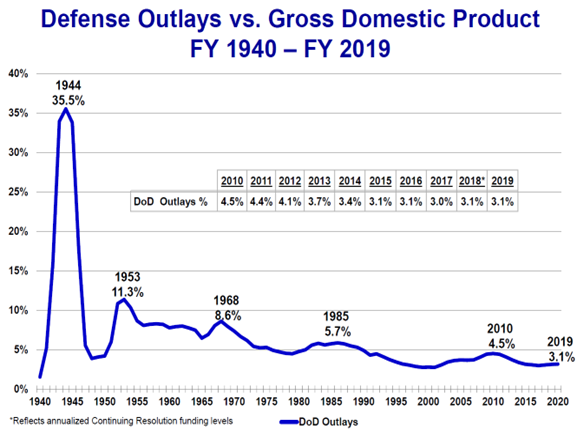
Luckily, military spending did not spiral out of control. American military spending as a percentage of GDP declined over time. The United States won the Cold War, managed to successfully close a huge number of unnecessary military bases (not the sort of thing an overly powerful Military Industrial Complex would like to see). The United States may have had a “Military Industrial Complex” problem to manage, but it managed it successfully.
We’ve yet to successfully manage our school District Lobbying Complex.
Part of the challenge of the Military Industrial Complex was that defense contractors (quite deliberately) spread facilities widely across congressional districts. Military bases likewise were ubiquitous. The Phoenix area for instance once hosted two Air Force bases, with another less than a couple of hours drive away in Tucson. Austin and San Antonio, Texas, each had Air Force bases. Obviously once the world went all Red Dawn and we lost the bases in Tucson and San Antonio, our forces would regroup in Phoenix and Austin or…something (?)
Such things may not have made a lot of sense from a national security standpoint, but they were great from the standpoint of politics. School districts likewise have amassed an abundance of underused facilities. Keeping them around makes little utilitarian sense, but the District Lobbying Complex is not eager to give them up for political reasons.
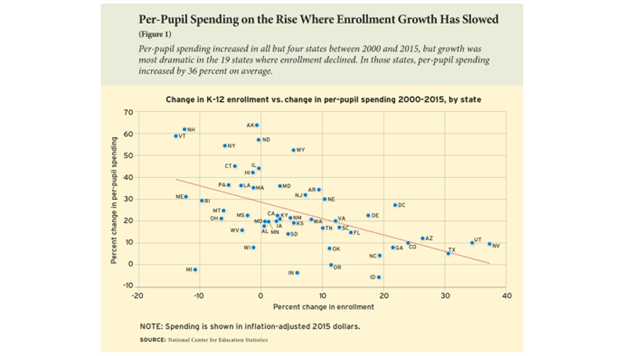
In recent decades the states with declining or slow K-12 enrollment growth have had the largest increases in per pupil spending. That has been quite a feat for what we can only half-jokingly call the District Lobbying Complex, but it seems unlikely to be sustained. Like the Military Industrial Complex, the district system is spread far and wide across the country, and the education unions have been ranked as among the most powerful state level special interest group.
The federal government provides about 35% of the average state’s budget and has tested the outer limits of fiscal insanity with a determined vigor (see first chart above). How long they will be able to keep this up remains unknown but put me down for “less than forever.”
Like the Military Industrial Complex, the District Lobbying Complex may prove to have already peaked. The period in which states could turn up the per pupil spending knob despite declining enrollments coincided with and was enabled by America’s massive Baby Boom generation being in their prime earning years. The average Baby Boomer turned 65 in 2022. Any guesses on where their spending priorities will lie in a competition between their health care and retirement programs and K-12? American families, in increasing numbers, are hitting the exits for districts in search of better opportunities. And then there is the baby bust that began decades ago to consider.
The rise of district employee unions certainly squared with Eisenhower’s “disastrous rise of misplaced power.” This power, however, has gone into an inexorable decline.

Indiana State Superintendent Tony Bennett
Indiana: The race for state superintendent is a referendum on the direction of education reform, including expanded school choice (Associated Press).
Florida: The state's teachers unions are among the weakest in the nation, according to a new Fordham Institute report (Orlando Sentinel). The Duval County school district agrees to settle with a proposed virtual charter school, run by online provider K12, that it had initially opposed (State Impact Florida).
Washington: Education leaders from around the state sign a letter saying they oppose the charter school initiative on Tuesday's ballot (Seattle Times).
Tennessee: Education Commissioner Kevin Huffman, also a member of Jeb Bush's Chiefs For Change, urges parents to use his state's latest education report card to ask questions and consider options (The Tennessean). Groups pushing for education reform and school choice spend heavily in campaign contributions (The Tennessean).
Michigan: Critics question the state's decision to okay new charters from companies whose existing schools are not performing well (Detroit News).
Wisconsin: One school district hopes to stem declining enrollment by expanding online offerings (Oshkosh Northwestern).
Maine: Five proposed charter schools apply to open next year (Kennebec Journal).
Georgia: A lawsuit claims language in the proposed charter school amendment is purposely misleading (Athens Banner Herald). Students from historically black colleges in Atlanta rally for the amendment (Atlanta Journal Constitution.)
The teachers union in Minneapolis has a long history of progressive leadership. My friend Louise Sundin was president of the Minneapolis Federation of Teachers (MFT) for 22 years and helped us start the Teacher Union Reform Network in the mid-1990s. Under Louise’s leadership, the MFT was an intelligent force for innovation and the MFT’s current president, Lynn Nordgren, is continuing this tradition.
In this recent Minneapolis Star Tribune column, Nordgren foreshadows the future of teacher unionism as she explains why the MFT is embracing charter schools as a vehicle for teacher empowerment.
We believe there can and should be outstanding new schools with autonomy over increasing student achievement, defining curriculum, and managing budget, scheduling, and staffing … This isn't the first time, of course, that the MFT has led the way in establishing innovative, teacher-run schools. The union tried for years to launch "self-governed" schools, which give teachers a powerful role, in partnership with Minneapolis public schools.
The industrial model of unionism teachers borrowed from the steel and auto workers in the 1960s erroneously assumes that individual teachers must be disempowered in the interest of greater collective power. But the new unionism the MFT is implementing through this charter school initiative sees collective and individual power as mutually enhancing, and not in conflict. The MFT’s collective power will grow -- and not diminish -- as it uses its collective power to empower individual teachers.
Teacher-run schools are consistent with a larger cultural trend toward worker-run enterprises. As this recent New York Times column observed, Americans are increasingly becoming involved in co-ops and worker-owned companies: “Some 130 million Americans, for example, now participate in the ownership of co-op businesses and credit unions. More than 13 million Americans have become worker-owners of more than 11,000 employee-owned companies …”
In public education, the movement toward greater teacher and parent empowerment is accelerating, and Nordgren and her MFT colleagues are smart to begin repositioning their union now. The future of teacher unionism is being formed in Minneapolis.

