 According to the Wall Street Journal, the Securities and Exchange Commission is examining the for-profit business practices of Florida’s teacher unions and their for-profit business partners.
The Journal reported recently that teacher union leaders are pushing teachers to purchase retirement investments from union-owned, for-profit companies that charge unusually high management fees. These higher fees are increasing the unions’ profits at the expense of teachers’ retirement funds.
The Journal writes: “The setup is one of an array of similar deals in which unions and other groups get income from endorsements of investment products and services — often at the expense of teachers … The ties help explain why many local-government workers continue to pay relatively high retirement-plan costs, while fees in corporate-based retirement plans are often lower and have been falling for years.”
I was first informed about the for-profit business ventures of teacher unions when I became a local union president in 1978. I had questions, but I was 22, and my mentors assured me our profits benefited our members and the union. Forty years later I still use a credit card that is managed by a for-profit joint venture involving the National Education Association (NEA), MasterCard, and Bank of America, even though I haven’t been an NEA member since 1997.
Given how critical teacher unions often are of for-profit businesses operating in public education, it’s ironic that these same unions operate a variety of for-profit businesses themselves. But the unions are selective in their criticisms. They only criticize for-profit businesses they perceive as competition, such as the small number of for-profit charter schools that aren’t unionized. For-profit contractors, bus companies, furniture vendors, teacher training providers and hardware and software companies, among others, are fine.
I do not object to teacher unions, or anyone else, operating for-profit businesses in public education. Without profit there would be no credit. Without credit there would be no scalable innovation. And without scalable innovation, we’d all be living in caves.
I also don’t object to teacher unions using their influence with the Democratic Party and the media to maximize their profits, provided it’s done legally and with transparency. All multimillion-dollar corporations, including teacher unions, work the media and lobby government to enact policies that advantage their businesses. I do object to teacher unions promoting their business interests in ways that hurt our most vulnerable and disadvantaged children. While the SEC is investigating the legality of the unions’ business practices, my concern is with the morality of their business practices.
In Florida, teacher unions have used their profits to help fund lobbying and lawsuits to take away education options from our state’s highest-poverty, lowest-performing students. Their goal is to protect their market share and revenue even though these actions hurt disadvantaged children and are inconsistent with the values of most teachers. Instead of attacking our most vulnerable children, teacher unions need a new business model that allows them to find common ground with these children and their families.
The future of public education is customization. Soon every child will have access to a customized education. Teacher unions need a business model that aligns with and supports customization. They will go out of business if they continue insisting that public education can only take place in government-managed schools covered by one-size-fits-all collective bargaining agreements. This 1970s model of public education, and the early 1900s model of industrial unionism that accompanies it, doesn’t work for many children and is going away.
There is a positive role for teacher unions in public education if they will adopt a new unionism that puts people above profits and empowers teachers and families to have more control over how each child is educated.

Dress’d in a little brief authority
Most ignorant of what he’s most assur’d --
-- William Shakespeare, Measure for Measure
In September, the California Legislature passed, and the governor signed, a bill forbidding public and charter schools to suspend or expel any pupil from kindergarten through eighth grade “… who disrupts school activities or otherwise willfully defies the valid authority of supervisors, teachers, administrators or school officials.”
We are told this curiosity was intended primarily to ensure that minority children would no longer dominate the disciplinary statistics. In due course, word of this shift in the authority structure from Ms. Jones to Little Miss Muffet will get to every child; from there on, things will be unpredictable.
As a confirmed pessimist, I fear that various species of pandemonium will come to flourish in more than a few classrooms. Over the long haul, this invitation to self-expression by the children could have a profound effect upon both neighborhood and charter schools.
Brassy kids are not unknown even to the chosen so-called “public” schools of California’s wealthy suburbs. Of course, this toleration of puerile rant could, and might be, taken by every child as the invitation to maturity some defenders expect it to be. As myself an enthusiastic would-be classroom agitator of the 1940s, I find that hope a bit romantic. But then I was made to pay the price of my sins, hence my restoration!
Did the governor and company consider the effect of puerocracy upon the appetite of teachers to stick it out and of would-be teachers to join the profession? There was already a certain heroism entailed in the role of these necessary people; how many who were on the brink of volunteering will choose to be bankers? Did the teacher union simply miss this reality?
What could seem equally worrisome for our doughty legislators is the reaction of those suburban public school pilgrims whose fifth-grader recounts over dinner the classroom excitements of the day. These folks may be ready to shift Susie once again – this time to a private (or home) school where class just might be more peaceful.
Such a curious outcome; the supporting union will have shot itself in the foot! Of course, it would still have the poor in their inner-city cloisters, but … well, peace be to them all.
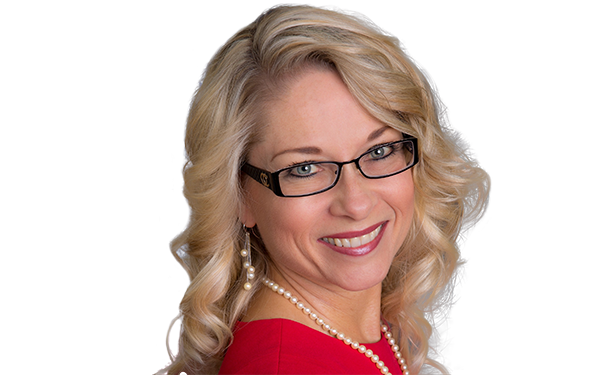
Rebecca Friedrichs is the author of 'Standing Up To Goalith' and joins us for an interview on the latest episode of podcastED.
Rebecca Friedrichs is the fearless California public school teacher best known for being lead plaintiff in Friedrichs v. California Teachers Association, the high-profile lawsuit that – until the unexpected death of U.S. Supreme Court Justice Antonin Scalia in 2016 – was destined to end the union practice of forcibly collecting “agency fees” from non-union members. (Subsequently, last June, Janus v. AFSCME did end the practice.)
But what people may not know about Friedrichs is how much her support for educational choice fueled that crusade.
In her just-released autobiography, “Standing Up To Goliath,” Friedrichs details her rise from rank-and-file teacher to anti-union activist, including the role that choice played. In an interview with redefinED, she offers more insight into the teachers-and-choice piece, including why more teachers aren’t clamoring to expand options that, she says, would benefit them as much as students and parents.
“We will see widespread school choice when we can educate teachers on the truth,” Friedrichs said in the interview. Once teachers see “that these choice schools really are not bad, that charter schools really do have to close down within a few years if they don’t get the job done, that public schools go on and on and on and on for years even though they’re failing … once teachers know the truth, they’ll be on our side.”
Friedrichs describes herself as conservative. But “school choice” isn’t conservative, she said, no matter how often it’s often portrayed that way by critics and the press.
“That’s just another lie promoted by the unions,” she said. “I don’t care if you’re apolitical, you’re a Democrat, you’re a Republican, you’re a libertarian, you don’t vote. Everybody I know, once they understand school choice, and they realize it’s just what’s best for the child, they’re all for school choice.”
Friedrichs’s support is personal. At different points in her life, she said, she needed educational options for each of her sons. For Ben, her youngest, no option materialized, which left Ben in vulnerable situations and Friedrichs, then a single mom, crying all the way to work. For Kyle, an option did come through, just as drugs and other issues had him spiraling down.
Said Friedrichs, “School. Choice. Saved. His. Life.”
Friedrichs shares more details in the podcast, with a bonus for Major League Baseball fans. Kyle, now thriving as a pitcher in the minor leagues (in the Oakland A’s system), recently got a chance to face future Hall of Famer Mike Trout …
You’ll either have to buy Friedrichs' book or listen to the podcast to find out what happened. ????
In a new ruling, the Pulitzer-Prize winning PolitiFact concludes a Florida teachers union ad attacking a proposed school choice scholarship for bullied students is “Half True,” with its bottom line reflected in the headline, “Attack on House Speaker Richard Corcoran, HB 7055 need more context.” But neither union claim – that the proposal would “divert” more money from public schools, and to “unaccountable” private schools – is remotely true.
In this case, PolitiFact itself needs more context. And a few more facts.
First, the diversion myth.
When contacted by PolitiFact, the union attempted to tar the proposed new “Hope Scholarship” by pointing to the 17-year-old Florida Tax Credit Scholarship, which this year serves 107,000 economically disadvantaged students (and is administered by nonprofits such as Step Up For Students, which publishes this blog). That’s not a surprise. What is a surprise, though, is PolitiFact then ignoring the stack of evidence about the latter’s fiscal impact – evidence it cited just a few years ago when it ruled on a remarkably similar statement.
It’s a fact that eight separate analyses, from a wide range of independent groups and agencies, have all found the tax credit scholarship saves taxpayer money that can be reinvested in public schools. In a 2008 report, for example, the Florida Legislature’s research arm concluded taxpayers save $1.49 in general revenue for every $1 that corporations contribute in return for tax credits. In 2012, the Florida Revenue Estimating Conference projected the program would save $57.9 million the following year. Both entities have well-deserved reputations as straight shooters.
It’s also a fact that not a single study has found a negative fiscal impact. How can that be, given all the broken-record claims of diversions and drainings? Because even today, after a series of increases in individual scholarship amounts, the full value of the scholarship is still two-thirds of the average per-pupil expenditure in district-run schools.
Need more proof? The evidence for a positive fiscal impact is so overwhelming, it played a role in the dismissal of the highly publicized, union-led lawsuit, filed in 2014, to try and kill the scholarship program. Both the circuit court and appellate court in McCall v. Scott denied standing in part because the plaintiffs could not provide evidence the program was financially harming public schools. That’s a fact. It’s also a fact that in 2014, PolitiFact found a similar statement by then state Sen. Nan Rich -- she said $3 billion would be diverted from public schools and spent on the scholarship program over five years – was “Mostly False.”
The 2014 ruling was based on the same fundamental points I’m making here. To quote the 2014 PolitiFact: “There’s no guarantee that money would otherwise have gone to public schools. And, private school vouchers tend to cost less than what it costs to educate a child in public schools, which complicates how much money taxpayers would pay if the children in private schools instead went to public schools.”
As for accountability …
Critics of educational choice programs hold to a narrow definition of accountability – a definition that sees accountability driven by regulations alone. That’s not how accountability works in many sectors of our lives, including public education. School accountability runs on a continuum between regulatory force and parental choice. Both force and choice can drive quality and effectiveness, and the work in progress – for all education sectors – is finding the right balance between the two.
PolitiFact doesn’t seem to have considered any definition other than the one offered by Kevin Welner, a University of Colorado professor who has devoted his career to criticizing choice programs in general and tax credit scholarships in particular. Welner is quoted extensively and allowed to assert that the Florida scholarship regulations are “weak and ineffective” without providing proof.
It’s true accountability with scholarship programs rests on a different point on the continuum than accountability with traditional district-run public schools. It’s true that by design, scholarship programs offer a fair bit of power and discretion to parents to exercise accountability. But the evidence suggests those parents are exercising that power and discretion wisely. I don’t know how a determination can be made about accountability, by PolitiFact or anybody else, without considering those outcomes.
So, for example: We know from a decade’s worth of standardized test results (testing is mandated as part of the state’s regulatory regimen for private schools participating in scholarship programs) that scholarship students are, on average 1) the lowest-performing students in district-run schools and 2) making solid progress in the private schools their parents chose for them. We also know, thanks to fresh research from the Urban Institute, that scholarship students enroll in college and earn degrees at higher rates than like students in district schools. That college-going rate is 15 percent higher for scholarship students overall, and 40 percent higher for those on scholarship four or more years.
By what standard, then, are Welner and PolitiFact judging accountability to be “weak and ineffective”?
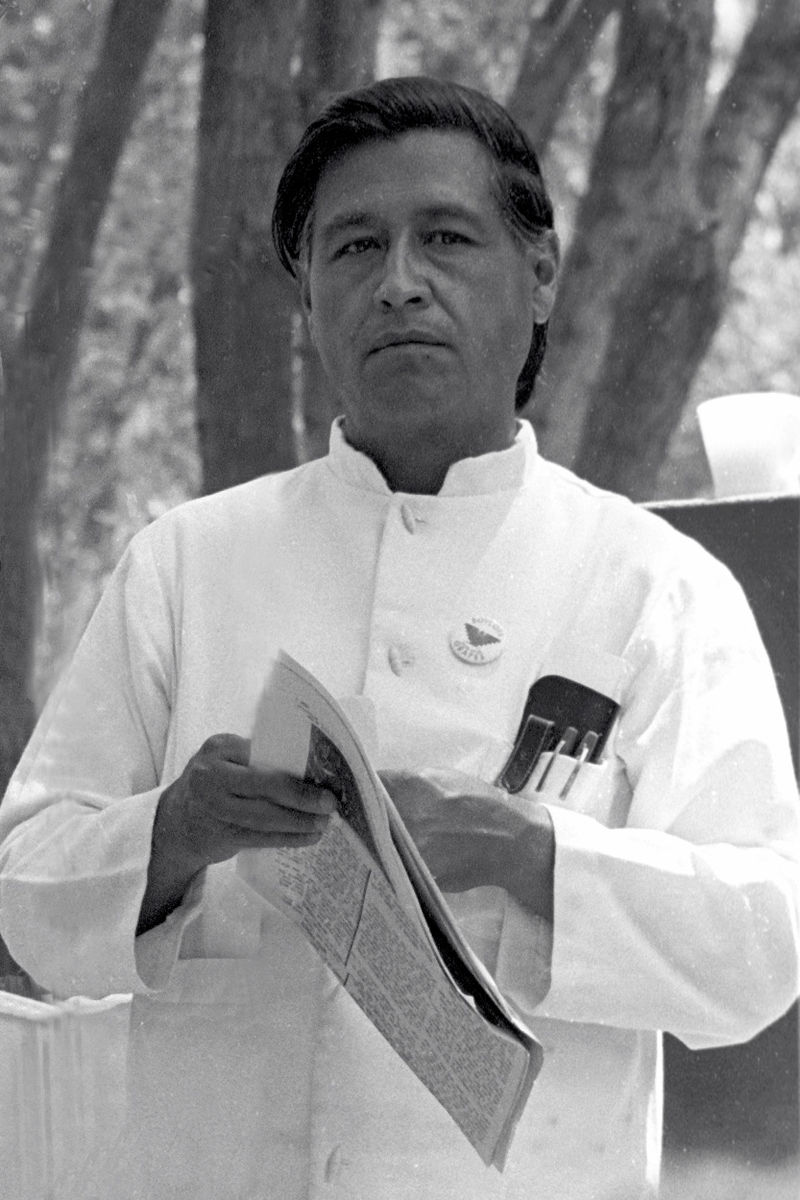
Cesar Chavez (image from Wkimedia Commons).
This is the latest post in our occasional series on the center-left roots of school choice.
More than 30 years ago, liberal activists working to get a revolutionary plan for school vouchers on the California ballot approached labor leader Cesar Chavez, according to one of those activists, Berkeley law Professor Jack Coons. The co-founder of the United Farm Workers (Si Se Puede!) told Coons he liked school choice, but as far as supporting it publicly, No se puede.
Doing so would put the teacher union’s generous financial support for his union at risk, he said.
Other evidence suggests Chavez wasn’t just politely telling a fellow traveler no. More on that in a sec. In the meantime, it’s worth noting the Chavez anecdote isn’t the only example of labor unions occasionally backing school choice or, in a few cases, outright distancing themselves from their teacher union brethren.
Consider:
To be sure, I’m not suggesting union alliances against choice are about to crumble, and I can’t pretend to know if extenuating circumstances led these unions to make a break. But I think it is fair to say these examples shed more light on the myth that only conservatives and libertarians see the value of having more educational options for kids. The Netherlands, a union-friendly nation, and a pretty liberal one at that, embraced one of the planet’s most complete systems of school choice a long time ago.
I also think it’s fair to suggest from these examples that teacher unions, like the NAACP, risk becoming increasingly isolated from traditional allies because of head-scratching positions that leave those allies on the outs with their kids.
In our back yard, more than 800 parents of students using tax credit scholarships in Florida work for public school districts, according to data from Step Up For Students.* Some of those parents are public school teachers. Some, in fact, are teacher union members. But because of the income eligibility requirements, I’d guess the majority are custodians, bus drivers and other blue-collar workers – workers represented by the likes of AFSCME and the SEIU.
If the Florida teacher union succeeds in its lawsuit to kill the scholarship program, some of its members may rejoice. But tens of thousands of parents, including hundreds in other labor unions, will be heartbroken. I can’t imagine how that would be good for solidarity.
Back to Cesar Chavez.
In the early 1970s, farm workers in Blythe, Calif. started their own on-a-shoestring private school because they were fed up with conditions in public schools. Parents met at the local United Farm Workers hall to get the ball rolling, as longtime choice advocate Alan Bonsteel notes in the 1997 book he co-authored, “A Choice for Our Children.” The father of the woman who would become the school’s director, Carmela Garnica, was a UFW organizer.
The Escuela de la Raza Unida became a community gem. Garnica, a Democrat, became a voucher proponent. Chavez became a frequent visitor.
Si se puede? For vouchers?
It’s not as farfetched as people think.
*Step Up For Students is a nonprofit that helps administer the state’s tax credit scholarship program. It also hosts this blog and pays my salary.
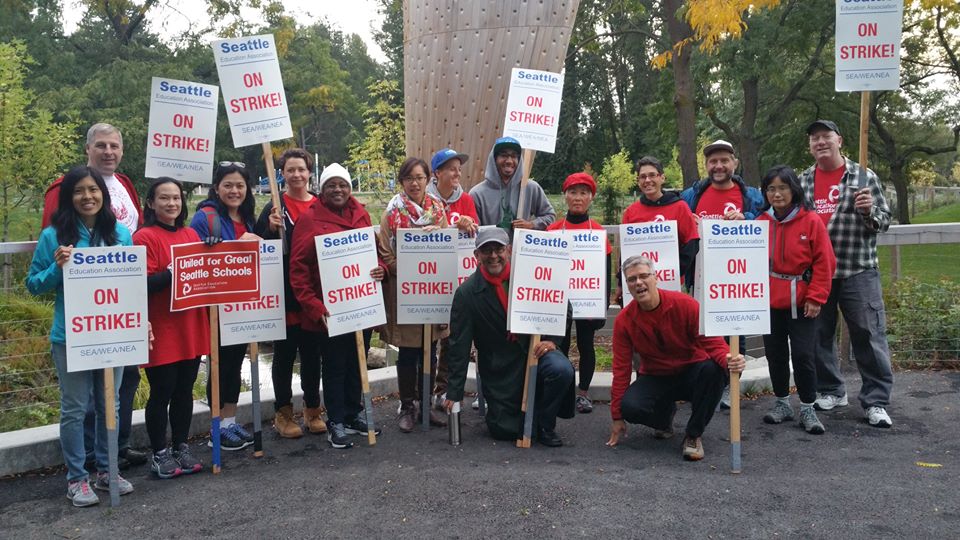
Seattle teachers went on strike last month. (Photo from Seattle Education Association facebook page.)
The annual swarm of strikes (and threatened strikes) called by public school unions arrived on schedule across the nation this fall, just as parents and children arrived at the schoolhouse to honor their civic obligation. With the teachers themselves truant, attendance was not an option for the families. Happily for the better-off parents there were familiar fallbacks; one can work at home, hire childkeepers or switch to the private sector and pay tuition.
For the rest of the nation’s families – call them “ordinary” – school strikes were a serious aggravation. As a rough analogy to their plight, imagine a military conscript who reports for duty as ordered – but finds the base empty. He knows he has to do something, but what? Of course this bewildered recruit would be the only person who suffers from that sort of foul-up. By contrast, when the teacher union decides to strike, the family itself becomes in effect a full squad of perplexed draftees – mothers, fathers, etc. – all bound both by government and by the very nature of the family. There is no substitute available for them to choose. They are legally and morally responsible for their child’s welfare – even when both parents must hold jobs to sustain the family. Eventually, of course, the strike gets settled and the mother returns to her job – if she still has one. In the meantime, however, what to do?
The state drafts the ordinary family for its own schools – there to learn only those ideas allowed to the mind of government; this the child hears five days a week, seven hours a day. What conception of human dignity could account for this deliberate humiliation? And when the state next allowed its own employees to abandon their charges without provision for the dilemmas presented thereby to the ordinary parent, just how was this good for anyone but the teacher unions and their elite? Yet again I would recall the words of my departed friend, Albert Shanker: “I’ll represent children’s interest when they start paying union dues.” With all due respect Albert, children in fact pay union dues simply by being enrolled and thereby providing jobs for union members. (more…)
 National Coalition for Public Education
The Federal Title I program provides funds to school districts in order to improve the education of economically disadvantaged students in grades K-12. Senator Lamar Alexander (R-TN) wants to amend Title I funding so that the money is “portable,” allowing the funds to follow low-income students to their new public school.
The National Coalition for Public Education strongly opposes this idea and provides three reasons in an open letter to the Senator:
1) Ensuring the Title 1 money goes to the school where the impoverished child enrolls will lead to vouchers.
Put the tinfoil away. Ensuring that schools enrolling poor kids receive extra funding does not lead to vouchers.
2) It hurts the district’s ability to take advantage of “Economies of scale” to combine resources and help students.
 Title I funding was created because there are serious problems in schools with high concentrations of poverty. To take maximize of “economies of scale” (the way the coalition argues) districts would need to keep economically-disadvantaged students concentrated in high-poverty schools, sustaining the problems Title 1 hopes to address.
3) It takes away from district’s ability to direct resources to public schools with high concentrations of poverty.
According to the left-of-center New America Foundation, $6.4 billion (or 45 percent of Title I funding), is distributed through the “Basic Grant Formula.” That formula requires districts to have a mere 2 percent economically disadvantaged student population. That low threshold means that pretty much every district is eligible for Title I funding. If funding high-poverty schools was the coalition’s real priority, why send the money through the districts first? The money should go where the needs are.
It makes one wonder if public-school organizations are less concerned with whether this money helps kids than they are with who (them) decides what to do with it.
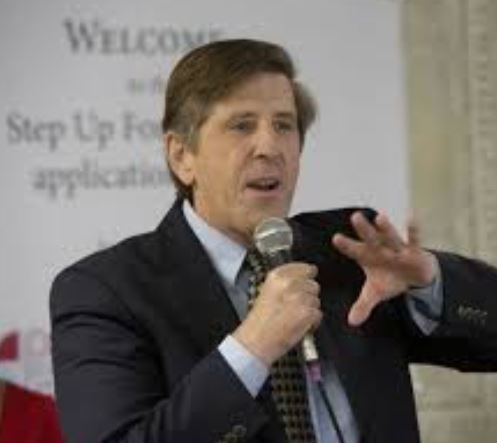
Doug Tuthill is president of Step Up For Students, which helps administer the nation's largest private school choice program (and co-hosts this blog).
I often get asked how I went from being a teachers union president to the president of the country’s largest private school choice organization. It feels like a natural transition to me, but when I step back I can see how others might find it an unusual journey.
My wife likes to tell everyone how boring I am and that I’ve been giving the same empowerment speech since I was 22. She’s right on both counts.
My world view has changed little since I was first elected a local teachers union president in 1978. I was 22, and believed strongly that organizations and societies work best when they maximize the value of their greatest asset – their people. And since individual empowerment is a necessary condition for healthy human development, my work in public education has always focused on creating well-managed education systems that empower individuals.
As a teachers union leader in the 1970s, 80s, and 90s, I was a strong advocate for teacher empowerment. I traveled across the country on behalf of the National Education Association, our nation’s largest teachers union, preaching the gospel of school-based decision making.
But while the NEA leadership regularly highlighted my views in speeches, publications and press events, most of the NEA bureaucracy thought I was naïve and wrong. They saw teachers unions as being in the business of protecting teachers from bad administrators, clueless politicians and dysfunctional school districts. They saw decentralization of power as antithetical to their efforts.
These teachers union traditionalists believe teacher power should be centrally controlled and used by the union for the greater good of teachers collectively, which is where I split from them. I believe a primary function of collective teacher power is the empowerment of individual teachers.
A good example of this difference is how teacher compensation is determined. I believe in free agency. That is, teachers should be able to sell their services to the highest bidder. I would use the collective power of teachers to strengthen free agency, similar to what the professional sports unions do. Teachers unions strongly oppose free agency. They believe all teacher salaries should be determined centrally through a one-size-fits-all salary schedule.
Another good example is found in how teachers unions think about charter schools. I believe teachers unions should help teachers start and run their own schools, while the traditionalists think all publicly-funded schools should be centrally owned and managed by school boards and district bureaucracies.
The school choice movement is founded on a belief in parental empowerment, so adding that to my lifelong commitment to teacher empowerment feels natural to me. I believe in giving teachers the power to create and manage new and innovative learning options for families, and I believe in giving families the power to match their children with the learning options that best meet their needs. For me, both are necessary components of a highly effective and efficient public education system.
I’m a strong advocate of teachers organizing themselves and using their collective power to promote the public good. I’m convinced teachers unions will eventually embrace a model that does that. But this shift is still years away. Until then, teachers unions will continue to be one of the biggest obstacles to improving our country’s public education system.
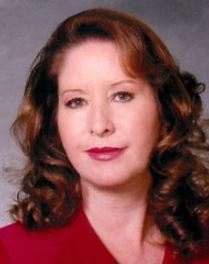
Gloria Romero
Editor’s note: This is the last post in our series on the Democratic Party’s growing divide over ed reform and ed choice.
by Gloria Romero
While in the belly of the beast of government, I had a front row seat on how the wheels of government are greased to function for politically connected interests. Over time, I chose not to just be a cog in the ever-churning wheel of special interests and status quo, from both the left and the right. I saw a political system, led by Democrats, that was all too willing to ignore the needs of ordinary citizens, particularly the poor and minority kids I represented in East Los Angeles.
There is no aspect of state government operations or public policy in California, particularly education policy and budgeting, that is untouched by the power of the California Teachers Association (CTA) and its affiliates in Sacramento. With approximately 300,000 members, each paying some $1,000 a year in dues, it commands the most powerful war chest in California, raising over $300 million annually to finance its operations. From 2000-2010, CTA spent over $210 million on political campaigning — more than any other donor in the state, even outspending the pharmaceutical, oil, and tobacco industries combined.
Its political war chest is legendary. It dominates elections, including school board races in which voter turnout is anemic, often less than 10 percent. Political consultants fear crossing them because of the potential to be “blacklisted.” Almost half the entire California budget funds education thanks to Proposition 98, a 1988 initiative crafted by CTA. Democratic legislators fear interfering with it even though few understand how the formula functions.
Former Democratic Senate President Don Perata was one of the few to challenge it, comparing it to a “runaway escalator.” In retribution, CTA ran ads against him. It was not interested in “taking him out”; rather, the message was akin to sending dead fish to fellow caucus members so they would have to choose loyalty: their own president or CTA.
Former CTA staffers are ensconced in legislative leadership offices. Legislation benefiting their membership flies through the Capitol. Indeed, class size reduction was sold to voters as “benefiting kids.” In fact, it has more so grown the numbers of dues-paying members rather than improved the academic skills of, particularly, poor and minority children.
California teachers are amongst the highest-paid in the nation; yet, there is little accountability for student achievement or teacher performance. Laws make it almost impossible to fire teachers for incompetence or misconduct. Charter schools, mostly non-union, are attacked by the teachers unions. Any hint of privatization, including opportunity scholarships for kids in failing schools, are “off the table.” The 2010 Parent Empowerment Act I wrote, giving parents unprecedented tools to fight for their kid, like parent trigger and open enrollment, continues to be vilified.
Money flows to those who control the levers of power, and in California that means Democrats. (more…)
Editor's note: This is the fifth post in our series on the Democratic Party's growing divide over ed reform and ed choice.

Whitmire
by Richard Whitmire
This spring I attended the Democrats for Education Reform conference in Lake Placid and watched a line of teacher union protesters, including Randy Weingarten, stand in the cold Adirondack rain and wave signs at us with slogans such as “Public Education is not for Sale.” I recall thinking: "This is going nowhere good.”It’s hard to be optimistic about the possibility that this political divide among Democrats will narrow. In Chicago, fiery teachers union president Karen Lewis is close to running against Democratic Mayor Rahm Immanuel. In New York, progressives still haven’t forgiven Democratic Gov. Mario Cuomo for putting down Democratic Mayor de Blasio over charter schools. In Los Angeles, where all the players are Democrats, the school board temporarily severed two of the highest performing charter schools there. And then there’s the NEA weirdly calling for the resignation of Education Secretary Arne Duncan. Yes, that nice Democrat Arne!
All these conflicts have one thing in common: Democrats v. Democrats. Or, to put it more precisely, liberals (think Cuomo) v. progressives (think de Blasio). While there are many education issues that fall along this divide, only one appears to have no resolution: charter schools. The bluer the state, the bigger the divide. On July 16 the Massachusetts Senate rejected an attempt to lift the very tight lid on charter schools, despite the fact that the state has the nation’s highest-performing charters.
What’s the problem? The fact that top charters have gotten significantly better in recent years (I define that as roughly the top fifth, the charters capable of adding a year-and-a-half of growth for every school year) presents a broad and enduring threat to traditional school districts and unions: These charters can both replicate quickly and produce student results that most districts can’t match. How to contain such an existential threat? Superintendents and unions, joined in common cause, rely on friendly legislatures (think of what just played out in Massachusetts) and lawsuits (think of San Jose, where opponents use zoning laws to slow down charter expansion).
Will the “pushback” strategy work? Definitely, at least in the short term. But not the long term. Given that parental choice is relatively widespread, and parents are not inclined to relinquish that choice, all that will matter in the end are quality schools, whether they are district or charter. But that “end,” can be far, far away. The power of the anti-charter forces to block expansion is considerable, and, at least from my perspective, that means denying quality schools to thousands of parents. How to solve that dilemma? (more…)