 From redefinED host Doug Tuthill: Today we begin a new feature at redefinED – an ongoing dialogue between myself (that's me pictured on the right) and John Wilson, who writes the Unleashed blog at Education Week. For the last 25 years, I’ve been one of Wilson’s biggest fans. I worked hard for John when he ran for president of the National Education Association in the late 1980s (we lost), and I’ve always respected the sincerity and dignity with which he conducts himself. John is a passionate and intelligent advocate for children, teachers and public education - and he’s a gentlemen. So I was thrilled when John accepted my invitation to dialogue with me on redefinED about how best to improve public education. I’m looking forward to learning from John, and I’m hoping our exchanges will inject some more civility into our public discourse. Our first installment is below.
Doug Tuthill: John, I was pleased to read your endorsement of customization on your blog recently. For readers who missed it, you wrote, “our citizens want choice. Parents want to choose the school that best fits their children. Let's not stifle this customization, but embrace it.” But I was especially intrigued when you wrote that we need to “stop the fragmentation and welcome charter schools back into the community and the conversation.” The charter school folks I know think they are in the community and think they are part of the conversation. So I was hoping you’d elaborate on what you meant.
John Wilson: Doug, I always start with my strong support for the institution of public schools. I believe public schools are the foundation of our democracy, best prepared to educate the masses, and the most strategic driver of the American economy. Public schools deserve necessary funding to accomplish their mission, and they must be relevant to the needs of that public. For the 21st century, that means customization to assure every child receives an education that prepares them for success. That means a willingness to collaborate with more appropriate providers that serve children but within the public school institution. Creating a hodgepodge of providers outside the public schools causes fragmentation and weakens our public schools. We have tried division; I want us to try addition.
Doug Tuthill: John, I share your belief that public education lies at the foundation of our democracy. Public education is responsible for helping ensure every child, regardless of economic class, ethnicity, disability or race, has an equal opportunity to succeed. This promise is what holds our democracy together, and while I doubt we’ll ever achieve full equality of opportunity, this ideal should always guide our work. (more…)
 Louisiana: State education officials set accountability rules for private schools participating in the state's new voucher program (Reuters). More from the New Orleans Times Picayune. The state deems a troubled private school ineligible to receive vouchers (Alexandria Town Talk). Meanwhile, a law firm representing a state teachers union sends letters to participating private schools, threatening them with litigation unless they opt out of the program until a lawsuit is settled (New Orleans Times Picayune).
Wisconsin: A Milwaukee charter school gets help from a national fund co-run by tennis legend Andre Agassi (Milwaukee Journal Sentinel)
Michigan: Speaking at the American Federation for Teachers convention, Vice President Joe Biden takes aim at vouchers and says teachers are under "full blown attack" from Republicans. (MLive.com)
Indiana: The state's year-old voucher program is becoming more diverse as it grows (Indianapolis Star). The mayor of Indianapolis tussles with parents over the future of a low-performing charter school (Indianapolis Star).
Florida: The school board in Pinellas County votes to allow an F-rated charter school to remain open after students and teachers plea for more time. (Tampa Bay Times)
Illinois: Charter school leaders in Chicago fear budget cuts because of uncertainty over the district's contract with teachers. (Chicago Tribune) (more…)
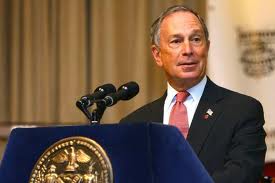 New York: For the third year in a row, New York City charter schools outperform traditional public schools, drawing praise from Mayor Michael Bloomberg, pictured here (New York Times). More from the New York Daily News.
New Jersey: The state teachers union fights new charters even as it attempts to unionize charter school teachers (NJ Spotlight). State education officials approve nine new charters, but reject 10 and postpone 13 (NJSpotlight), including a full-time virtual charter. (NJ.com)
Florida: State education officials reject appeals from three virtual charter schools seeking to open in the Miami-Dade school district. (Miami Herald) Education Commissioner Gerard Robinson defends charter schools at a town hall meeting (South Florida Sun-Sentinel). In a key Democratic primary in South Florida, state senate candidates differ over support for vouchers and tax credit scholarships. (Palm Beach Post)
Louisiana: Students and schools in the state's new voucher program are not likely to face the same regulatory accountability measures as public schools (Baton Rouge Advocate). A nonpartisan watchdog group recommends state education officials seek legislative guidance as they craft accountability rules (Associated Press). The state teachers union pans the academic results of the state's first all-grades, on-line charter school, but the school fires back with accusations of cherry picking (Baton Rouge Advocate).
Michigan: Democrats fear vouchers will be part of Gov. Rick Snyder's plans to overhaul school funding (MLive.com).
Washington: Gubernatorial candidates Rob McKenna and Jay Inslee agree on many aspects of education policy, but disagree on charter schools. (Seattle Times)
Elsewhere: Study finds students in K12 Inc. virtual charter schools are lagging behind their peers in traditional public schools. (Washington Post)
Pennsylvania: A budget deal expands the state's existing tax credit scholarship program and creates a new one aimed at helping students in struggling schools. (Philadelphia Inquirer)
 Washington: Bill Gates chips in $1 million for a ballot initiative to bring charter schools to one of the last states without any. (Associated Press) It appears supporters gathered enough signatures to get the initiative on the ballot. (Associated Press)
Florida: Former Gov. Jeb Bush endorses a local school board member who openly supports vouchers, tax credit scholarships and other forms of expanded school choice. (Tampa Bay Times) The incoming state House speaker also backs the board member. (Tampa Bay Times)
New Jersey: The state-appointed superintendent in Newark overrules a local advisory board and moves ahead with plans to lease empty buildings to charter schools. (NJ Spotlight)
Louisiana: State Superintendent John White continues to face criticism for his handling of a questionable private school that is seeking to participate in the state's new voucher program. (New Orleans Times Picayune) A state lawmaker now says she regrets voting for the program because she fears it will promote Islam. (Huffington Post)
California: The teachers union at Green Dot charter schools pushes for performance pay and evaluations tied to test scores. (Contra Costa Times)
Tennessee: A charter school operator vows to appeal to the state after a local school board rejects its plan to open charter schools in wealthy West Nashville. (The Tennessean)
Oklahoma: Online learning is growing more popular in Oklahoma, with supporters seeing it as an equalizer between districts that are big and small, rural and urban. (Tulsa World)
(Image from businessweek.com)
"We're living in a revolutionary moment," says Ben Austin, executive director of the Parent Revolution, as we begin our interview for redefinED's inaugural podcast. And the moment to which he refers has been marked by California's "parent trigger," a law that has upended the status quo at one Compton school in a way that few education measures can do with such sweep. A majority of parents at McKinley Elementary wanted a charter operator to come and take over their struggling school, just as the parent-trigger law allows, and what Austin and the Parent Revolution fought for, and the Compton Unified School District has done everything possible to make their job harder. The struggle will be left to the courts to resolve, but Austin does see success in the very nature of what the law has sanctioned.
The trigger has allowed parents to essentially organize and effectuate change at a bargaining table that has been the exclusive province of school boards and teachers unions. Whatever the outcome at McKinley, the law has transformed relations between school boards and the parents at their failing schools, said Austin, a former member of the California State Board of Education, who also served Los Angeles as a deputy mayor from 2000-2001 as well a variety of roles in the Clinton White House. "Already there are parents across California that are organizing to get to 51 percent with no intention of at least initially turning the signatures in," he said. "They're organizing to bargain. They're organizing to basically say, 'You haven't listened to us for years, but now we have the power to fire you, so you have to listen to us.'"
We talked with Austin about the launch of the Parent Revolution and how its role as a parent union might manifest itself at the bargaining table. What else did we ask?
Why the parent trigger, and not a more collaborative approach? "It's people with power that want a collaborative approach ... Power and Money is the language that the other side understands, and if you're not speaking that language, they're not going to listen to you."
Can the PTA fulfill the role as a parent union? "We've had good experiences with the PTA, and we've had bad experiences with the PTA. We believe there needs to be a lot more "P" in the PTA."
Click here to listen to the rest of the conversation, which runs about 24 minutes.

