PALM BEACH GARDENS, Fla. – Cristina Bedgood, a 15-year former public school teacher, took two years to craft plans for her own private learning center. She knew she needed 40 students in year one to make it work. But in April, when she held her first open house for Curious Innovators of America, she looked out the front door five minutes before the start time and saw … nobody.
 Her heart sank.
Thankfully, it floated right back up, because in the next few minutes, 30 families appeared. “And every person who walked in the building said, ‘Oh my God, we need this! ‘ ”
The calls keep coming. Bedgood signed up 10 students on one day in August alone. Most of them use state-supported education savings accounts.
Bedgood said the response has been gratifying – and going her own way as a teacher, liberating.
“I needed to be able to break free. I felt like I was being caged,” Bedgood said, referring to traditional schools. “I knew I could do so much, but I was being limited.”
In Florida, a national leader in expanding education choice, it’s tough to keep up with the growing ranks of former public school teachers who are leveraging choice programs to create their own options.
Bedgood said she came to realize she could help more students by creating her own model – in this case, a K-8 tutoring center focused on math, reading, and enrichment that caters to a wide range of students with a wide range of schedules.
She didn’t come to this conclusion lightly.
Bedgood was the instructional coach at a high-poverty, public elementary school for six years. She found the work “exhilarating.” But she also began to have doubts about the best path forward.
Bedgood said she was effective in part because she had a principal who gave her the freedom to veer from district dictates; to “go rogue” when she thought she needed to. Bedgood said she re-ordered and re-focused some parts of the curriculum, doubled down on others, and better aligned it to state standards. She leaned into response boards for formative assessments. She made widespread use of manipulatives that previously were gathering dust.
Her approach worked. The school’s state-issued grade gradually rose from a D to an A. Math proficiency rose from 47 percent to 72 percent.
But Bedgood said she also saw that principals like hers were rare. And that not everybody had high expectations for high-poverty students.
“I knew it. I watched it. I saw kids who were Level 1’s (the lowest level on Florida’s standardized tests) shoot up to proficiency,” she said. And yet, in some places, “the climate was almost like, ‘These kids can’t do it.’ “
Bedgood asked herself: If I rose through the ranks, would I truly be in position to do what works?
Ultimately, she concluded, there was a good chance she wouldn’t be. So, she looked for the exit. She overcame fears about starting her own operation; persuaded her husband, a firefighter; consulted with experts, including other teachers; and found a good location without too much hassle.
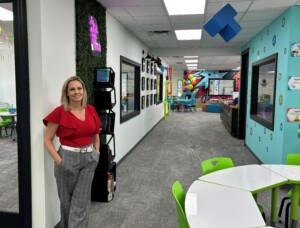 Bedgood describes Curious Innovators as a tutoring center and microschool. She opened in April with two students: Her own kids.
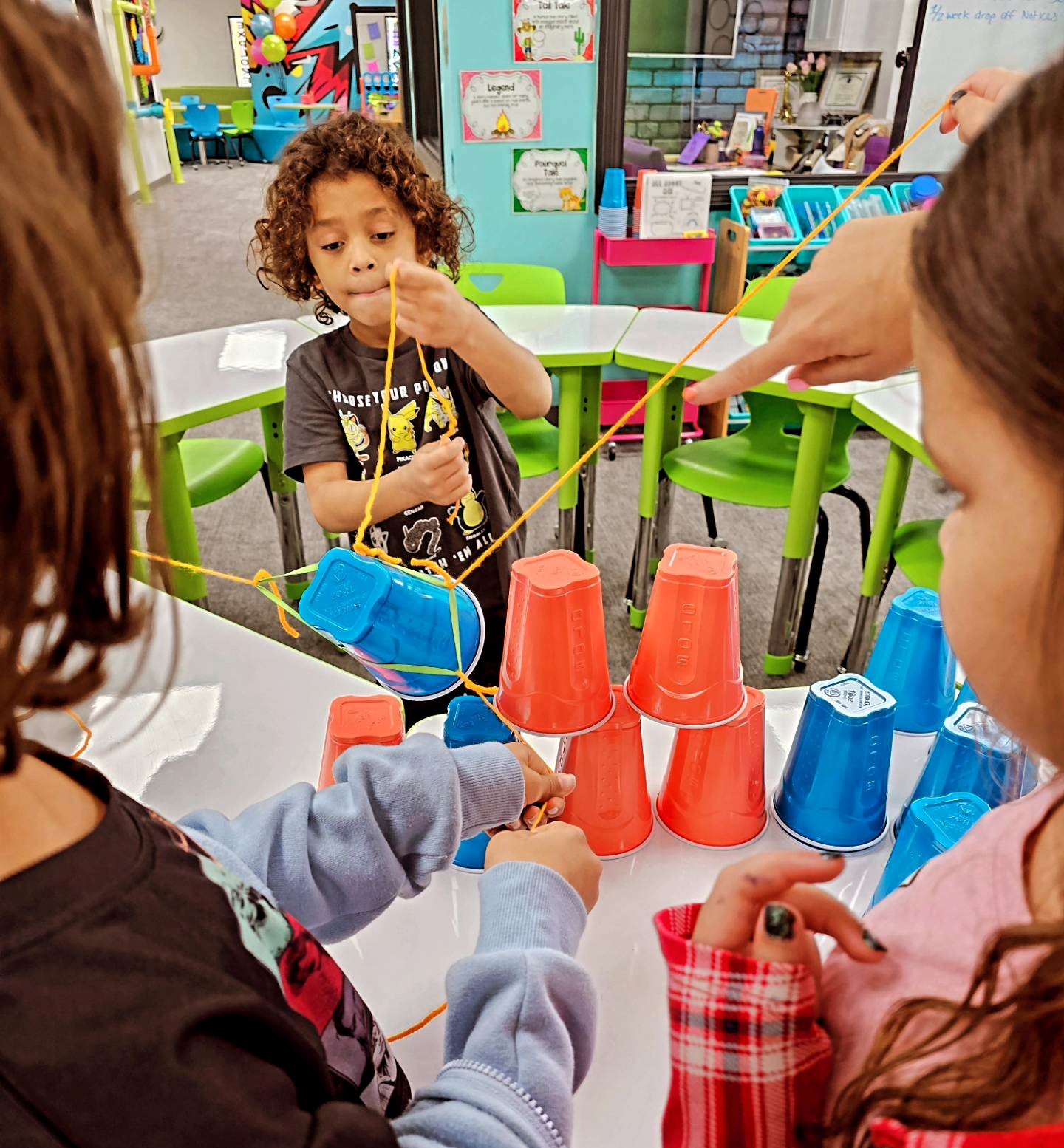
The center is 4,200 square feet, in a trim office building framed by oaks and palms. The interior is colorful and comfortable, with giant, geometric puzzle pieces hanging from the ceiling, all of it designed to stimulate creativity. There are separate rooms for reading, math, and STEM, and multiple stations for students to collaborate.
Bedgood employs five instructors, three of them full time. Two are former public school teachers.
All the students are homeschooled.
Some need tutoring in reading and/or math. Some are there for enrichment. Some mix and match from both. Bedgood emphasizes project-based and inquiry-based learning, but each student’s programming is created in tandem with them and their parents.
Reading and math classes are offered three days a week. Enrichment classes include art, music, drama, debate, creative writing, STEM, and entrepreneurship.
Maria Tobon signed up her daughter and son for math, reading, and science this fall after getting to know Curious Innovators during a three-week summer program. They attend full days on Mondays and Fridays.
One of her children uses Florida’s Family Empowerment Scholarship for Students with Unique Abilities. The other uses a Personalized Education Program scholarship. Both are administered by Step Up For Students.
“The beauty of a tutoring program like Cristina has built is you can hand pick what you need,” said Tobon, a former Montessori teacher who manages a homeschool co-op.
Tobon said between all her children, she has experienced a full gamut of educational options, from traditional public schools to magnet, charter, and private schools. She decided to homeschool after one of her children was diagnosed with cancer, and the COVID-19 pandemic made traditional schooling too risky.
Homeschooling, she said, turned out to be “absolutely mind-blowing.”
“When I took control … they grew in every sense,” Tobon said. “Going back to a full-time program sounds like jail.”
Kristen Collins wanted part-time schooling for her children, too. Her husband travels a lot for work, and homeschooling allows the family to occasionally join him, without missing a beat educationally.
Bryson, 6, and Aaliyah, 8, both use PEP scholarships. They attend Curious Innovators full days on Tuesdays, Wednesdays, and Thursdays.
“It’s just a great happy medium,” Collins said. And her kids “don’t want to leave. They’re having a blast.”
In some ways, Bedgood’s approach to teaching and learning is mainstream.
She follows the “science of reading” for younger students and struggling readers. She uses standardized tests to gauge proficiency. She tends to follow the grade-level progressions laid out in state standards.
The difference is, she has the flexibility to deviate from those tools, or supplement them, in any way she and the parents see fit.
Collins said that approach is working for Aaliyah, who has struggled a bit in math.
“Cristina recognizes that students learn differently, with different modalities. It’s not one size fits all,” she said. Aaliyah “has only been there two and a half weeks, but I can see she’s getting to these higher levels.”
After experiencing what’s possible outside traditional schools, Bedgood said she couldn’t go back.
Giving parents and teachers options, she said, is the best path to progress.
“I want choice to be the primary form of education,” she said. “The change needs to come from out of the system.”
VERO BEACH, Fla. – For eight years, Danielle McLean couldn’t believe her luck. Through all of pre-school and elementary school, her twin boys Jackson and Lincoln, both on the autism spectrum, had only three teachers. Two were Teacher of the Year finalists in their east Central Florida school district, and all of them, McLean believed, were exceptional.
So, when it came time for middle school, McLean was distraught. She was not hearing good things about where her boys were headed. And at a meeting last October to discuss next steps, two of their teachers weren’t optimistic either. “I’m almost in tears,” McLean recalled. “I’m like, ‘Where should I go?’ “
One of the teachers, Ryan Sandgren, wasn’t sure where he was going either. He had his own frustrations with the system. He told McLean, “If you created something, we are willing to be creative with you.”
McLean got the hint. That night she asked, “Alexa, how do you start a school?”
McLean did not start a “school.”
But last month, she, Sandgren, the other teacher at the meeting, Jessica Geary, and Megan Knowles, a speech language pathologist, opened the nonprofit Keystone Education Center.
Keystone is a full-time tutoring operation for students in grades three through seven that focuses on life skills, job skills, and academics. It uses 1,600 square feet of space in a church. It serves 17 students, including 16 on the autism spectrum and many with attention-deficit/hyperactivity disorder, also known as ADHD.
All of them use the Family Empowerment Scholarship for Students with Unique Abilities, a state-funded education savings account administered by Step Up For Students.
It’s the funding and flexibility of those ESAs that allowed the foursome to create the learning model they wanted.
“The whole journey has been this pinch-me-I-can’t-believe-this-is-happening,” said McLean, who was briefly a public school teacher herself.
“It was always like a dream, to have a school to help students in need, to have more control and input” into how education should be done, said Sandgren, who worked in public schools for eight years. “You look around and you’re like, ‘I can do this.’ If you have the right team, you can.”
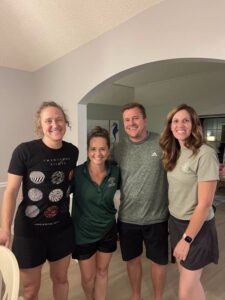
Founders from left to right, Jessica Geary, Danielle McLean, Ryan Sandgren, and Megan Knowles. Courtesy of Keystone Education Center
The story of Keystone Education Center underscores so many distinctive subplots happening in Florida, the most choice-rich state in America.
For one, it’s not a school. That’s significant because as Florida leads the nation in the transition from school choice to education choice, more diverse options like tutoring centers, hybrid homeschools, and a la carte providers are on the rise.
The teacher empowerment angle is key, too. The former public school teachers who co-founded Keystone join a growing list of teachers who are finding choice is giving them the power to create what they think is best, rather than submit to bureaucracies they find smothering. A number of them are creating options, like this one and this one and this one, that are specifically for students with special needs.
Sandgren comes from a family of public school educators. He said he’s always been passionate about helping students with special needs develop their talents. But sometimes, in traditional settings, obstacles creep into the way, like, in his view, too much emphasis on standardized testing, or classes with such a wide variety of special needs, no student truly gets the instruction they need.
“There came a breaking point,” he said.
Keystone is also another good example of the barriers that continue to challenge education entrepreneurs even when robust choice programs are in place.
The founders had no problem attracting families who wanted an alternative to traditional schools. “I didn’t need to do a market analysis,” McLean said. “I knew there was a gap for kids like mine.”
But finding a building that was affordable and accessible? Different story.
McLean said the pickings were so slim, the founders considered signing a lease for a building that would have cost $8,000 a month. Fortunately, McLean was relentless in reaching out to local pastors. and one of them offered church space for a fraction of that cost.
Keystone’s founders plan to add a grade a year through high school. They’re emphasizing small class sizes, best practices from applied behavioral sciences, and character development to nurture lifelong learners who can “thrive beyond the classroom as kind, contributing citizens.”
“We want to make learning applicable to real life,” Sandgren said.
The center’s schedule reflects those goals.
Mondays are for recreational activities and social clubs. The founders wanted to make sure students eased into the week and started on a joyful note.
Tuesdays, Wednesdays, and Thursdays are for core academics.
Fridays are for field trips. Publix, the movie theater, the bowling alley – anywhere, McLean said, where community-based instruction can help students work on functional skills.
Geary, who worked in public schools for 10 years, said she’s grateful for Florida’s choice programs and what they’re allowing her to do as an educator.
Having meaningful input into core components like curriculum and scheduling and assessment is a pleasant contrast to the dynamic in district schools, she said. Recently, the team at Keystone called a local business that offers sailing lessons to see if it could accommodate Keystone students on a field trip. (The answer was yes.)
“I could never do something like that at the district,” Geary said.
The rush of creating your own option, she continued, is “better than I ever though it could be.”

