
Keith Jacobs II, affectionately called "Deuce," with his parents, Keith and Xonjenese Jacobs. Photos courtesy of the Jacobs family
When our son Keith — affectionately known as “Deuce” — was diagnosed with autism spectrum disorder at age 3, we were told he might never speak beyond echolalia (the automatic repetition of words or phrases). Until age 5, echolalia was all we heard.
But Deuce found his voice, and with it, a unique way of seeing the world.
He needed to find the right learning environment, with the assistance of a Florida education choice scholarship.
Deuce spent his early academic years in a district public school, supported by an Individualized Education Plan (IEP). Despite the accommodations, learning remained a challenge. We realized that for some, a student’s success requires more than paperwork. It requires community, compassion, and collaboration with the parents.
Imagine having words in your head but lacking the ability to communicate when you need it most. That was Deuce’s experience in public school. His schools gave him limited exposure to social norms and rigor in the classroom. Additionally, through his IEP, he always needed therapy services throughout the school day, which limited his ability to take electives and courses he enjoyed.
His mother and I instilled the importance of having a strong moral compass and working hard toward his social and academic goals. Although we appreciated his time in public school, we knew a change was needed to prepare him for post-secondary education. We applied and were approved for the Family Empowerment Scholarship for Students with Unique Abilities.
Knowing the potential tradeoffs of leaving public school and the IEP structure behind, we chose to enroll Deuce at Bishop McLaughlin Catholic High School in Spring Hill, about 35 miles north of Tampa. We believed the nurturing, faith-based environment would help him thrive. It was the right decision.
Catholic school provided Deuce with the support he needed to maximize his potential. Despite his autism diagnosis, he was never limited at Bishop. He was accepted into their AP Capstone Program. This was particularly challenging, but Bishop was accommodating. The school provided him with an Exceptional Student Education (ESE) case manager dedicated to his success, and he received a student support plan tailored to his diagnosis and learning style. The school didn’t lower expectations; instead, it empowered him to take rigorous coursework with the right guidance.
Any transition for a child with autism will take time to adjust. On the first day, I received a call: Deuce had walked out of class. This was due to his biology teacher using a voice amplifier. The sound overwhelmed Deuce’s senses, and he began “stimming”— rapidly blinking and tapping his hands. Instead of punishing him or ignoring the issue, the staff immediately reached out.
Together, we crafted a Student Success Plan tailored to Deuce’s needs, drawing from his public school IEP without being bound by it. His plan included preferential seating, frequent breaks, verbal and nonverbal cueing, encouragement, and clear direction repetition. For testing, he was given extended time, one-on-one settings, and help understanding instructions.
These adjustments made all the difference.
Throughout high school, Deuce maintained a grade-point average of over 4.0 while taking honors, AP, and dual enrollment courses. Additionally, he was inducted into the National Honor Society and Mu Alpha Theta Math Honor Society while also playing varsity baseball. Because of his success at Bishop, he will continue his educational journey at Savannah State University, where he will major in accounting and continue to play baseball.

Deuce Jacobs earned an academic scholarship to Savannah State University, where he plans to major in accounting and continue playing baseball.
Catholic schools in Florida increasingly are accommodating students with special needs. The state’s education choice scholarship programs have been instrumental in making Catholic education available to more families. Over the past decade, during a time when Catholic school enrollment has declined across much of the nation and diocesan schools have been forced to close, no state has seen more growth than Florida.
At the same time, the number of students attending a Catholic school on a special-needs scholarship has nearly quadrupled, from 3,004 in 2014-15 to 11,326 in 2024-25. Clearly, many families are choosing the advantages of a private school education without an IEP versus a public school with an IEP.
So, I’m puzzled why federal legislation being considered in Congress, the Educational Choice for Children Act (ECCA), includes a mandate that that all private schools provide accommodations to students with special education needs, including those with IEPs.
Although more and more students with special needs are accessing private schools, not every school can accommodate every student’s unique needs (which is also true of public schools). And, as I learned with Deuce, some schools can accommodate students more effectively if they aren’t bound by rigid legal mandates and have the flexibility to collaborate with parents who choose to entrust them with their children’s education.
If the IEP mandate passes, it would prohibit many schools from accepting funds through a new 50-state scholarship program, undermining the worthy goal of extending educational choice options to more families. The U.S. Conference of Catholic Bishops has called it a “poison pill” that would “debilitate Catholic school participation.”
Bishop McLaughlin’s willingness to partner with me as a parent not only allowed Deuce to succeed academically but also gave him the dignity and respect every child deserves. IEPs work for many. For others, like Deuce, it takes something more like collaboration to build a path forward together.
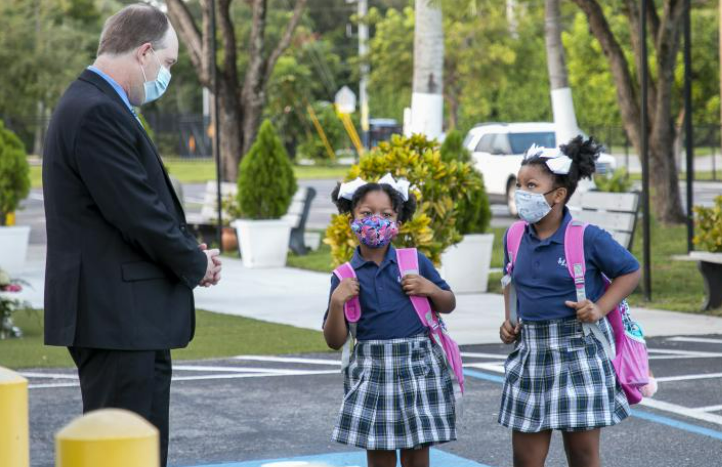
Jim Rigg, superintendent for the Archdiocese of Miami, credits Florida’s education choice programs for having a "profound impact” on nearly 10,000 students in his area and hopes such empowering opportunities can be expanded to benefit students nationwide.
Editor’s note: reimaginED senior writer Lisa Buie provided a Florida context to this national story that appeared recently in New Jersey’s Catholic Star Herald.
The United States Conference of Catholic Bishops and Catholic education leaders are urging support for a federal school choice bill that is poised to aid families whose children attend Catholic schools. The Educational Choice for Children Act would create a new tax credit for donors who give to scholarship awards, which would increase available scholarship funding.
Mary McElroy, assistant superintendent for government programs for the Archdiocese of Newark, has voiced support for the bill, saying it would benefit students who attend Catholic schools in every state because families who meet the income requirements would have significantly increased ability to apply for scholarships for their children to attend Catholic schools.
Florida Catholic school leaders also are encouraging the House and Senate to approve the legislation, saying it would further enhance options in a state that has long been a national leader in education choice.
“We are so blessed here in the state of Florida to have such a robust school choice scholarship program that serves families that otherwise would not be able to afford the option of a private school, in our case a Catholic school,” said Deacon Scott Conway, superintendent for the Diocese of St. Augustine.
“Thank you to our legislators, this past year we served over 5,000 students who received one of the scholarships and anticipate our 2022-23 scholarship recipient numbers to be substantially higher. This program has enabled families who could not afford a Catholic school, children with unique abilities, active law enforcement, and active military, to now have options they could not imagine before.”
Jim Rigg, superintendent for the Sunshine State’s largest Catholic School district, the Archdiocese of Miami, said Florida’s choice programs have had “a profound impact” on nearly 10,000 students in his area. He hopes such empowering opportunities could be expanded to benefit all students nationwide.
“Parents deserve to have the choice of where to educate their child, and a federal program would help establish true equity in school selections for families of all backgrounds,” he said.
The federal legislation, which has garnered support from entities like the Invest in Education Coalition, has been praised as a measure that will expand educational freedom and opportunity for youth across the country.
“A legacy of families’ struggles during the pandemic with school closures, mandates, and transparency is the increase in families across the country who are looking for schools that more closely align with their faith and values,” McElroy of Newark said. “This federal bill puts control in choosing an education that fits their family into the hands of parents.”
The legislation in its current form stipulates that scholarship funds could support tuition, fees, curriculum needs, technology and special education services, among other expenses, to be determined by the organizations granting scholarships. The federal bill defines eligible students as those in elementary or secondary institutions, including homeschool, who reside in households with incomes at or below 300% of the median income level in their area.
“I support federal policy providing families in all 50 states access to the school of their choice, and I applaud the design and protections in your bills,” Bishop Thomas A. Daly, chairman of the USCCB Committee on Catholic Education, wrote in a letter to the bill’s sponsors.
“The Educational Choice for Children Act does not create a new federal education program, nor does it compel states to create a new program. Rather, the act provides students opportunity for scholarships exclusively through individual or corporate philanthropy.”
Daly adds in his letter, “These protections ensure that private and religious institutions can participate, including almost six thousand U.S. Catholic schools.”
The USCCB encourages Catholics to contact legislators and urge them to support the legislation through co-sponsoring the bill. As of mid-August, the Senate version of the bill had nine co-sponsors and the House version had 27.
“In supporting this legislation, Catholics are supporting a key part of their own parishes and saying that Catholic education is important to offer to all families both now and in the future,” McElroy said.
To learn more and to access an online platform for communicating with federal representatives, visit the USCCB’s Action Center at www.votervoice.net/USCCB/Campaigns/96808/Respond.

