The story: Students with disabilities and English language learners were poorly served before the pandemic and will need urgent, long-term help to recover from learning losses, according to a report from the Center for Reinventing Public Education.
The Arizona State University think tank released its annual State of the American Student report today, with a bit of good news but mostly bad news.
“Our bottom line is we’re more worried at this point than we thought,” said Robin Lake, the center’s executive director. “COVID may have left an indelible mark if we don’t shift course.”
The good: Students are bouncing back in some areas. The average student has recovered about a third of their pandemic-era learning losses in math and a quarter in reading.
States and districts nationwide have implemented measures like tutoring, high-quality curricula, and extended learning time, and more school systems are making these strategies permanent. Florida, which offers the New Worlds Scholarship for district students struggling in reading and math, is on a list of states lauded for providing state-funding for parent-directed tutoring.
 Rigorous evaluations confirm the effectiveness of tutoring at helping students catch up.
Education systems across the country – as well as students and families – are starting to recognize the value of flexibility. “As a result, more new, agile, and future-oriented schooling models are appearing.”
That includes microschools and other unconventional learning environments, which are multiplying to meet increasing parent demand.
The bad: These proven strategies aren’t reaching everyone. The recovery is slow and uneven. Younger students are still falling behind. Achievement gaps are also widening with lower-income districts reporting slower recoveries. And the positive studies that show tutoring’s massive boosts to student learning tended to operate on a small scale. Making high-quality academic recovery accessible to every student remains an unmet challenge.
Districts face “gale-force headwinds,” including low teacher morale, student mental health issues, chronic absenteeism, and declining enrollment.
The ugly: The report singled out services to vulnerable student populations for a special warning. The report said this group, poorly served before the first COVID-19 infection, suffered the most. Evidence can be found in skyrocketing absentee rates and academic declines for English language learners.
Special education referrals also reached an all-time high, with 7.5 million receiving services in 2022-23. The report attributed some of this to the pandemic’s effects on young children, especially those in kindergarten who were babies at the pandemic’s onset, but other factors, such as improved identification techniques and reduced social stigma around disability, are also at play.
In short, school systems face larger numbers of students requiring individualized support than ever before.
‘Heart-wrenching struggles’: While some families adapted well, most parents reported difficulty getting services for their children with unique needs. Schools were often insufficient in their outreach. Even the most proactive parents reported difficulty reaching school staff, the report said. Parents who were not native English speakers also had the additional burden of trying to teach in a language they were still learning.
“Many families said schools didn’t communicate often or well enough, and many parents felt blindsided when they found out just how far behind their child had fallen,” the report said.
Recommended fixes: Schools should improve parent communication. The report called for schools to “tear down the walls” by adding schedule flexibility to ensure students’ special education services don’t conflict with tutoring and adding more individual tutoring and small-group sessions. It said schools should also seek help from all available sources, including state leaders, advocates and philanthropists. Schools should also prioritize programs such as apprenticeships and dual enrollment to prepare students for life after graduation.
How policymakers can help: The report urged policymakers to gather deeper data on vulnerable populations so problems can be identified and corrected; provide parents with more accurate information about their children’s progress and offer state leaders a clearer picture of whether those furthest behind are making the progress they need, and help teachers use AI and other tech tools to engage students with unique needs.
The report urged policymakers to place more control in the hands of families by making them aware of their right to compensatory instruction or therapies for time missed during school closures. It also advocated offering parents the ability to choose their tutors at district expense.
The bottom line: Urgent efforts to improve education for students with exceptional needs will benefit all students, the report said. “There can be no excuse for failing to adopt them on a large scale. National, state, and local leadership must step up, provide targeted support, and hold institutions accountable.”
SARASOTA, Fla. — It was time for the valedictorian to address the assembly, so Emma Howey rose from her seat in the front row of the auditorium, left her walker behind, and, with the help of her favorite teacher, made her way to the edge of the stage.
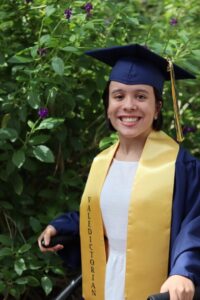 “I can’t believe I’m doing this,” she remembered thinking last May as she graduated from CES Academy of Bradenton.
Emma was born with cerebral palsy and has used a walker since she was 3. But, two years earlier, at the end of her sophomore year, Emma set a goal of walking across the stage at graduation.
Emma’s only concession was that CES Academy teacher Charlie Stephenson would walk beside her holding her hand to help her balance. The rest would be all Emma, the result of 24 months of carefully planned occupational and physical therapy.
Also, determination.
And grit.
Emma’s walk of a lifetime required her to climb the six steps to the stage, turn left, and then walk 25 steps to the podium.
“I gotta do this,” she remembered thinking when she reached the foot of the staircase.
And she did.
The audience clapped, and someone shouted, “EMMA!” as she marched before them. She smiled as her goal became reality.
Emma’s voice grew with confidence as she read her speech that ended with this message:
“Graduates, always remember to keep focused, don’t lose hope, and never give up.”
A few minutes later, Emma made the trip again, this time to receive her diploma.
“It was,” she would tell her family afterward, “the best night of my life.”
A big idea
Emma, now 19, attended CES Academy with the help of the Family Empowerment Scholarship for Students with Unique Abilities. Managed by Step Up For Students, the scholarship functions as an education savings account (ESA), which gives families more flexibility in how they spend their students’ funds. Over the years, Emma has used the ESA to purchase a therapy swing, an exercise trampoline, and an iPad. It paid for her hippotherapy, a type of equine-assisted therapy. The ESA also covered tuition at her private K-12 school that serves children with educational exceptionalities.
“I really learned to be on my own there,” she said.
Emma, who lives in Sarasota with her mom, Jennifer, attended her district school through the fifth grade but struggled with the large class sizes. Navigating hallways was difficult given the number of students trying to get to classes. Opening doors can be a chore for Emma, and her schoolmates weren’t always eager to lend a hand.
CES Academy could better accommodate her needs, especially when she met Charlie Stephenson.
“He always focused on what I could do, instead of what I couldn't. That was something different,” Emma said.
Emma thrived in CES Academy’s academic setting. She was an honor student who tutored other students and was a star in the school’s Mighty Knights program, where juniors and seniors were paired with K-3 students.
“Emma was awesome working with those little kids,” said Mike Van Hoven, who was CES’s principal last year and now teaches science at the school.
Emma was born prematurely and suffered a brain injury at birth, that led to cerebral palsy which affects most of her muscles. She also has neuromuscular scoliosis. She’s had surgeries to lengthen her legs and to correct fatigue in her eye muscles. She wears braces on her legs while using her walker or crutches.
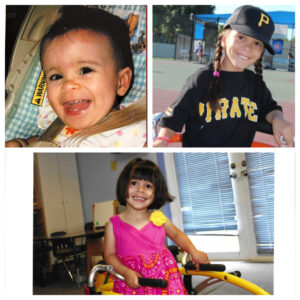 She also plays the piano and can speak Spanish, Italian, and sign language. Among the items on her bucket list are trips to Paris and Italy.
She loves to swim.
“I can walk in the pool. I still don't understand that,"” she said. “How can I get on land and not do it? It's like the reverse Ariel, like the Little Mermaid.”
Emma is currently in vocational rehab as she looks for a job. She’s applied for positions to work the front desk at a hotel, the reception desk at a nursing home, and for a position at a library.
“I’m a people person,” she said.
Emma refers to herself as disabled but won’t let that define her.
“I don't let that limit me (trying) to be the best of my ability,” she said. “There’s stuff I can't do, but I try not to let that get in the way.”
One thing that does get in the way is her walker when it comes to climbing stairs. She always stood in front of the stage when she received awards at school while her classmates walked across the stage.
In 2019, Emma’s brother Jonathan graduated from high school. She watched him walk with his class and had an idea.
‘This is going to happen’
Ouida Wellenberger was a physical therapist and Sharon Yadven was an occupational therapist at Kidspot in Palmetto. They worked with Emma for years.
Emma told them about watching Jonathan walk with his class.
I want to do that,” Emma said.
“Let’s go for it,” Wellenberger said.
“This is going to happen,” Yadven said.
In 2022, the three began working toward that goal.
Emma’s mom, Jennifer, knew it was an ambitious quest. Could her daughter physically reach such a demanding goal? Possibly. After all, this is the same girl who spent one summer learning to hit a pitched baseball from Jonathan after she learned she was the only player in her age group in the Miracle League of Manasota still hitting off a batting tee.
“She's always been very strong-willed and determined,” Jennifer said. “She’s done a lot of things in therapy that she did not like, but she knew she had to do it, so she did it.”
“No matter what we threw at her, she accepted it, worked on it, and did it,” Wellenberger said. “The neat thing was that it was her goal, and it wasn't someone else’s.”
Team Emma immediately went to work on increasing Emma’s strength and stamina with incredible attention to detail. They walked the city block from Kidspot to the old Palmetto library to build Emma’s tolerance. They used the stairs in front of the building to strengthen Emma’s legs so she could lift them high enough to clear a step.
Once Emma decided Stephenson would walk with her, Yadven walked alongside Emma with her left hand at the same height as Stephenson’s so Emma was used to holding her right hand at that height.
Emma practiced letting go of Stephenson’s hand so she could turn and receive her diploma with her right hand.
A few months before graduation Emma learned she was valedictorian. That threw a wrench into the plans. Now Emma had to build endurance so she could stand for three minutes, which was the allotted time for her speech.
And walk across the stage – twice.
Emma has a startle reflex, which is an involuntary response to sudden noises. Because of that, Wellenberger and Yadven blasted “Pomp and Circumstance” and “He's a Pirate” from the movie “Pirates of the Caribbean” to get Emma used to sudden noises she might hear on her big night, like someone shouting her name as she walked across the stage or the standing ovation she received after her speech. That could cause her to lose her balance.
“We covered everything and more because we wanted to overprepare,” Emma said.
Stephenson attended a couple of Emma’s therapy sessions to practice the walk. Wellenberger and Yadven visited Bayside Community Church in Bradenton – the site of the graduation ceremony – to measure the height and width of the steps to the stage.
“So many things that so many of us take for granted, she has to work really hard to do, and she did not falter in her commitment toward working toward that goal,” Yadven said. “And not only did she not falter, really, but she grew in her determination and her excitement. It was an amazing process to share with her.”
‘I feel I can do anything’
Emma wasn’t sure how to approach Stephenson about assisting her, so she wrote him a letter. She explained how much he meant to her and why he was the right person for the job. Stephenson cried when he read it.
“I was overwhelmed,” he said. “It was a huge honor.”
Then Stephenson left his job at CES Academy and returned to his native Michigan to attend to a personal matter. But he told Emma he would be back for graduation.
“There wasn’t a chance I was going to miss that,” said Stephenson, who retired as a teacher after last school year. “I couldn’t have asked for a better sendoff from my teaching career. It was magical.”
Van Hoven, her former principal, said in his 40 years of teaching he’s never had a student whom he respected as much as he respected Emma.
“Every teacher in that school, she’s touched their heart,” he said.
Emma’s walk was the talk of CES Academy of Bradenton’s 2024 graduation.
“In the sense of goal setting, that proved to me and everyone else that I have the ability – anyone has the ability – to set a goal and hit it, no matter what obstacles,” Emma said. “I feel I can do anything, really.”

Last week, I watched a panel hosted by Harvard University on “Emerging School Models: Moving from Alternative to Mainstream.” During the discussion, John Kirtley of Step Up For Students noted that Step Up had allowed ESA families to purchase paddle boards because they were a useful form of balance therapy for children with disabilities. Kirtley noted that children with disabilities could develop balance and strength because they fall in the water without getting hurt.
“We saw that as a legitimate physical education activity,” Kirtley said. “I guess that was viewed differently by others.”

Stand Up Paddle Boarding Aquatic Therapy (SUPAT) is in fact a therapy that is being practiced and is being formally evaluated in medical journals, for example, regarding benefits for students with cerebral palsy:
These findings support the notion that the SUPAT program is beneficial for increasing gross motor function, improving balance, and decreasing the number of falls. SUPAT could be a viable alternative therapeutic intervention to traditional aquatic therapy and an opportunity to participate in an outdoor sport.
A Georgia newscast segment provides a glimpse into SUPAT therapy in action.
“We are showing them the world that doesn’t need to be inside a clinic,” program instructor Alyssa Walz explained. “A paddle board is an unstable surface, so just sitting on the board, even if you are not doing anything on the board, you are working on your core.”
According to the segment, paddle board therapy provides an activity “where you can stand tall and independent in a world that might focus on the things you cannot do.”
"How do I know it's working? I see it! I see kids go from not being able to stand on an unstable surface to standing on the paddle board standing by themselves,” Walz said.
Alas, there has been no small amount of effort put into scoring cheap political points, both by choice opponents and by journalists. For example:
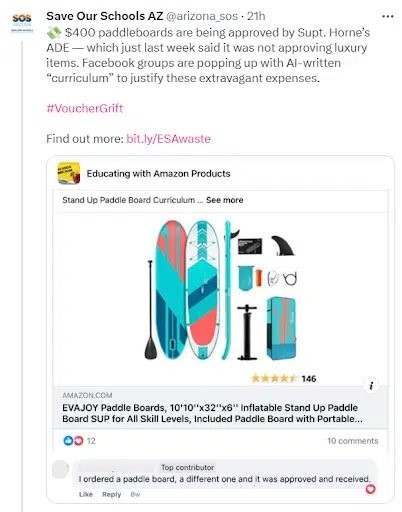
Journalists tend to be drawn like moths to a flame to something that sounds controversial and don’t always bother to gather much in the way of context. Here is an example:
 The much dreaded “raised eyebrow” can at times translate into “repeating uninformed grousing by opponents eager to take things out of context.” As Alan Kay once famously noted:

In a discussion of this issue on the platform formerly known as Twitter, Isabella Lopez, the parent of a child with a disability noted:
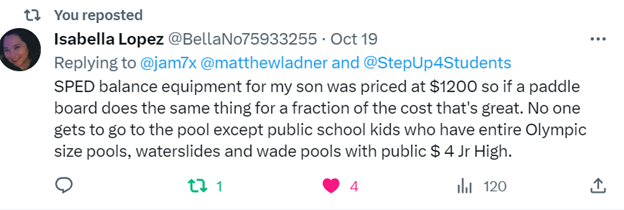 Lopez makes a crucially important point: it is of unspeakable importance to give people the space and flexibility to try new approaches. Experimentation is literally the engine driving progress: novel approaches that improve the human condition. The ESA mechanism gives families the incentive to maximize the utility of funding by seeking not just good education services, but the optimal services for the individual needs of a particular child.
SUPAT, thus must compete with other techniques-Equine therapy for example, which is also used to develop core body strength for students with disabilities and has also been the subject of poorly thought-out efforts to discredit ESAs. I’ve even seen grousing from choice opponents that public school students don’t often get access to innovative therapies.
Whose fault would that be? Remember that most ESA students are only receiving a fraction of the average weighted total per pupil funding provided to students in districts. Could it be that hopelessly complex bureaucratic structures with overlapping and sometimes contradictory local, state and federal governance authorities are not the ideal context for innovation?
In any case, dear reader, you’ll continue to see this sort of grousing from opponents, and the allure of a controversial headline will be too much for reporters to resist. Just recall going forward that for any ESA purchase, context is crucial.

