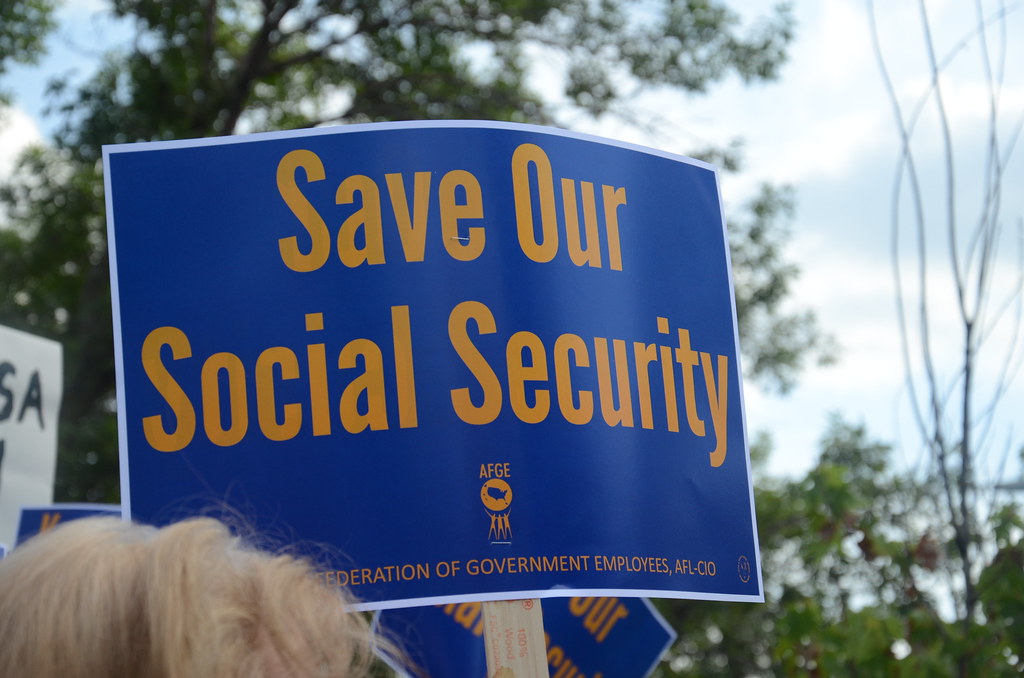
Programs that are open to everyone, like Social Security, are often politically untouchable
Over the years, we've aired debates about the best way to design education choice scholarship programs. One key question has been eligibility. Should programs be open to all students? Or should they be targeted to students with the highest needs?
I've tried to lend a sympathetic ear to both sides of the debate. Most of the time, my sympathies tended toward the latter position.
When the Urban Institute released its first study on the program's impact on students' educational attainment, it noted that scholarship students were "triply disadvantaged. They have low family incomes; they are enrolled at low-performing public schools (as measured by test scores), and they have poorer initial test performance compared with their peers."
When Florida's teachers union and other groups sued to shut down Florida Tax Credit Scholarships, the program's supporters derived great moral authority from the fact that scholarships were reserved for low-income students. The lawsuit, eventually dismissed, threatened to oust tens of thousands of children from schools their parents had chosen and likely could not access by other means.
Now, Florida is shifting to universal eligibility for its educational choice scholarships. And that's clearly the direction of the national movement. Programs created or expanded across the country are increasingly open to all, or nearly all, K-12 students, rather than specific disadvantaged groups.
Proponents of universal programs tend to argue their approach is politically advantageous. Public schools, national parks, and Social Security have two things in common: They are open to all Americans (or at least claim to be), and they are politically untouchable. Programs targeted at narrower slices of the population tend to be more vulnerable to political upheaval.
I've rethought my own prior beliefs on targeted programs for different reasons. Universal programs could be more effective at providing sustainable help to families, for several reasons.
1. Simplicity
When families apply for targeted programs, they have to prove they're eligible. Verifying a family's income can be cumbersome. They may work multiple part-time jobs. Some of those jobs may pay them in cash. They may not have a computer at home, and find themselves downloading bank statements or juggling government documents on a mobile phone.
This likely helps explain why only 82 percent of families who qualify for federal Supplemental Nutritional Assistance Program benefits actually participate in the program. And the participation rate is even lower (72 percent) among the "working poor," a group the program is specifically designed to help. Notably, these workers have to prove their income to qualify for nutrition assistance, where other individuals have more options, such as age or disability status, to prove their eligibility.
The need to prove income in targeted education choice scholarship programs likely creates barriers for families the programs are intended to help.
2. Stability
Whenever a program has an income-based cutoff for eligibility, it creates distorted incentives for people with incomes near the cutoff.
For example, Alabama's newly expanded tax credit scholarship program is now available to families with incomes up to 250 percent of the federal poverty level, or $75,000 for a family of four.
A public-school teacher in Alabama might earn $55,000 per year. Even if their spouse works part time to bring in some additional money, their household could likely qualify for two scholarships worth up to $10,000 each under new legislation passed this year. However, if that spouse decided to go to work full time (perhaps because both kids are now school age), they'd risk losing the scholarships. That might not wipe out all of the financial advantages of taking a full-time job, but it would offset them substantially.
Some programs allow families with higher incomes to receive partial scholarships, which helps smooth some of these eligibility cliffs. Universal programs eliminate them entirely.
3. Stigma (or lack thereof)
Researchers have identified two major forms of stigma that affect people applying for means-tested social service programs.
First, potential beneficiaries of these programs tend to expect poor treatment, assuming the quality of service will be low. Second, they feel applying for programs aimed at disadvantaged groups harms their self-identity. Bluntly, they perceive applying for such programs as seeking a handout.
This stigma can sometimes show up in schools. A school where any student can be a scholarship student is more likely to be a school where all students are treated equally. Making a program open to everyone might be a program to which families are less hesitant to apply.
Other ways to prioritize the needs of low-income families
As they become open to broader swaths of students, educational choice scholarship programs should still prioritize students with the highest needs.
For starters, any program with a limited number of scholarships available should send students from lower-income families to the front of the line. Florida's program, expanded under HB 1, sets two income-based priority levels for students who apply: Those with incomes below 185 percent of the federal poverty level, and those with incomes up to 400 percent of the federal poverty level. This ensures low-income families take priority, and middle-income families take priority access before more affluent families.
In addition, to the extent possible, the amount of funding each student receives should be tailored to their level of need. Florida's scholarships for students with unique abilities allow those with more complex needs to receive larger funding amounts. Similar logic could apply to students from low-income households, who might need help paying for supplemental tutoring, flexible transportation, or other services that affluent families can afford more easily, and that scholarship funds can help purchase.
Matthew Joseph of ExcelinEd recently outlined strategies states can use to identify low-income students for supplemental funding while limiting the additional hoops families and educators have to jump through. For example, states can provide additional funding to every student who qualifies for Medicaid, using data the state government should already have.
The goal should be to combine the virtues of universal programs (simplicity, stability, and a lack of stigma) and targeted programs (prioritizing resources for the students who need them most). That remains a work in progress.
 Editor’s note: This commentary from Christian Barnard, senior policy analyst at Reason Foundation, appeared Monday on the foundation’s website.
The argument that private school choice programs save taxpayer money has been compelling and straightforward for decades. Most private school vouchers, tax credit scholarships, and education savings account programs have had income-based or other eligibility limits that ensured most school choice program participants—usually between 85 and 95% -- were previously public school students.
This high “switcher” rate—the share of school choice program participants who were previously enrolled or would have enrolled in public schools—saves taxpayer money because choice scholarships are cheaper than public schools. That’s why proponents have been able to argue that both participating families and taxpayers benefit from private school choice.
But in today’s policy environment, where states are adopting universal school choice programs—like Arizona, Arkansas, West Virginia, and Florida have recently—the taxpayer savings argument becomes more complicated.
By definition, universal school choice is available to all students. This makes it a far more impactful and widespread choice program but complicates the key variable responsible for fiscal savings—switcher rates.
When fully implemented and assuming there are no cost caps, universal school choice programs are open to entire populations of students already attending private schools or being homeschooled, and these students weren’t previously receiving taxpayer support.
This is new territory for school choice proponents since past programs were primarily designed to target low-income families or students with disabilities who were likely to be enrolled in public schools. By making choice scholarships quickly available to non-public school student populations with little incentive not to take the taxpayer funds, universal school choice programs have lower up-front switcher ‘
To continue reading, click here.
 Editor’s note: This commentary from Daniel Martnez, director of external affairs for Americans for Prosperity – Florida and a reimaginED guest blogger, is an exclusive to reimaginED.
The 2023 legislative session was truly historic, marking the beginning of truly meaningful education choice for parents across the state. This will result in even brighter futures for Florida's children. By enacting HB 1 into law, state leaders have dramatically boosted the opportunity for every child in the state to receive an education carefully tailored to their individual needs.
Major school choice reform was the number one legislative priority of Americans for Prosperity-Florida, and we couldn’t have achieved this success without a supportive Legislature – and, equally important, the overwhelming support of our members across the state.
So, when the new law takes effect July 1, what will it mean for you and your family? The biggest change is that it allows all Florida children to have Education Savings Accounts (ESAs), which will provide families with the freedom and flexibility to use state education funds to open up a wide range of education options – including public, private, magnet, or charter schools or home education, whether online or in person.
This legislation guarantees that the state money allocated for each student follows them, even if they leave the one-size-fits-all monolith of traditional public schools. Students and their parents will now be able to make the choice that’s best suited for each child’s unique abilities – opening access and opportunity by removing the barriers that ZIP codes or financial status currently pose for students hoping to receive a different form of education.
How can your family take advantage of this new educational opportunity? We expect school choice to be in full effect quite soon, so to begin your application, you’ll need to provide:
Once approved, you’ll be able to access a portal where you can view your funds and apply the money toward tuition and other pe-approved expenses.
To learn more about the scholarship programs, visit the Florida Department of Education.
As Florida continues to be a trendsetter in education, showing other states the path to true educational excellence, we look forward to seeing the far-reaching positive impacts of this education reform. We’re confident that it will continuously transform education in our state for the better, changing the lives of young Floridians and their families.
None of this would have been possible without Florida’s dedicated leaders, especially House Speaker Paul Renner and bill sponsors Rep. Kaylee Tuck, Rep. Rene Plasencia, Sen. Corey Simon. We thank them for their dedication to ensuring brighter futures for all of Florida’s children. With leadership like this, Florida will continue to lead the way for years to come.
 Editor’s note: This commentary from Jeff Yass, co-founder and managing director of Philadelphia-based Susquehanna International Group and an early investor in TikTok, appeared Tuesday on forbes.com.
Milton Friedman was not only a brilliant economist, but he was prescient on the potential for markets to drive a demand for education freedom. In 2005, when educational mediocrity was on the rise, he predicted there would be a breakthrough in how we deliver education. “We shall get a universal voucher plan in one or more states,” he said.
And sure enough, Friedman was right, even if his prediction was a long-time coming and not yet fully realized.
He first discussed his idea for universal education savings accounts in his 1955 essay, “The Role of Government in Education.” Arguing that empowering parents with the right, and resources, to choose schools for their children would spur competition. With these financial resources, Friedman wrote:
“Parents could express their views about schools directly, by withdrawing their children from one school and sending them to another…” This, Friedman reasoned, would lead to greater efficiencies, cost effectiveness and improved overall quality of education.
Friedman’s thoughts weren’t put into action until 34 years later when, in 1989, Wisconsin passed the nation’s first funding legislation. To be fair, the motivation here was not to test Friedman’s economic theories. It was far more personal and practical. Milwaukee public schools were failing to provide children with an education and parents had no way to enroll them elsewhere.
To address this crisis – and for the families whose children were trapped in failing schools, it was a crisis – Wisconsin adopted the Milwaukee Parental Choice Program. Authored and championed by education freedom pioneer, Assemblywoman Polly Williams, the program was the first in the nation to allow public funds to be used to help low-income families enroll in private schools and to give parents options in where their children were educated.
To continue reading, click here.
Editor’s note: This commentary from Patricia Levesque, chief executive officer for ExcelinEd, appeared recently on the ExcelinEd website.
In the span of just a few years, more than a dozen states have gone from nibbling at the edges of school choice to a full-throated embrace of universal education scholarship accounts or targeted ESA programs. These life-changing opportunities offer families the ability to customize a child’s education in ways we policy wonks could only dream of when the parental choice movement first began to take shape decades ago.
With unencumbered choice policy sweeping the nation, there’s no turning back: Families who have access to K-12 options will not have to accept a school that’s assigned to them based on where they live.
For those new to the most flexible form of school choice: Universal ESAs empower parents to pay for myriad educational expenses, including tuition, textbooks, therapies, exam fees, technology and other educational materials.
Universal choice means students can attend a private school, supplement their education with tutoring or technology, participate in a home education program or enroll in public school part-time to access their courses of choice. Unlike traditional voucher programs—which historically were designed to serve low-income families, students with special needs or families with children in failing schools—universal choice programs, including ESAs, are available to all families, regardless of income or school district.
But as we know from states like Florida, Arizona and Indiana, where public and private school choice have been the law of the land for some time, passing a program is just the beginning. I was pleased to recently join advocates from those states for a podcast exploring what comes next for states as they set up their educational choice programs.
The answer is simple: Implementation is everything, and implementation is so much more than setting up an initial framework.
For parents to use ESAs effectively, they must first know that the program exists. There also must be a clear and streamlined process for setting up the scholarship accounts, a user-friendly approach for managing funds and a comprehensive list of eligible schools and providers from which parents can choose.
And beyond these basics, lawmakers and public officials in states that have universal ESAs will likely need to tackle several big policy issues as their implementation of universal school choice moves forward:
SUFFICIENT FUNDING FOR ALL ESA STUDENTS: Is there sufficient funding for the program, especially when it comes to funding that follows low-income students, students with special needs and other at-risk students?
FUNDING AT ALL LEVELS OF GOVERNMENT: Is local funding, not just state funding, following the student? States may need to make up for the local share or require local funds to follow the student to make that student financially whole.
TRANSPORTATION: Are parents able to access the educational options that work best for their children? The physical act of getting to a provider can be an enormous barrier for many families.
PRIVATE SCHOOL SUPPLY: We know that parent demand is growing for private and nontraditional schooling, but in many states the supply side is not keeping up. States might need to consider some supports similar to those created in the charter school space, such as revolving loan funds for school construction, low-interest state-supported financing and access to unused public school facilities.
LOCAL INTERFERENCE: Whenever choice expands, those who wish to maintain the status quo react. Opponents are finding less success with traditional legal challenges lately, as courts continue to find in favor of school choice programs. So, choice opponents are getting creative and turning to the local level, where interference can be less obvious, such as misuse or modification of zoning policy or health code provisions to prevent providers from serving families. States need to be on the lookout for attempts to thwart choice using local rules that were never intended to apply to K-12 education.
NAVIGATING CHOICE: States like Florida are thinking ahead to provide parents, especially low-income families, with navigation services to help them figure out how a program works so they can obtain the outcomes they seek for their children.
The passage of universal ESA programs across the nation means millions more students will be able to access customized learning options. However, in order for these programs to be as effective as possible, policymakers must continue to ensure seamless and smooth implementation that centers on parents, educators and service providers and allows for continued refinement as the program matures.

Editor’s note: This commentary appears in the Spring 2023 issue of Education Next.
America is in the midst of a parental choice revolution. In the past few months, five states—Arizona, Arkansas, Iowa, Utah and West Virginia—have adopted education savings account, or ESA, programs, which extend private-school-choice eligibility to all or most K-12 students.
These programs provide students with public resources for an array of education expenses, including tuition, micro-schooling, homeschooling, education therapies, and tutoring. Florida and Texas may soon join them, and other states seemed poised to adopt more modest private-school-choice programs.
Recently, Florida Gov. Ron DeSantis, a strong parental-choice supporter, questioned the wisdom of universal ESA programs, remarking, “I’d like to see the focus remain on … low income [and] middle class” families. DeSantis’s position is not unreasonable. For decades, parental-choice advocates have emphasized the need to expand the educational opportunities available to kids who lack the financial resources to exit public schools that fail them.
As Howard Fuller, an architect of the nation’s voucher program, once observed, parental choice is today “more of a rescue mission than a fight for broad societal change.” And Florida leads the nation in advancing that mission. Although 30 states have at least one private-school-choice program, nearly 25% of participating students reside in Florida, which has four.
There is tension between universal eligibility and this traditional case for parental choice: In universal programs, resources will necessarily go to wealthy children who do not need to be rescued. This is one reason that, until last summer, all private-school-choice programs restricted eligibility in one or more ways.
Unfortunately, as I detail in a new Manhattan Institute report, eligibility restrictions often impede the effective implementation of private-school-choice programs. While means-testing is relatively straightforward, it is frequently paired with other eligibility restrictions that undercut program effectiveness.
For example, both parents and participating schools find it difficult to navigate programs limited to students attending “failing” public schools or school districts, as currently proposed in pending legislation in Georgia. Not only do most private schools draw students from multiple school districts, but the criteria for designating districts and public schools as “failing” vary across states (and from year to year within them); they are also subject to manipulation by regulators.
Restricting eligibility to students who were previously enrolled in a district public school—another common eligibility requirement—saves money. But it also excludes otherwise-eligible students currently enrolled in private schools, which can generate resentment among families who have sacrificed to pay private school tuition.
Moreover, studies suggest that students almost always suffer some short-term learning loss when switching schools, so “switching” requirements are harmful to student learning. When these three eligibility restrictions—means-testing, a “failing” school or district, and prior public school enrollment—are combined, the result is many program participants arriving at their new schools in need of substantial remediation.
Other design elements also pose significant barrier to private-school-choice success. Approximately half of existing programs rely on tax policy to incentivize donations to nonprofits providing private-school scholarships. Many of these “scholarship-tax-credit” programs provide less than a one-for-one credit for donations to scholarship-granting organizations, impeding effective fundraising.
For example, legislation pending in Nebraska would give donors a 50% tax credit for donations to a support private-school scholarships. Not surprisingly, fundraising efforts in these programs often fall short, and the scholarships amounts provided through them are lower than voucher and ESA programs.
To continue reading, click here.
Editor's note: This guest post from StudentsFirst is authored by Vice President of Fiscal Strategy Rebecca Sibilia and fiscal policy analyst Sean Gill.
We appreciate Doug Tuthill’s recent redefinED post challenging StudentsFirst to consider supporting voucher or tax-credit scholarship programs that aren’t just limited to what he describes as the “failing schools” model. We agree with his assertion that school choice policies, including private school options, are about empowering parents to select the best school for their child.
It is true that we believe voucher programs should prioritize low-income students in low-performing schools. However, we want to make clear that this position is not based simply on a “politically safe compromise.” Indeed, our entire State Policy Report Card judges not what is politically popular, but rather the laws and policies we believe, through evidence, best practices, and common sense, will deliver the best results for kids.
We think it is important that states focus on more than policies that just provide access to schools; states must prioritize expanding access to high-quality choices for families that traditionally lack them. A Brookings study found that students from low-income households are much more likely to attend low-performing schools than middle or high-income students. This is important because the same study further confirms that low-income kids can actually achieve at high levels when they attend high-performing schools. Unfortunately, as Florida Education Commissioner Tony Bennett has mentioned, low-income families often lack the resources to enroll in potentially higher-performing private schools or to relocate to a school district that offers a better public education.
Policymakers must always consider tradeoffs and unintended consequences when considering how to budget limited resources. Consider if a state adopted a universal voucher program. This would provide the most theoretical choice, but it could also easily have the unintended effect of simply subsidizing the students already enrolled at private schools and those in families who may otherwise be able to afford private school tuition. This would result in few new students being able to attend a high quality school option, and wouldn’t expand access to those who need it the most. Presumably, avoiding this problem is one of the reasons why the Florida Tax Credit Scholarship program is currently limited to low-income children.
Using this logic, we believe that when state resources are limited or the existing supply of desirable private schools is limited, it also makes sense to prioritize vouchers or scholarships for those low-income children attending a low-performing school or living in low-performing school districts. There are practical, administrative considerations that also make targeted programs more effective. For instance, when looking at the state of Tennessee, where Gov. Haslam has proposed a voucher program, we’ve determined that the four districts with the lowest performing schools also have both higher concentrations of low-income families and private schools in their communities.
We find that most voucher and scholarships programs are capped by enrollment or appropriation levels. Given that low-income students can be found in most counties throughout a state, these caps then create an unintended consequence of spreading out scholarship recipients among multiple communities, which would not provide enough demand to create new private school options. (more…)
Editor’s note: Wendy Howard is executive director of the Florida Alliance for Choices in Education, which includes a broad range of school choice organizations. The views expressed here are her own and not that of FACE.
Four years after my daughter Jessica Howard began a petition drive to make it easier for students to access virtual education in Florida, she is still not eligible for the virtual provider of her choice. No wonder so many parents settle for learning options that may not necessarily be the best option. There is so much bureaucracy and public attack if a parent merely wants more choice.
As a parent advocate, I have met many parents who are desperate for just that.
One told me her child wrote a suicide note after severe bullying at her school, but fortunately everything turned out okay after they found another option. Another couldn’t transfer her child to a virtual school – despite severe allergies – because of the “seat time” restrictions that were in place at the time. Instead, she had to access a district’s “hospital homebound” program, which cost taxpayers an exorbitant amount of money.
In other cases, parents have children who are failing in the system, or are far ahead of the system, or are pursuing athletic or professional careers that require some reasonable flexibility with academic schedules. There are endless reasons why some families want to choose schools outside of their traditional zoned school, or prefer Option X to Option Y, or want to mix and match those options so their kids can thrive.
All of those parents and their stories have made me wonder: Why can’t we just let all parents decide? Why are we limiting their choices?
Why not all parents, all choices? (more…)
Editor's note: After redefinED posted Howard Fuller's comments about universal school choice, we asked the Cato Institute's Andrew J. Coulson for a response, which we published last week. To keep the debate going, we asked Matthew Ladner, senior advisor of policy and research at the Foundation for Excellence in Education, for his take. He generously offered the following.
 My friends Howard Fuller and Andrew Coulson started a needed discussion regarding the direction of the parental choice movement. Dr. Fuller has been quite outspoken in his opposition to universal choice programs in recent years, and Coulson raised a number of interesting and valid points in his redefinED piece. The parental choice movement has suffered from a nagging need to address third-party payer issues squarely. It’s a discussion that we should no longer put off. The example of American colleges and universities continues to scream a warning into our deaf ear regarding the danger of run-away cost inflation associated with education and third-party payers.
Howard Fuller and Andrew Coulson also indirectly raise a more fundamental question: where are we ultimately going with this whole private school choice movement? Dr. Fuller supports private choice for the poor and opposes it for others. He has concerns that the interests of the poor will be lost in a universal system. I’m sympathetic to Howard’s point of view. I view the public school system as profoundly tilted towards the interests of the wealthy and extraordinarily indifferent to those of the poor. We should have no desire to recreate such inequities in a choice system.
Andrew makes the case that third-party payer problems are of such severity that we should attempt to provide public assistance to the poor through a system of tax credits, and have other families handle the education of their children privately. Andrew’s proposed solution to the very real third-party payment issues is in effect to minimize third-party payment as much as possible, and to do it as indirectly as possible through a system of tax credits.
Despite the fact that Howard comes from the social justice wing of the parental choice movement and Andrew from the libertarian right, they agree that private choice should be more or less limited to the poor.
My own view is different from both Howard and Andrew’s. I believe the collective funding of education will be a permanent feature of American society and that it should remain universally accessible to all. I believe Howard’s real concerns over equity and Andrew’s real concerns over third-party payment can be mitigated through techniques other than means-testing. (more…)

