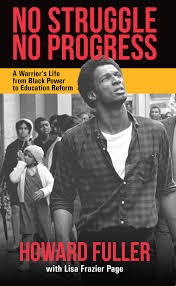
 In 1998, at a luncheon in Chicago, former superintendent, activist and now-icon Howard Fuller was on an education panel with an up-and-coming state senator. Barack Obama told the audience that vouchers were a “distraction,” and said those who support them don’t want to tackle the difficulties of changing the “entire system.”

Dr. Fuller
Fuller laments the spectacle of black leaders going toe to toe in public, but he did not shy from a retort. As he recalls in his just-released autobiography, “No Struggle, No Progress,” he answered from experience about teachers unions’ resistance to change, then lowered the boom:
“And you sit here and claim that we can make changes in the existing system? If you can do that, God bless you. But I’m going to tell you this. Those of us who are out there fighting are not going to wait for you to do that. We’re going to keep trying to find ways to help people whose kids are being undereducated, miseducated, not educated.”
Howard Fuller’s passion for parental choice is common knowledge in choice circles. He is arguably the best known and most revered figure in that realm. But thanks to his book, a wider swath of people will get a chance to meet him. Written with noted author Lisa Frazier Page, the book would compel even if school choice wasn’t such a hot topic; it chronicles an extraordinary American life. But it has the potential, too, of knocking a few more holes into the tired narratives about choice supporters and what motivates them.
Low-income parents are lining up in droves for alternatives to district schools, and one prominent Democrat after another is swinging towards them, including President Obama who, while still hung up on vouchers, wholeheartedly supports charter schools. The Dem divide is real, and as it grows, more rank-and-file Democrats will have second thoughts. Fuller’s story can hasten the process. Politically, he’s part of the same extended tribe, and for many folks that external validation makes all the difference.
It wasn’t until after he embraced vouchers in the late 1980s, Fuller notes, that he heard of economist Milton Friedman. Fuller’s views about education and everything else were forged in a different world: through his own humble upbringing by strong black women who found ways to get him the best education possible (including stints in Catholic schools); and in the tumult of the 1960s – in civil rights and Black Power, in protest marches and rent strikes.
It’s clear from every page that Fuller is motivated by love for “my people,” and for finding ways to right wrongs and uplift them. “No Struggle, No Progress” is brimming with passages that speak to his heart – passages like this one, where Fuller describes one of the Durham, N.C. neighborhoods he was assigned to help as a community organizer in the 1960s:
“Though I’d grown up in public housing and spent my earliest days in a poor southern community, I’d never seen poverty and neglect like this. Hayti, the largest neighborhood in my target area, sat in the heart of a major city, yet some areas still had dirt streets. Dirt streets! In the middle of town! That was incomprehensible to me. Shotgun shacks were everywhere, and some of them had no running water indoors. My heart hurt when I saw how my people were living and how they had accommodated themselves to survive under conditions that no human being should have to endure. Anger burned deep inside. But far from feeling overwhelmed, it made me even more determined to figure out how to change the condition.”
Early on, Fuller was captivated by another concept too: “maximum feasible participation.” (more…)
 A new survey from Education Next suggests conservatives interested in expanding school choice may be shooting themselves in the foot by opposing Common Core.
The reason? According to the survey results, Americans become more favorable to school choice (and other education reforms) when they are better informed about the relative achievement of students at local schools.
Released Tuesday, the survey by researchers Michael B. Henderson, William G. Howell and Paul E. Peterson divides respondents into two groups – the informed and the uninformed. It then asks questions related to how the public feels about local schools, teachers, teacher unions, standardized testing and school choice. Informed responders were made aware, by the authors, of how well local students performed relative to their peers statewide or nationally.
Consistent with other surveys, the public held fairly high opinions of their local schools but low opinions of all other schools. Opinions of local school performance fell when the public was made aware of local student achievement. Informed Americans did not change their already favorable opinion on testing and standards in general, but did have an increased preference for high-stakes testing tied to third-grade promotion and high school graduation.
In regards to school choice, Americans actually become less supportive of “targeted vouchers” (vouchers for low-income students) and more supportive of “universal vouchers” (voucher for all) when informed of relative student achievement. Residents living in below-average school districts were significantly more supportive of universal vouchers.
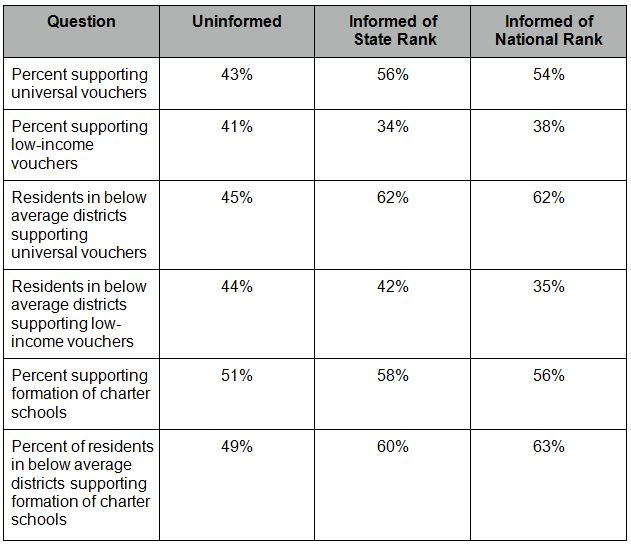
With more information about how local students perform relative to their peers, Americans do appear to become more supportive of school choice and other policies supported by the education reform community. It is entirely possible that Common Core could make Americans more informed about student achievement. As the authors’ note, “there is a certain irony in the fact that CCSS’s opponents favor many of the reforms that seem primed for winning greater public approval should the standards be fully implemented.”
However, not all opponents of Common Core are in the ed reform camp. I don’t expect the teacher unions and their supporters to jump with excitement at this survey’s findings. Read the full survey here.
Editor's note: This guest post from StudentsFirst is authored by Vice President of Fiscal Strategy Rebecca Sibilia and fiscal policy analyst Sean Gill.
We appreciate Doug Tuthill’s recent redefinED post challenging StudentsFirst to consider supporting voucher or tax-credit scholarship programs that aren’t just limited to what he describes as the “failing schools” model. We agree with his assertion that school choice policies, including private school options, are about empowering parents to select the best school for their child.
It is true that we believe voucher programs should prioritize low-income students in low-performing schools. However, we want to make clear that this position is not based simply on a “politically safe compromise.” Indeed, our entire State Policy Report Card judges not what is politically popular, but rather the laws and policies we believe, through evidence, best practices, and common sense, will deliver the best results for kids.
We think it is important that states focus on more than policies that just provide access to schools; states must prioritize expanding access to high-quality choices for families that traditionally lack them. A Brookings study found that students from low-income households are much more likely to attend low-performing schools than middle or high-income students. This is important because the same study further confirms that low-income kids can actually achieve at high levels when they attend high-performing schools. Unfortunately, as Florida Education Commissioner Tony Bennett has mentioned, low-income families often lack the resources to enroll in potentially higher-performing private schools or to relocate to a school district that offers a better public education.
Policymakers must always consider tradeoffs and unintended consequences when considering how to budget limited resources. Consider if a state adopted a universal voucher program. This would provide the most theoretical choice, but it could also easily have the unintended effect of simply subsidizing the students already enrolled at private schools and those in families who may otherwise be able to afford private school tuition. This would result in few new students being able to attend a high quality school option, and wouldn’t expand access to those who need it the most. Presumably, avoiding this problem is one of the reasons why the Florida Tax Credit Scholarship program is currently limited to low-income children.
Using this logic, we believe that when state resources are limited or the existing supply of desirable private schools is limited, it also makes sense to prioritize vouchers or scholarships for those low-income children attending a low-performing school or living in low-performing school districts. There are practical, administrative considerations that also make targeted programs more effective. For instance, when looking at the state of Tennessee, where Gov. Haslam has proposed a voucher program, we’ve determined that the four districts with the lowest performing schools also have both higher concentrations of low-income families and private schools in their communities.
We find that most voucher and scholarships programs are capped by enrollment or appropriation levels. Given that low-income students can be found in most counties throughout a state, these caps then create an unintended consequence of spreading out scholarship recipients among multiple communities, which would not provide enough demand to create new private school options. (more…)
Editor’s note: Wendy Howard is executive director of the Florida Alliance for Choices in Education, which includes a broad range of school choice organizations. The views expressed here are her own and not that of FACE.
Four years after my daughter Jessica Howard began a petition drive to make it easier for students to access virtual education in Florida, she is still not eligible for the virtual provider of her choice. No wonder so many parents settle for learning options that may not necessarily be the best option. There is so much bureaucracy and public attack if a parent merely wants more choice.
As a parent advocate, I have met many parents who are desperate for just that.
One told me her child wrote a suicide note after severe bullying at her school, but fortunately everything turned out okay after they found another option. Another couldn’t transfer her child to a virtual school – despite severe allergies – because of the “seat time” restrictions that were in place at the time. Instead, she had to access a district’s “hospital homebound” program, which cost taxpayers an exorbitant amount of money.
In other cases, parents have children who are failing in the system, or are far ahead of the system, or are pursuing athletic or professional careers that require some reasonable flexibility with academic schedules. There are endless reasons why some families want to choose schools outside of their traditional zoned school, or prefer Option X to Option Y, or want to mix and match those options so their kids can thrive.
All of those parents and their stories have made me wonder: Why can’t we just let all parents decide? Why are we limiting their choices?
Why not all parents, all choices? (more…)
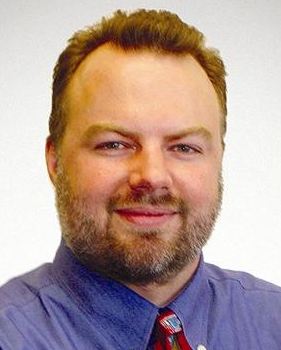
Ladner
Call them Vouchers 2.0. In the age of customization, researcher Matthew Ladner sees education savings accounts as the tool for the times. Unlike vouchers or tax credit scholarships, ESAs would allow parents to use state funds to pay for a blend of K-12 educational options – schools, tutors, online programs, etc., in whatever combo works - and perhaps squirrel away some of those funds for college.
“We we like to say that ESAs are sort of school choice and parental control over education down to the last penny,” Ladner said in a podcast interview with redefinED. “What we really want to do is allow parents to customize the education for their child. Education shouldn’t be necessarily an all or nothing proposition - you’re either attending this school or that school. In fact, the whole definition of what a school is is being fairly rapidly changed by technology.”
Ladner is senior advisor of policy and research at the Foundation for Excellence in Education. He’s one of the creators of the ESA concept and its most diligent Johnny Appleseed. In October, the Friedman Foundation for Educational Choice published a report he authored about ESAs called, “The Way of the Future.” Ladner also was instrumental in creating the ESA program in Arizona, which to date is the only one in the country but was recently expanded.
A key feature of ESAs, Ladner said, is that it requires parents to make choices based on quality and price. That in turn will spur innovation and, at the same time, reign in costs that have risen steeply for decades with little improvement in academic outcomes. “If you want to reverse that, you have to do something that’s going to seem a little radical at first,” Ladner said. “But by giving parents complete control over the money and requiring them to consider possible alternative uses for that money, it really sets them up to be discriminating consumers.“
Florida lawmakers flirted with ESAs in 2011, with critics panning the idea as “universal vouchers” and “vouchers for all.” But Ladner said even if a state went “whole hog” with the idea, the vast majority of kids would remain in public schools, as the Florida experience has shown with McKay vouchers and tax credit scholarships. In his view, ESAs should also be designed for equity - with greater funding for students with greater needs.
Are people ready for ESAs? Maybe not just yet, Ladner said. But it took a while for people to catch on to Palm Pilots, too. “As a movement we always need to be taking a strong interest in the development of our product. And our product in this case is our methods to increasing the freedom and the effectiveness of parents the parents within the schooling system,” Ladner said. “I think there is work to be done. But I do think that when this work is done we will have a product that is clearly superior to the ones we have today.”
 Our preoccupation these days with a Florida amendment removing the state’s no-aid-to-religion clause may strike some redefinED readers as a touch obsessive, and we won’t argue the point. But the truth is that we agonize over whether to write at all, and we want to explain why.
At the end of the day, we are confident that Amendment 8, whether it passes or fails, will have no legal effect on school vouchers. And yet opponents so far have invested $1 million in a campaign that argues otherwise. They not only contend the amendment will open the door to new vouchers, but that those programs will be, to borrow the words of one elected Alachua County school board member, “the very death of public schools.”
So the quandary is obvious. We’re a blog built around the new definition of public education, run by an organization that administers private options to low-income students, and we think we can bring clarity to the issue. But how do we complain about a debate that we say is falsely about vouchers without being viewed as though we doth protest too much? How do we enter the volatile, polarizing world of political campaigns and not be viewed as an angry combatant?
This is shaping up as a most peculiar campaign. The pro- and anti-amendment forces are on two entirely different planets, one fighting against the scourge of vouchers and the other extolling the virtues of faith-based community services. And yet the legal landscape is unmistakable: The state Supreme Court overturned Opportunity Scholarship vouchers in 2006 through a public education uniformity clause that would be untouched by this amendment. In other words, the principle barrier to any new vouchers is not on the ballot. That’s one of the reasons, and this is important to note again, that no groups supporting parental choice are spending a penny on this campaign. They see it as legally irrelevant.
We admit taking offense at some of the liberties that have been taken so far with the legal truth. And we’re left only to speculate on why the opponents would spend so much on an amendment that means so little in the education world. (more…)
Editor's note: After posting Howard Fuller's concerns about universal vouchers last week, we asked Andrew J. Coulson, director of the Cato Institute's Center for Educational Freedom, to offer his perspective.
 It’s not hard to see why Howard Fuller might be skeptical of universal government education programs. Public schooling is one such program and it has done an atrocious job of serving the poor. But is its universality the cause of its failure? Fuller believes that the poor are forgotten and given short shrift under universal programs and that the wealthy are favored by them. If that were the case in public schooling, we would expect schools serving the poor to receive less funding than those serving the wealthy. In responding to Fuller, Matthew Ladner contends that this is indeed the case: that public schooling “systematically distributes more money per pupil” to wealthier kids.
Actually, though, that doesn’t appear to be true. According to the federal Department of Education’s Condition of Education 2010, Indicator 36-1, districts with the poorest students are the highest spending. Public schools serving these students are not atrocious because they are underfunded, they are atrocious despite the fact that they are the best funded districts in the nation.
Having voted to raise public school spending relentlessly for generations, and having chosen to direct the highest level of per-pupil spending to the poorest children, it is hard to believe that Americans are indifferent to the education of the poor.
A more plausible explanation of the facts is that Americans would love to see their poorest countrymen thrive educationally but don’t know how to make that happen. For generations they have been told by the media, academics, and political leaders that the solution is higher spending. They have gone along with that recommendation and it has failed utterly. A few are finally beginning to realize that, but they still don’t know how to improve matters.
But the school choice movement believes it does know the cause of the problem: the lack of alternatives. Middle and upper income families find it easier to pay for private schooling or to relocate away from the worst public schools. They have alternatives that the poor do not. As a result, they get better service. The movement’s solution is thus to ensure that everyone has alternatives.
And this brings us back to Fuller’s claim: that the poor will be better served by a school choice program targeted exclusively at them. Is he right? In answering that question, it helps to consider a few facts and distinctions that are usually overlooked:
• First, there is a difference between universal access to the education marketplace and universal participation in a government program;
• Second, tiny markets are dramatically inferior to vast ones;
• And third, it actually matters who is footing the bill for a child’s education.
Saying that everyone should have educational choice is not the same thing as saying that everyone should participate in a particular government program. (more…)
 When Indiana's celebrated state superintendent of instruction, Tony Bennett, spoke in support of universal vouchers at last week's American Federation For Children summit, the panel's moderator did not sit quietly. After all, just last year, Howard Fuller (pictured here) fought legislative attempts to include high-income families in a Milwaukee voucher program he helped create for poor children. Of the prospect of universal vouchers in Wisconsin, Fuller proclaimed, "That's when I get off the train."
So Fuller, a legend in the school choice movement, politely invoked "the moderator's privilege" after Bennett spoke. And he was characteristically blunt.
“The thing that I most worry about is that people will forget the importance of protecting poor people in this,” Fuller said, before adding a few sentences later, “I just want people to know … when folks move towards universal (vouchers), just know that some of us are going to fight it.”
The world of school choice is more textured and dynamic than it’s portrayed. It’s not a monolith. It’s many camps, with overlapping but not always consistent visions. For the most part, those differences were glossed over at the AFC summit, and for good reason. The summit was a fitting celebration of recent victories. It was rightly punctuated by moving speeches from New Jersey Gov. Chris Christie, Louisiana Gov. Bobby Jindal and Newark Mayor Cory Booker.
But the differences are there. And beneath the surface, some tensions too. Fuller has drawn a line in the sand before, including in this podcast interview last year with former redefinED editor Adam Emerson. Here are his latest remarks in full, as best as I could hear and transcribe them: (more…)

