 H.B. 7069 lawsuit: The Clay County School Board votes 3-2 to join 14 other school districts in suing the state over the new education law, H.B. 7069. The suit, which has not yet been filed, is expected to challenge the constitutionality of the law on grounds that it covers more than one subject, and that it redirects traditional public school money to charter schools while stripping local boards of authority over those charter schools. Florida Times-Union. Collier County School Board members decline to join the lawsuit, by a 4-1 vote. Next month the board will consider filing a separate lawsuit. Naples Daily News. At a Hillsborough County School Board finance committee meeting, several district officials express reluctance to join other districts in suing the state over the new education law. "Why is it that we just can't we just go up there and talk?" mused Gretchen Saunders, the district's chief business officer. The board will discuss the lawsuit at a workshop Thursday. Gradebook.
Makeup days: Palm Beach County school officials want to use three professional development days as makeup days for classtime lost to Hurricane Irma, and will ask the state to waive two more makeup days. Students were out of school seven days, and the state has already waived two of those days. In Broward County, officials are proposing that two early-release days be converted to full days. Schools must be in session for 180 days, or 720 hours for K-3 and 900 hours for grades 4-12. Palm Beach Post. Sun-Sentinel. WPBF.
Gains for choice students: Low-income students who use Florida tax credit scholarships to attend private schools are more likely to go to college and get degrees than their peers in public schools, according to a study by the Urban Institute. The college enrollment rate is 15 percent higher, but jumps to 40 percent among students who use a scholarship for at least four years. More than 100,000 students use the scholarships. Step Up For Students, which hosts this blog, helps administer the program. redefinED. Associated Press. Chalkbeat. Politico Florida.
District budgets: The Collier County School Board approves a $1.05 billion budget, which is an increase of about $24 million over last year's spending. Naples Daily News. The Brevard County School Board approves a $942 million budget over the protests of teachers who want a raise of more than 1 percent. Florida Today.
The “triply disadvantaged” students who participate in the nation’s largest private school choice program enroll in college and obtain degrees at higher rates than like students in public schools, and those rates climb the longer the students use the scholarship, according to a first-of-its-kind study released this morning by The Urban Institute.
The college enrollment rate overall is 15 percent higher for the low-income students who use Florida tax credit scholarships, the study found. That climbs to about 40 percent higher for students who use a scholarship at least four years.
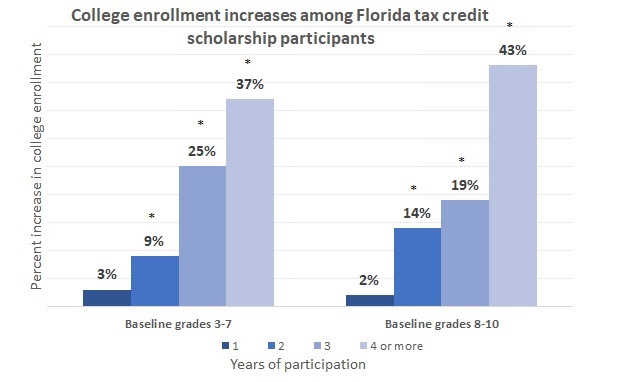
The longer students participate in the Florida tax credit scholarship program, the more likely they are to enroll in college, compared to peers who do not receive scholarships. Chart by Step Up For Students, using data from the Urban Institute.
Meanwhile, scholarship students are 8 percent more likely to obtain associate degrees. That number rises to 29 percent for those who secured scholarships in earlier grades and used them at least four years.
Annual evaluations of standardized test results in the scholarship program have consistently found the average student who uses the program to attend a private school makes roughly one year's academic progress in one year's time.
They've also found students who use the scholarships tend to be more disadvantaged than other lower-income students who don't use them.
Urban Institute authors Matthew M. Chingos and Daniel Kuehn describe scholarship students this way: "They have low family incomes, they are enrolled at low-performing public schools (as measured by test scores), and they have poorer initial test performance compared with their peers."
Studies have looked at long-term outcomes for other programs that help disadvantaged students pay private school tuition.
They found students in Washington, D.C. and Milwaukee were more likely to graduate high school or attend college, respectively, if they received a voucher.
But researchers haven't looked as much at college enrollment among students who received scholarships from big, statewide programs. The Urban Institute report is unprecedented in its scale. It looks at more than 10,000 students across the nation's third-largest state. It uses data from the Florida Department of Education, as well as Step Up For Students, the nonprofit that helps administer the scholarships.
Unpacking the findings (more…)

