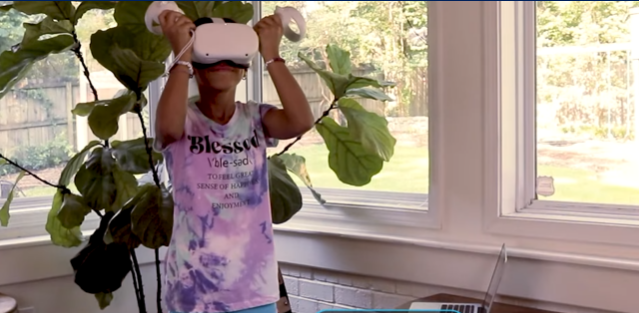
 “Each day, our scholars will receive live instruction in the metaverse (our virtual reality classroom that could be anywhere from the ancient theater in Pompeii to a prehistoric watering hole) and experience an immersive, collaborative, and socially appropriate experience with their instructor and peers.” – Erika Donalds
Imagine going to class in Pompeii, underwater, or even outer space. That’s what Florida students who enroll in Optima Classical Academy will get to do when the school opens this fall.
Billed by its founders as “the world’s first virtual reality charter school,” Optima is expected to open in August with 1,300 students in grades 3-8. The academy intends to expand classes up to 10th grade for the 2023-24 school year.
The new school is the vision of Erika Donalds, president and CEO of the Optima Foundation. A former Collier County School Board member who helped launch Parents ROCK charter school in her hometown of Naples, Florida, Donalds has been a longtime supporter of education choice. Her husband, Byron Donalds, a Republican member of the U.S. House of Representatives and a former member of the Florida Legislature, has supported education choice at the federal level and at the state level while he served in the Florida House of Representatives.
Erika Donalds recently discussed the details of Optima Classical Academy with reimaginED. Answers have been edited for brevity and clarity.
Q. How did you get the idea for a virtual reality classical school?
A. During the pandemic, we created a high-quality classical education online program and received stellar reviews from our parents, many of whom asked us to continue offering a virtual option. I was connected with Adam Mangana, now our executive director, and he introduced the idea of incorporating the VR classroom into our classical virtual school. Marrying the two ideas is the perfect combination of traditional and innovative education ideas to ensure our students succeed academically.
Q. From what Florida counties will students be eligible to attend?
A. Florida allows for open enrollment, so our program will be available statewide in Florida in August 2022.
 Q. What are the advantages of a VR approach over a school-hosted virtual platform such as Zoom?
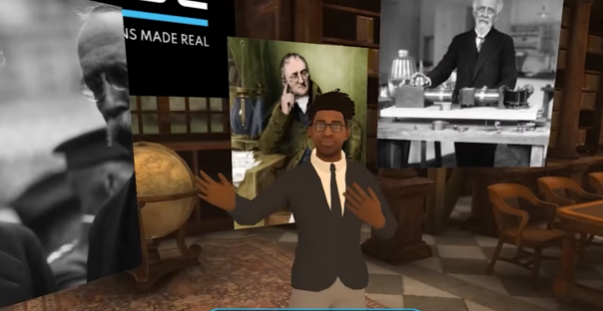
A. Each day, our scholars will receive live instruction in the metaverse (our virtual reality classroom that could be anywhere from the ancient theater in Pompeii to a prehistoric watering hole) and experience an immersive, collaborative, and socially appropriate experience with their instructor and peers. Instead of the checkerboard of faces, scholars are immersed into a common classroom environment where they can interact real-time with the avatars of their teachers and fellow students. It is far more engaging, there are no distractions, and the ability to use the classroom as a second teacher are just a few of the ways it is superior to Zoom.
Q. What will a typical day be like? How long will students be using the headsets? Will they be used for all classes? If not, which ones will they be used in?
A. Students will have live virtual interaction with their teachers and peers four days per week in each of their classes. The live portion of classes will be about 30 minutes each, with breaks in between, from 8 a.m. to noon. The afternoons are reserved for asynchronous work, either online or using analog materials like paper books, journals, or other projects.
Q. Tell me about your staff. Who is your head of school and how many teachers will be working with students? What are their backgrounds?
A. Adam Mangana is our executive director. He oversees both the academic and technological aspects of our school and curriculum. Adam has a degree in the classics from Brown University but did his capstone at Vanderbilt on the VR classroom. He is a former independent school leader and a great education innovator. Our head of school is Dan Sturdevant, an independent school leader from North Carolina who is dedicated to both classical education and virtue-based education. Dr. Sturdevant will be the teacher leader and culture builder for Optima Classical Academy. Teachers will be sourced from around the country and will be well trained in teaching both classically and virtually.
Q. Where are some of the virtual places you plan to take students with this technology?
A. Scholar experiences include trips to Pompeii, Independence Hall, under water and outer space. We will continue to build thousands of new classrooms for our students to explore in every subject and at every grade level.
Q. Will there be extra-curricular activities? If so, will some of those also use VR?
A. We will have a plethora of extracurricular activities available in and out of the metaverse. We have VR ‘recess’ and a student union in VR for students to play and interact outside of class time and will hold VR clubs and activities. We will also be assisting to organize in-person clubs and sports for students within their geographical areas.
Q. Creating a VR school sounds like an expensive venture. How were you able to afford the headsets?
A. We are purchasing the headsets using the per-student education funding from the state. Since we run charter schools, we are used to doing more for our students and providing a high-quality academic experience on a lower per-student funding amount.
Q. What equipment will students need to supply?
A. Students will need a laptop and normal school supplies (pencils, notebooks, etc.) to participate in the program, and these can be provided for disadvantaged students if they qualify.
Q. With so many students returning to brick-and-mortar schools, what is the demand for a virtual at-home option?
A. Prior to the pandemic, virtual education was growing rapidly. We have seen a spike in demand but believe that the pre-pandemic trend will be accelerated now that more families were exposed to this academic option. While many families prefer brick and mortar, there are some who discovered virtual can work for their student and for their family. More parents are working from home now, or have more flexible schedules, and they want to be more involved in what their students are learning. I believe the quality, accessibility, and flexibility of Optima Domi will be very attractive to many families.
Q. Why did you choose to be a charter school as opposed to a private school that accepts school choice scholarships?
A. Private school scholarships are only available to families below a certain income level, and in Florida, they cannot be used for virtual schools. We want our education options to be available to all families, so we chose to launch in the charter school format.
Q. If Florida had a more widespread education savings account program, would you have considered that route?
A. If Florida’s education savings accounts were more accessible, I would absolutely have chosen the private school route. I would convert all the charter schools we manage into private schools if Florida’s education savings account program were universally available.
Q. What other details would you like families to know?
A. One of our key differentiators is the focus on ensuring scholars can work through the material independently. We know one pain point for parents during the pandemic was they had to act as the teacher, directing students from task to task. We are building an intuitive program that allows students to attend class and complete their assignments with minimal parent involvement.
Q. How can parents learn more?
A. Parents can learn more and apply for the charter school lottery at OptimaClassical.org.
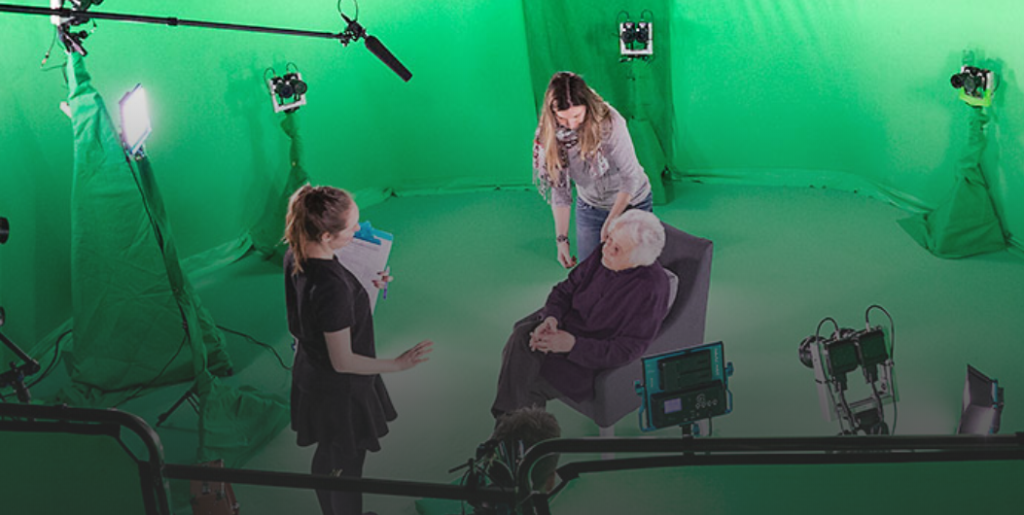
USC Shoah Foundation’s Dimensions in Testimony enables people to ask questions that prompt real-time responses from pre-recorded video interviews with Holocaust survivors and other witnesses to genocide.
Never again.
It’s the vow from Holocaust survivors not to allow the world to forget their past, lest genocide be repeated in the future.
Today, an innovative, high-tech method of delivering that message to the current generation holds promise for distance education opportunities on the horizon.
The USC Shoah Foundation, a Holocaust history organization founded in 1994 by director Steven Spielberg at the University of Southern California, is taking the practice of recording the oral histories of survivors to an entirely different level. It has created 3-D interactive holograms of survivors who not only recount their chilling experiences in Nazi concentration camps and ghettos during World War II; they can respond to a viewer’s questions in real time.
Forever.
Called Dimensions in Testimony, the program (which debuted in 2017) uses advanced filming techniques – green screen, dozens of cameras arranged in 360 degrees – to create a three-dimensional digital image of the subject. Over the course of several days, the survivor is interviewed about his or her story, and then answers more than 1,000 questions that would be anticipated from an audience (“What was life like before the war?” “Do you feel hope for the future?”).
Viewers receive more than a narrative. They can have a virtual conversation with a survivor who not only isn’t physically present but who is no longer alive.
Fewer than 100,000 Jews who were in camps, ghettos and in hiding under Nazi occupation are still alive today, according to the Conference on Jewish Material Claims Against Germany. The youngest are in their mid-70s. Time is running out.
Aaron Elster, one of 20 interviewees listed on Shoah’s Dimensions in Testimony website, died in 2018 at age 85 after recording his testimony in 2015. Nevertheless, Elster has been immortalized in a medium that allows him to interact with individuals in ways that create personal connections that run deeper than what the printed word or traditional audiovisual presentations can provide.
The viewer can personalize the experience by taking the virtual discussion in almost any way he or she chooses. The only limitation is the inability to shake a survivor’s hand or give him or her a hug.
Shoah currently has made the Dimensions in Testimony available to seven other Holocaust museums in the United States, with more access on the way. Some of the interviews are conducted in languages other than English, such as German and Hebrew, opening them to wider audiences around the globe. And of course the technology can be expanded to any number of oral histories, such as survivors describing the nuclear bombings of Japan – and to other areas of education.
The COVID-19 pandemic has exposed scores of students to distance learning for the first time, and with wildly uneven results. Many school districts were forced to migrate lessons to rudimentary online platforms on impossibly short notice, causing endless frustration and dissatisfaction from students, teachers and parents. Most agree that group instruction on Zoom is insufficient. Florida Virtual School, which way back in 1997 became the nation’s first statewide K-12 virtual public school, has more experience – and a proven track record -- in providing a more robust distance learning environment.
Dimensions in Testimony takes the concept to a different level. It’s like something from a Ray Bradbury story, only it’s science fact, not fiction.
It’s superior to videoconferencing because it’s not dependent on time. Holographic lessons can occur whenever they’re convenient while still remaining interactive. And they are customizable – they are as flexible as the artificial intelligence can take them. As the Shoah Foundation states, they enable students “to be agents in their own learning.”
Obviously, 3-D holograms aren’t an immediate solution to how to improve remote learning when (if?) schools re-open this fall. Still, the technology is beyond the concept stage and already in limited use. (For reference, the fictional communicators of “Star Trek” in the late 1960s were realized as actual flip phones a mere 30 years later.)
For Dimensions in Testimony, a project created to keep the past alive, the future is now, paving the way for other education innovators to follow.

