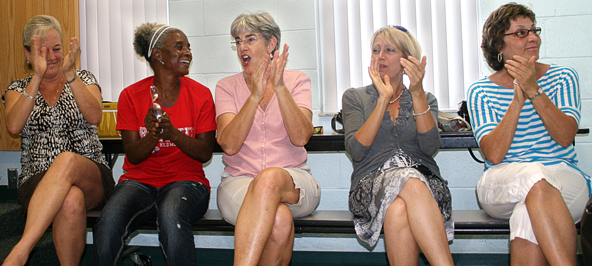
Rowlett Magnet Elementary teachers react after hearing the final vote count for a charter conversion school.
In a state that has found itself politically deadlocked over whether parents should be given the power to change who runs a public school, a Bradenton elementary magnet school pulled its own type of trigger this week. The vote to convert to a charter school was made under existing Florida law, which calls for both parents and teachers to approve, and the results were a disquieting declaration of educational independence. Parents: 480-26. Teachers: 57-4.
This is an arts school mimicking art, conducting what amounts to its own version of Won’t Back Down, the Hollywood drama that featured a band of parents and teachers who fought to turn their own school around. Yes, there are clear differences: Rowlett Elementary is not suffering. It is a popular magnet school that has received an A or B rating from the state over the past five years and has enjoyed the financial fruit of a Rowlett Family Association that raised $170,00 just last year.

Parents gathered at Rowlett Magnet Elementary in Bradenton, Fla., recently to witness the final vote count to turn the district school into a charter school.
But Rowlett is a racially and economically diverse school, in a middle- to low-income neighborhood, and what is familiar is the powerful sense of self-determination. The campaign has brought together teachers and parents who in other circumstances might have been skeptical of such tools. One of the parents is an active member of a group in Florida, Fund Education Now, that has taken credit for defeating the parent trigger bill the past two years.
“It’s not the direction I thought we would be going in after 13 years,” said principal Brian Flynn, a 34-year school district employee who has led the school since it opened in 2000. “It’s not about wanting to leave the district. We wanted to be able to continue the type of programs that we have always offered.”
"We will be able to continue the excellence, the programs, the tone, that Rowlett already has," parent Glorianne Flint told the Sarasota Herald-Tribune. "What is the School Board going to do to continue the wonderful programs that Rowlett has? The district can't give us that answer." (more…)
Actress Viola Davis is great as a teacher/parent in “Won’t Back Down,” the potent movie about parental empowerment that’s hitting theaters Friday. But as a spokeswoman for school choice, she’s even better in real life. Here’s what she said the other night on “The Tonight Show,” to huge applause, after Jay Leno asked her why the movie is being called controversial:
I am a parent. And as a parent, I have a child and I know that the only way she’s going to get a part of the American Dream is through education. And so if that great education is a public school, I’m going to send my kid to the public school. If that great education is a charter school, I’m going to send my kid to a charter school. If it’s a private school, I’ll send her to a private school.
I think that it’s about wanting do what’s best for your kid.
 Chicago: Expansion of charter schools, which tend to employ non-unionized teachers, is a big undercurrent in the teachers union strike (New York Times). Media coverage of the strike puts charter schools in a positive light (redefinED). (Image from aei-ideas.org)
Florida: Khan Academy and Step Up For Students are partnering to bring cutting-edge technology to private schools that accept tax-credit scholarships (redefinED). The new chair of the state Board of Education says "the train has left the station" when it comes to expanding school choice (redefinED).
New Jersey: State lawmakers to take a closer look at online education. (NJSpotlight)
Rhode Island: The superintendent of the Providence school district and the president of the teachers union are working together to promote district-operated charter schools (Boston.com). State education leaders disagree about whether to close a low-performing charter school (Providence Journal).
Nevada: Lawmakers may consider parent trigger legislation in the wake of the Won't Back Down movie. (Las Vegas Sun)
Louisiana: In the wake of the state's new voucher program, the state's top education official offers a plan for closer scrutiny of private schools (New Orleans Times Picayune). About 5,000 students enroll in the new voucher program (New Orleans Times Picayune). A spokesman for a Louisiana teachers unions tries to explain why the group said a black school choice group supports "KKK vouchers" (Daily Caller).
New Hampshire: A Q&A with the head of the state's first tax credit scholarship funding organization. (Concord Monitor)
 Like the Democratic Party platform on education, this is no surprise: Democratic tension over school choice and parental empowerment is on display at in Charlotte. But some of the developments and statements are still worth logging in.
StudentsFirst co-sponsored a special screening of the new movie “Won’t Back Down” at the DNC yesterday, just as it did at the RNC in Tampa last week. And in the panel discussion that followed, Ben Austin, executive director of Parent Revolution, told the audience that the parent trigger law – upon which the movie is loosely based – is a progressive idea aimed at giving parents more power to right struggling schools. According to coverage of the panel by Education Week’s Politics K-12 blog:
The laws allow parents to "unionize and collectively bargain, just like teachers' unions," said Austin, who served in the Clinton White House. "Parent trigger fundamentally makes public schools more public. ... We need to be modern 21st-century progressives" who stand for government working.
To be sure, people like Austin and former California state Sen. Gloria Romero have tried, mightily, to dispel the notion that the trigger is a right-wing creation, but the myth persists. In June, the U.S. Conference of Mayors unanimously endorsed the parent trigger idea, and among the big-city Democrats who led the charge was Los Angeles Mayor Antonio Villaraigosa.
Villaraigosa is chairman of the Democratic National Convention this year, as the Huffington Post notes in this piece over the weekend. He’s also a former teachers union organizer. Wrote the HuffPo: “It is hard to paint the school reform movement as a right-wing conspiracy. Support for taking on teachers’ unions is growing in Democratic and liberal circles.”
More DNC coverage of the growing divide between Dems and teachers unions in the Los Angeles Times and the Washington Times.
After going 56 years without attending a national political convention, I’m headed to Charlotte for my second convention in a week. For school choice advocates, the Democratic National Convention will be a somewhat hostile environment, unlike last week’s Republican National Convention in Tampa, where all forms of school choice were enthusiastically embraced.
As we’ve discussed previously on redefinED, the political left, including wide swaths of the Democratic Party, was supportive of giving parents - especially low-income and minority parents - access to more diverse schooling options in the 1960s and throughout most of the 1970s. That support began eroding when the National Education Association gave Jimmy Carter its first-ever presidential endorsement in 1976, and was mostly gone by 1980.
President Clinton’s support of charter schools marked the beginning of a renewed interest in school choice within the party, and pro- and anti-school choice forces have been battling ever since. After two decades of struggle, the momentum today is clearly on the side of the pro school choice Democrats, which has caused anti-choice Dems to become more desperate and strident. American Federation of Teachers’ President Randi Weingarten’s recent attack on the new teacher/parent empowerment movie, Won’t Back Down, was so disingenuous and hyperbolic I was embarrassed for her.
Both Weingarten and NEA President Dennis Van Roekel will be participating in a town hall meeting tomorrow sponsored by Democrats for Education Reform. Four years ago, at the Democratic convention in Denver, DFER burst on the scene at a similar event, and, with close ties to the Obama Administration, immediately became a majority power center within the party. I’m anxious to see what issues predominate tomorrow, and how Weingarten and Van Roekel position themselves.
Won’t Back Down is a quintessential Hollywood drama in which a teacher and parent unite to fight against the odds and restore hope to their dysfunctional elementary school, and it comes complete with a tear-evoking final scene in which a young girl conquers a stressful passage of reading. Only in the real world of education, though, would a feel-good movie provoke a national teacher union president to release a 2,000-word critique branding it as “divisive” and claiming it “demoralizes millions of great teachers.”
Let’s just say this is American Federation of Teachers president Randi Weingarten playing to type.
The film is fictional and, interestingly enough, presents characters that in many ways have more dimension than those in the educational documentary, Waiting for Superman, that featured Weingarten herself. The director, Daniel Barnz, comes from a family of teachers and told a screening audience this week at the Republican National Convention that: “We wanted to create a film that suggests that people can come together.”
Though the movie is being billed as a dramatic reenactment of parent trigger laws, Barnz himself calls attention to a significant difference. In his fictional account, the “fail-safe” law does not allow charter conversion and only allows for a leadership change at a school with the support of both the parents and the teachers – and then the school board.
Yes, the school principal, school administration and the local teacher union are cast as villains. But the teachers are most certainly not. (more…)
 Liberal Democrat Michelle Rhee and conservative Republican Jeb Bush shared a stage at the RNC in Tampa today and suggested that despite the hyper partisanship on so many issues, there is increasingly common ground when it comes to education reform.
“This is a chance for a Switzerland,” said Bush, the Republican Party’s standard bearer on education, referring to that country's policy of neutrality in wars.
Bush, who is giving a prime time speech at the RNC Thursday, said Mitt Romney will be a “very good president on education.” But he also praised President Obama and U.S. Secretary of Education Arne Duncan on their education initiatives, including Race to the Top. “This will be very heretic but I’m getting used to being heretical,” Bush said. “The president by picking Arne Duncan did a good thing for the country.”
Rhee, the former Washington D.C. education chancellor who now heads the advocacy group StudentsFirst, said it’s important to continue building bipartisan bridges to counter critics who will continue to try and sow division. “We have to fight really hard against that polarization,” she said.
Comments from the pair came after StudentsFirst sponsored a special screening of “Won’t Back Down,” the soon-to-be-released Hollywood movie about a mother and a teacher who use a parent-trigger-type law to turn around a struggling, inner-city school. They spoke before hundreds at the Straz Center for the Performing Arts along with the film director, Daniel Barnz, producer Mark Johnson and the moderator, former CNN anchor Campbell Brown. (Former Secretary of State Condoleezza Rice was also scheduled to be part of the panel, but could not make it because of the weather.)
Barnz and Brown also contributed to the nonpartisan atmosphere.
“This is not a partisan concern, this is an American concern,” Brown said after noting America’s high dropout rate and middling academic performance among other industrialized nations.
Said Barnz: “The movie makes an appeal for a kind of centrism … What I’d really like to see happen with the movie is to kind of strike a middle road.”
Rhee recalled that in D.C., former Mayor Adrian Fenty, a Democrat, put all of his political capital into backing her hard-charging plans to address low-performing teachers and schools. Fenty lost re-election, and Rhee resigned. Among the lessons learned, she said: critics were organized and able to quickly mobilize while “there was no equivalent political network on the education reform side.”
Both Bush and Rhee offered strong support for expanding school choice. With Bush, that’s no surprise given his longtime backing of private school vouchers, tax credit scholarships and charter schools. But Rhee is better known for tackling reforms like teacher tenure and evaluations. (more…)
Randi Weingarten must be watching the RNC goings-on pretty closely too. Minutes ago, the president of the American Federation of Teachers sent out a lengthy press release criticizing "Won't Back Down," the new movie about a mother and a teacher who use a parent trigger type law to turn around a struggling, inner-city school.
I mention the timing because StudentsFirst is sponsoring a special screening of the movie at the RNC this afternoon, followed by a panel discussion with Jeb Bush, Condoleezza Rice, Michelle Rhee and the movie's director, Daniel Barnz.
In her statement, Weingarten specifically mentions the parent trigger debate in Florida earlier this year. Here's an excerpt:
This movie could have been a great opportunity to bring parents and teachers together to launch a national movement focused on real teacher and parent collaboration to help all children. Instead, this fictional portrayal, which makes the unions the culprit for all of the problems facing our schools, is divisive and demoralizes millions of great teachers. America’s teachers are already being asked to do more with less—budgets have been slashed, 300,000 teachers have been laid off since the start of the recession, class sizes have spiked, and more and more children are falling into poverty. And teachers are being demonized, marginalized and shamed by politicians and elites who want to undermine and dismiss their reform efforts.
Parent engagement is essential to ensuring children thrive in the classroom. The power of partnerships between parents, teachers and the community is at the heart of school change.
But instead of focusing on real parent empowerment and how communities can come together to help all children succeed, “Won’t Back Down” offers parents a false choice—you’re either for students or for teachers, you can either live with a low-performing school or take dramatic, disruptive action to shut a school down.
At the RNC in Tampa this week, a small but bright constellation is scheduled to line up on education reform. Democrat Michelle Rhee, who famously tangled with teachers unions as schools chief in Washington D.C., will share a spotlight with Jeb Bush, who has praised President Obama’s ed initiatives, and Condoleezza Rice, who co-authored a Council on Foreign Relations ed report with Democrat Joel Klein. The panel will be moderated by Campbell Brown, the former CNN anchor who just got into a Twitter spat with Randi Weingarten. All will come together after a private screening of “Won’t Back Down,” a new movie that shows even Hollywood has embraced parental empowerment in education.
This will be a remarkable little event – a hopeful symbol of a centrist political coalition, in the midst of a red partisan sea, that is poised to take advantage of historic opportunities to re-shape the nation’s schools.
Poised, that is, unless it get chewed up by the fringes.
The Republican Party may be tilting even more right, but on education the centrists still hold sway. Jeb Bush, who supports a federal role for education, and backs national academic standards, remains one of the party’s leading lights on ed reform. His prime-time speech will likely generate more ink about education than anything else that happens at the RNC.
But obviously, there is tension. Rising Tea Party currents want to erode recent federal activism in ed reform – a position that so ironically leaves them pitching tents next to teachers unions. Their passion is well-meaning; their arguments worth considering. But their timing is especially bad: Reform-minded Republicans and Democrats are getting close when it comes to a common vision for public education – a vision that includes a healthy dose of school choice and bottom-up transformation. This rare alignment is mostly intact because the GOP led on education, and enough Democrats bucked their own fringes to shift the GOP’s way.
In a recent op-ed for redefinED, Margaret Spellings, the secretary of education under George W. Bush, didn’t call out Tea Party groups by name, but she didn’t mince words when it comes to the potential consequences of their aims: “This ‘unholy alliance’ between the unions and those who want no role for the federal government in education is propping up the status quo on the backs of our most vulnerable children,” she wrote. “It’s shameful beyond words.”
Mitt Romney and the ed centrists won a quiet victory in Tampa last week. They beat back attempts to restore an old plank in the GOP platform – eliminating the U.S. Department of Education. Tea Party linked groups got almost everything else they wanted. But according to Politico, instead of using the word “eliminate” in the draft language regarding the U.S. DOE, a subcommittee voted to replace it with a call to “support the examination and functions of.”
That’s a breather, but a temporary one. It should give added urgency to those in both parties who want to see constructive change and know more will get done, quicker, if centrists work together and find ways to grow their ranks. It’s important to remember that today, at the start of the storm-delayed RNC, before the spin makes every crack between Romney and Obama on education look like a canyon.

