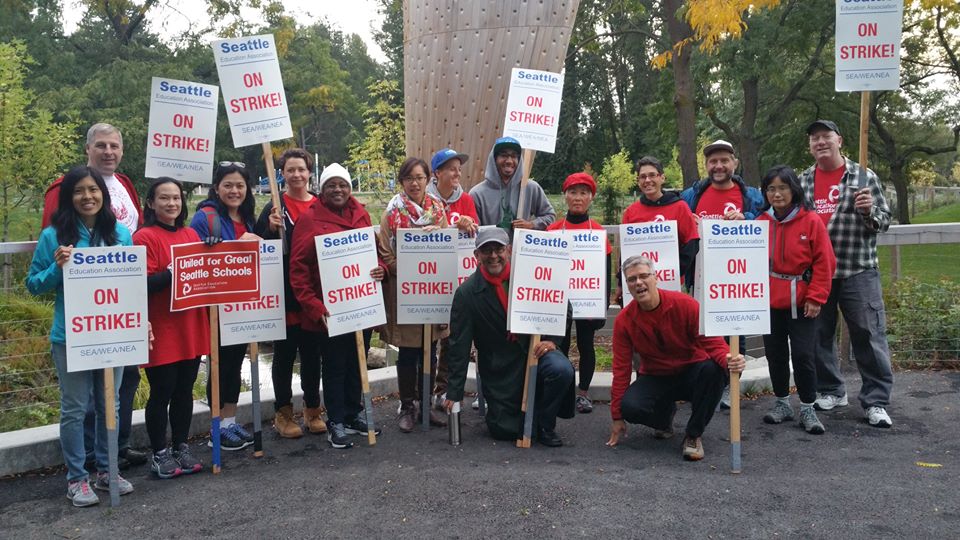
Seattle teachers went on strike last month. (Photo from Seattle Education Association facebook page.)
The annual swarm of strikes (and threatened strikes) called by public school unions arrived on schedule across the nation this fall, just as parents and children arrived at the schoolhouse to honor their civic obligation. With the teachers themselves truant, attendance was not an option for the families. Happily for the better-off parents there were familiar fallbacks; one can work at home, hire childkeepers or switch to the private sector and pay tuition.
For the rest of the nation’s families – call them “ordinary” – school strikes were a serious aggravation. As a rough analogy to their plight, imagine a military conscript who reports for duty as ordered – but finds the base empty. He knows he has to do something, but what? Of course this bewildered recruit would be the only person who suffers from that sort of foul-up. By contrast, when the teacher union decides to strike, the family itself becomes in effect a full squad of perplexed draftees – mothers, fathers, etc. – all bound both by government and by the very nature of the family. There is no substitute available for them to choose. They are legally and morally responsible for their child’s welfare – even when both parents must hold jobs to sustain the family. Eventually, of course, the strike gets settled and the mother returns to her job – if she still has one. In the meantime, however, what to do?
The state drafts the ordinary family for its own schools – there to learn only those ideas allowed to the mind of government; this the child hears five days a week, seven hours a day. What conception of human dignity could account for this deliberate humiliation? And when the state next allowed its own employees to abandon their charges without provision for the dilemmas presented thereby to the ordinary parent, just how was this good for anyone but the teacher unions and their elite? Yet again I would recall the words of my departed friend, Albert Shanker: “I’ll represent children’s interest when they start paying union dues.” With all due respect Albert, children in fact pay union dues simply by being enrolled and thereby providing jobs for union members.
Does my dismay at the historic record of government unions make me another libertarian crank complaining about the unions in general as an unhealthy constraint upon the free market? Emphatically not! If I were a steelworker, a mineworker, a dishwasher, a trucker (some of these I have been), I would judge my union’s behavior as I would that of anyone, or any institution, that I have engaged to represent me; I would pay my dues as a responsibility inherent in the relationship between us. For I am financing the union in order to discipline my employer on my behalf; I support the UMW in expectation that it will behave in a rational manner, one that will help me to keep my employer – hence my job – in existence. The union’s responsibility is to secure the largest benefit that can come to the worker when the company prospers. If my own representative drives my employer out of business, it has hardly served me well.
Public schools can’t go out of business; and the tenured public teacher is virtually beyond danger of discharge. The only competition to be feared would come from a financially empowered parent, delivered from economic captivity and free to choose a private alternative in one form or another.
Unions then are not by nature anti-competitive – except in the public sector where, in general, they enjoy a form of monopoly power protected by law. Recall that charter schools are, in general, not unionized and are also subject to fierce competition in those states where more than a handful have been allowed to exist. They are called “public” but are in essence private and vulnerable to all the challenges of a free market. Forty-five years ago, Stephen Sugarman and I suggested specific statutory models that would encourage teacher unions themselves to become entrepreneurs, forming their own schools (later to be dubbed “charters”) in whatever image they choose. For a few years that idea (shared by other writers) tantalized the teacher unions. By 1975, however, they had decided to follow not a competitive, but a strictly political path in order to preserve their dominion over the pool; with few exceptions they have never regained that spirit – that confidence and conscience – to risk competition, even in the form of charters. Insofar as teacher unions have succeeded in preserving their monopoly, the poor have been the most obvious losers, as was widely predicted.
This story of civic failure is in no way subtle and has been retold often as a political morality tale. But reform here comes hard. The peculiar and unspoken coincidence of teacher unions' self-interest with the cool reserve of those parents already able to exercise choice makes the going hard. But there have been happy surprises – and maybe more will follow.
An authentic liberation of the choiceless family could, over time, contribute to the civic cultivation of the mind of both parent and child as each grasps and assimilates the dignity of personal responsibility. Quite apart from test scores and efficiencies wrought by the market, the message of human perfection through self-imposed duty could, over time, encourage a renaissance in the mind-set of the poor. It is unnecessary and wasteful – it is vicious – to keep families in servility to government strangers.

