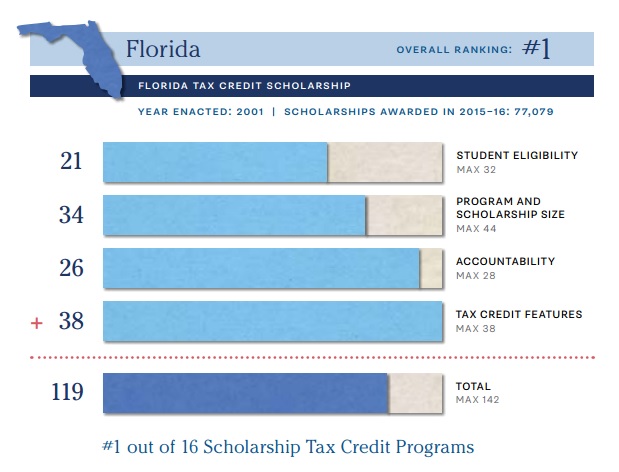
 Florida is home to the top school choice program in the country, according to a new report by a national advocacy group.
The American Federation for Children ranked 27 private school choice policies, which include tax credit scholarships as well as school vouchers and education savings accounts. Florida's tax credit scholarships rank no.1, and are closely followed by Indiana's statewide vouchers and Nevada's new tax credit scholarships.
The group wants states to make their programs available to large numbers of students, including those in the middle class, but to prioritize the needs of the most disadvantaged children. And it backs accountability measures, like public reporting of academic results, but wants to limit other regulations that might undermine schools' autonomy.
On those scores, Florida's program (which my employer, Step Up For Students, helps administer) earns high marks. Among other things:
Indiana's vouchers, created during a wide-ranging school reform blitz in 2011, get strong marks for accountability. The new tax credit scholarship in Nevada is worth watching because, while it's starting with a relatively low annual funding cap of $5.5 million, it could grow by as much as 10 percent a year. And it could work in concert with a new education savings account program in the Silver State, which wasn't included in the rankings and remains in legal limbo.
At an event hosted by the Thomas B. Fordham Institute to discuss the report, Whitney Marcavage, AFC's policy director, was asked whether her group's rankings reflected student achievement. Recent research has suggested students in large statewide voucher programs are struggling academically. Vouchers in Indiana and Louisiana were created or expanded statewide within the last five years, however, and there are signs their academic outcomes are improving. In Florida's 15-year-old program, eight years of annual evaluations show the disadvantaged students in the program have kept pace with all students nationally.
"You've got the research to back up that the Florida program is producing," Marcavage said.
Indiana state Rep. Robert Behning said private schools need time to help their new, often low-income students catch up academically. He said that as the program matures, students' learning gains will likely improve.

