Florida's charter schools are less likely than their district-run neighbors to enroll children of color, children living in poverty or children with special educational needs.
That finding comes from a new study by the American Enterprise Institute, which looked at charter schools around the country and compared them to their nearest neighbors, including comparable traditional public schools (TPS).
A key point, which the study drives home, is that the national charter school debate often obscures differences from one state to the next.
Student poverty is a perfect example. Charters are often assumed to serve more poor students than TPSs. Compared to their neighboring TPSs, many charters do serve substantially more poor students; however, just as many serve fewer poor students, and both groups differ by comparable amounts.
Clarifying these national differences between charters and TPSs is worthwhile for a national debate. However, that clarity may be even more important at the state and local levels, where charter policies are articulated. Across the nation, charters differ from both their neighboring TPSs and other charter schools. Some of those differences are balanced nationally, but that is not the case in all states. Looking across states can also show how the charter sectors in one state can look very different from another.
In some places (like Massachusetts), charter schools are largely an urban phenomenon. They often follow some version of the "no-excuses" model, become members of the "cool kids club" and enroll large numbers of low-income children in the neighborhoods where they open.
In Florida, the study suggests, the opposite is true.
Sunshine State charters appear to bust one negative charter school stereotype: Their suspension rates tend to be lower than comparable traditional public schools.

Source: AEI study
Meanwhile, Florida charters tend to enroll fewer low-income students, relatively more white students and fewer students who have special needs.
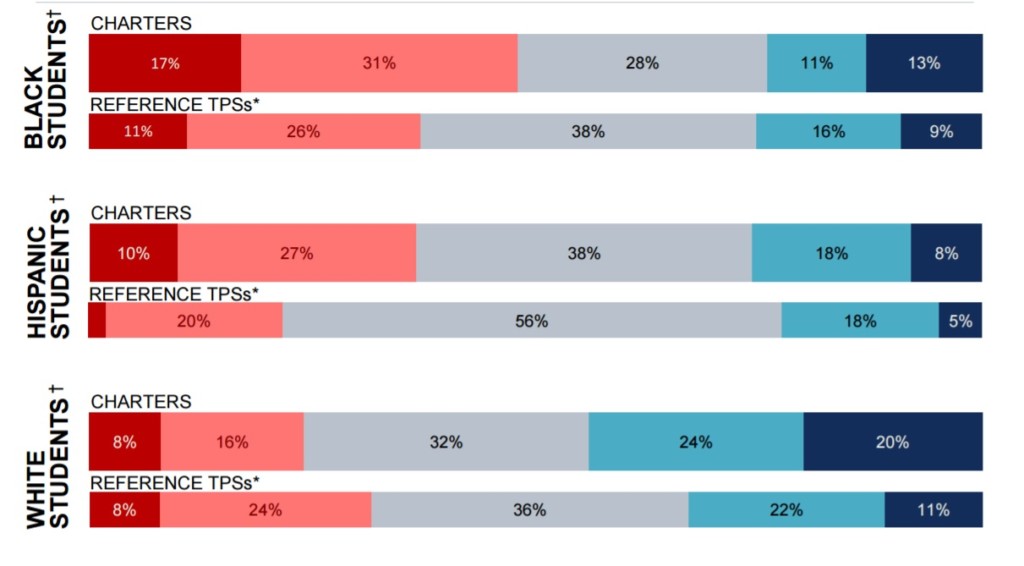
Source: AEI study
There's a key caveat here: The study is based on federal data from the 2011-12 school year. Since then, Florida's charter school student population has changed. Charters in the Sunshine State, on average, now enroll proportionally more Hispanic students than traditional public schools, but that wasn't true before 2013.
These findings also raise questions about access. If districts offered common enrollment systems that made it easier for students to apply to charters and other schools of choice, and all students had transportation available to the schools they chose, and there was more easily accessible information about what schools offer, perhaps more low-income students would enroll in charter schools.
State education officials say they want to bring more top charter schools into Florida's disadvantaged neighborhoods. If they succeed, these numbers could look different in a few years.