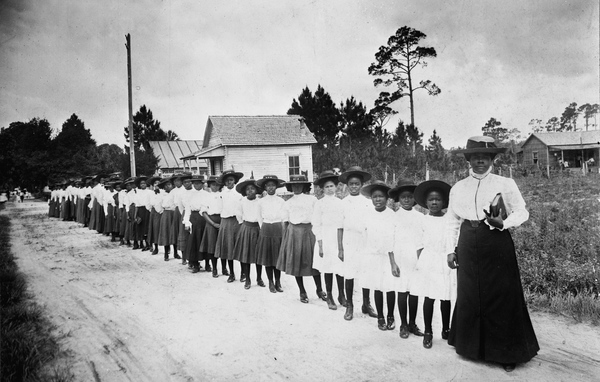
Civil rights activist Mary McLeod Bethune opened a private, faith-based school in Daytona in 1904 to expand educational opportunity for African-American girls. (Photo from State Archives of Florida, Florida Memory.)
A pioneering educator will be the first black woman honored at National Statuary Hall.
Gov. Rick Scott on Monday night signed SB 472, a measure replacing Florida's statue of Confederate General E. Kirby Smith with one of Mary McLeod Bethune.
Her likeness will join that of John Gorrie, the father of air conditioning, representing the Sunshine State at the U.S. Capitol.
Bethune was a civil rights leader and educational freedom-fighter whose commitment to racial uplift resonates in the present.
As this blog has noted before:
With $1.50 to her name, Bethune opened the Daytona Educational and Industrial Training School for Negro Girls in 1904. There were public schools for black students in early 1900s Florida, but they were far inferior to white schools.
Bethune’s vision for something better was shaped by her own educational experience.
She attended three private, faith-based schools as a student. She taught at three private, faith-based schools before building her own. In every case, support for those schools, financial and otherwise, came from private contributions, religious institutions – and the communities they served. Backers were motivated by the noble goal of expanding educational opportunity. Black parents ached for it. That’s why, in the early days of her school, Bethune rode around Daytona on a second-hand bicycle, knocking on doors to solicit donations. That’s why her students mashed sweet potatoes for fund-raiser pies, while Bethune rolled up the crust.

