Students at private schools, for example, were 8 percent more likely to have never experienced physical conflicts, 28 percent more likely to have never experienced another student possessing a weapon on campus, and 13 percent more likely to have never experienced racial tension between students.
As the nation’s first private school scholarship for bullied students shifts into higher gear, a new study finds that private schools are more likely than public schools to offer safer learning environments.
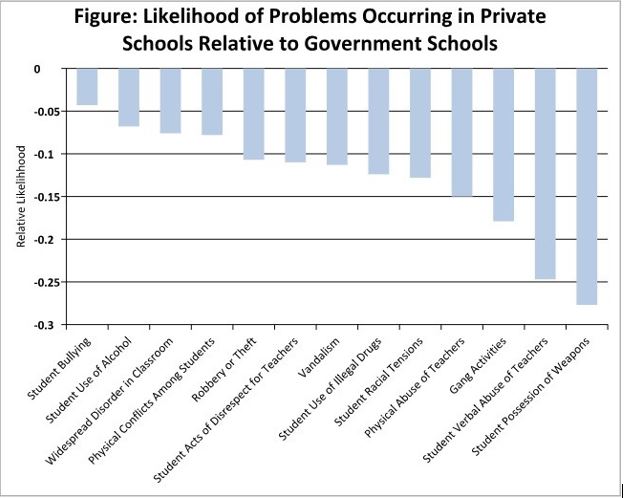
Private schools are far less likely to report problems such as physical conflicts, robbery, drug abuse, possession of illegal weapons, and bullying, according to researchers Danish Shakeel and Corey DeAngelis, in a recently published report in the Journal of School Choice.
The researchers examined responses to the national School and Staffing Survey from both public and private schools, including self-reported safety practices, and occurrence of problems and crime. Even when controlling for school-level characteristics, private schools came out ahead.
Students at private schools, for example, were 8 percent more likely to have never experienced physical conflicts, 28 percent more likely to have never experienced another student possessing a weapon on campus, and 13 percent more likely to have never experienced racial tension between students.
“We find that private schools have a statistically significant advantage for each of the 13 discipline problems examined - even after controlling for factors such as school size, school type, enrollment, student-teacher ratio, percentage of minority teachers, percent of minority students and urbanicity,” wrote DeAngelis in the Washington Examiner.
The findings come as fundraising is set to begin for the Hope Scholarship, a new, state-supported private school scholarship in Florida that aims to help students victimized by bullying or other incidents such as assault, battery and hazing.
The scholarship was created by the Florida Legislature last spring, and will be administered by Step Up For Students, a nonprofit scholarship funding organization that hosts this blog. It’ll be funded by purchasers of motor vehicles, who, beginning Oct. 1, can designate up to $105 of the sales taxes for Hope.
The application process has yet to begin, but more than 1,600 students have already signed up on an interest list.
There are many differences between public and private schools, and isolating which policy or characteristic causes the perceived differences in school crime or bullying is difficult.
According to the study, public schools were far more likely to perform random searches using drug sniffing dogs, close the campus during lunch, require clear backpacks, use metal detectors and require students to wear badges or picture IDs.
Private schools were more likely to enforce strict dress codes and require uniforms.
So were charter schools. They were also less likely to use metal detectors and drug-sniffing dogs than traditional public schools.
Whether metal detectors and clear backpacks are responses to perceived threats, or whether they encourage poor behavior or make students feel more or less safe, is also difficult to determine. The researchers suggested respecting student civil liberties “might make students feel more comfortable and trustworthy.”
 Religious private schools had a slight advantage over secular private schools, the researchers found. “We find some evidence for the moderating role of religious schools associated with a lower likelihood of crime related to incidents on campus,” they concluded.
When offenses did occur, the study found, private schools were more likely than traditional public schools to expel students but less likely to suspend them.
Private schools also reported higher participation among parents in volunteering and school governance, and with events like back-to-school night and parent-teacher conferences.
The Hope Scholarship offers bullied students a scholarship worth up to $7,111 to attend a private school, or $750 to cover transportation to an out-of-district public school. It also allows the student to openly transfer to any public school with space available.

